Category Archives: Religion

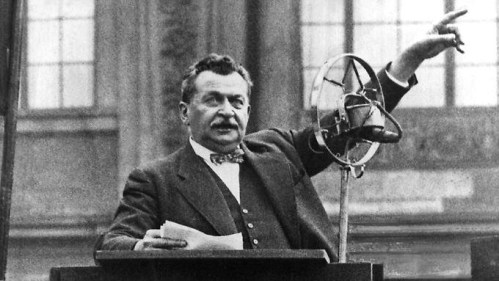
“You can take our lives and our freedom, but you cannot take our honour. We are defenseless but not honourless.” Remembering the Resistors to the Enabling Act Of 1933

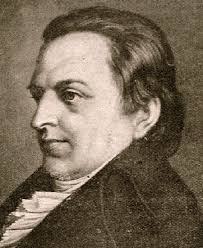
Otto Wels

Friends of Padre Steve’s World,

I will not be talking about the Mueller report until we know what is actually contained in it. So I will continue to discuss historical events that are relevant in our time.

One of the most relevant as this country and others lurch toward legally elected authoritarian governments is the example of the Hitler’s Enabling Act, or by its full title Gesetz zur Behebung der Not von Volk und Reich (“Law to Remedy the Distress of People and Reich”) came on the heels of the Reichstag Fire Decree and though very short had tremendous repercussions for the German Republic and in effect made Hitler and his administration a dictatorship. The legislative branch, the Reichstag was limited to nothing more than a rubber stamp for the executive, as was the judicial branch, the Reichsrat. It supposedly protected the rights of the President, the Reichstag, and judiciary, but it made Hitler the the sole decider of domestic and social laws, as well as all foreign policy decisions.

The law stated:

The Reichstag has enacted the following law, which is hereby proclaimed with the assent of the Reichsrat, it having been established that the requirements for a constitutional amendment have been fulfilled:

Article One

In addition to the procedure prescribed by the constitution, laws of the Reich may also be enacted by the government of the Reich. This includes the laws referred to by Articles 85 Paragraph 2 and Article 87 of the constitution. (Article 85 and 87 dealt with the budgetary process and allocation of funds for advertisement.)

Article Two

Laws enacted by the government of the Reich may deviate from the constitution as long as they do not affect the institutions of the Reichstag and the Reichsrat. The rights of the President remain unaffected.

Article Three:

Laws enacted by the Reich government shall be issued by the Chancellor and announced in the Reich Gazette. They shall take effect on the day following the announcement, unless they prescribe a different date. Articles 68 to 77 of the Constitution do not apply to laws enacted by the Reich government. (These Articles dealt with the legislative process in which the Reichstag, Government, Reichsrat, and President all had specific responsibilities which limited the power of the government to rush laws into force without due process and deliberation, and if needed the approval of the electorate)

Article Four

Treaties of the Reich with foreign states, which relate to matters of Reich legislation, shall for the duration of the validity of these laws not require the consent of the legislative authorities. The Reich government shall enact the legislation necessary to implement these agreements. (This removed the requirement of the Reichstag to approve treaties)

Article Five

This law enters into force on the day of its proclamation. It expires on April 1, 1937; it expires furthermore if the present Reich government is replaced by another.

When the legislation was introduced the debate was muted. While the Communist Party was yet to be banned, deputies of the Communist Party could not attend the session, many had already been arrested and many more were in hiding or had fled the country. Hermann Goering adjusted the rules for a quorum in order to compensate for the lack of members in attendance. Deputies of the Social Democratic Party were also terrorized, hounded, and some arrested, but 94 attended, outnumbered they did not buckle under the Nazi threats, which included the chamber being ringed by armed members of the SA and SS.

The non-Nazi Protestant based conservative parties provided no resistance, but the Catholic Center Party was torn by concerns that the legislation could limit the rights of the Catholic Church. However, they had been outmaneuvered by Hitler who had already negotiated a Concordant with the Vatican. The result was to ensure that the Catholic Center Party would vote for the measure, which passed with a mere 94 deputies opposing it, all members of the Social Democratic Party.

The only member of the Reichstag to speak against the measure was the head of the Social Democrats, Otto Wels. In defiance of Hitler, Goering, the Nazi Deputies, and the threatening SA and SS men uttered words that every resistor in every country threatened by authoritarian leaders who despise the rule of law and the Constitutions that they used to gain power need to hear and proclaim, because the truth can never be silenced:

“You can take our lives and our freedom, but you cannot take our honour. We are defenseless but not honourless.”

Otto Wels died as an exile in France. Many Social Democrats were placed in Concentration Camps and died, likewise some Communists. The Catholic Center Party would find itself betrayed, and many of its leaders would be killed, jailed, or placed in Concentration Camps, and Hitler would persecute opposition members of the Catholic Church as if no Concordat had ever been negotiated.

But eventually the Nazis would be driven from power. Their descendants today must be confronted at all costs. Democracy, and Constitutional republics based on the principles of the Declaration of Independence, which recognizes that all men are created equal, and the Constitution of the United States which was the first to checks and balances between the Executive, Legislative, and Judicial branches of government in which the Legislative branch was assumed to be the most important.

We have reached a point in the history of the United States where the Executive Branch, over a period of decades has assumed the powers of dictatorship as the Legislative branch over the corresponding time has surrendered its prerogatives and powers, while the judicial branch had become the domain of politically appointed judges and justices,

One does not know what will happen next, but anyone who values the primary principles of the Declaration and the Constitution must ne willing to take a stand like Otto Wels when confronted with a dictatorship in the making. Even if the President unleashes the power of the police and his own heavily armed supporters against opponents, we must remember like Otto Wels, they can “take our lives and freedom, but they cannot take our honor…”

This is something that anyone committed to the principles of the Declaration and Constitution must take seriously over the next 19 months leading to the next Presidential election. If we fail, the effects will be felt for at least a generation, and the institutions of our government will be transformed in ways that the founders could only imagine in their worst dreams.

Democrats and Never Trump conservatives must keep this in mind. Nothing is guaranteed right now, it is quite possible that Trump and his cult like supporters in Congress and the courts could enact something like the Enabling Act if we are not careful, regardless of the findings of the Mueller investigation or anything else, and we must be careful to watch for the major terrorist attack, or war that could lead to the implementation of already legislated laws, or executive orders that give nearly dictatorial powers to the executive, and which would be supported by a majority of Americans.

So until tomorrow.

Peace,

Padre Steve+

Leave a comment

Filed under ethics, History, laws and legislation, nazi germany, News and current events, philosophy, Political Commentary, Religion

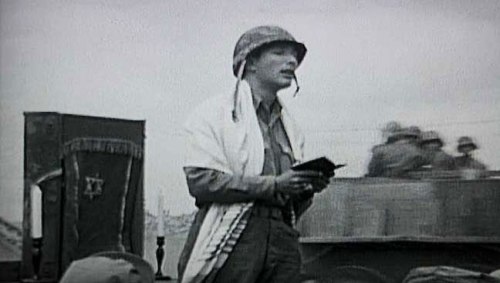
“We do not Foolishly Suppose that Victory on the Battlefield will Gaurentee Democracy at Home: Rabbi Roland Gittlesohn’s Sermon at the Dedication of the Cemetery on Iwo Jima

39GittelsonIwoJima2

Rabbi Roland Gittelson, Chaplain Corps U.S. Navy

Friends of Padre Steve’s World,

I have been serving in the military for almost 38 years between the Army and the Navy, and I have been a chaplain for almost 27 of those years. Over six of those years as a Navy Chaplain were spent serving with the Marine Corps. During that time I have gotten to know, respect, and become with Jewish Rabbis serving in the Chaplan Corps. There are not many of them currently serving, and like so much of American religion, they are divided into different denominations, Orthodox, Conservative, and Reformed. Like all current military personnel they are volunteers. The Rabbis I have served with are primarily Reformed or Conservative, and all have done what they could to care for the spiritual needs of all who come to them. They serve in the highest tradition of the Chaplain Corps, and fight for and preserve the religious freedoms of  all personnel.

Like them, Rabbi Roland Gittelson volunteered to serve as a Navy Chaplain in the Second World War and like many Navy Chaplains he was assigned to serve with the Marines. He was the first Rabbi to serve with the Marines.

He went ashore with the 5th Marine Division at Iwo Jima. The battle was one of the most brutal ever fought by the Marines. In the month long battle for the 8.1 square mile island the Marines and Navy suffered nearly 7,000 men killed and 19,000 wounded. Over 18,000 of the island’s Japanese defenders died. On March 21st 1945 the Rabbi was one of the Chaplains to dedicate the cemetery for the fallen. The prejudice was such that many of his Christian colleagues wanted nothing to do with him and nothing to do with any service that he conducted. Though the division Chaplain had wanted him to conduct the main service to commemorate all of the fallen: Protestant, Catholic, Jewish, White, Black, and Mexican because no one else would conduct an ecumenical service, but both realized that the push back would be too much, so Gittelsohn conducted the Jewish service, expecting little to come of it except for the spiritual impact that it might have on his Jewish Marines, but unbeknownst to him a few Protestant Chaplains watched the service and then distributed it throughout the division and back to home.

Rabbi Gittelsohn’s message is one of the most remarkable that I have heard or read by any Chaplain and is very similar to the message of Abraham Lincoln’s Gettysburg Address. It is a message that needs to be heard today. That is why I am posting it here.

Have a great weekend,

Peace

Padre Steve+

This is perhaps the grimmest and surely the holiest task we have faced since D-day. Here before us lie the bodies of comrades and friends. Men who until yesterday or last week laughed with us, joked with us, trained with us. Men who were on the same ships with us and went over the sides with us, as we prepared to hit the beaches of this island. Men who fought with us and feared with us. Somewhere in this plot of ground there may lie the man who could have discovered the cure for cancer. Under one of these Christian crosses, or beneath a Jewish Star of David, there may rest now a man who was destined to be a great prophet—to find the way, perhaps, for all to live in plenty, with poverty and hardship for none. Now they lie here silently in this sacred soil, and we gather to consecrate this earth in their memory.

It is not easy to do so. Some of us have buried our closest friends here. We saw these men killed before our very eyes. Any one of us might have died in their places. Indeed, some of us are alive and breathing at this very moment only because men who lie here beneath us had the courage and strength to give their lives for ours. To speak in memory of such men as these is not easy. Of them, too, can it be said with utter truth: “The world will little note nor long remember what we say here. It can never forget what they did here.”

No, our poor power of speech can add nothing to what these men and the other dead of our division who are not here have already done. All that we can even hope to do is follow their example. To show the same selfless courage in peace that they did in war. To swear that, by the grace of God and the stubborn strength and power of human will, their sons and ours shall never suffer these pains again. These men have done their job well. They have paid the ghastly price of freedom. If that freedom be once again lost, as it was after the last war, the unforgivable blame will be ours, not theirs. So it is the living who are here to be dedicated and consecrated.

We dedicate ourselves, first, to live together in peace the way they fought and are buried in war. Here lie men who loved America because their ancestors, generations ago, helped in her founding, and other men who loved her with equal passion because they themselves or their own fathers escaped from oppression to her blessed shores. Here lie officers and men, Negroes and whites, rich men and poor—together. Here are Protestants, Catholics, and Jews—together. Here no man prefers another because of his faith or despises him because of his color. Here there are no quotas of how many from each group are admitted or allowed. Among these men there is no discrimination. No prejudice. No hatred. Theirs is the highest and purest democracy.

Any man among us the living who fails to understand that will thereby betray those who lie here dead. Whoever of us lifts his hand in hate against a brother, or thinks himself superior to those who happen to be in the minority, makes of this ceremony and of the bloody sacrifice it commemorates, an empty, hollow mockery. To this, them, as our solemn, sacred duty, do we the living now dedicate ourselves: to the right of Protestants, Catholics and Jews, of white men and Negroes alike, to enjoy the democracy for which all of them have here paid the price.

To one thing more do we consecrate ourselves in memory of those who sleep beneath these crosses and stars. We shall not foolishly suppose, as did the last generation of America’s fighting men, that victory on the battlefield will automatically guarantee the triumph of democracy at home. This war, with all its frightful heartache and suffering, is but the beginning of our generation’s struggle for democracy. When the last battle has been won, there will be those at home, as there were last time, who will want us to turn our backs in selfish isolation on the rest of organized humanity, and thus to sabotage the very peace for which we fight. We promise you who lie here; we will not do that! We will join hands with Britain, China, Russia—in peace, even as we have in war, to build the kind of world for which you died.

When the last shot has been fired, there will still be those whose eyes are turned backward not forward, who will be satisfied with those wide extremes of poverty and wealth in which the seeds of another war can breed. We promise you, our departed comrades: this, too, we will not permit. This war has been fought by the common man; its fruits of peace must be enjoyed by the common man! We promise, by all that is sacred and holy, that your sons, the sons of miners and millers, the sons of farmers and workers, will inherit from your death the right to a living that is decent and secure.

When the final cross has been placed in the last cemetery, once again there will be those to whom profit is more important than peace, who will insist with the voice of sweet reasonableness and appeasement that it is better to trade with the enemies of mankind than, by crushing them, to lose their profit. To you who sleep here silently, we give our promise: we will not listen! We will not forget that some of you were burnt with oil that came from American wells, that many of you were killed by shells fashioned from American steel. We promise that when once again men seek profit at your expense, we shall remember how you looked when we placed you reverently, lovingly, in the ground.

This do we memorialize those who, having ceased living with us, now live within us. Thus do we consecrate ourselves, the living, to carry on the struggle they began. Too much blood has gone into this soil for us to let it lie barren. Too much pain and heartache have fertilized the earth on which we stand. We here solemnly swear: this shall not be in vain! Out of this, and from the suffering and sorrow of those who mourn this, will come—we promise—the birth of a new freedom for the sons of men everywhere.

Amen.

1 Comment

Filed under faith, History, Military, Religion, US Marine Corps, US Navy, world war two in the pacific

America’s Original Sin and its Continuing Legacy: Part Two, “Liberty for the few – slavery in every form, for the mass”

Friends of Padre Steve’s World,

I am going to be posting a number of articles from my various texts dealing with the American Civil War era dealing with topics that some would want to forget, but are very important if we want to fully appreciate the struggle of African-Americans for equality. This is the second of those posts.

Of course this original sin is the distinctly American version of slavery that arose in the American South, was protected in the Constitution, and supported by not only the Slave holders, and their Southern political protectors, but the businessmen, bankers, and equally complicit political allies in the North.

I honestly wish that we had really advanced beyond where we are now. But we are not. We’re still dealing with what has been called our nation’s original sin. over course slavery was abolished, and African Americans given citizenship and voting rights, but those rights would become a mockery in the Post-Reconstruction Jim Crow South, and in the Sundown Towns of the North and West. Even today, after the gains of the Civil Rights Movement we still deal with the continued effects of it. Our President and his closest advisers are White Nationalists, and White Supremacy is thriving under his tacit blessing. But that’s not enough, men like the Democratic Party Governor of Virginia posed in black face or in a KKK hood in his medical school yearbook. I could go on with a laundry list of other issues related to this but that would turn this introduction into another book, which is ironic because the content of this article was an introductory chapter of a Civil War Text about the Battle of Gettysburg that became part of a book of its own.

American Slavery and Racism is the subject of this and the following articles. More articles will follow in the next couple of weeks.

Have a great day,

Peace,

Padre Steve+
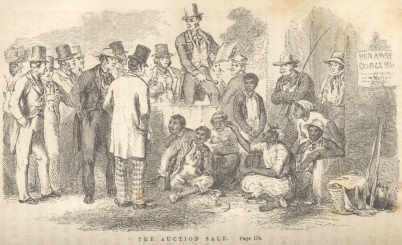
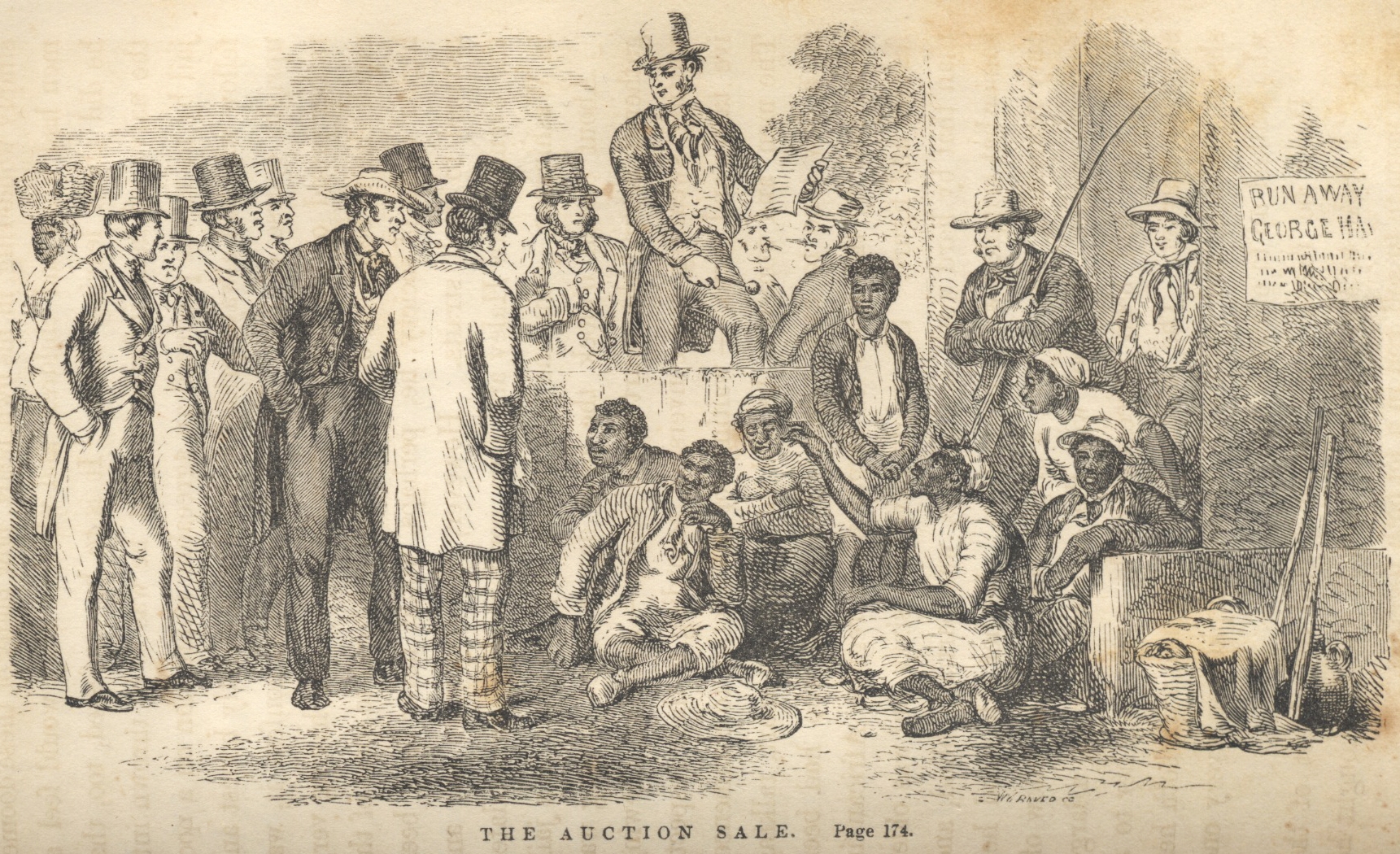
OTCauction

Abolition versus Slave Power

The conflicting ideologies of the Abolitionists who believed that African Americans were created by God and had the same rights as whites, as well as the arguments of Southern political leaders that blacks were inferior and slavery was a positive good, were buttressed by profoundly religious arguments which were related directly to a divergence in values. These diverging values crept into every aspect of life and as such it was this “conflict of values, rather than a conflict of interests or a conflict of cultures, lay at the root of the sectional schism.” [1]   The support of the church in Europe and the Americas was key to the religious and moral belief in the rightness of slavery.

Slavery was the key issue that permeated all aspects of the Civil War to include the cultural, the economic and the ideological. David M. Potter summed up this understanding of the connection between the ideological, cultural and economic aspects of the conflict and just how the issue of slavery connected all three realms in the American Civil War:

“These three explanations – cultural, economic and ideological – have long been the standard formulas for explaining the sectional conflict. Each has been defended as though it were necessarily incompatible with the other two. But culture, economic interest, and values may all reflect the same fundamental forces at work in a society, in which case each will appear as an aspect of the other. Diversity of culture may produce both diversity of interests and diversity of values. Further, the differences between a slaveholding and a nonslaveholding society would be reflected in all three aspects. Slavery represented an inescapable ethical question which precipitated a sharp conflict of values.” [2]

Sadly this is something that those who study the war from a purely military perspective tend to miss, or even willingly gloss over in order make the war more palatable to their own prejudice tend to “blur the reality that slavery was at the heart of the matter, ignore the baser realities of the brutal fighting, romanticize our own home-grown terrorist organization, the Ku Klux Klan, and distort the consequences of the Civil War that still intrude on our national life.” [3] For many people it is far easier not to deal with the harsh reality that slavery and racism was at the heart of the issue and escape to the bloodless romanticism which even ignores the human cost of the war, approximately 750,000 military dead alone. If we extrapolate the percentage of the population that that 750,000 represents and compared it to today’s census that number would be the equivalent of 7.5 million Americans dead. This is a fact that many Civil War buffs tend to ignore.

The political ends of the Civil War grew out of the growing cultural, economic, ideological and religious differences between the North and South that had been widening since the 1830s. However, slavery was the one issue which helped produce this conflict in values and it was “basic to the cultural divergence of the North and South, because it was inextricably fused into the key elements of southern life – the staple crop of the plantation system, the social and political ascendency of the planter class, the authoritarian system of social control.” [4] 

Without slavery and the Southern commitment to an economy based on slave labor, the southern economy would have most likely undergone a similar transformation as what happened in the North; thus the economic divergence between North and South would “been less clear cut, and would have not met in such head-on collision.” [5] But slavery was much more than an economic policy for Southerners; it was a key component of their religious, racial and philosophic worldview. A world without slavery was unimaginable and incomprehensible to them: politics, economics, religion, philosophy, and even the interpretation the Constitution itself depended on one’s view of slavery and white supremacy.
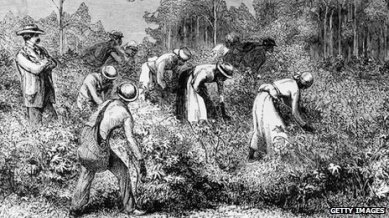
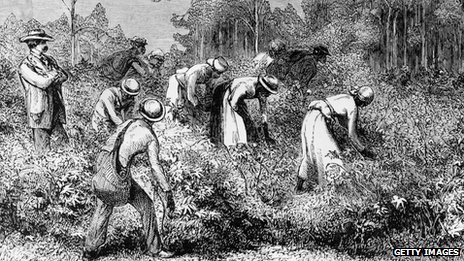
_65344344_cottonpickers1875_getty

The issue of slavery divided the ante-bellum United States on even what the words freedom and liberty meant. The dispute can be seen in the writings of many before the war, with each side emphasizing their particular understanding of these concepts. In the South, freedom was reserved for those who occupied the positions of economic power; slavery was key to that from not only an economic point of view but as a social philosophy. The concept of human equality, which was so much a part of the Declaration of Independence was downplayed to accommodate slavery and white supremacy.
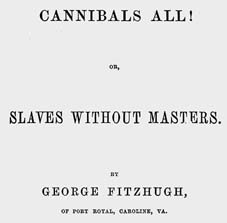
George Fitzhugh, a planter and slave owner in eastern Virginia commented that that concept “is practically impossible, and directly conflicts with all government, all separate property, and all social existence.” [6] Fitzhugh was very critical of the founder’s philosophy of natural liberty and human equality which he found repugnant and error ridden. He wrote:

“We must combat the doctrines of natural liberty and human equality, and the social contract as taught by Locke and the American sages of 1776. Under the spell of Locke and the Enlightenment, Jefferson and other misguided patriots ruined the splendid political edifice they erected by espousing dangerous abstractions – the crazy notions of liberty and equality that they wrote into the Declaration of Independence and the Virginia Bill of Rights. No wonder the abolitionists loved to quote the Declaration of Independence! Its precepts are wholly at war with slavery and equally at war with all government, all subordination, all order. It is full if mendacity and error. Consider its verbose, newborn, false and unmeaning preamble…. There is, finally, no such thing as inalienable rights. Life and liberty are not inalienable…. Jefferson in sum, was the architect of ruin, the inaugurator of anarchy. As his Declaration of Independence Stands, it deserves the appropriate epithets which Major Lee somewhere applies to the thought of Mr. Jefferson, it is “exuberantly false, and absurdly fallacious.”   ” [7]

The political philosophy such as Fitzhugh’s, which was quite common in the South, and was buttressed by a profound religious belief that it was the South’s God ordained mission to maintain and expand slavery. One Methodist preacher in his justification of slavery wrote, “God as he is infinitely wise, just and holy never could authorize the practice of moral evil. But God has authorized the practice of slavery, not only by bare permission of his providence, but by the express permission of his word.” [8] Buttressed by such scriptural arguments Southerners increasingly felt that they were the only people following God. The Northern abolitionists as well as those who advocated for the concept of human equality and free labor were heretics to be damned. As such the “South’s ideological isolation within an increasingly antislavery world was not a stigma or a source of guilt but a badge of righteousness and a foundation for national identity and pride.” [9]

Speaking of the necessity for slavery, as well as limitations on the equality of human beings no matter what their race or sex; Fitzhugh penned words that explained that human relationships were not to be seen in terms of individual liberty, “but in relations of strict domination and subordination. Successful societies were those whose members acknowledged their places within that hierarchy.” [10]

Fitzhugh was quite caustic when he discussed the real implications of his philosophy:

“We conclude that about nineteen out of twenty individuals have “a natural and inalienable right” to be taken care of and protected, to have guardians, trustees, husbands or masters; in other words they have a natural and inalienable right to be slaves. The one in twenty are clearly born or educated in some way fitted for command and liberty.” [11]

Fitzhugh’s chilling conclusion was summarized in the words “Liberty for the few – slavery in every form, for the mass.” [12]

But many Southerners, including many poor whites, especially the Yeoman farmers who were the backbone of the Southern populace did not see or understand the limitations that were placed on their own liberty by the slavery system and instead saw slavery as the guarantee of their economic freedom.

John C. Calhoun said to the Senate in 1848 that “With us, the two great divisions of society are not the rich and poor, but white and black; and all of the former, the poor as well as the rich, belong to the upper class, and are respected and treated as equals.” [13] Calhoun’s racial distinction is important if we are to understand why poor whites would fight and die for a social and economic idea that did not benefit them or their families, then as well as now.

But it was Abraham Lincoln, who cut to the heart of the matter when he noted the difference between his understanding of liberty and that of Calhoun and others in the South who defended slavery and the privileges of the Southern oligarchs:

“We all declare for liberty” but “in using the same word we do not all mean the same thing. With some the word liberty may mean for each man to do as he pleases with himself and the product of his labor; while with others the same word may mean for some men to do as they please with other men and the product of other men’s labor.” [14]

The growing economic disparity between the Slave and Free states became more about the expansion of slavery in federal territories as disunion and war approached; for a number of often competing reasons. These differences, amplified by the issue of slavery led to the substitution of stereotypes of each other and had the “effect of changing men’s attitudes toward the disagreements which are always certain to arise in politics: ordinary, resolvable disputes were converted into questions of principle, involving rigid, unnegotiable dogma.” [15] The Charleston Mercury noted in 1858 “on the subject of slavery…the North and the South…are not only two peoples, but they are rival, hostile peoples.” [16]

This was driven both by the South’s insistence on both maintaining slavery where it was already legal, and expanding it into new territories, even where it was forbidden by Federal laws enacted by Congress. This set it against the vocal abolitionist movement. But Southern exponents of expanding slavery were fighting an even more powerful enemy than the abolitionists, who despite their vocal protests were not yet in a position to influence policy. They were now fighting Northern industrialists who were not as idealistic as the abolitionists who were much more concerned with “economic policy designed to secure Northern domination of Western lands than the initial step in a broad plan to end slavery.” [17]

This competition between the regions not only affected politics, it affected religion and culture. In the South it produced a growing culture of victimhood, which was manifest in the words of Robert Toombs who authored Georgia’s declaration of causes for secession:

“For twenty years past, the Abolitionists and their allies in the Northern states, have been engaged in constant efforts to subvert our institutions, and to excite insurrection and servile war among us…” whose “avowed purpose is to subject our society, subject us, not only to the loss of our property but the destruction of ourselves, our wives and our children, and the dissolution of our homes, our altars, and our firesides.” [18]

As the social, economic, cultural and religious differences between the two regions grew wider and the people of the South became ever more closed off from the North. “More than other Americans, Southerners developed a sectional identity outside the national mainstream. The Southern life style tended to contradict the national norm in ways that life styles of other sections did not.” [19]

The complex relationship of Southern society where “Southern bodies social, economic, intellectual, and political were decidedly commingled” came to embrace the need for slavery and its importance to Southern society. This occurred despite the fact that the system did not benefit poor whites in the South and actually harmed them economically.

Southern society had become dependent on a race based social hierarchy in which dissent was neither welcome or tolerated. This

system of subordination reached out still further to require a certain kind of society, one in which certain questions were not publically discussed. It must give blacks no hope of cultivating dissention among the whites. It must commit non slaveholders to the unquestioning support of racial subordination…. In short, the South became increasingly a closed society, distrustful of isms from outside and unsympathetic to dissenters. Such were the pervasive consequences of giving top priority to the maintenance of a system of racial subordination.” [21]

A number of slave revolts, and planned slave revolts which were caught before they could erupt serve to heighten the fear and paranoia of Southerners living in the “Black belts” where slaves outnumbered whites by great margins. “In thickly enslaved areas, fancied dangers united white classes and sexes. Whites in black belts shared horror images about freed blacks as rioters, rapists, arsonists, and cannibals. The whites characteristically thought that using slavery to control alleged barbarians meant saving civilization.”[22]

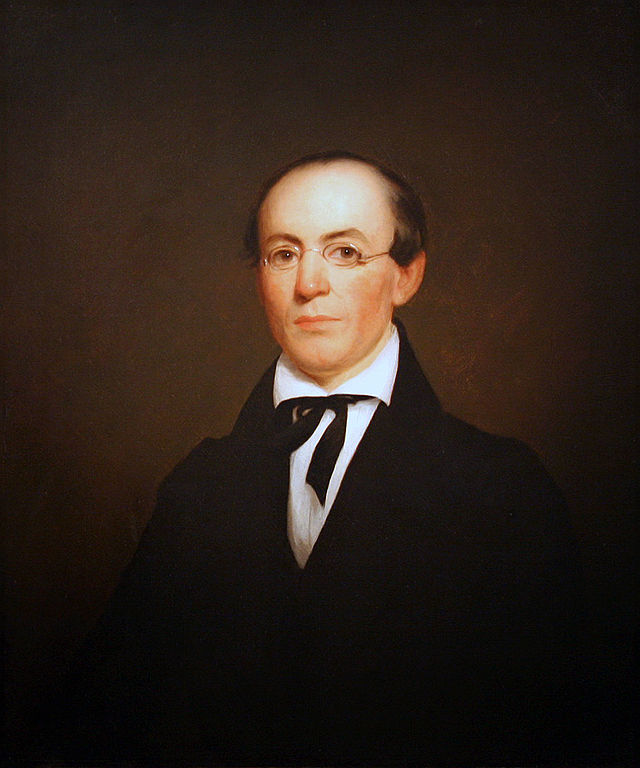
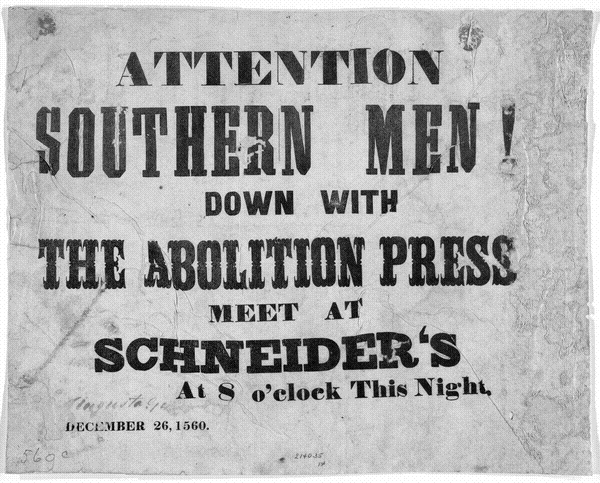
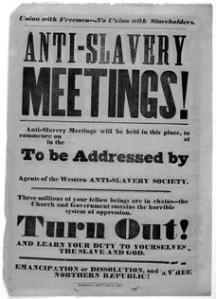
Even before the abolitionist movement took any recognizable form in the North, “with an intensity that escalated through the Civil War, planters declared war on all open criticism of the peculiar institution.” [23] As Northern abolitionists like William Lloyd Garrison and his newspaper The Liberator grew in its distribution and began to appear in the South various elected officials throughout the South “suppressed antislavery books, newspapers, lectures, and sermons and strove generally to deny critics of bondage access to any public forum. [24] Despite this resistance, abolitionists continued to use the U.S. Mail service to send their literature south provoking even more drastic action from Southern legislators.
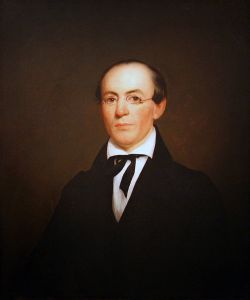
garrison by jocelyn 1833

William Lloyd Garrison 

But Garrison and the more radical abolitionists did not have a great following even in the North, most Northerners who even leaned toward abolition were supporters of a very gradual emancipation and not supportive of the immediate emancipation demanded by Garrison and his allies. In fact in the North, Garrison and his followers were not popular, they were “a small and often despised group.” [25] This was born out by facts that Garrison understood all too well, which made him even more uncompromising in his message even as support for it dropped. Even in the North Garrison was considered an unlikeable extremist.

In 1840, support for Garrison extremism peaked at around 2 percent of the northern voting population. The other 98 percent of northern citizens considered immediate abolition to be too extreme to be American, too problack to be tolerable, too keen on seizing property to be capitalistic, and too antisouthern to be safe for the Union.” [26] 

Garrison despised his northern opponents and wrote that he found among them “contempt more bitter, opposition more active, detraction more relentless, prejudice more stubborn, and apathy more frozen, than among slave owners themselves.” [27] Opponents broke up his meetings and on one occasion paraded Garrison “through the streets of Boston with a rope around his neck.” [28]

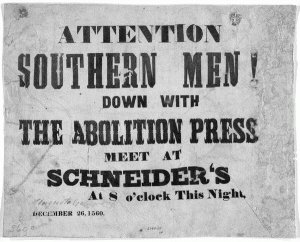
But Southerners, particularly those in the Black Belts where slaves constituted a majority of the population were further outraged by Garrison and his follower’s incendiary words and what they considered to be “almost pornographic diatribes,” which they felt had assaulted their “self-respect and sense of honor.” [29] In response to the proliferation of abolitionist literature in the South which was being sent through the mail, Senator John C. Calhoun proposed that Congress pass a law to prosecute “any postmaster who would “knowingly receive or put into the mail any pamphlet, newspaper, handbill, or any printed, written, or pictorial representation touching the subject of slavery.” [30] The law was a direct assault on the First Amendment, but in the South anything and anyone that took a stand against slavery had no Constitutional rights.

Calhoun was not alone as other members of Congress as well as state legislatures worked to restrict the import of what they considered subversive and dangerous literature. The condescending attitude of the radical abolitionists provoked an “emotional wildfire” [31] in the South, which united slave owners and poor whites in the Black Belt regions and served to increase their fear and loathing of Yankees who they believed wanted to destroy them and their way of life. Had they really understood just how united much of the North was with them they may not have pushed as hard to force Northern allies to accept laws that eventually offended the sensibilities of even non-abolitionists Northerners.
attention-southern-men

But Southern fears of real and imagined slave revolts, and hatred of radicals like Garrison brought about a host of new problem. Southerners now attempted to crush First Amendment protections of free speech in the north and to blot out any mention of slavery in the House of Representatives.

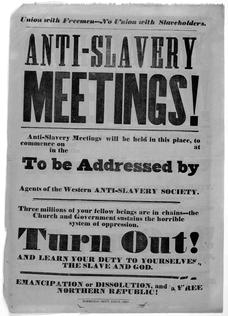
Beginning in 1836 the House of Representatives, led by Southern members of Congress passed a “gag rule” for its members. The “Gag Rule” “banned all petitions, memorials, resolutions, propositions, or papers related in any way or to any extent whatever to the subject of slavery.” [32]Former President John Quincy Adams continually challenged the gag-rule beginning in 1842, as did a number of others. The pressure was such that in 1844 the House finally voted to rescind it.
anti-slavery-meetings

However, Southern politicians were unhappy with the recension of the Gag Rule and “began to spout demands that the federal government and the Northern states issue assurances that the abolitionists would never be allowed to tamper with what John Calhoun had described as the South’s “peculiar domestic institution.” [33] As tensions grew between the regions; the issue of slavery more than any other issue, “transformed political action from a process of accommodation to a mode of combat.” [34]

Around the same time as the gag rule was played out in Congress the Supreme Court had ruled that the Federal government alone “had jurisdiction where escaped slaves were concerned”which resulted in several states enacting “personal liberty laws”to “forbid their own elected officials from those pursuing fugitives.” Southern politicians at the federal and state levels reacted strongly to these moves, which they believed to be an assault on their institutions and their rights to their human property. Virginia legislators said these laws were a “disgusting and revolting exhibition of faithless and unconstitutional legislation.” [35]

The issue of slavery shaped political debate and “structured and polarized many random, unoriented points of conflict on which sectional interest diverged.” [36] As the divide grew, leaders and people in both the North and the South began to react to the most distorted images of each other imaginable- “the North to an image of a southern world of lascivious and sadistic slave drivers; the South to the image of a northern world of cunning Yankee traders and radical abolitionists plotting slave insurrections.” [37]

To be continued…

Notes

[1] Potter, David M. The Impending Crisis: America before the Civil War 1848-1861 completed and edited by Don E. Fehrenbacher Harper Collins Publishers, New York 1976 p.41

[2] Ibid. Potter The Impending Crisis p.41

[3] Burns, Ken A Conflict’s Acoustic Shadows in The New York Times Disunion: Modern Historians Revisit and Reconsider the Civil War from Lincoln’s Election to the Emancipation Proclamation Black Dog and Leventhal Publishing, New York 2013 p.102

[4] Ibid. Potter The Impending Crisis p.42

[5] Ibid. Potter The Impending Crisis p.42

[6] Ibid. Levine Half Slave and Half Free: The Roots of the Civil War Revised Edition p.140

[7] Fitzhugh, George. New Haven Lecture 1855, in The Approaching Fury: Voices From the Storm, 1820-1861 Stephen B. Oates, Editor, University of Nebraska Press, Lincoln and London 1997 p.135

[8] Ibid. Daly When Slavery Was Called Freedom: Evangelicalism, Proslavery, and the Causes of the Civil War pp.63-64

[9] Ibid. Faust, Drew The Creation of Confederate Nationalism: Ideology and Identity in the Civil War South p.61

[10] Ibid. Levin Half Slave and Half Free p.140

[11] Ibid. Levin Half Slave and Half Free p.140

[12] Ibid. Levin Half Slave and Half Free p.141

[13] McPherson, James M. Drawn With the Sword: Reflections on the American Civil War Oxford University Press, Oxford and New York 1996 p.50

[14] Ibid. Levin Half Slave and Half Free p.122

[15] Ibid. Potter The Impending Crisis p.43

[16] Ibid. McPherson Drawn With the Sword p.16

[17] Egnal, Marc Clash of Extremes: The Economic Origins of the Civil War Hill and Wang a division of Farrar, Straus and Giroux New York 2009 p.6

[18] Dew, Charles B. Apostles of Disunion: Southern Secession Commissioners and the Causes of the Civil War University Press of Virginia, Charlottesville and London 2001 p.12

[19] Thomas, Emory The Confederate Nation 1861-1865 Harper Perennial, New York and London 1979 p.5

[20] Ibid. Thomas The Confederate Nation p.5

[21] Ibid. Potter The Impending Crisis pp.457-458

[22] Freehling, William W. The South vs. The South: How Anti-Confederate Southerners Shaped the Course of the Civil War Oxford University Press, Oxford and New York 2001 p.20

[23] Ibid. Levine Half Slave and Half Free p.166

[24] Ibid. Levine Half Slave and Half Free p.166

[25] Ibid. Goldfield America Aflame: How the Civil War Created a Nation p.27

[26] Ibid. Freehling The South vs. The South p. 34

[27] Ibid. Varon Disunion! The Coming of the American Civil War 1789-1858 pp.70-71

[28] Ibid. Goldfield America Aflame p.27

[29] Ibid. Freehling The South vs. The South p.22

[30] Ibid. Guelzo Fateful Lightning pp.50-51

[31] Ibid. Freehling The South vs. The South p.22

[32] Ibid. Levine Half Slave and Half Free pp.169-170

[33] Ibid. Guelzo Fateful Lightning pp.51-52

[34] Ibid. Potter The Impending Crisis p.43

[35] Ibid. Levine Half Slave and Half Free pp.169-170

[36] Ibid. Potter The Impending Crisis p.43

[37] Ibid. Potter The Impending Crisis p.43

Leave a comment

Filed under civil rights, civil war, ethics, History, laws and legislation, leadership, News and current events, Political Commentary, Religion

Remembering the Four Chaplains Of the Dorchester

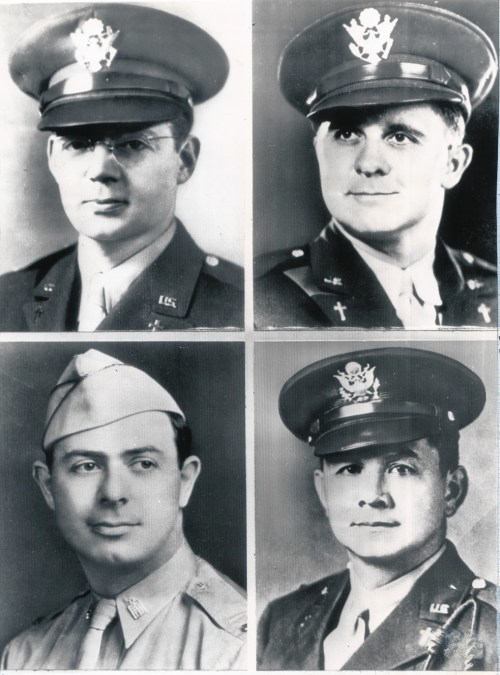
four chaplains

The Four Chaplains

Friends of Padre Steve’s World,

Today I am writing a brief remembrance of four men who I never met but whose lives helped guide me into my vocation as a Priest and Chaplain. I think I first read about them in junior high school and at that time I had never thought about becoming a minister, priest, or chaplain. To be sure, ever since I was in early grade school I wanted to be in the military but it would not be until my senior year of high school that I felt a call to become a Navy Chaplain. I’ll come back to that in a moment, but first a brief op-ed on religion in the United states.

In this day and age where fanatical religious extremists of many faiths seek to divide society, launch wars of religion, discriminate against non-believers or even people who believe differently than them, or hold different philosophical or political beliefs, it is important as Americans to find something that holds us together. The fact that our founders were profoundly against establishing or favoring any particular faith or denomination, there are those today who militantly fight to establish an Evangelical Christian theocracy that has no basis for existence based on the testimony of the Founders, and the earliest proponents of religious liberty in the United States including Virginia Baptist John Leland who helped influence James Madison in crafting the First Amendment of the Constitution wrote:

“The notion of a Christian commonwealth should be exploded forever. … Government should protect every man in thinking and speaking freely, and see that one does not abuse another. The liberty I contend for is more than toleration. The very idea of toleration is despicable; it supposes that some have a pre-eminence above the rest to grant indulgence, whereas all should be equally free, Jews, Turks, Pagans and Christians.”

Sadly, men like Franklin Graham, Pat Robertson, Jerry Falwell Jr., Robert Jeffress, and a host of others use their theocratic political judgments to condemn people of good faith in this life and the next. Aided by men like President Trump they stand in opposition to Leland and the others like him who understood that the American experiment in religious liberty could not be tied to fixed dogma or a particular religion or denomination.

But I digress, you can read previous articles on this site in which I quoted Leland and other defenders of real religious freedom. For me it’s a matter of my Christian faith. So back to the story of the four Chaplains of the U.S. Army Transport Dorchester.

The four men that I never met were Army Chaplains. These are their stories.

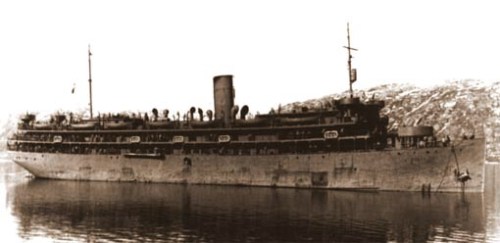
George Lansing Fox was a 42 year old Methodist minister from Lewiston, Pennsylvania who had served as a medic in the First World War in which he was awarded the Silver Star, the Purple Heart, and the French Croix De Guerre. Thirty-one year old Reformed Rabbi Alexander Goode of Brooklyn, New York was the son of a Rabbi who before the war had applied but not been accepted as a Navy Chaplain. After Pearl Harbor he volunteered and was commissioned as an Army Chaplain. Clark V. Poling was a Baptist minister serving as pastor of a Reformed Church when the war broke out. His father had served as a Chaplain in the First World War and Poling, the married father of one child became an Army Chaplain in 1941. Father John Patrick Washington of Newark New Jersey was a Roman Catholic Priest who entered active duty in May 1942. The four men attended the Army Chaplain’s School, then at Harvard and were united for the journey across the Atlantic aboard the transport ship SS Dorchester.

U.S. Army Transport Dorchester

On the night of February 3rd 1943 the Dorchester was torpedoed by the German submarine U-223. She went down in 20 minutes, of the 904 men aboard the ship only 230 survived. Despite the fact that the ship’s captain had ordered a high state of readiness and that all hands wear life jackets at all time, “Many soldiers sleeping deep in the ship’s hold disregarded the order because of the engine’s heat. Others ignored it because the life jackets were uncomfortable.”

When the ship was hit by a torpedo power went out and the four chaplains worked amid the chaos to calm the situation and assisted the soldiers, sailors, and merchant mariners aboard the ship as they tried to abandon ship. The four chaplains handed out life jackets until the supply ran out and then gave their own life jackets to soldiers that had none.

In doing so they signed their own death sentence, the water temperature was just 34 degrees, the air temperature was 36 degrees, many who survived the sinking died of exposure within minutes of the sinking, rescue ships found hundreds of bodies floating in the water. As the ship went down they died together, praying with arms linked after giving away their life jackets as the troop transport that they were on sank beneath the waves into the icy depths of the North Atlantic. A survivor wrote:

“As I swam away from the ship, I looked back. The flares had lighted everything. The bow came up high and she slid under. The last thing I saw, the Four Chaplains were up there praying for the safety of the men. They had done everything they could. I did not see them again. They themselves did not have a chance without their life jackets.”

Other survivors reported hearing the prayers of the chaplains in English, Latin, and Hebrew as the ship went down. Their bodies were never recovered. They have been remembered as heroes. In 1960 Congress named February 3rd as Four Chaplains Day. The U.S. Post Office commissioned a stamp in their honor in 1948. The Chapel of the Four Chaplains was dedicated in the basement of Grace Baptist Church in Philadelphia in 1951. President Harry Truman spoke at its dedication noting:

“This interfaith shrine… will stand through long generations to teach Americans that as men can die heroically as brothers so should they live together in mutual faith and goodwill.”

The chapel was moved to Temple University in 1953 and to the former Philadelphia Naval Shipyard in 2001.


ph-ph-ag-four-chaplains-preview-jpg-20140205

Father John Patrick Washington (Top Left), Reverend Clark V. Poling (Top Right), Rabbi Alexander Goode (Bottom Left), and Reverend George Lansing Fox

Of course my journey in finding that call and answering it had a number of detours in which I first rejecting following the call. Instead, when I was in college I simply enlisted in the Army National Guard, entered ROTC and then was commissioned as an Army officer. After a number of incidents on active duty which renewed that sense of call I left active duty to go to seminary, went back into the National Guard and in September of 1992 became an Army National Guard and civilian hospital chaplain.  On February 9th 1999 I resigned my commission as a Major in the Army Chaplain Corps to become a Navy Chaplain, and in the process accepting a reduction in rank.

In the nearly 37 years that I have served in the military of which almost 26 have been spent as a chaplain I have had the privilege of serving with many fine ministers of many denominations, priests, rabbis, and even an imam.  Of course I have served alongside some chaplains who regardless of their faith or denomination were simply assholes, but that being said I truly do appreciate those men and women from so many faiths and denominations who have cared for me. I do think that any of them could have linked arms with me and prayed after doing the last best things that we could do for the soldiers, sailors, marines, and airmen who entrust themselves to our care.

Despite what some senior chaplains in both the Army and Navy had done to me at different points; when I think of those men and women who regardless of their beliefs or the beliefs of the religious organizations that endorse them for the chaplaincy, I realize just how blessed that I am.

In the day that we live I can still stand with Harry Truman when he praised these chaplains. Now I am sure that there are quite few people who would say that either Goode, Fox, Poling, or Washington are already in Hell; but I don’t believe that. I understand from Scripture and the teachings of Jesus that God looks on the heart, and that the most important commandments are to love God and love our neighbors. I think that Jesus said that in doing those things that people fulfill the entire law.

Thus I thank God for the Chaplains of various denominations, Mainline Protestants, Evangelicals, Catholics, Orthodox Christians, Anglicans, Mormons, Jews, Buddhists, and Muslims who I would be blessed to link arms with to care for those in our care.

So today, I ask my readers to share this message with others.

Until tomorrow,

Peace

Padre Steve+

Leave a comment

Filed under ethics, faith, History, leadership, Military, ministry, Religion, us army, World War II at Sea

“Our Civil Rights Have no Dependency on Our Religious Opinions…” Celebrating the 233rd Anniversary of the Virginia Statute for Religious Liberty

Friends of Padre Steve’s World,

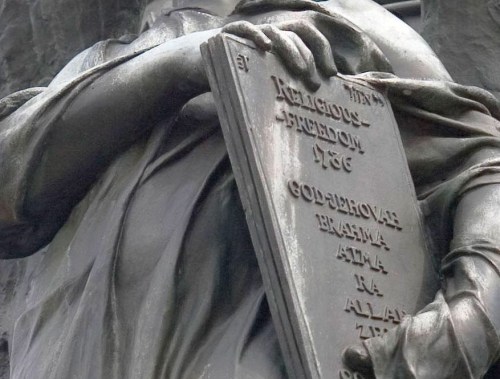
On this day, 233 years ago, the the legislature of the Commonwealth Of Virginia ratified a law written by Thomas Jefferson. It was the precursor to the Establishment and the Free Exercise Clauses Of the First Amendment to the Constitution of the United States.

It is the antithesis of, and the antidote to all theocratic movements, to include contemporary Christian Nationalism and it’s close cousin Christian Dominionism, or as it is sometimes called Seven Mountains Theology.

Jefferson, James Madison, and their Virginia Baptist ally, John Leland understood the threat to a republic such as ours posed by religious theocrats of any type, to include Christians.

The Virginia statute was necessitated by militant Anglicans who desired to re-establish themselves as the state religion in Virginia and had gone about using physical violence against various dissenters, especially Virginia’s Baptist minority. It is fascinating, in a frightening and grotesque sense of the word to see Virginia Baptists like Jerry Falwell Jr., and other Evangelical leaders of the Free Church tradition interpreting Religious Freedom in a manner similar to the Anglicans of Virginia in the 1780s, or in the manner of all Christians who follow the path of Constantine.

Such was the warning of the great Southern Baptist Pastor and seminary president George Truett, who wrote:

“Constantine, the Emperor, saw something in the religion of Christ’s people which awakened his interest, and now we see him uniting religion to the state and marching up the marble steps of the Emperor’s palace, with the church robed in purple. Thus and there was begun the most baneful misalliance that ever fettered and cursed a suffering world…. When … Constantine crowned the union of church and state, the church was stamped with the spirit of the Caesars…. The long blighting record of the medieval ages is simply the working out of that idea.”

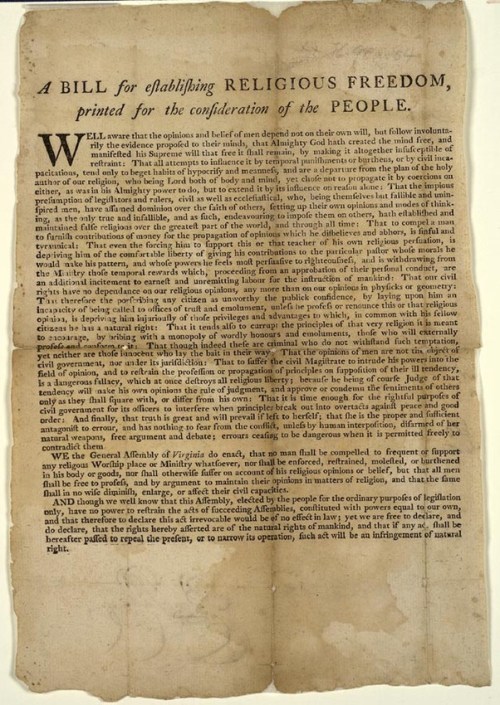
The Virginia Statute stood in complete opposition to theocratic minded Americans then, and now. The statute which I post below in its entirety is must reading for anyone who thinks that they understand what the founders of the United States believed about religious liberty:

An Act for establishing religious Freedom

Whereas, Almighty God hath created the mind free;

That all attempts to influence it by temporal punishments or burthens, or by civil incapacitations tend only to beget habits of hypocrisy and meanness, and therefore are a departure from the plan of the holy author of our religion, who being Lord, both of body and mind yet chose not to propagate it by coercions on either, as was in his Almighty power to do,

That the impious presumption of legislators and rulers, civil as well as ecclesiastical, who, being themselves but fallible and uninspired men have assumed dominion over the faith of others, setting up their own opinions and modes of thinking as the only true and infallible, and as such endeavouring to impose them on others, hath established and maintained false religions over the greatest part of the world and through all time;

That to compel a man to furnish contributions of money for the propagation of opinions, which he disbelieves is sinful and tyrannical;

That even the forcing him to support this or that teacher of his own religious persuasion is depriving him of the comfortable liberty of giving his contributions to the particular pastor, whose morals he would make his pattern, and whose powers he feels most persuasive to righteousness, and is withdrawing from the Ministry those temporary rewards, which, proceeding from an approbation of their personal conduct are an additional incitement to earnest and unremitting labours for the instruction of mankind;

That our civil rights have no dependence on our religious opinions any more than our opinions in physics or geometry,

That therefore the proscribing any citizen as unworthy the public confidence, by laying upon him an incapacity of being called to offices of trust and emolument, unless he profess or renounce this or that religious opinion, is depriving him injuriously of those privileges and advantages, to which, in common with his fellow citizens, he has a natural right,

That it tends only to corrupt the principles of that very Religion it is meant to encourage, by bribing with a monopoly of worldly honours and emoluments those who will externally profess and conform to it;

That though indeed, these are criminal who do not withstand such temptation, yet neither are those innocent who lay the bait in their way;

That to suffer the civil magistrate to intrude his powers into the field of opinion and to restrain the profession or propagation of principles on supposition of their ill tendency is a dangerous fallacy which at once destroys all religious liberty because he being of course judge of that tendency will make his opinions the rule of judgment and approve or condemn the sentiments of others only as they shall square with or differ from his own;

That it is time enough for the rightful purposes of civil government, for its officers to interfere when principles break out into overt acts against peace and good order;

And finally, that Truth is great, and will prevail if left to herself, that she is the proper and sufficient antagonist to error, and has nothing to fear from the conflict, unless by human interposition disarmed of her natural weapons free argument and debate, errors ceasing to be dangerous when it is permitted freely to contradict them:

Be it enacted by General Assembly that no man shall be compelled to frequent or support any religious worship, place, or ministry whatsoever, nor shall be enforced, restrained, molested, or burthened in his body or goods, nor shall otherwise suffer on account of his religious opinions or belief, but that all men shall be free to profess, and by argument to maintain, their opinions in matters of Religion, and that the same shall in no wise diminish, enlarge or affect their civil capacities. And though we well know that this Assembly elected by the people for the ordinary purposes of Legislation only, have no power to restrain the acts of succeeding Assemblies constituted with powers equal to our own, and that therefore to declare this act irrevocable would be of no effect in law; yet we are free to declare, and do declare that the rights hereby asserted, are of the natural rights of mankind, and that if any act shall be hereafter passed to repeal the present or to narrow its operation, such act will be an infringement of natural right.

Please, take some time to let those words sink in, especially if you think that religious liberty is only for people of your favorite religion, or the one that you belong to. The fact is, that those who established religious liberty in the United States, many of them like John Leland, professing Christians, did not think that religious liberty was for the powerful, or those who wanted to dominate others on the basis of religion wedded to government and political power.

Leland wrote:

“The notion of a Christian commonwealth should be exploded forever. … Government should protect every man in thinking and speaking freely, and see that one does not abuse another. The liberty I contend for is more than toleration. The very idea of toleration is despicable; it supposes that some have a pre-eminence above the rest to grant indulgence, whereas all should be equally free, Jews, Turks, Pagans and Christians.”

With that I bid you a good night.

Until tomorrow and another day of Trump’s Evangelical supported Shutdown,

Peace,

Padre Steve+

4 Comments

Filed under christian life, civil rights, faith, History, laws and legislation, Loose thoughts and musings, News and current events, Political Commentary, Religion

2019: The Coming Disorder and a Spark that Cannot be Extinguished

Friends of Padre Steve’s World,

Abraham Lincoln noted:

“The best thing about the future is that it comes one day at a time.”

It is good to remember Lincoln’s words in times of turmoils. I do, and they bring me great motivation to work, believe, and fight for justice, truth, and the belief in a spark of goodness in humanity which enables me to believe the words of the Declaration of Independence:

“We hold these truths to be self-evident, that that all men are created equal, that they are endowed by their Creator with certain unalienable Rights, that among these are Life, Liberty and the pursuit of Happiness.”

The fact that those words come from a time of tumult, yet in a time where men were beginning to wrestle with and proclaim principles of the Enlightenment matters much to me, especially in times like we live today, where that principle is being attacked and undermined by the American President.

That being said, I believe that 2019 will be remembered in history as a time great turmoil, upheaval, and probably usher in a new epoch of war, economic, and ecological disaster. We may again be witnesses to genocide that leaders of governments fail to take the necessary actions to stop.

I don’t want to sound like a pessimist, but as a historian I to look at the world through how human beings, governments, and businesses behave in times of crisis. In fact, human beings are the singular constant in history and in crisis human beings don’t always live up to our ideals.

When major powers and international systems of order break down, or collapse for whatever reason, instability, disorder, and primordial hatreds based on nationalism, religion, and racism rise. A vacuum is created, filled by other powers, but not without some element of travail. Edmond Taylor wrote in his classic “The Fall of the Dynasties: The Collapse of the Order, 1905-1922:

“The collapse of the great supranational — or at least supraparochial — authorities and the dissolution of long-accepted Imperial bonds released upon Europe a fearsome flood of conflicting national ambitions, of inflamed minority particularisms, of historic (sometimes almost prehistoric) irredentisms, of irreconcilable social aspirations and of rival political fanaticisms.

The impending collapse of the old order today can be seen in a return to a more isolationist policy by the United States, rising populist, nationalist, and ethnocentric movements in Europe which are threatening the existence of the European Union. Those include Brexit, ethnic nationalism mixed with a bit of Fascism in Hungary, Italy, Poland, and great strains in France and Germany between right and left wing populist movements.

The common thread is the center which was the key to so much social progress, democracy, economic growth and stability, scientific advancement, and international security is giving way. There are many reasons for this, on the American side going back to the imperialist overreach of the George W. Bush administration, the inconsistent and detached method of the Obama administration towards the Middle East, especially Syria and Iraq, following that, and now the decidedly inconsistent, often irresponsible, and irreconcilable policies of isolationism and militarism.

A rejuvenated Russia is rushing to fill the void in the Middle East as well as working to destabilize its neighbors, Europe, and even the United States. The Chinese are attempting to make gains in other areas and to drive the United States out of Asia by using every element of national power: diplomacy, information, military might, and economics, while the United States following the Trump Administration’s withdraw from the Trans Pacific Partnership, and subsequent punishing tariffs that are hurting allies and Americans more than China the United States is now at a decided disadvantage in Asia.

I could go on, and could go into details on the causes of the current situation but they are many. What we are seeing now is the beginning of the collapse of an order that we have known most of our lives. While many people might be uneasy, most don’t view things in terms of history, in many cases because the events that led to the establishment of the current order are too distant and the witnesses to those times are few, and dying off. People today seldom study history, and even worse no longer know people, including family members who remember what happened to remind them of it.

That was quite similar to the situation in 1914. Europe had been at relative peace for a century. With the exception of the French Republic, most of Europe was still ruled by monarchies with rather limited democratic participation, if any. Barbara Tuchman wrote in her book The Proud Tower: A Portrait Of the World Before the War, 1890-1914:

“The proud tower built up through the great age of European civilization was an edifice of grandeur and passion, of riches and beauty and dark cellars. Its inhabitants lived, as compared to a later time, with more self-reliance, more confidence, more hope; greater magnificence, extravagance and elegance; more careless ease, more gaiety, more pleasure in each other’s company and conversation, more injustice and hypocrisy, more misery and want, more sentiment including false sentiment, less sufferance of mediocrity, more dignity in work, more delight in nature, more zest. The Old World had much that has since been lost, whatever may have been gained. Looking back on it from 1915, Emile Verhaeren, the Belgian Socialist poet, dedicated his pages, “With emotion, to the man I used to be.”

I believe that 2019 will the a year of multiple crises and the further erosion, if not collapse of the old order. What will come I do not know, but I expect that at the minimum it will be unsettling and disruptive, if not catastrophic. That doesn’t mean that I am a pessimist, it means that I study history. Provided that humanity does not find a way to destroy itself, we will recover. It may not be pretty and it certainly will not be the same as it was, but we will recover.

Walter Lord wrote about this his book on American in the early Twentieth Century The Good Years: 1900-1914. In the book he wrote about how things changed for Americans as Europe plunged into war. The effects of the war were soon felt in the United States though it would not enter the war until 1917. Lord wrote:

Economics were only part of the story. Almost overnight, Americans lost a happy, easygoing, confident way of looking at things. Gone was the bright lilt of “When You Wore a Tulip”; already it was the sadly nostalgic, “There’s a Long, Long Trail a-Winding,” or the grimly suggestive, “I Didn’t Raise My Boy to Be a Soldier.” A mounting crescendo of screaming headlines… atrocity stories… U-boat sinkings… charges and counter-charges shocked the nation, jarred its faith, left a residue of doubt and dismay.

Nothing seemed simple any more. Nothing was black and white. Nothing was “right” or “wrong,” the way Theodore Roosevelt used to describe things. And as the simple problems vanished, so did the simple solutions. Trust-busting, direct primaries, arbitration treaties and all the rest. They somehow lost their glamour as exciting panaceas, and nothing took their place. But the problems grew and grew —preparedness… taxes… war… Bolshevism… disillusionment… depression… Fascism… Moscow… fallout… space… more taxes.

So the old life slipped away, never to return again, and wise men sensed it almost at once. Men like Henry White, the immensely urbane diplomat who had served the country so well. “He instinctively felt,” according to his biographer Allan Nevins, “that his world —the world of constant travel, cosmopolitan intercourse, secure comfort and culture —would never be the same again.” The Philadelphia North American felt the same way, but in blunter words: “What does this mean but that our boasted civilization has broken down?”

Perhaps it was just as well. There was much that was wrong with this old way of living —its injustices, its naivete, its waste, its smug self-assurance. Men would come along to fix all that. New laws, controls, regulations, forms filled out in triplicate would keep anybody from getting too much or too little. And swarms of consultants, researchers, special assistants, and executive committees would make sure that great men always said and did the right thing.

There would be great gains. But after all the gains had been counted, it would turn out that something was also lost —a touch of optimism, confidence, exuberance, and hope. The spirit of an era can’t be blocked out and measured, but it is there nonetheless. And in these brief, buoyant years it was a spark that somehow gave extra promise to life. By the light of this spark, men and women saw themselves as heroes shaping the world, rather than victims struggling through it.

Actually, this was nothing unique. People had seen the spark before, would surely do so again. For it can never die as long as men breathe. But sometimes it burns low, leaving men uncertain in the shadows; other times it glows bright, catching the eye with breath-taking visions of the future.

The truth is, even in the midst of crises that the spark that enables people to believe, to hope, and to labor for a better future where the possibilities of peace, justice, freedom, and progress can be realized.

2019 will likely be a very difficult year, a year of change and turbulence, and truthfully it will probably be just the beginning; but unless finds a way to destroy itself, it will not be the end.

So, unless I get a hair up my ass to write something else before midnight, I wish you a Happy New Year, and all the best.

Peace,

Padre Steve+

1 Comment

Filed under ethics, faith, History, leadership, life, middle east, Military, national security, News and current events, Political Commentary, Religion

“Christmas Day Will Always be, Just as long as We have We” Everything I Know Really About Christmas comes from Peanuts and the Grinch

Friends of Padre Steve’s World,

I am a Priest, and I am actually a pretty learned theologian as well as a historian. I am probably a better historian than theologian, in fact on of my Deans at the Joint Forces Staff College said that I was “a historian masquerading as a chaplain, not that there is anything wrong with that.” But the fact is that as learned as I am of the theology of the Incarnation and how important that is to real Christian theology. The Incarnation not about creating some kind of Christian theocracy in order to usher in the Kingdom of God, instead it is about a God that chooses to become fully human, to be born of a woman, and to endure the death of a criminal, despised and rejected by the types of people that theocracy minded “Christian leaders” emulate in thought, word, and deed.

With that being said I will not bore you with an essay citing historical references, Scripture, or quotations of theologians, pastors, and historians much more learned, and for that matter probably better Christians than me. So, please, if you feel the need to criticize my theology, feel free, but please, have the decency to arrange to do that over a beer or your favorite tasty beverage later, don’t ruin your Christmas or mine to do that, there are plenty of other days to do just that take a deep breath whether you are a Christian Fundamentalist, a Traditionalist Catholic, a militant Atheist, or whatever.

But here’s the deal. The truth is when all is said and done I learned ever that I need to know about Christmas from Merry Christmas Charlie Brown by Charles Schulz, and How the Grinch Stole Christmas by Dr. Seuss.

To me it is fascinating because Schulz, who brought us Charlie Brown, Snoopy, and the whole Peanuts Gang for half a century was a Christian who battled depression and faith, yet his classic animated cartoon of Christmas which was released in 1965 has probably reached more people with the Christmas message than any great preacher of the past century or more.

The decision to include the speech by Linus was controversial, because of the expressly religious implications, by Schulz insisted that it be reatained.

I saw it for the first time when it was released in 1965, and now 53 years later it retains its freshness and innocence.

 Charlie Brown: Isn’t there anyone, who knows what Christmas is all about?!

Linus: Sure Charlie Brown, I can tell you what Christmas is all about. Lights please?

And there were in the same country shepherds, abiding in the field, keeping watch over their flock by night. And, lo, the angel of the Lord came upon them, and the glory of the Lord shone round about them! And they were sore afraid. And the angel said unto them, “Fear not! For, behold, I bring you tidings o great joy, which shall be to all my people. For unto you is born this day in the city of David a Saviour, which is Christ, the Lord. And this shall be a sign unto you: Ye shall find the babe wrapped in swaddling clothes, lying in a manger.” And suddenly, there was with the angel a multitude of the Heavenly Host praising God, and saying, “Glory to God in the Highest, and on Earth peace, and good will toward men.

That’s what Christmas is all about, Charlie Brown.

Likewise, I think that Dr. Seuss, who was Jewish, may very well have done the same in his story about the Grinch.

I think of the last part of the Grinch and think about these words:

Welcome, Christmas, bring your cheer. Cheer to all Whos far and near. Christmas Day is in our grasp, so long as we have hands to clasp. Christmas Day will always be just as long as we have we. Welcome Christmas while we stand, heart to heart, and hand in hand.

I know, kind of simplistic and ecumenical. But I have learned so much about Christmas and the Incarnation from others, of course many are Christians, but I have also learned from Jews, Muslims, and others. So for all of my friends and readers I simply repeat the words of Dr Seuss. Welcome Christmas, bring your cheer… Christmas Day will always be just as long as we have we…

Peace,

Padre Steve+

4 Comments

Filed under christian life, faith, film, life, Religion

Silent Night at 200: A Song Of Hope

Friends of Padre Steve’s World,

It will soon be Christmas and instead of the government shutdown or the depraved and irresponsible actions of President Trump, I am going to focus on Christmas, particularly musical expressions, as well as meditations about my own faith journey as well as the experience of soldiers during the holidays.

In the midst of everything happening in Washington D.C. and the potential crises that could plunge the world into war in the coming months it still is important to focus on the holidays. Since I am a Christian I share about Christmas without any shame, even as I respect and honor other people’s traditions and expressions of faith.

So here is a post about the song Silent Night. 

800px-Stille_nacht

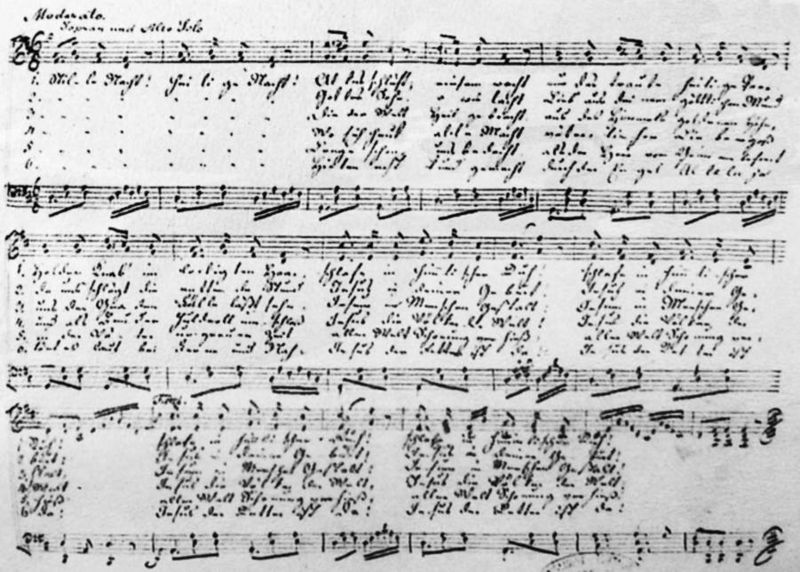
Stille Nacht Autograph in the Hand of Joseph Mohr

In 1816 a young Austrian Catholic Priest in a small parish near Salzburg penned the lyrics to a hymn that even in the midst of war can bind people together. Father Joseph Mohr after moving to another parish in Oberndorf took those lyrics to Franz Gruber a nearby schoolmaster and organist. Mohr asked Gruber to put the words to music, specifically with a guitar accompaniment. Together the performed the song at Oberndorf’s parish church’s Vigil Mass on December 24th 1818.

malamkudus_11

There are a number of fanciful apocryphal stories about why the song was written and performed on the guitar, including one about the bellows of the church organ having been eaten by mice, but these are akin to sensationalist tabloid journalism. The simple truth is that Mohr sought out Gruber to arrange the song for guitar to be sung by two people accompanied by a choir for that Christmas Vigil Mass.

Stille Nacht, Heilige Nacht 

Stille Nacht, heilige Nacht,
Alles schläft; einsam wacht
Nur das traute hochheilige Paar.
Holder Knabe im lockigen Haar,
Schlaf in himmlischer Ruh!

Stille Nacht, heilige Nacht,
Hirten erst kundgemacht
Durch der Engel Halleluja,
Tönt es laut von fern und nah:
Christ, der Retter ist da!

Stille Nacht, heilige Nacht,
Gottes Sohn, o wie lacht
Lieb’ aus deinem göttlichen Mund
, Da uns schlägt die rettende Stund’.
Christ, in deiner Geburt!

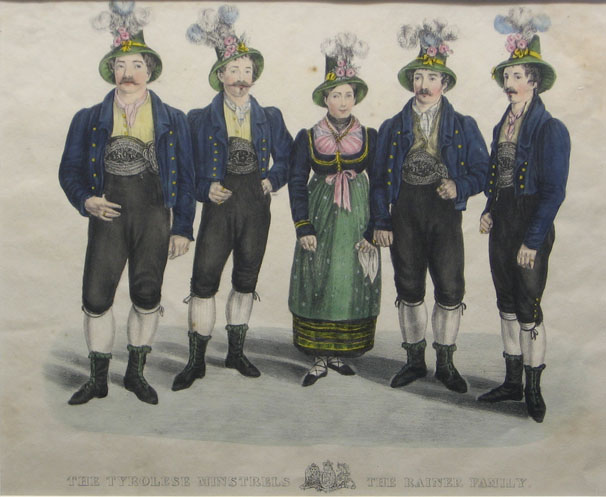
 The song rapidly grew in popularity and spread quickly in Europe. A traveling Austrian singing group, the Rainer family performed it in front of Austrian Emperor Franz I and Tsar Alexander I.

7998

They also gave its first American performance in New York outside the famed Trinity Church in 1839. I continued to grow in popularity and was translated into many languages, now numbering about 140.

21760570

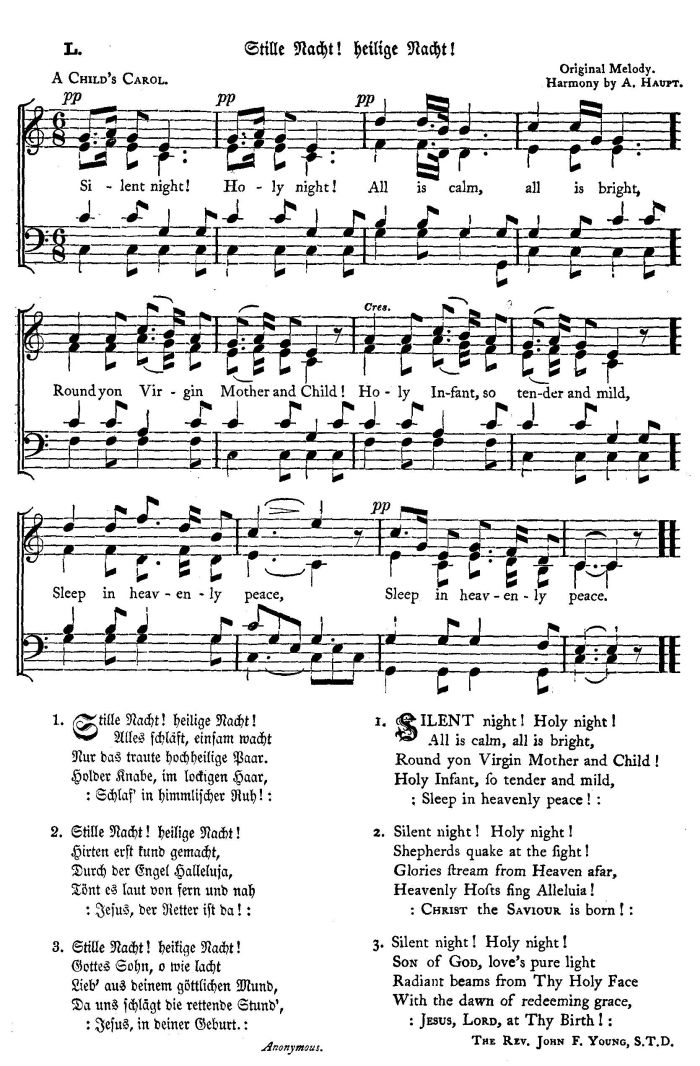
The American Episcopalian Bishop John Freeman Young translated it into English in 1863. It is his version that is most used today in English speaking lands today. A website called the Silent Night Web http://silentnight.web.za has 227 versions of the song in 142 languages on its site.

50-Silent_Night

Silent night, Holy night

 All is calm, all is bright

‘Round yon virgin , mother and child

Holy infant so, tender and mild
Sleep in heavenly peace,
Sleep in heavenly peace.

Silent night, Holy night
Shepherds quake, at the sight
Glories stream from heaven afar
Heavenly, hosts sing Hallelujah.
Christ the Savior is born,
Christ the Savior is born.

Silent night, Holy night
Son of God, love’s pure light
Radiant beams from thy holy face
With the dawn of redeeming grace,
Jesus, Lord at thy birth,
Jesus, Lord at thy birth.

The song is one that always takes me back to a very simple faith and an event that by all accounts is not explainable by logic. Karl Barth, perhaps the most influential theologians in the history Of the Christian faith wrote:

”The nativity mystery “conceived from the Holy Spirit and born from the Virgin Mary”, means, that God became human, truly human out of his own grace. The miracle of the existence of Jesus , his “climbing down of God” is: Holy Spirit and Virgin Mary! Here is a human being, the Virgin Mary, and as he comes from God, Jesus comes also from this human being. Born of the Virgin Mary means a human origin for God. Jesus Christ is not only truly God, he is human like every one of us. He is human without limitation. He is not only similar to us, he is like us.”

Silent Night is the most simple and profound hymn of the incarnation and because of its simplicity it has become a song that points to an end of war, an end of suffering, and the beginning of new life.

Until tomorrow,

Peace,

Padre Steve+

Go back

Your message has been sent

Warning
Warning
Warning
Warning

Warning.

, Holy night
Shepherds quake, at the sight
Glories stream from heaven afar
Heavenly, hosts sing Hallelujah.
Christ the Savior is born,
Christ the Savior is born.

Silent night, Holy night
Son of God, love’s pure light
Radiant beams from thy holy face
With the dawn of redeeming grace,
Jesus, Lord at thy birth,
Jesus, Lord at thy birth.

Father Mohr refused to profit from his song and donated his proceeds to care for the elderly and educate children in the parishes and towns he served. He died in 1848.

889

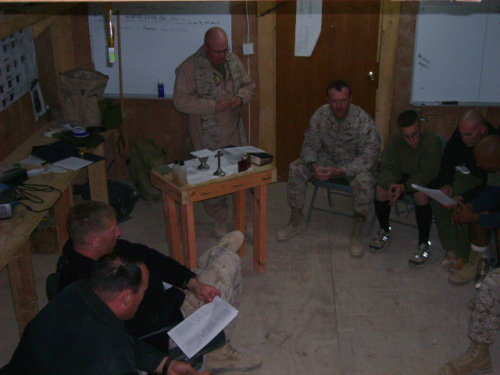
I find that the song will bring me to tears fast than almost any song. It is one that I have sung in English, German and French. In my travels as a military Chaplain have used on every Christmas Eucharist celebration that I have done, including at two lonely COPS in Iraq, COP South and COP North on the Syrian Border in Al Anbar Province. Likewise I have celebrated joint ecumenical Christmas services with German military chaplains and civilian clergy. Last Friday I did that again for the members of the German NATO contingent at my chapel.

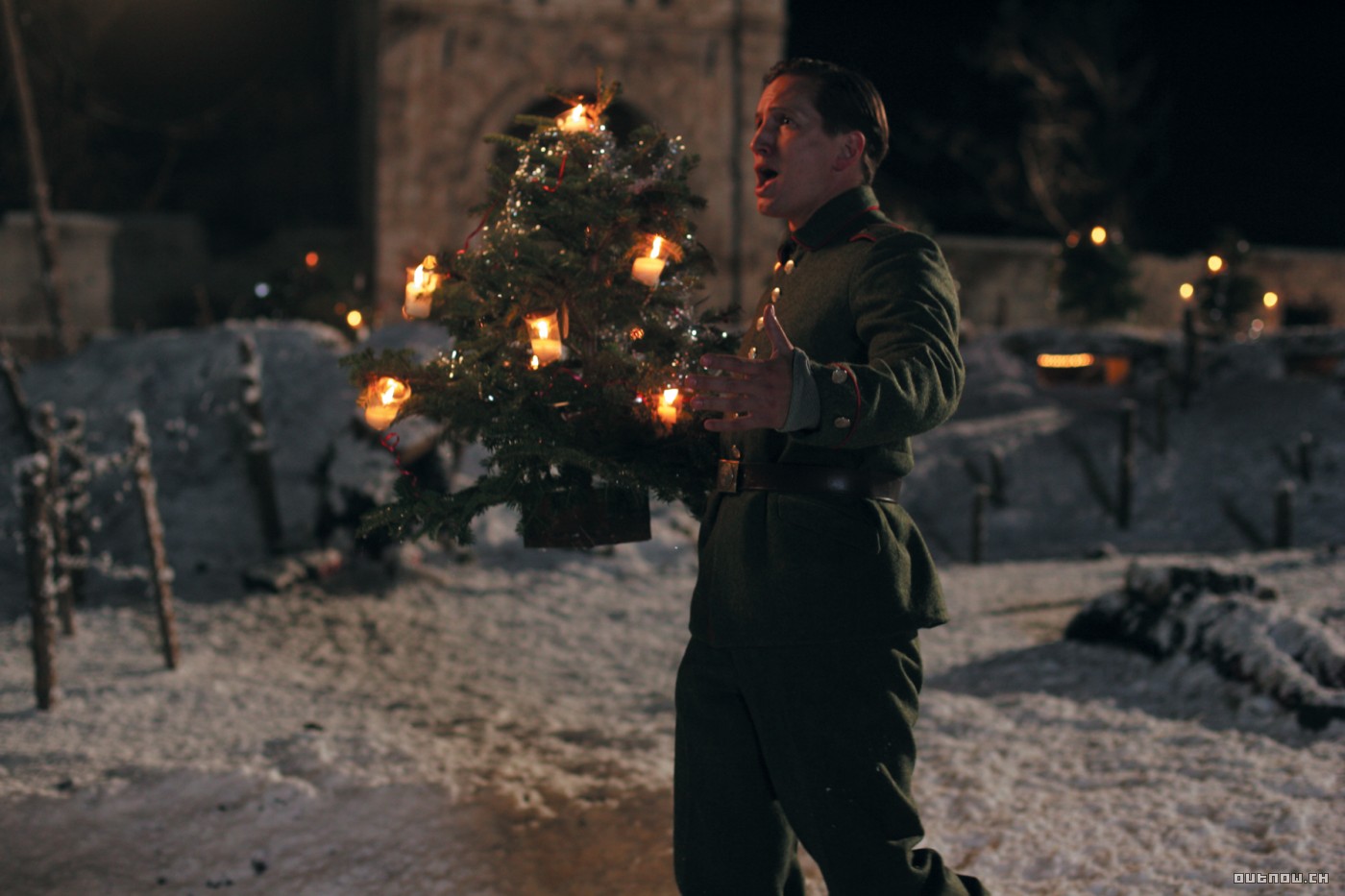
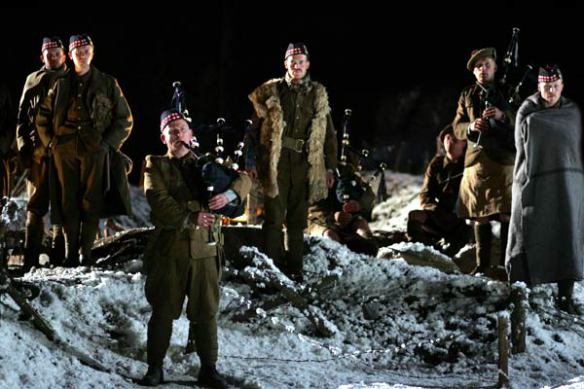
It is a simple and humble song. It is performed the world over by the great and small, the famous and the unknown. It is a song that in two world wars has stopped the violence as opposing soldiers paused to sing it together each in their own language. This happened during the Christmas Truce truce of 1914 as well as in 1944 along the Western Front during the Battle of the Bulge.

13-1

http://www.youtube.com/watch?v=EbGZ7T5EHpQ

joyeux-noel-4

On Tuesday as people gather for Christmas Eve Sunday and when they gather for Christmas Day services the song will be sung around the world. In lands where war rages the song will be sung. It is my hope that someday that war will be no more and the tiny child spoken of in this humble hymn will understand the incredible grace of the message spoken by the Angels as recorded in Luke’s Gospel:  “Glory to God in the highest, And on earth peace among men in whom he is well pleased.” (American Standard Version)

Peace

Padre Steve+

1 Comment

Filed under christian life, culture, faith, History, music, Religion

Justice and Life as an Exercise in Exceptions: Faith in the Age of Trump

thedrumhead117

Friends of Padre Steve’s World,

The English Mathematician and founder of Process Philosophy, Alfred North Whitehead wrote:

Religion carries two sorts of people in two entirely opposite directions: the mild and gentle people it carries towards mercy and justice; the persecuting people it carries into fiendish sadistic cruelty…” 

I find much truth in Whitehead’s words. Those who follow my writings know how much I struggle with faith and doubt on a daily basis. I believe, but as the man told Jesus when he asked Jesus to heal his child “I believe, help my unbelief.” I no longer believe in the “absolute truths” that I once believed.

Of course to some this makes me a heretic or worse. That being said, as a Christian, I have faith in a God I cannot see or prove. I have faith in a God who Scripture and Tradition clothes himself in human weakness and allows himself to be killed based on the trumped up charges of corrupt and fearful religious leaders aided by fearful politicians. For me this is part of being a theologian of the Cross in a post-Auschwitz world.

Jürgen Moltmann, a German theologian who wrote the book The Crucified God answered a question about believing in God after Auschwitz:

“A shattering expression of the theologia crucis which is suggested in the rabbinic theology of God’s humiliation of himself is to be found in Night, a book written by E. Wiesel, a survivor of Auschwitz:

The SS hanged two Jewish men and a youth in front of the whole camp. The men died quickly, but the death throes of the youth lasted for half an hour. ‘Where is God? Where is he?’ someone asked behind me. As the youth still hung in torment for a long time, I heard the man call again, ‘Where is God now?’ And I heard a voice in myself answer: ‘Where is he? He is here. He is hanging there on the gallows…’

Any other answer would be blasphemy. There cannot be any other Christian answer to the question of this torment. To speak here of a God who could not suffer would make God a demon. To speak here of an absolute God would make God an annihilating nothingness. To speak here of an indifferent God would condemn men to indifference.

(Jurgen Moltmann, The Crucified God, p 273-274)

In answer to the question “How can we believe in God after Auschwitz he responded:

“In whom can we believe after Auschwitz if not God?

Likewise, Rabbi Emil Fackenheim noted:

If we abandoned our faith in God after Auschwitz, we would give Hitler a posthumous victory.

And as long as we know that the ‘Sh’ma Yisrael’ and the ‘Our Father’ prayers were prayed in Auschwitz, we must not give up our faith in God.”

Thus, while I believe, I have a problem with Christians or members of other religions try to use the police power of state to enforce their beliefs on others. In this belief I am much like the great Virginia Baptist leader, John Leland who was a driving force behind the First Amendment and the Bill of Rights who wrote:

“Is conformity of sentiments in matters of religion essential to the happiness of civil government? Not at all. Government has no more to do with the religious opinions of men than it has with the principles of mathematics. Let every man speak freely without fear–maintain the principles that he believes–worship according to his own faith, either one God, three Gods, no God, or twenty Gods; and let government protect him in so doing, i.e., see that he meets with no personal abuse or loss of property for his religious opinions. Instead of discouraging him with proscriptions, fines, confiscation or death, let him be encouraged, as a free man, to bring forth his arguments and maintain his points with all boldness; then if his doctrine is false it will be confuted, and if it is true (though ever so novel) let others credit it. When every man has this liberty what can he wish for more? A liberal man asks for nothing more of government.”

When it comes to God, I believe, but my doubts are all too real. Frankly I cringe when I hear religious people speaking with absolute certitude about things that they ultimately cannot prove, and that includes the concept of justice, which cannot always be measured in absolutes.

Captain Jean Luc Picard (Patrick Stewart) noted in the Star Trek the Next Generation episode Justice: 

“I don’t know how to communicate this, or even if it is possible. But the question of justice has concerned me greatly of late. And I say to any creature who may be listening, there can be no justice so long as laws are absolute. Even life itself is an exercise in exceptions.”

I have found and learned to accept that life as we know it “is an exercise in exceptions.”  We all make them, and the Bible and the history of the church is full of them. So I have a hard time with people who claim an absolute certitude in beliefs that wish to impose on others.

True believers frequently wrap themselves in the certitude of their faith. They espouse doctrines that are unprovable and then build complex doctrinal systems to prove them, systems that then which must be defended, sometimes to the death. Eric Hoffer wrote:

A doctrine insulates the devout not only against the realities around them but also against their own selves. The fanatical believer is not conscious of his envy, malice, pettiness and dishonesty. There is a wall of words between his consciousness and his real self.”

Henri Nouwen, the Priest who wrote the classic book on pastoral care, The Wounded Healer, and many other works wrote:

Theological formation is the gradual and often painful discovery of God’s incomprehensibility. You can be competent in many things, but you cannot be competent in God.” 

No one can be competent in God, I certainly am not. I am sure that even well meaning people who claim to be are hopelessly deluded, and those that those that use their alleged competence in God to prop up evil are far worse, they are evil men masquerading as good.

Those men and women that speak of absolutes and want to use the Bible or any other religious text as some sort of rule book that they alone can interpret need to ask themselves this question, “When has justice ever been as simple as a rulebook?” The Bible is not a rule book, but a story of imperfect people trying to understand and live an experience with a being that they, like us, can only imagine and often misunderstand.

Sadly too many people, Christians, Moslems, Jews, Hindus, and others apply their own misconceptions and prejudices to their scriptures and use them as a weapon of temporal and divine judgement on all who they oppose. However, as history, life and even our scriptures testify, that none of us can absolutely claim to know the absolutes of God. As Captain Picard noted “life itself is an exercise in exceptions.” 

It takes true wisdom to know when and how to make these exceptions, wisdom based on reason, grace and mercy. Justice, is to apply the law in fairness and equity, knowing that even our best attempts can be misguided. If instead of reason we appeal to emotion, hatred, prejudice or vengeance and clothe them in the language of righteousness, what we call justice can be more evil than any evil it is supposed to correct, no matter what our motivation.

But we see it all too often, religious people and others misusing faith or ideology to condemn those they do not understand or with whom they disagree. It is happening again.

When such people gain power, especially when the do so supporting a leader who is they tend to expand that power into the realm of theocratic absolutism and despotism. As Captain Jean Luc Picard noted in the Start Trek Next Generation episode The Drumhead: 

“We think we’ve come so far. Torture of heretics, burning of witches it’s all ancient history. Then – before you can blink an eye – suddenly it threatens to start all over again.”

It is happening, all around the world, and it could easily happen here. Our founders realized how easily it could happen, they warned about it; but they are dead, and neither Trump or his followers give a damn about them or the Constitution that they crafted. In fact, his followers are for more dangerous thanTrump, because they will outlast him by a generation, or more, always waiting for the chance to grab power by any means possible.

Peace,

Padre Steve+

Padre Steve+

Leave a comment

Filed under christian life, civil rights, ethics, faith, History, holocaust, News and current events, Political Commentary, Religion

The Nazi Battle Against the Churches: Robert Jackson’s Opening Statement at Nuremberg, Part Three

Friends of Padre Steve’s World,

Earlier in the week I began to write about the Nuremberg Trials and the opening statement of the American Chief Prosecutor, Supreme Court Justice Robert Jackson. The first section was comprised his general remarks. The second dealt with the Nazi war against free organized labor. The third section presented here was the shortest part of his opening statement. It deals with the Nazi battle against the Churches.

Jackson lays out his argument to show how this was directed with the aim of suppressing or corrupting all competing institutions of power in the state that could potentially become centers of resistance. Likewise, he builds up this to show the attempt to remove any moderating influence that could stand against its plans for aggressive warfare and genocide.

The division of the German State Church into the Evangelical Church (Lutheran and Reformed) and Roman Catholicism was a Problem for the Nazis. They desired a coordination of religion under their rule. The Protestant and Catholic state churches of Germany were potential rivals for the soul of the citizenry of the Third Reich. They ran schools, universities, hospitals, benevolent organizations, published influential newspapers, and had their own political parties and labor organizations.

German Protestantism since the day of Martin Luther was linked to German nationalism and seen by the Nazis as the ideal vehicle to build upon. The Catholic Church which was predominant in Bavaria and was strong in the other states of southern and western Germany. It was not very strong in the north, especially Prussia where in the 1800s Otto Von Bismarck persecuted the Catholic Church through the Külturkampf. Like Bismarck, Hitler, though Catholic himself viewed the Church as less than fully committed to the Reich because of its allegiance to Rome, which Hitler and many other Nazis considered to be a foreign power.

Likewise, other Nazi leaders of Catholic background realized the power of the Church and its institutions, and even stood in awe of them. Heinrich Himmler would pattern his SS indoctrination upon the Jesuits. The former Catholics included Joseph Goebbels, Heinrich Himmler, and Himmler’s number two man, Reinhard Heydrich. Richard Evans wrote in his book The Third Reich in Power:

Himmler’s deputy, Reinhard Heydrich, reacted against a strict Catholic upbringing with a hatred of the Church that can only be called fanatical. In 1936, Heydrich classified the Jews and the Catholic Church, acting above all through political institutions such the Centre Party, as the two principal enemies of Nazism. As an international body, he argued, the Catholic Church was necessarily subversive of the racial and spiritual integrity of the German people. Moreover, the Catholics, unlike the Protestants, had been largely represented by a single political party, the Centre, whose voters, again unlike those of most other parties, had mostly remained loyal and resisted the appeal of Nazism during the elections of the early 1930s. Much of the blame for this could be laid in the Nazis’ view at the feet of the clergy, who had preached vehemently against the Nazi Party, in many cases ruled that Catholics could not join it, and strongly urged their congregations to continue voting for the Centre or its Bavarian equivalent, the Bavarian People’s Party. For many if not most leading Nazis, therefore, it was vitally important to reduce the Catholic Church in Germany as quickly as possible to total subservience to the regime. (Third Reich In Power pp. 234-235)

The average church member was not the physical target of their attacks, instead the Nazis worked at, and quite often were very successful at weaning away many of the faithful from anything more that perfunctory and traditional displays of religion. Even there the Nazis did their best to supplant holidays such as Christmas and Easter with Nazi themes and ideology.

The battle for the Party was to deprive the Churches of their social and political power, and for the most part they were successful in their campaign. They suppressed church political parties and newspapers, labor unions, youth organizations. The latter were dissolved and replaced by the Reich Labor Front, and the Hitler Youth. Church schools were eventually closed by 1939 and religious education in public vocational schools was reduced to very small amounts of time with the teaching becoming more in line with Nazi racial ideology and anti-semitism.

The Protestant Church mostly fell in line with a minority in opposition known as the Confessing Church. Even so the Protestant opposition for the most part limited its opposition to the Nazis to the infringements against the church, not the nationalism or Nazi war aims. Richard Evans wrote:

The co-ordination of the Protestant Church was driven forward, among other factors, by the appointment of the lawyer August Jäger as State Commissioner for the Evangelical Churches in Prussia. Jäger declared that Hitler was completing what Luther had begun. They were ‘working together for the salvation of the German race’. Jesus represented ‘a flaring-up of the Nordic species in the midst of a world tortured by symptoms of degeneracy’. In conformity with the ‘leadership principle’, Jäger dissolved all elected bodies in the Prussian Church and replaced many existing officials with German Christians. Meanwhile, Reich Bishop Ludwig Müller had taken over the administrative headquarters of the Evangelical Church with the aid of a band of stormtroopers. By September, pressure was growing within the Reich Church to dismiss all Jews from Church employment. Much of the pressure came from ordinary pastors. Prominent here were young pastors from lower-middle-class backgrounds or non-academic families, men for whom war service had often been a life-defining experience, and racially conscious pastors from areas near Germany’s eastern borders for whom Protestantism represented German culture against the Catholicism of the Poles or the Orthodox faith of the Russians. Such men desired a Church militant based on the aggressive propagation of the Gospel, a crusading Church whose members were soldiers for Jesus and the Fatherland, tough, hard and uncompromising. Muscular Christianity of this kind appealed particularly to young men who despised the feminization of religion through its involvement in charity, welfare and acts of compassion. The traditional Pietist emphasis on sin and repentance, which dwelt on images of Christ’s suffering and transfiguration, was anathema to such men. They demanded instead an image of Christ that would set a heroic example for German men in the world of the here and now. For them, Hitler took on the mantle of a national redeemer who would bring about the rechristianization of society along with its national reawakening. (Third Reich in Power pp. 224-225)

The Nazified and nationalistic German Protestants, led by these clergy paint a striking image very similar to conservative American Evangelical Christians who echo many of the same theological themes, and who have in many cases elevated President Donald Trump into a redeemer and nearly messianic figure.

Jackson continued his opening statement at Nuremberg dealing with this toward the middle of the day on November 21st 1945. These are his words:

The Nazi Party was always predominantly anti-Christian by ideology. But we who believe in freedom of conscience and of religion base no charge of criminality on anybody’s ideology. It is not because the Nazis themselves were irreligious or pagan, but because they persecuted others of the Christian faith that they became guilty of crime, and it is because the persecution was a step in the preparation for aggressive warfare that the offence becomes one of international consequence. To remove every moderating influence among the German people and to put its population on a total war footing, the conspirators devised and carried out a systematic and relentless repression of all Christian sects and churches.

We will ask you to convict the Nazis on their own evidence, Martin Bormann in June 1941 issued a secret decree on the relation of Christianity and National Socialism. The decree provided:

“For the first time in German history the Fuehrer consciously and completely has the leadership of the people in his own hand. With the Party, its components, and attached units, the Fuehrer has created for himself, and thereby for the German Reich leadership, an instrument which makes him independent of the church. All influences which might impair or damage the leadership of the people exercised by the Fuehrer with the help of the N.S.D.A.P. must be eliminated. More and more the people must be separated from the churches and their organs, the pastors. Of course, the churches must and will, seen from their viewpoint, defend themselves against this loss of power. But never again must an influence on leadership of the people be yielded to the churches. This influence must be broken completely and finally. Only the Reich government, and by its direction the Party, its components, and attached units, have a right to leadership of the people. Just as the deleterious influence of astrologers, seers, and other fakers are eliminated and suppressed by the State, so must the possibility of church influence also be totally removed. Not until this has happened does the State leadership have influence on the individual citizens. Not until then are the people and Reich secure in their existence for all the future” (D-75).

And how the Party had been securing the Reich from Christian influence will be proved by such items as this teletype from the Gestapo, Berlin, to the Gestapo Nuremburg, on 24th July, 1938. Let us hear from their own account of events in Rottenburg:

“The Party, on 23rd July, 1939, from 2100 carried out the third demonstration against Bishop Sproll. Participants, about 2,500-3,000, were brought in from outside by bus, etc. The Rottenburg populace again did not participate in the demonstration. This town took rather a hostile attitude to the demonstrations. The action got completely out of hand of the Party Member responsible for it. The demonstrators stormed the palace, beat in the gates and doors. About 150 to 200 people forced their way into the palace, searched the rooms, threw files out of the windows, and rummaged through the beds in the rooms of the palace. One bed was ignited. Before the fire got to the other objects or equipment in the rooms and the palace, the flaming bed was throw from the window and the fire extinguished. The Bishop was with Archbishop Groeber of Freiburg, and the ladies and gentlemen of his menage in the chapel at prayer. About 25 to 30 pressed into this chapel and molested those present. Bishop Groeber was taken for Bishop Sproll. He was grabbed by the robe and dragged back and forth, Finally the intruders realised that Bishop Groeber was not the one they were seeking. They could then be persuaded to leave the building. After the evacuation of the palace by the demonstrators I had an interview with Archbishop Groeber, who left Rottenburg in the night. Groeber wants to turn to the Fuehrer and Reich Minister of the Interior Dr. Frick anew. On the course of the action, the damage done, as well as the homage of the Rottenburg populace beginning today for the Bishop, I shall immediately hand in a full report, after I begin suppressing counter mass meetings. In case the Fuehrer has instructions to give in this matter, I request that these be transmitted most quickly.” (848-PS).

Alfred Rosenberg Nazi Ideologist and Reich Minister for Occupied Territories

Later, defendant Rosenberg wrote to Bormann reviewing the proposal of Herrl as Church minister to place the Protestant Church under State tutelage and proclaim Hitler its supreme head. Rosenberg was opposed, hinting that Naziism was to suppress the Christian Church completely after the war.

The persecution of all pacifist and dissenting sects, such as Jehovah’s Witnesses and the Pentecostal Association, was peculiarly relentless and cruel. The policy toward the Evangelical Churches, however, was to use their influence for the Nazi’s own purposes. In September, 1933, Muller was appointed the Fuehrer’s representative with power to deal with the “affairs of the Evangelical Church” in its relations to the State. Eventually, steps were taken to create a Reich Bishop vested with power to control this Church. A long conflict followed, Pastor Niemoller was sent to a concentration camp, and extended interference with the internal discipline and administration of the Churches occurred.

A most intense drive was directed against the Roman Catholic Church. After a strategic Concordat with the Holy See, signed in July, 1933, in Rome, which never was observed by the Nazi Party, a long and persistent persecution of the Catholic Church, its priesthood and its members, was carried out. Church Schools and educational institutions were suppressed or subjected to requirements of Nazi teaching inconsistent with the Christian faith. The property of the Church was confiscated and inspired vandalism directed against the Church property was left unpunished. Religious instruction was impeded and the exercise of religion made difficult. Priests and bishops were laid upon, riots were stimulated to harass them, and many were sent to concentration camps.

After occupation of foreign soil, these persecutions went on with greater vigour than ever. We will present to you from the files of the Vatican the earnest protests made by the Vatican to Ribbentrop summarising the persecutions to which the priesthood and the Church had been subjected in this Twentieth Century under the Nazi regime. Ribbentrop never answered them. He could not deny. He dared not justify.

I now come to “Crimes against the Jews.”

THE PRESIDENT: We shall now take our noon recess. (A recess was taken until 1400 hours.)

THE PRESIDENT: The Tribunal will adjourn for fifteen minutes at half past three and then continue until half past four.

MR. JUSTICE JACKSON: I was about to take up the “Crimes Committed Against the Jews.”

Until tomorrow,

Peace,

Padre Steve+

Leave a comment

Filed under History, holocaust, Loose thoughts and musings, nazi germany, News and current events, Political Commentary, Religion