Category Archives: civil war

John Brown: Fanatical Idealist and “Warrior for God”

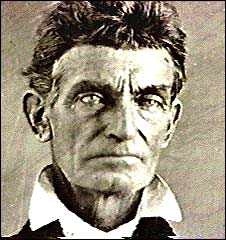
John_brown.JPG

                                                        John Brown

Friends of Padre Steve’s World,

October 16th is the anniversary of John Brown’s attempted seizure of the Federal Armory at Harpers Ferry. He was executed after trial on December 2nd 1859. Brown was  a man who had a righteous cause, but surrendered the moral high ground because of his fanaticism. Justice Robert Jackson wrote:“[I]n our country are evangelists and zealots of many different political, economic and religious persuasions whose fanatical conviction is that all thought is divinely classified into two kinds — that which is their own and that which is false and dangerous.” John Brown was a fanatic who in his desire to achieve his goal was not above committing murder as he did in Kansas, and insurrection as he did at Harper’s Ferry. There are many people in this country who harbor similar beliefs. John Brown serves as a warning to all of us. Violent means in service of a honorable or righteous cause often make things far worse.

This article is part of my draft book Mine Eyes have Seen the Glory: Race, Religion, Ideology and Politics in the Civil War Era. 

Peace

Padre Steve+

In the North there too existed an element of religious fanaticism. While “the restraining hand of churches, political parties and familial concerns bounded other antislavery warriors,” [1] and while most abolitionists tried to remain in the mainstream and work through legislation and moral persuasion to halt the expansion of slavery with the ultimate goal of emancipation; there were fanatical abolitionists that were willing to attempt to ignite the spark which would cause the powder keg of raw hatred and emotion to explode.

Most prominent among these men was John Brown. Brown was a “Connecticut-born abolitionist…a man with the selfless benevolence of the evangelicals wrought into a fiery determination to crush slavery.” [2] His father was an early abolitionist who helped later found Oberlin College. In his early years Brown “formulated a certitude about divine intervention against sinners, starring himself as God’s warrior against slaveholders.” [3] As early as 1834 John Brown was “an ardent sympathizer the Negroes,” desiring to raise a black child in his own home and to “offering guidance to a colony of Negroes on the farm of the wealthy abolitionist Gerrit Smith at North Elba New York.” [4]Brown regarded moderate free Staters with distain and though he was a fanatical Christian he never joined any church, and “obeyed only his conception of God’s unbounded command.” [5]

Brown “ridiculed Republican’s mainstream tactics. He disparaged even Yankee extremists for deploying too non-violent a strategy.” [6] After a series of failed business ventures the militant Brown went to Kansas and set about to change the equation through the use of terror. After the sack of Lawrence, Brown and a company of his marauders set upon and slaughtered the family of a pro-slavery settler at Pottawatomie Creek. [7] Brown and his son’s entered the house of one family, “dragged three men outside, shot the father through the head, and hacked and mutilated his two sons with broadswords.”[8] Two years later Brown went to Missouri where he “murdered a slaveholder, seized eleven slaves, and led the new freedmen 1100 miles to Canadian sanctuary.” [9]

The example of John Brown provides us with a good example to understand religious extremism, especially when it becomes violent. The counterinsurgency field manual notes in words that are certainly as applicable to Brown as they are to current religiously motivated terrorists, that “Religious extremist insurgents….frequently hold an all-encompassing worldview; they are ideologically rigid and uncompromising….  believing themselves to be ideologically pure, violent religious extremists brand those they consider insufficiently orthodox as enemies.”[10] 

Brown was certainly “a religious zealot…but was nevertheless every much the product of his time and place….” [11] Brown was a veteran of the violent battles in Kansas where he had earned the reputation as “the apostle of the sword of Gideon” as he and his men battled pro-slavery settlers. Brown was possessed by a zealous belief that God had appointed him as God’s warrior against slaveholders. He despised the peaceful abolitionists and demanded action. “Brave, unshaken by doubt, willing to shed blood unflinchingly and to die for his cause if necessary, Brown was the perfect man to light the tinder of civil war in America, which was what he intended to do.” [12]

Brown attempted to gain financing from wealthy abolitionists for a new expedition to seize the Federal arsenal at Harper’s Ferry Virginia, and most would have nothing to do with his scheme. When they “touted their pacific antislavery societies, Brown responded that “your methods are perfectly futile; you would not release five slaves in a century; peaceful emancipation is impossible.” [13] After hearing William Lloyd Garrison and other abolitionist leaders plead for peaceful abolition he remarked: “We’ve reached a point,” I said, “where nothing but war can get rid of slavery in this guilty nation. It’s better that a whole generation of men, women, and children should pass away by a violent death than that slavery should continue to exist.” I meant that literally, every word of it.” [14]

Following that meeting, as well as a meeting with Frederick Douglass who rejected Brown’s planned violent action, Brown went about collecting recruits for his cause and set out to seize 10,000 muskets at the Federal armory in Harper’s Ferry, Virginia in order to ignite a slave revolt. Brown and twenty-one followers, sixteen whites and five blacks moved on the arsenal. As they went, Brown:

“believed that we would probably fail at the Ferry, would probably die. But I believed that all we had to do was make the attempt, and Jehovah would do the rest: the Heavens would turn black, the thunder would rend the sky, and a mighty storm would uproot this guilty land, washing its sins away with blood. With God’s help, I, John Brown, would effect a mighty conquest even though it was like the last victory of Samson.” [15] 

After initial success in capturing the armory, Brown’s plan was frustrated and Brown captured by a force of U.S. Marines, led by Colonel Robert E. Lee and Lieutenant J.E.B. Stuart. Brown was tried and hanged, but his raid “effectively severed the country into two opposing parts, making it clear to moderates there who were searching for compromise, that northerner’s tolerance for slavery was wearing thin.” [16]

It now did not matter that Brown was captured, tried, convicted and executed for his raid on Harper’s Ferry. Brown to be sure was “a half-pathetic, half-mad failure, his raid a crazy, senseless exploit to which only his quiet eloquence during trial and execution lent dignity” [17] but his act was the watershed from which the two sides would not be able to recover; the population on both sides having gone too far down the road to disunion to turn back.

Brown had tremendous support among the New England elites, the “names of Howe, Parker, Emerson and Thoreau among his supporters.” [18] To abolitionists he had become a martyr “but to Frederick Douglass and the negroes of Chatham, Ontario, nearly every one of whom had learned something from personal experience on how to gain freedom, Brown was a man of words trying to be a man of deeds, and they would not follow him. They understood him, as Thoreau and Emerson and Parker never did.” [19]

But to Southerners Brown was the symbol of an existential threat to their way of life. In the North there was a nearly religious wave of sympathy for Brown, and the “spectacle of devout Yankee women actually praying for John Brown, not as a sinner but as saint, of respectable thinkers like Thoreau and Emerson and Longfellow glorifying his martyrdom in Biblical language” [20] horrified Southerners, and drove pro-Union Southern moderates into the secession camp. The Richmond Enquirer wrote in its editorial, “The Harper’s Ferry invasion has advanced the cause of Disunion, more than any other event that has happened since the foundation of the Government; it has rallied to that standard men who formerly looked on it with horror; it has revived, with ten fold strength the desire of a Southern Confederacy…” [21]

The day that Brown went to his hanging he wrote his final missive. This was written once more in apocalyptic language, but also in which he portrayed himself as a Christ figure going to his cross on the behalf of a guilty people, but a people whom his blood would not atone:

“It’s now December second – the day of my hanging, the day the gallows become my cross. I’m approaching those gallows while sitting on my coffin in the bed of a military wagon. O dear God, my eyes see the glory in every step of the divine journey that brought me here, to stand on that platform, in that field, before all those soldiers of Virginia. Thank you, Father, for allowing an old man like me such might and soul satisfying rewards. I am ready to join thee now in Paradise…

They can put the halter around my neck, pull the hood over my head. Hanging me won’t save them from God’s wrath! I warned the entire country: I, John Brown, am now quite certain that the crimes of this guilty land will never be purged away, but with blood.” [22]

Brown’s composure and dignity during trial impressed Governor Henry Wise of Virginia who signed Brown’s death warrant as well as that of fire-eater Edmund Ruffin. In his diary Ruffin “praised Brown’s “animal courage” and “complete fearlessness & insensibility to danger and death.” [23]

UBrown’s death was marked with signs of mourning throughout the North, for Brown was now a martyr. Henry David Thoreau “pronounced Brown “a crucified hero,” [24] while through the North, Brown’s death was treated as a martyr’s death. Even abolitionists like William Lloyd Garrison who had condemned violence in the quest of emancipation praised Brown’s actions, while throughout the North:

“Church bells tolled, black bunting was hung out, minute guns were fired, prayer meetings assembled, and memorial resolutions adopted. In the weeks following, the emotional outpouring continued: lithographs of Brown circulated in vast numbers, subscriptions were organized for the support of his family, immense memorial meetings took place in New York, Boston and Philadelphia…” [25]

Future Confederate General Lafayette McLaws spoke for many Southerners in the army when he wrote: His diary entry for February 27th 1860 noted:

“Debates in congress show no mitigation of sec. feeling…. I think it would be better not to be so fanatical on any subject, the extreme pro-slavery man is as bad as that type as that type of anti-slavery, John Brown. I do not consider slavery an evil by any means, but I certainly do not think it the greatest blessing.” [26]

But in the South there was a different understanding of Brown’s assault on Harper’s Ferry. Despite official denunciations of Brown by Abraham Lincoln and other Republican leaders, the message proclaimed by Southern newspapermen, ministers and politicians was that the North could not be trusted.  Brown’s raid, and the reaction of Northerners to it “was seized upon as argument-clinching proof that the North was only awaiting its opportunity to destroy the South by force….” [27]

Of course that was not the feeling in much of the North, but Brown’s actions and words were seized upon by the Southern versions of Brown to make Civil War inevitable once the political balance changed, and they neither controlled the Presidency, House, or Senate.

                                                          Notes 

[1] Ibid. Freehling The Road to Disunion Volume II p.207

[2] Ibid. Guelzo Fateful Lightning p.81

[3] Ibid. Freehling The Road to Disunion Volume II p.207

[4] Ibid. Potter The Impending Crisis p.211

[5] Ibid. Freehling The Road to Disunion Volume II p.207

[6] Ibid. Freehling The Road to Disunion Volume II p.206

[7] Ibid. Potter The Impending Crisis pp.211-212

[8] Ibid. Goldfield America Aflame p.118

[9] Ibid. Freehling The Road to Disunion Volume II p.208

[10] Ibid. U.S. Army/ Marine Counterinsurgency Field Manual p.27

[11] Ibid. Levine Half Slave and Half Free p.197

[12] Ibid. Korda, Clouds of Glory p.xviii

[13] Ibid. Freehling The Road to Disunion Volume II p.208

[14] Ibid. Oates The Approaching Fury p.203

[15] Ibid. Oates The Approaching Fury p.284

[16] Ibid. Korda Clouds of Glory p.xxxix

[17] Ibid. Catton Two Roads to Sumter p.18

[18] Ibid. Potter The Impending Crisis p.381

[19] Ibid. Potter The Impending Crisis p.375

[20] Ibid. Catton Two Roads to Sumter p.187

[21] ___________ The Harper’s Ferry Invasion as Party Capital The Richmond Enquirer, 23 October 1859 in The Civil War and Reconstruction: A Documentary Collection edited by William E. Gienapp, W.W. Norton and Company, New York and London 2001 p.54

[22] Ibid. Oates The Approaching Fury p.290

[23] Ibid. Thomas The Confederate Nation p.3

[24] Ibid. McPherson The Battle Cry of Freedom p.210

[25] Ibid. Potter The Impending Crisis p.378

[26] Oefinger, John C. Editor A Soldier’s General: The Civil War Letters of Major General Lafayette McLaws University of North Carolina Press, Charlotte and London 2002 p.18

[27] Ibid. Guelzo Fateful Lightning p.119

3 Comments

Filed under civil rights, civil war, ethics, faith, History, leadership, Political Commentary, racism, Religion

Threats of Civil War and Accusations Of Treason: Trump, His Reichsbishof, and Those Ready to Kill in his Name

Friends Of Padre Steve’s World,

Just a couple of thoughts tonight. We celebrated Judy’s Birthday with our friends in Germany and even made a trip over the border to France where we got her birthday cake. But I digress…

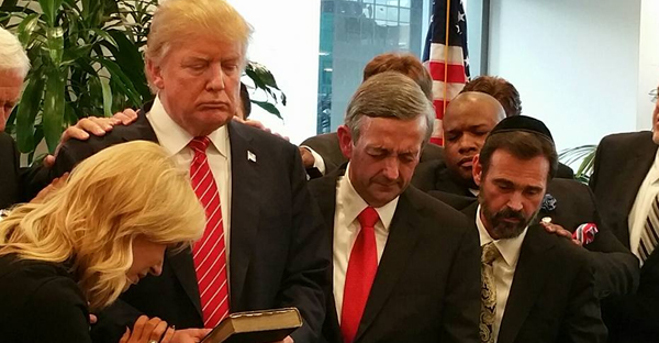
Tonight I am very concerned about what President Trump and some of his leading supporters, especially his Reichsbishof , Pastor Robert Jeffress, of First Baptist Church Dallas threatened that if he were impeached that it would bring about a civil war. During his Twitter tirade the President accused the Congressman Adam Schiff, Chairman of the House Intelligence Committee of Treason.

First, the whole concept of Treason when it comes to United States law and the Constitution, which set very tight limitations on what can be charged as treason.

In fact it is spelled out in the Constitution:

“Treason against the United States, shall consist only in levying war against them, or in adhering to their enemies, giving them aid and comfort.” 

That does not sound like Schiff, the Whistleblower, or any of Trumps political opponents or media critics. The only ones coming close to the definition is Trump himself, Rudi Giuliani, Attorney General Barr, and Secretary of State Mike Pompeo who all seem to be neck deep in not only the Ukrainian affair, but those involving other countries as well. Sadly, this is just the tip of the iceberg.

Unlike Hitler’s Germany, the Soviet Union Of Stalin, or for than matter any government ruled by a dictator, our Constitution does not say that the President is above the law. That is why the process impeachment of impeachment, and what can trigger it is in the Constitution. It is not about where you like a President or his policies at all, it is about holding the Chief Executive accountable to the Legislative Branch, which is given first place in the Constitution, including oversight of the Exectutive Branch, and advice, consent, and voting on the appointment of those of the Judicial Branch.

Okay, that was bad enough, a President who does not respect the Constitution and law is pretty bad, but one who re-tweets men like Jeffress that make threats of civil war is repugnant and repulsive. Trump tweeted Jeffress’s comments with his own his own comments:

If the Democrats are successful in removing the President from office (which they will never be), it will cause a Civil War like fracture in this Nation from which our Country will never heal,”

This is dangerous. The fact that first a Pastor would threaten civil war should the man he supported for president and defends today is much more like an Ayatollah, Taliban preacher, or somebody out of the religiously supported wars of the Reformation, or the Crusades than anything our Founders accepted. The fact that Jeffress pastors the flagship church of a denomination which was founded upon its support of slavery and later secession and civil war is ironic. They are remarks that any Southern Baptist today should flee from, and I am a graduate of Southwestern Baptist Theological Seminary, class of 1992.

Likewise I am a historian who has studied and written extensively about the American Civil War, Slavery, Reconstruction, Jim, Crow and the Civil Rights Movement, the German Civil War that followed World War One, during the Weimar Republic, and the wars which followed the Reformation in Europe and England. I have also visited countries in the Balkans after their civil wars of the 1990s, and been in the middle of of the Sunni-Shia Civil War in Iraq in 2007-2008.

The civil war that Trump, Jeffress, and other Trump supporters, including the so-called Oath Keepers threaten, will not be like the American Civil War with massed armies fighting a continental war, instead it will be much more like the Spanish Civil War, Iraq, Syria, Ireland, the wars in the former Yugoslavia, or those of the 1970s and 1980s in Central America. They will be murderous, terrorist type wars, insurgencies with no end. I have seen and studied these wars. Anyone advocating them is either evil, or insane.

I think that applies to both the President, the Pastor, and their armed fanatical supporters.

I say, let the Congress do its job and follow the law and Constitution regardless of where it leads.

So until tomorrow,

Peace,

Padre Steve+

30 Comments

Filed under civil rights, civil war, ethics, faith, History, Political Commentary

It’s Not Just Old History: The Fugitive Slave Act Of 1850 at 179 Years

thomas-sims-marched-into-slavery-nypl

Enforcing the Fugitive Slave Act in Boston 

Friends of Padre Steve’s World

Since we are busy tonight getting ready to go to Germany tomorrow I am reposting an article from a series dealing with an uncomfortable period of history for Americans with either a sense of conscience, or those who believe the racist myths surrounding the “Noble South” and “The Lost Cause.”  I hope that you find them interesting, especially in light of current events in the United States.

Peace,

Padre Steve+

                                    The Fugitive Slave Act of 1850

Robert Toombs of Georgia was an advocate for the expansion of slavery into the lands conquered during the war. Toombs warned his colleagues in Congress “in the presence of the living God, that if you by your legislation you seek to drive us from the territories of California and New Mexico, purchased by the common blood and treasure of the whole people…thereby attempting to fix a national degradation upon half the states of this Confederacy, I am for disunion.”  [1]

The tensions in the aftermath of the war with Mexico escalated over the issue of slavery in the newly conquered territories brought heated calls by some southerners for secession and disunion. To preserve the Union, Henry Clay and Daniel Webster, supported by the new President Millard Fillmore were able to pass the compromise of 1850 solved a number of issues related to the admission of California to the Union and boundary disputes involving Texas and the new territories.  But among the bills that were contained in it was the Fugitive Slave Law, or The Fugitive Slave Act of 1850. The act was the device of Henry Clay which was meant to sweeten the deal for southerners. The law would “give slaveholders broader powers to stop the flow of runaway slaves northward to the free states, and offered a final resolution denying that Congress had any authority to regulate the interstate slave trade.” [2]

fugitive-slave-law

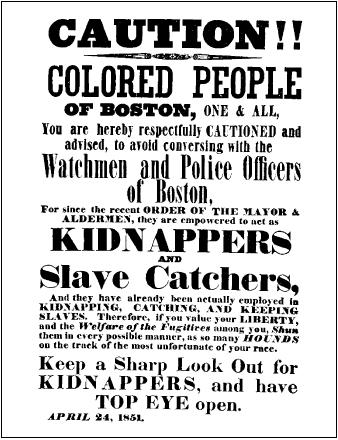
    A Warning to Blacks in Boston regarding the Fugitive Slave Law

For all practical purposes the Compromise of 1850 and its associated legislation nationalized the institution of slavery, even in Free States. It did this by forcing all citizens to assist law enforcement in apprehending fugitive slaves. It also voided state laws in Massachusetts, Vermont, Ohio, Connecticut, Pennsylvania and Rhode Island, which barred state officials from aiding in the capture, arrest or imprisonment of fugitive slaves. “Congress’s law had nationalized slavery. No black person was safe on American soil. The old division of free state/slave state had vanished….” [3] If there was any question as to whose “States Rights” the leaders of the South were advocating, it was certainly not those of the states whose laws were voided by the act.

That law required all Federal law enforcement officials, even in non-slave states to arrest fugitive slaves and anyone who assisted them, and threatened law enforcement officials with punishment if they failed to enforce the law. The law stipulated that should “any marshal or deputy marshal refuse to receive such warrant, or other process, when tendered, or to use all proper means diligently to execute the same, he shall, on conviction thereof, be fined in the sum of one thousand dollars.” [4] In effect the law nullified state laws and forced individual citizens and local officials to help escaped slaves regardless of their own convictions, religious views, and state and local laws to the contrary.

Likewise the act compelled citizens in Free states to “aid and assist in the prompt and efficient execution of this law, whenever their services may be required….” [5] Penalties were harsh and financial incentives for compliance attractive.

“Anyone caught providing food and shelter to an escaped slave, assuming northern whites could discern who was a runaway, would be subject to a fine of one thousand dollars and six months in prison. The law also suspended habeas corpus and the right to trial by jury for captured blacks. Judges received a hundred dollars for every slave returned to his or her owner, providing a monetary incentive for jurists to rule in favor of slave catchers.” [6]

The law gave no protection for even black freedmen, who simply because of their race were often seized and returned to slavery. The legislation created a new extra-judicial bureaucratic office to decide the fate of blacks. This was the office of Federal Commissioner and it was purposely designed to favorably adjudicate the claims of slaveholders and their agents, and to avoid the normal Federal Court system. There was good reason for the slave power faction to place this in the law, many Federal courts located in Free States often denied the claims of slave holders, and that could not be permitted if slavery was to not only remain, but to grow with the westward expansion of the nation.

When slave owners or their agents went before these new appointed commissioners, they needed little in the way of proof to take a black back into captivity. The only proof or evidence other than the sworn statement by of the owner with an “affidavit from a slave-state court or by the testimony of white witnesses” [7] that a black was or had been his property was required to return any black to slavery. The affidavit was the only evidence required, even if it was false.

runaway

Since blacks could not testify on their own behalf and were denied legal representation before these commissioners, the act created an onerous extrajudicial process that defied imagination. Likewise, the commissioners had a strong a financial incentive to send blacks back to slavery, unlike normal courts the commissioners received a direct financial reward for returning blacks to slave owners. “If the commissioner decided against the claimant he would receive a fee of five dollars; if in favor ten. This provision, supposedly justified by the paper work needed to remand a fugitive to the South, became notorious among abolitionists as a bribe to commissioners.” [8] It was a system rigged to ensure that African Americans had no chance, and it imposed on the citizens of Free states the legal obligation to participate in a system that many wanted nothing to do with.

Douglass.JPG

                                                  Frederick Douglass 

Frederick Douglass wrote about the new law in the most forceful terms:

“By an act of the American Congress…slavery has been nationalized in its most horrible and revolting form. By that act, Mason & Dixon’s line has been obliterated;…and the power to hold, hunt, and sell men, women, and children remains no longer a mere state institution, but is now an institution of the whole United States.” [9]

Douglass was correct as was demonstrated during an incident in Boston in 1854 where an escaped slave named Anthony Burns, who had purchased his freedom, was arrested under the Fugitive Slave Act. The arrest prompted a protest in which, “an urban mob – variously composed of free Negro laborers, radical Unitarian ministers, and others – gathered to free him. They stormed the Federal courthouse, which was surrounded by police and wrapped in protective chains….Amid the melee, one protestor shot and killed a police deputy.” [10] The heated opposition to Burns’ arrest provoked the passions of thousands of Bostonians who protested for his release that caused the Massachusetts governor to deploy two batteries of artillery outside the courthouse to deter any more attacks.

When the Federal Fugitive Slave Law commissioner consigned Burns to his Southern owner, the prisoner was placed in shackles and was marched down State Street. Tensions were now running extremely high and a “brigade of Massachusetts militia and local police were required to run Burns through a gauntlet and deposit him on the ship that would remand him to Virginia.” [11]Bostonians began to see their city as it was in the early days of the American Revolution, as a place that resisted tyranny. Neither did they did not forget Burns but raised the money to purchase his freedom. William Lloyd Garrison wrote, “the “deed of infamy… demonstrated as nothing else that “only “the military power of the United States” could sustain slavery.” [12] Nevertheless, Boston’s “mercantile elite had vindicated law and order” [13] but in the process they helped move so abolitionists who had been advocates of pacifism and non-violence to physical resistance to the bounty hunting Southerners. “Across the North, prisons were broken into, posses were disrupted, and juries refused to convict.” [14] Continue reading

Leave a comment

Filed under civil rights, civil war, History, leadership, Political Commentary, racism, Religion

The Bloodiest Day In American History: The Battle Of Antietam, September 17th 1862

Friends of Padre Steve’s World,

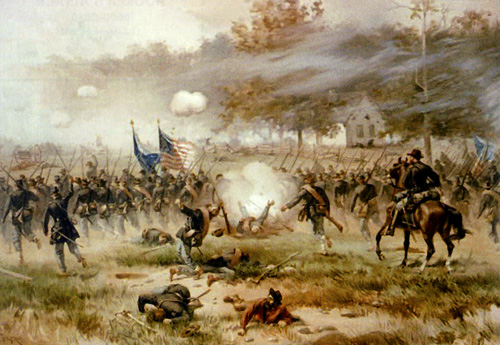
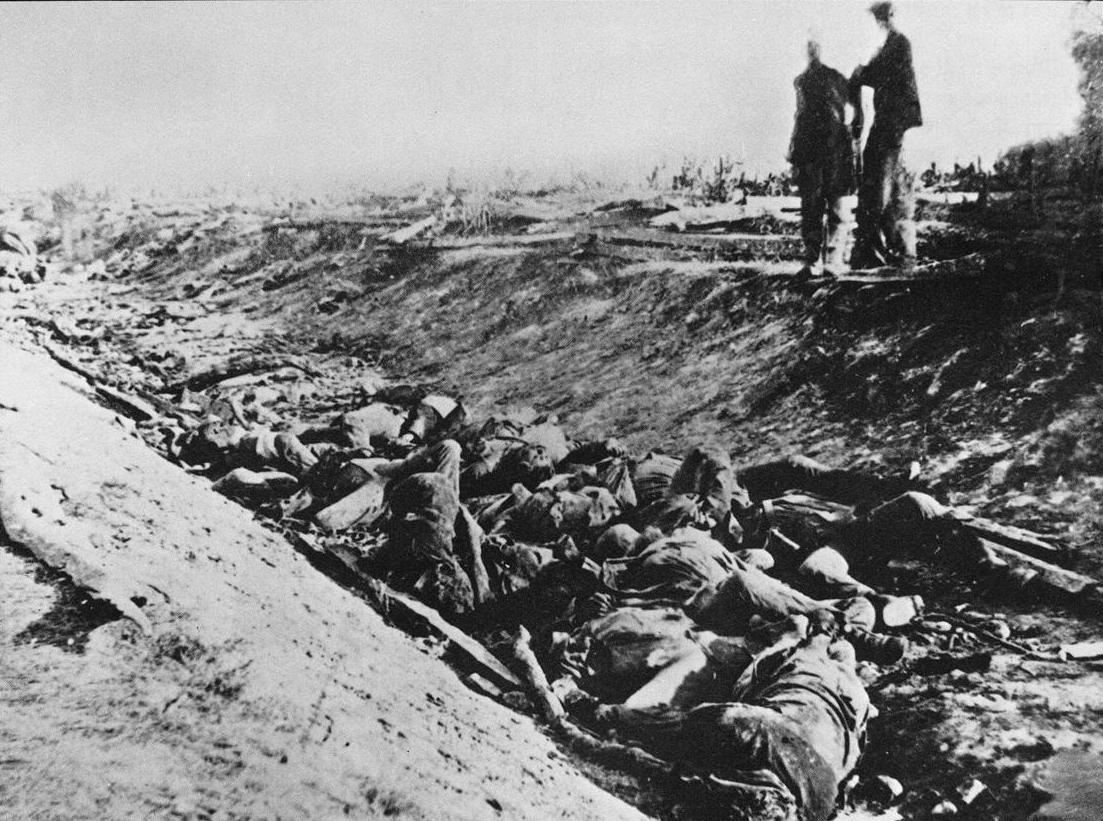
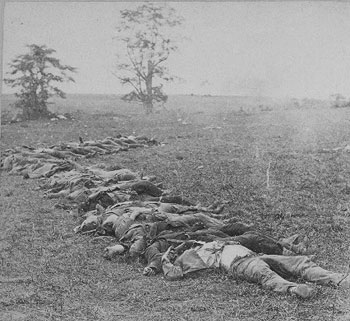
I have visited the battlefield of Antietam, at Sharpsburg, Maryland numerous times going back to the 1990s. Apart from Gettysburg, I have been to it more than any other battlefield in North America. It it a haunting place, not nearly as commercialized as the outskirts of Gettysburg have become. Yet on it, more Americans were killed or wounded on any single day in American history, and it was Americans killing other Americans. Though the battle itself was a draw in terms of tactical terms, it turned out to be one that helped decide the course of history. Historian Stephen W. Sears wrote:

“Of all the days on all the fields where American soldiers have fought, the most terrible by almost any measure was September 17, 1862. The battle waged on that date, close by Antietam Creek at Sharpsburg in western Maryland, took a human toll never exceeded on any other single day in the nation’s history. So intense and sustained was the violence, a man recalled, that for a moment in his mind’s eye the very landscape around him turned red.” 

Captain Emory Upton, of the 2nd U.S. Artillery, and later one of the men who helped modernize the tactics of of the Army in the 1880s wrote:

“I have heard of ‘the dead lying in heaps’, but never saw it till this battle. Whole ranks fell together.”

Another officer, Lieutenant Frederick L. Hitchcock Of the 132nd Pennsylvania at the Bloody Lane:

“We were in the very maelstrom of the battle. Men were falling every moment. The horrible noise was incessant and almost deafening. Except that my mind was absorbed in my duties, I do not know how I could have endured the strain.” 

To the west of Frederick Maryland a small town named Sharpsburg sits on the west side of a creek. Named Antietam the creek’s headwaters are in Franklin County Pennsylvania and it meanders south where just to the south of Sharpsburg it empties into the Potomac River.

It is a peaceful place, rolling hills and agricultural country with some well preserved stone arch bridges, including one just outside of Sharpsburg. It is hard to believe that 150 years ago the town and the creek were the scene of the bloodiest single day of battle in American history.

On that indian summer day of 1862 the Confederate Army of Northern Virginia, General Robert E. Lee, commanding made a stand against the much larger Union Army of the Potomac, Major General George B. McClellan, commanding.

Lee had invaded Maryland following a string of successes in Northern Virginia during that summer of 1862, defeating McClellan outside of Richmond in the Seven Days, and in a campaign of maneuver bested a newly formed Army, the Union Army of Virginia commanded by Major General John Pope defeating it at the Second Battle of Bull Run between 28-30 August 1862. With Northern Virginia’s crops and livestock depleted and his opponents in crisis Lee moved his army north into Maryland. The decision was driven partly by the need to provision his army, but also had the hope of drawing Maryland away from the Union mistakenly believing that public sentiment in that state was pro-Confederate. If the people of Maryland rose up to support Lee it would be disastrous to the Union and endanger the capital itself. A final consideration was the hope that a Confederate victory on Northern soil would bring about the foreign recognition and possibly the intervention of Great Britain on the side of the Confederacy.

                                                   The Lost Order

Lee crossed the Potomac on September 3rd and sent his Second Corps west with some elements seizing the Union armory in Harper’s Ferry, others to secure the Baltimore and Ohio Railroad at Martinsburg the rest of the Army was in the area of Frederick. He was pursued by the very cautious McClellan at the head of the Army of the Potomac.

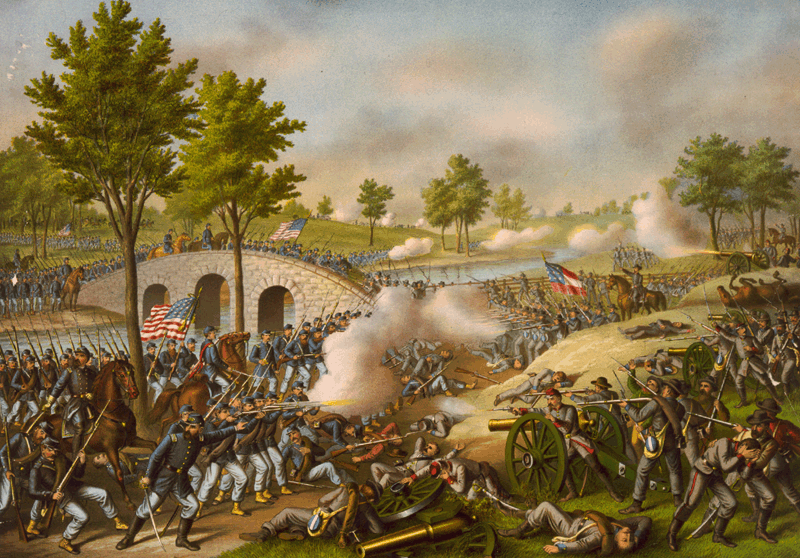
On September 9th Lee issued General Order 191, the infamous “lost order” which a copy of which was found by Union soldiers wrapped around three cigars at a campground recently occupied by Lee’s rear guard element, the division of D.H. Hill on September 13th. The order detailed the disposition of Lee’s army and McClellan seized the opportunity. On the 14th the Army of the Potomac attacked part of Lee’s army at the Battle of South Mountain. The Union won that battle forcing the outnumbered Confederate forces to withdraw, though the delay allowed Lee to concentrate more of his army at Sharpsburg on the 15th.

Although he outnumbered Lee McClellan believed the reports of the Pinkerton Detective Agency which provided intelligence to the army. Those estimates which credited Lee with more than 100,000 troops. He delayed his attack until he had drawn up his full army on the on the 17th.

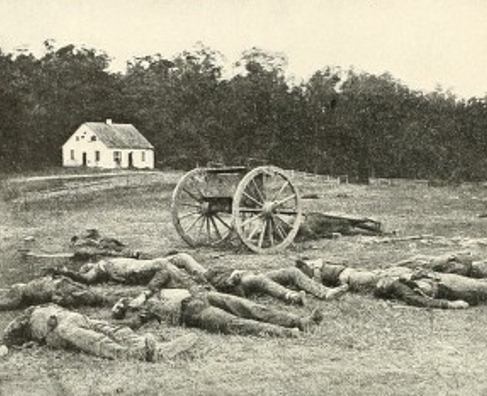
                            The Dead Near the Dunker Church

When he did attack on the 17th his attacks were uncoordinated and though he came close to decisive breakthrough Lee’s army desperately clung to its positions. The action began to the north of the town in the morning and both sides showed incredible ferocity at the Cornfield, where in the space of about three hours nearly 8000 soldiers were killed or wounded. The fighting shifted to the center of the line opposite the town by mid-day. Amid the destructive storm of artillery the armies fought around the Dunker Church and a sunken lane now known as “Bloody Lane.” In the confines of that 800 yard stretch of road over 5000 soldiers were killed or wounded in the course of about four hours. The Union forces broke the Confederate line but reinforcements were not sent and when the the division commander, Major General Israel Richardson was mortally wounded the attack lost its verve and the Confederates under Lieutenant General James Longstreet were able to restore the line.

The south remained quiet as McClellan ordered Major General Ambrose Burnside’s IX Corps to hold off on attacking. Burnside did not receive his orders to attack until 1000. He finally attacked across the south bridge, now known as Burnside’s Bridge in the afternoon. It was another tough fight and Burnside, after several attempts move to the south to flank Confederate forces in the late afternoon with the intention of cutting Lee from off his only escape route.  The Confederates were in a desperate condition. It was at this point, about 3 PM when the division of Major General A.P. Hill arrived and immediately counterattacked breaking up Burnside’s attack. Burnside requested reinforcements from McClellan who refused saying that he had none available. This was not the case, McClellan had two full corps of infantry uncommitted to the battle but still believing that he was outnumbered and that Lee was attempting to trap him.

The actioned ended by 530 PM with both sides rested and reorganized for action the next day. Lee prepared to defend but no Union attack was offered on the 18th. An informal truce was observed to allow the evacuation of the wounded and Lee began his withdraw across the Potomac into Virginia that night. Despite being goaded by Lincoln to pursue McClellan did not and the Union lost the opportunity to destroy Lee’s army n Union territory.

Casualty estimates vary but according to Stephen W Sears in his book Landscape Turned Red that the Army of the Potomac lost 2108 dead, 9540 wounded and 753 missing. He states the best estimate of Confederate casualties are 1546 dead, 7752 wounded and 1018 missing. Most of the missing were likely killed and buried in mass graves or discovered and buried by civilians after the battle. In the space of 12 hours 22719 Americans were killed or wounded. It was the bloodiest single day in American military history.

Though the battle was inconclusive in that Lee’s army survived but had to break off its offensive it had more influence than expected. President Lincoln issued the Emancipation Proclamation on September 22nd and though it did not take effect until January 1st 1863 it marked a turning point in the war.

McClellan failed to take up the offensive in the next tow months and Lincoln relieved him of command giving the Army of the Potomac to Burnside who goaded by Lincoln took the army into battle at Fredericksburg where it met with defeat.

I have been to the battlefield a number of times, on my own in 1997, once as part of a “staff ride” with the Marine battalion that I was assigned in May of 2000, and a couple of other times on my own. The last time I was there in 2017, I walked over 17 miles on the battlefield.

Each time I go I take the time to ponder the great losses endured by both armies and the individual courage of the soldiers involved. Some of the units that I served with in the Army National Guard in Texas and Virginia trace their lineage and honors to regiments that fought at Antietam and I have felt a connection to the battle because of that. It is hard to imagine the amount of death and carnage taking place in such a placid location in such a short amount of time.

It is something to ponder when some Americans openly suggest another civil war if their party does not win the next Presidential election.

Peace

Padre Steve+

Leave a comment

Filed under civil war, History, Military, Political Commentary, us army

The Continuing Struggle, Part Three: Harriett Tubman “The General” and Women’s Rights Today


Friends of Padre Steve’s World,

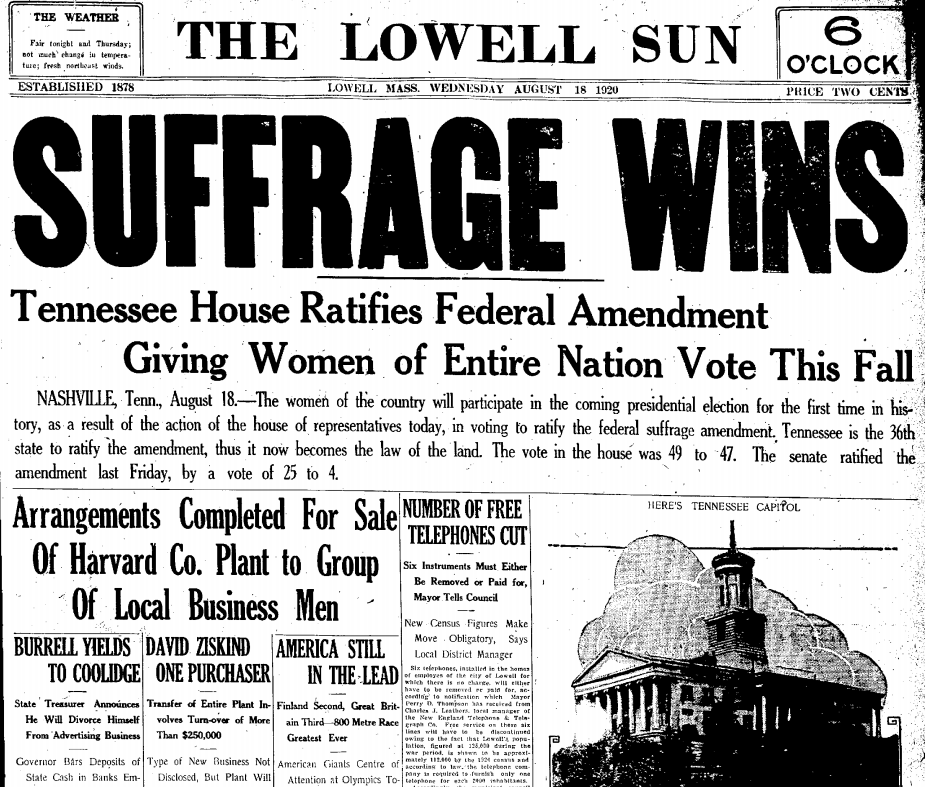
Over the past few days I have been going back to the theme of Women’s rights following the 99th anniversary of the ratification of the Nineteenth Amendment.

So today I am posting a section of the portion of my text dealing with a most amazing woman, Harriet Tubman. The more I read about her the more I stand I awe. This section was a lot less detailed that in is now. I have spent a lot of time working on this section recently, and will probably do some more in the coming weeks, but I think that you will find it interesting, and still relevant in our society.

Her image was to be featured on the $20 bill beginning next year, replacing that of Andrew Jackson, but the Trump administration has put this off until at least 2028. Her story should not be forgotten. Maybe after I retire I can write an in depth biography of this remarkable woman and American Patriot.

So until tomorrow, I with you peace, health, and safety,

Peace

Padre Steve+

The innate prejudices of many military and political leaders about the abilities and limitations of women in military service, often caused them to overlook how women could use that prejudice to their advantage, especially as spies. “African American women were generally dismissed as militarily harmless, a miscalculation that Harriet Tubman…used to immense advantage. Tubman, who had escaped from slavery in Maryland twenty years before the war and who had amassed considerable experience venturing into the south to guide runaways to the North undertook spying expeditions for the Federal troops on the South Carolina Sea Islands.” [1] The incredibly brave woman served throughout the war accompanying Union forces and securing vital information even as she worked to set other slaves free. Tubman’s “spying activities included convincing slaves to trust the Union invaders,” [2] many of whom would join the ranks of the newly raised regiments of U.S. Colored Troops.


Tubman had been fighting her personal civil war for over twenty years before the war began. As an escaped slave she returned to the South time and time again as a “conductor” on the Underground Railroad, smuggling escaped slaves out of the South and to freedom. She “successfully returned nineteen more times, bringing out an estimated 300 to 400 people…. She worked with a determination bordering on ruthlessness: if an escaped slave tarried, she pushed him in; if a baby cried she muffled the sound.as she herself said later…. “I was the conductor on the Underground Railroad for eight years, and I can say what most conductors can’t say – I never ran my train off the track and I never lost one passenger.” [3]

In early 1863, Union commanders in South Carolina decided that Tubman would be valuable as a covert operative to lead reconnaissance missions behind Confederate lines and along contested waterways where Confederate personnel had laid torpedoes, what we now know as sea mines, and she organized a small unit of nine men who used small boats to find the torpedoes and warn the captains of Union vessels operating in those streams and rivers.

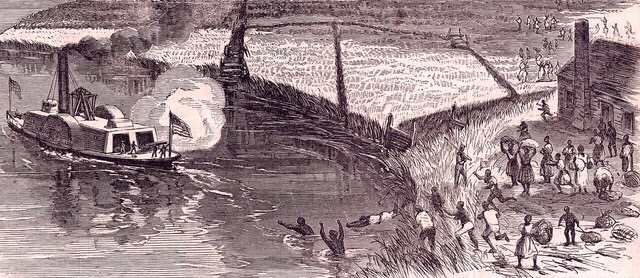
Eventually, Tubman’s actives “evolved into a kind of special forces operation under Colonel James Montgomery. A fervent believer in guerrilla warfare, Montgomery was a veteran of antislavery border fighting in Kansas.” The pair developed some of the most effective operations mounted by irregular and regular forces conducted by the Union in the war. In July 1863, Tubman came up with a plan for a raid, and in it acted as “Montgomery’s second-in-command during a night raid up the Combahee River, near Beaufort, South Carolina. The Union gunboats, carrying some 300 black troops, slipped up the river, eluding torpedoes that Tubman’s men had spotted. Undetected, the raiders swarmed ashore, destroyed a Confederate supply depot, torched homes and warehouses, and rounded up more than 750 rice plantation slaves.” [4]

The Confederate report on the raid unwittingly ended up praising the work of Tubman and the freed slaves of her unit. It noted that the enemy “seems to have been well posted as to the character and capacity of our troops… and seems to have been well guided with persons thoroughly acquainted with the river and country.” Union Brigadier General Rufus Saxton wrote to Secretary of War Stanton praised Tubman’s work, noting, “This is the only military command in American history wherein a woman, black or white, led to raid, and under whose inspiration, it was originated and conducted.” [5]

Tubman continued her work for the duration of the war and after it continued to assist freed slaves and black veterans and continued her work with campaign for women’s suffrage. In 1890 she was awarded a pension for her work as a spy, nurse, and combat leader. The valiant pioneer of abolition, women’s suffrage, and combat in war who was nicknamed “the General” by Frederick Douglass, died in 1913, and was buried with full military honors.

Other women served in various roles caring for the wounded. In the North, “Dorothea Dix organized the Union’s army nurses for four years without pay; Mary Livermore headed the Union’s Sanitary Commission, inspecting army camps and hospitals….Scores of others like Clara Barton, volunteered to be nurses.” [6] All of these women did remarkable service, mostly as volunteers, and many witnessed the carnage of battle close up as the cared for the wounded and the dying which often created ethic concerns for the women nurses:

“Clara Barton described her crisis of conscience when a young man on the verge of death mistook her for his sister May. Unable to bring herself actually to address him as “brother,” she nonetheless kissed his forehead so that, as she explained, “the act had done the falsehood the lips refused to speak.” [7]

The very existence of so many women who served in the ranks during the Civil War, and their “demonstrated competence as combatants, challenge long-held assumptions about gender roles…. From a historical perspective, the women warriors of the Civil War were not just ahead of their time. They were ahead of our time.” [8]

Of the women that served in the ranks during the war, some were discovered, and many of them remained protected by their fellow soldiers. Quite a few of these closeted women soldiers received promotions and even served as NCOs or junior officers. With women now serving in combat or combat support roles in the U.S. Military since Operation Desert Storm in 1991, the stigma and scandal that these cross-dressing women soldiers of the Civil War has faded and as scholars and the public both “continue probing cultural notions of gender and identity, the reemerging evidence that women historically and successfully engaged in combat has met with less intellectual resistance and has taken on new cultural significance.” [9] As the United States military services examine the issues surrounding further moves to integrate the combat arms we also should attempt to more closely examine the service of the brave and often forgotten women who served on both sides of the Civil War.

In addition to these tasked many other women were engaged in the war as “supply organizers, relief workers, pamphleteers all aided the cause, and female journalists covered it. Dorothea Dix and Clara Barton became powerful forces helping soldiers; Anna Carroll provided the propaganda. And the Civil War boasted its own version of Rosie the Riveter, women who did the dangerous work of making munitions at arsenals, many losing their lives in awful accidents.” [10]

Likewise, the war caused many educated women to take much more interest in “political and military issues and led many women to articulate a sharper consciousness of national affairs…. The feminist paper The Mayflower commented that “nearly every letter we receive breathes a spirit of deep feeling on the war question.” The editorial added that among women, “There seems to be little disposition to think, speak, read or write of anything else.” [11] In particular one women, Anna Ella Carroll, the daughter of Thomas King Carroll, a former governor of Maryland, “was interested in political theory and practice and was a profound logical thinker as well as an effective propagandist for the Union.” [12]  During the war she was in part responsible for persuading the governor of Maryland to keep the pro-secession legislature from meeting in 1861, defended Lincoln’s suspension of habeas corpus in that state, and is believed to have originated the military strategy in the Tennessee River Campaign, for which she was never given full credit even though there is documentary evidence that many leaders knew of her involvement. A recent biographer concluded that she “was a “tragic victim of reconstruction,” for if a military strategist, she was not given due credit.” [13] In the South it was often the same, the diaries of many educated Southern women show a tremendous interest and discernment of what was happening during the war, and in domestic politics, and frequently expressed their criticism of government and military strategy as the war continued.

                                                      Notes

[1] Ibid. Guelzo Fateful Lightning p.394

[2] Sizer, Lyde Cullen Acting Her Part: Narratives of Union Women Spies in Divided Houses: Gender and the Civil War Oxford University Press, New York and Oxford 1992 p.130

[3] Ibid. Sizer Acting Her Part: Narratives of Union Women Spies  p. 127

[4] Ibid. Central Intelligence Agency, Intelligence in the Civil War location 481 of 991

[5] Ibid. Central Intelligence Agency, Intelligence in the Civil War location 481-482 of 9911

[6] Ibid. Silvey I’ll Pass for Your Comrade p.10

[7] Faust, Drew Gilpin, This Republic of Suffering: Death and the American Civil War Vintage Books, a division of Random House, New York 2008 p.12

[8] Ibid. Blanton and Cook They Fought Like Demons p.208

[9] Ibid. Blanton and Cook They Fought Like Demons p.204

[10] Ibid. Roberts Capital Dames: The Civil War and the Women of Washington 1848-1868 p.3

[11] Attie, Jeanie Warwork and the Crisis of Domesticity in the North in Divided Houses: Gender and the Civil War edited by Catherine Clinton and Nina Silber, Oxford University Press, Oxford and New York 1992 p.253

[12] Ibid. Massey Women in the Civil War p. 168

[13] Ibid. Massey Women in the Civil War p.169

2 Comments

Filed under civil rights, civil war, History, News and current events, Political Commentary, racism, women's rights

The Continuing Struggle: The Nineteenth Amendment at 99 Years

Friends of Padre Steve’s World,

Today is the 99th Anniversary of the ratification of Nineteenth Amendment to the Constitution which gave women the right to vote. It was a watershed moment brought about through close to 8 decades of women fighting for the right to vote and for equality in general.

However, that decision was just a point of a long struggle for equality that  continues today. Despite the gains made since the past century women continue to have few rights than men, and when successful in business, sports, politics, the media, academia, or for that matter almost anything outside the traditional household remain second class citizens in most countries, even the United States, and all too sadly that is due to misogyny and religious prejudices which favor men and no matter how talented, intelligent, and brilliant many women are are consigned to a second place in the workplace, in the church, and almost everywhere else. 

So, tonight and for the next few nights I am going to repost a series of articles from one of my yet unpublished books which deal with the American Civil War, the Abolition Movement, and the post-War movement for women’s rights. 

So until tomorrow, 

Peace

Padre Steve+

Another development, which in large part is related to the abolition movement, was the campaign for women’s rights. The Civil War was also revolutionary because it was instrumental in propelling women into positions in American society that they had never before been allowed. The war Some of this was because many women decided to like those who campaigned for the end of slavery and the rights of African Americans to turn the world upside down. The war allowed the women who served, “in uniform or not, war permitted these women to experiment with a series of role reversals in gender,” [1] and in some cases gender and race. These experiments were the beginning of the struggle for women’s equality and to women serving in the military.

In much of the country and in particular the South women’s rights were the same as granted in English Common Law. Common law held to the more archaic understanding of the Christian Church that women were the property of their husbands, especially in cases of infidelity including during the trial of Dan Sickles for killing Barton Key. But the war “imposed on American society as such social disruption as it did physical destruction. Within that disruption, for one brief and bloody historical moment, an entirely new way of ordering of race and gender within a republican society became possible,” [2]however, in the end it would take another century or more for much of this change to be realized.

Southern culture and law ensured that women had even few rights than the women in the North.  In the North women were making some gains in the workplace and in various professions such as teaching and nursing, and as the industrial revolution modernized the workplace and required more skilled workers, particularly in the textile industries, the availability of work for women who wanted to work outside the home increased. Even uneducated Northern women sought work in the growing number of factories and by 1860 “there were more than 270,000 female operatives, the vast majority being employed in Northern textile, shoe, clothing, printing, and publishing establishments. Over 135,000 worked in New England factories and composed 65 percent of the region’s industrial labor.” [3]  Educated Northern women, while excluded from most professions, found their way into teaching, nursing, non-ordained religious work, and writing. Some found work in Federal government agencies in Washington DC, including “Clara Barton, a successful teacher who had trouble landing a position because she was a women, found work in the Patent Office, where she briefly made the same salary as her male colleagues.” [4]

But in the South women were continued to be held back. This was in large part due to the understanding that the “household was a spatial unit, defined by the property to which the owner not only held legal title over, but over which he exercised exclusive rights.” [5] As such Southern men had nearly unlimited rights and power over what occurred on his property, for “in societies in which landed property comprised the chief means of subsistence…legal title to the land had historically incorporated claims over the persons and labor of those who were dependents on it.” [6] In the South, as opposed to the North comparatively few women entered the Southern labor market, in large part because of the region’s emphasis on agriculture, dependence on slave labor, and a culture that frowned on women working outside the home.  1860 when Northern women were becoming a force to be reckoned with in the labor market, “only 12,000 women worked in factories, 10 percent of the regions wage earners.” [7] The lack of trained and experienced women workers would be a crippling impediment to the Confederate War effort.

For Southern men the stakes of ensuring slavery’s continuation and expansion were high, the culture of the South ante-bellum South was deeply patriarchal and “The possibility that the black man might be empowered like any other was such a threat to the southern social hierarchy that some white southerners were inclined to fear not only for their position as slaveowners but for the entire basis of their claim to patriarchal power. They feared for their power not only over their slaves but over their women as well.[8]

The Gimke Sisters, Abolitionists and Suffragettes 

William Lloyd Garrison and the leaders of the abolitionist movement came into contact with two southern women who had converted to the abolitionist cause; South Carolina cotton heiresses, Sarah and Angelina Grimke. The two women were passionate as well as eloquent and became popular lecturers on the abolitionist speaking circuit. Angelina Grimke was a powerful speaker linked to abolition and women’s rights, she made herself unwelcome in her native Charleston South Carolina “with the publication of An Appeal to the Christian Women of the South. She urged Southern women, many of whom opposed slavery, to speak out, and despite her failure to reach the audience to which she spoke, hers is one of the most significant abolitionist writings.” [9] She proclaimed:

“We cannot push Abolitionism forward with all our might until we take up the stumbling block out of the road…. If we surrender the right to speak in public this year, we must surrender the right to petition next year, and the right to write the year after, and so on. What then can the woman do for the slave, when she herself is under the feet of man and shamed into silence?” [10]

Her sister Sarah was also active in writing, but she focused her attention not just on abolition, but “on the inferior status of both woman and the Negro in The Equality of the Sexes and the Condition of Women.” [11] The Grimke sisters and other women like them brought Garrison and others in the abolitionist movement into contact with the early leaders of the new women’s rights movement. The leaders of the movement, Elizabeth Cady Stanton, Abby Kelley, and Lydia Maria Child were outspoken in their belief that “a campaign to emancipate slaves could not avert its eyes from the need to emancipate American women from social conventions and legal restraints that prevented them, like the slave, from owning property and voting, and kept them altogether subservient to the interests of white males.” [12]

The principals involved in the abolitionist and the women’s movements, those of freedom, emancipation and equality eventually forged a bond between them, and have provided inspiration to others in their quest for political and social equality. For William Lloyd Garrison “the woman question clearly demonstrated how the logic of reform united all good causes and carried them to new ground. If in their endeavors to break the chains of slavery women discovered, as Abby Kelley put it, that “we were manacled ourselves,” the abolitionist principle required a defense of equal rights without regard to race or sex.” [13]

While women and blacks were “being brought together in a dual crusade, often behind the same leaders,” [14] that did not mean that both parties were given equal consideration, even among the supporters of abolition and women’s rights. All to often, women found that their rights were not considered as important by the political leadership fighting for the rights of black men. Few in Congress “responded sympathetically to feminists’ demands. Reconstruction they insisted, was the “Negro’s hour,”  [15] a view shared by Frederick Douglass. Though the economic situation of women began to improve, especially through women being admitted to the Civil Service, much else remained unchanged, women were still second class citizens without the right to vote, with few legal rights, and few opportunities to move up in society apart from her husband.

But change was beginning to occur as women began to have more educational opportunities in the post-war years, and began to find employment opportunities with the expansion of industry. Women’s suffrage was not included in the Fifteenth Amendment, which caused a split between women’s groups and their long-time abolitionist allies who told them “If put on the same level and urged in the same connection, neither will soon be accomplished.” [16]   Even so in some territories women were granted the right to vote in territorial elections, “women were given the vote in Wyoming Territory in 1869. However, Wyoming’s admission as a state twenty years later came only after a heated debate on the women’s suffrage article in the state constitution.” [17]

In the 1800s women in the United States found themselves bound by two major factors, law and culture. English common law and early in the life of the Republic it was determined by John Adams that women should be exclude from political life as they were “unsuited by nature for the businesses of life or the hardy enterprises of war, they had nothing of value to offer the state.” [18] Women had no claim to property, wages, or even their children. Thomas Jefferson had “defined the essence of liberty as independence, which required ownership of productive property. A man dependent on others for a living could never truly be free, nor could a dependent class constitute the basis of republican government. Women, children, and slaves were dependent; that defined them out of the polity of republican freedmen.” [19] This understanding of the rights and citizenship of women persisted as the official law of the nation throughout the ante-bellum era, through and after the Civil War, and up until the passage and ratification of the Nineteenth Amendment.

As such, single women had few rights while married women had even fewer as, married women could not “own property in her own right, make contracts or otherwise conduct business of her own. She was supposed to be modest and submissive. The married woman, in fact, was for all intents and purposes the chattel of her husband.” [20] The reality was stark for women, but especially married women for as one historian noted: “marriage very nearly meant the legal annihilation of a woman…once a woman was married all property and property rights were transferred to her husband, and she was permitted to own nothing in her own name. Married women could not make contracts, could not sue, could not buy or sell, except over their husband’s signatures.” [21] Adult white women were citizens in a constitutional sense, but in the North and South alike their terms “of their citizenship had always been set by the perceived necessities of marriage and its gender asymmetries between man and woman, husband and wife.” [22]

The role of culture and religion was another major constraint on women’s rights during the ante-bellum period and much of this centered on Victorian social and cultural ideals which brought about what can be safely called a “a cult of true womanhood” which “dictated that women always appear demure, submissive, pious, and concerned with the home and family.” [23] In the Victorian ideal, it was the man whose sphere of life was in worldly pursuits, while women were limited to the task of bearing and raising children and maintaining the traditional private domain of hearth and home. This understanding of separate spheres was supported was often supported by the churches, especially those the conservative and evangelical variety.

While this was true in the North it was especially prevalent in the South and promoted by southern evangelical churches. The “explicit goal of southern evangelicalism was to keep the religious role of white women within narrow and carefully policed bounds. Evangelical Southerners clearly designated men as society’s (and women’s) rightful rulers and ultimate authorities. They were, in the 1830 words of Southern writer Virginia Carey, “the anointed lords of creation”; St. Paul’s injunction that wives “submit yourself to your own husbands as to the Lord” provided the text for many a Sunday sermon.” [24]

In matters of sexual behavior there was a pronounced double standard between men and women. If a man was an adulterer it was frowned upon, but not necessarily a condition that would invoke the scorn of the community unless an aggrieved husband took the law into his own hands and killed the adulterer, in which case the murderer could easily be forgiven. However, for the married adulteress, the social damnation was all too real, even from other women, who often believed that there was no excuse for such behavior and that the adulteress “deserved the most stringent fate for her violation of the dictates of virtue.” [25]

A married woman’s position was as close to being a slave as could be, and only the plight of black female slaves was worse, for they were simply chattel. The few free black women mainly stayed unmarried “in order to maintain what few property rights they were entitled to.”  [26] As they also did over blacks, white men ruled over women in all spheres of life. While the eventual emancipation of blacks provided more rights for black men, those did not help many black women as Sojourner Truth, a pioneering African-American abolitionist who spent forty-years as a slave said toward the end of her long life:

“There is a great stir about colored men getting their rights, but not one word about colored women; and if colored men get their rights, and not colored women theirs, you see colored men will be master over the women, and it will be just as bad as it was before. So I am for keeping the thing going while things are still stirring because if we wait till it is still, it will take a great while to get it going again….I suppose I am the only colored woman that goes on to speak for the rights of the colored women. I want to keep the thing stirring, now that the ice is cracked…” [27]

Elizabeth Cady Stanton was among the most vocal of women’s rights advocates. She was the daughter of a leading Federalist lawyer, who served a term in the House of Representatives and on the New York Supreme Court. Her father planted in her the desire to learn, a love for law, and a passion for civil rights which she was able to pursue. Unlike many women of her day, Stanton was able to graduate from the Johnstown Academy and the Troy Female Academy in Troy, New York, before she was married to Henry Brewster Stanton, a journalist, anti-slavery orator and attorney, with who she had seven children.

Stanton believed that a woman’s place in the home was ultimately destructive and “reflected her subordinate position in society and confined her to domestic duties that served to “destroy her confidence in her own powers, lessen her self respect, and to make her willing to lead a dependent and abject life.” [28] Stanton noted how the condition of women of her day was “more fully identified with the slave than man possibly can be… For while the man is born to do whatever he can, for the woman and the negro the is no such privilege.”  [29] It was a key observation and something even today, a state that some politicians, pundits and preachers would like to return women.

Since nearly all of the most “outspoken feminists had been schooled in abolitionist movement” they were “suspect in the South, where society was conservative, patriarchal, and insistence that ladies live in a kind of earthly limbo.”  [30]  Such women posed a threat to the pillars of Southern society. Since the South was now fighting tooth and nail against the abolitionist movement, anything closely connected with that movement, including the women who advocated abolition and women’s rights were shunned and their message rejected and inflammatory and revolutionary. It was not until the crisis caused by the Civil war that Southern women began to seize “the opportunity to lay claim to an increased reciprocity in gender relations.” [31]

But even with the abolition movement there was opposition the women’s rights, the 1839 meeting of the American Anti-Slavery Society witnessed a debate over including women in the membership. Conservative Evangelicals recoiled in disgust, and when the convention voted to allow women into the membership Lewis Tappan “got up a starchy “protest” which condemned the “repugnant” admission of women as an ‘expression of local and sectarian feelings…well suited to the unnecessary reproach and embarrassment to the cause of the enslaved as [it] is at variance with the general usage and sentiments of this and other nations.” [32] In May of 1840 the American Anti-Slavery Society split among religious lines when leading evangelicals led by the Tappan brothers withdrew from it.
senecafalls-womanspeaking

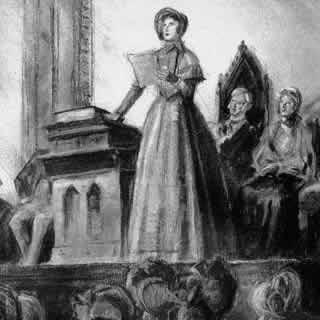
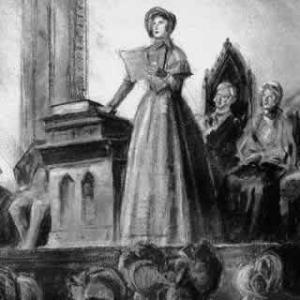
Elizabeth Candy Stanton at the Seneca Conference, 1848

But that neither stopped Garrison from working with women, nor kept Frederick Douglass from embracing them as part of the abolitionist movement. From this rather inauspicious beginning, the women’s rights movement began to infiltrate society, especially in the field of education. In 1848 at Seneca New York there was a convention that launched the modern women’s rights movement. Led by Stanton and Elizabeth Mott the delegates published a “Declaration of Sentiments, modeled on the Declaration of Independence, proclaimed “that all men and women are created equal” and deserved their “inalienable rights” include the right to elective franchise.” [33] The declaration was bold and its denunciation of the place of women in society to be considered revolutionary in character. Part read:

“He has never permitted her to exercise her inalienable right to elective franchise. He has compelled her to submit to laws, in the formation of which she had no voice. He has withheld from her rights which are given to the most ignorant and degraded men – both natives and foreigners… He has made her, if married, in the eye of the law, civilly dead. He has taken from her all right to property, even to the wages that she earns…. After depriving her of all her rights as a married woman, if single, and the owner of property, he has taxed her to support a government which recognizes her only when her property can be made profitable to it. He has monopolized nearly all the profitable employments, and from those she is permitted to follow she receives but a scanty remuneration. He closes against her all the avenues to wealth and distinction which he considers honorable to himself. As a teacher of theology, medicine of the law, she is not known… He has created a false public sentiment by giving the world a different code of morals for men and women, by which moral delinquencies which exclude women from society, are not only tolerated, but deemed of little account in man. He has usurped the prerogative of Jehovah alone, claiming his right to assign for her a sphere of action, when that belongs to her conscience and to her God. He has endeavored, in every way that he could, to destroy her confidence in her own powers, lessen her self-respect, and to make her willing to lead an abject and dependent life.” [34]

The declaration also stated, in words which inflamed many men that: “the history of mankind is a history of repeated injuries and usurpations on the part of man toward woman, having in direct object of an absolute tyranny over her.” [35] In the years following this meeting women took up an even more important place in the abolitionist movement, Abby Kelly Foster returned to head the work and recruited many talented women agents including Sallie Holley, Lucy Stone and Susan B. Anthony who “often made five or six appearances a week”in various abolitionist meetings and in 1850-1851 they were joined by the “black evangelist Sojourner Truth, whom Garrison had met and the Northampton colony in 1843 and for whom he had printed an autobiographical narrative.”[36] These women contributed greatly to the abolitionist cause and would in the years to come be among those who continued to fight not only for the rights of blacks, but the rights of women.

The new women’s rights groups continued to work hand in hand with the abolitionist groups but also began a campaign for the rights of women. In the mid-1850s primarily focused on “obtaining state laws guaranteeing women’s right to control their property and wages, to be legal guardians of their children, and to be paid salaries commensurate with their labors, while a few women advocated for more liberal divorce laws so that they could rid themselves of alcoholic, insane, criminal, or brutal husbands.” [37]These efforts secured some modest gains and by 1861 most states had granted women some type of property rights or had changed their laws to follow the community property principle.

While the movement made modest progress regarding property rights for women in some states, they made little progress in terms of elective franchise and better wages and working conditions. During the ante-bellum period, women who lobbied for such rights were met with open opposition and scorn. The press “frequently denounced and ridiculed the “strong-minded women…” [38] Despite such attitudes women did make some significant advancements, particularly in lay aspects of the church, such as Bible societies, moral reform organizations, as well as the abolition and temperance movements, which had gained prominence during the Second Great Awakening.

During the ante-bellum period women made great progress in education. By 1850 the United States was the only country where “girls went to elementary school and achieved literacy in virtually the same proportion as boys.” [39] Likewise a few women entered higher education, particularly at women’s seminaries, which were for all practical purposes boarding schools that produced teachers and writers, as well as the Oberlin College, which was founded by Christian abolitionists and welcomed students of both genders as well as of any racial minority. During the three decades prior to the war women made some specific gains, but more important “was the development to their talents for organization, cooperation, leadership, and self expression. It was a time of beginnings and not fulfillment, a time when most women realized and accepted the fact that they lived in a man’s world, a time when a few dedicated but belligerent visionaries were frustrated in their attempt to remake the social order “overnight.” [40]

However, the war would help bring about many more opportunities for women. In 1850 a follow on conference to the Seneca conference, the National Women’s Rights Convention denied the right of anyone to dictate what women could do with their lives:

“The right of any portion of the species to decide for another portion, of any individual to decide for another Individual what is not their “proper sphere”; that the proper sphere for all human beings is the largest and highest to which they are able to attain; what this is, can not be ascertained without complete Liberty of choice; women therefore, ought to choose for herself what sphere she will fill, what education she will seek, and what employment she will follow, and will not be bound to accept, in submission, the rights, the education, and the place which man thinks proper to allow her.”  [41]

To be continued…

Notes

[1] Ibid. Guelzo Fateful Lightning  p.395

[2] Ibid. Guelzo Fateful Lightning p.374

[3] Massey, Mary Elizabeth, Women in the Civil War University of Nebraska Press, Lincoln NE 1966 p.5

[4] Roberts, Cokie Capital Dames: The Civil War and the Women of Washington, 1848-1868 Harper Collins Publishers, New York 2015 p.18

[5] McCurry, Stephanie The Politics of Yeoman Households in South Carolina  in  Divided Houses: Gender and the Civil War Oxford University Press, Oxford and New York 1992 p.23

[6] Ibid. McCurry The Politics of Yeoman Households in South Carolina p.23

[7] Ibid. Massey Women in the Civil War p.5

[8] Whites, Leeann The Civil War as a Crisis in Gender in Major Problems in the Civil War and Reconstruction, 3rd Edition Edited by Michael Perlman and Murrell Taylor Wadsworth Centage Learning, Boston 2011 p.16

[9] Ibid. Massy Women in the Civil War p.15

[10] Ibid. Zinn The Other Civil War p.121

[11] Ibid. Massey Women in the Civil War p. 16

[12] Ibid. Guelzo Fateful Lightening pp.49-50

[13] Mayer, Henry All on Fire: William Lloyd Garrison and the Abolition of Slavery  W.W. Norton and Company, New York and London 1998 p.265

REPORT THIS AD

[14] Ibid. Massey Women in the Civil War p.16

[15] Ibid. Foner Forever Free p.124

[16] Ibid. Foner Forever Free p.125

[17] Ibid. Massey Women in the Civil War p. 358

[18] Ibid. McCurry Confederate Reckoning p.24

[19] Ibid. McPherson Battle Cry of Freedom p.23

[20] Brant, Nat The Congressman Who Got Away with Murder Syracuse University Press, Syracuse New York 1991 p.67

[21] Ibid. Guelzo Fateful Lightening p.391

[22] Ibid. McCurry Confederate Reckoning p.23

[23] Blanton, DeAnne and Cook, Lauren M. They Fought Like Demons: Women Soldiers in the Civil War Vintage a books, a Division of Random House New York 2002 p.3

[24] Ibid. Levine, Bruce Half Slave and Half Free: The Roots of the Civil War Revised Edition p.114

[25] Ibid. Brant The Congressman Who Got Away with Murder p.141

[26] Ibid. Guelzo Fateful Lightening p.391

[27] Ibid. Zinn The Other Civil War pp.53-54

[28] Ibid. Goldfield America Aflame p.74

[29] Ibid. Guelzo Fateful Lightening p.50

[30] Ibid. Massey Women in the Civil War p. 19

[31] Ibid. Whites The Civil War as a Crisis in Gender p.21

[32] Ibid. Mayer All on Fire p.267

[33] Ibid. McPherson Battle Cry of Freedom p.36

[34] Ibid. Blanton and Cook They Fought Like Demons: Women Soldiers in the Civil War pp.3-4

[35] Ibid. Guelzo Fateful Lightening p.392

[36] Ibid. Mayer All on Fire p.424

[37] Ibid. Massey Women in the Civil War p.21

[38] Ibid. Massey Women in the Civil War pp.21-22

[39] Ibid. McPherson The Battle Cry of Freedom p.36

[40] Ibid. Massey Women in the Civil War p.23

[41] Ibid. Guelzo Fateful Lightning p.392

2 Comments

Filed under civil rights, civil war, faith, History, labor, laws and legislation, leadership, News and current events, Political Commentary, women's rights

“Don’t Believe Him Anymore, He’s Telling the Truth: the Paradox Of Trump’s Lies and Racist Words and Actions

Friends of Padre Steve’s World,

Over the weekend in a series of tweets targeting female Democratic Party members of Congress, President Trump rekindled the subject of his racist and White Nationalist views, which he began the very day that he announced his candidacy for President. In his tweets he challenged their citizenship and told them that they should go home and fix the countries they came from. His tone was similar to when he referred to other countries as shit hole countries. The next day he doubled down on it and so did many of his Congressional, right wing media, and members of his White, Evangelical Christian base.

Likewise, over his first two and a half years the President has told over 8,000 direct lies or distortions of the truth, and regularly charges his critics with lying, fake news, or even treason. Back in 2015 I said that I believed that he was a racist, and I compared his words to those of the racist Know Nothings Of the 1830s to 1860s in a blog article back then.

Those words cost me friends, but I think that the President’s every tweet, word, and policy, as well as his actions have proven me right; from his announcement, to Charlottesville, to his immigration policies, to his “shit hole countries” remarks, to his tweets over the weekend, and remarks Monday. They were all bloody red meat which his followers swallowed hook line and sinker, especially White Evangelical Protestants who form a large part of his base.

The President’s racism is not not a new thing. In the 1990s when five black youths were falsely accused, charged and later acquitted of raping a woman jogger in New York’s Central Park, Trump took out newspaper adds urging their conviction and the use of the death penalty. One of his earliest ventures in the New York Real Estate market was in 1973  in which the Justice Department showed that he discriminated against minorities applying to live in his apartments. Trump settled out of court.

The President’s past anti-Semitic comments wreaked of Nazi comments in the Third Reich. His continued words and policies against non-White Christian immigrants before he was elected and since his election show all the evidence that he is an out and out racist. I would like to believe that such could not be true, but every action of his demonstrates it. The old saying that if it walks like a duck, swims like a duck, and quacks like a duck is most appropriate when dealing with the words, actions, tweets, and policies of this President, his administration, and his Party. Every day I see Republicans tweeting, writing, or saying that this is all President Obama’s fault, which is absolute bullshit.

If you asked me what the President could do to change my mind I would answer the following:

Stop lying. However, this is not possible because he honestly believes everything he says. He lies so much that he cannot tell truth from a lie. Most people understand when they are lying, even when they lie to protect someone from harm, but Trump cannot tell the difference. It’s habitual, and pathological, and his Party, supporters, and media accomplices let it happen. He was all in on the birther  conspiracy theories about President Obama, Hell, even the leaders of the Democrat controlled House of Representatives, and their so-called moderates struggle with accusing him of being a racist.

Second, the President could stop dividing Americans based on race or disagreement with his racial policies. He could easily stop his racist rants on Twitter or at his rallies if he did not personally believe them and revel in the adoration of his followers who pick up his chants.

As a historian it almost feels like the things I studied about the anti-immigrant Know Nothings, the ante-Bellum Slave Power South, Jim Crow, the treatment of almost every ethnic group which has ever arrived in the United States, to include the Irish, Germans, Italians, Poles, other Eastern Europeans, Arabs, Jews, Asians, including the internment of Japanese American citizens in World War Two, the treatment of others including Cubans, Haitians, and others fleeing political persecution or natural disasters. Please let’s not forget what how we treated the inhabitants of the country we took over in regard to Native Americans, Mexicans, and even the French.

Sure, we do have our better angels, but the history Of the United States demonstrates a clear, consistent, and unending history or racism, hatred of immigrants, especially those of darker skin, or non-Christian religions. Sadly, that racism is rising exponentially, in both extremist groups and in the mainstream of the GOP and White America. I can hardly believe what I am seeing. It reminds me of the very racist tenor of the busing debate in my home town back in 1974-75.

As far as the lying, I am reminded of the words of Adolf Hitler’s Finance Minister, Count Lutz Schwerin von Krosigk noted: “He wasn’t honest with his most intimate confidants…. In my opinion, he was so thoroughly untruthful that he could no longer recognize the difference between truth and lies. 

This very evening at one of his rallies Trump supporters began to chant “Send her back” in relation to U.S. Congresswoman Ilhan Omar, Democrat from Minnesota, a naturalized citizen whose parents fled war torn Somalia in the early 1990s. It sounded like a Nazi rally. Trust me, I have watched and listened to plenty of Nazi propaganda and seen just how the President uses the same type of language and gestures to goad his supporters into such behavior.

So my friends I will leave you with that to ponder. I think that the quote fits, and if he is not turned out of office that he will destroy the laws and institutions that made this country great.

And finally, this I hate to say, if after all of this someone still supports the President, they are most likely racist, and White Nationalist. Trump appeals not to the better angels of our nature, but the demonic nature, that which despises that Sacred Secular Scripture Of the Declaration “we hold these truths to be self-evident, that all men are created equal, and endowed by their creator with certain unalienable rights…” 

White Nationalists and Know Nothings hate those words and seek to limit them to themselves, as it appears that the President does. I don’t know them man, but his words and actions, past and current lead me to believe that there is no other answer to the paradox of Donald Trump.

So until tomorrow,

Peace,

Padre Steve+


4 Comments

Filed under civil war, ethics, faith, History, laws and legislation, leadership, News and current events, Political Commentary

The Disadvantages Of Belonging To Supposedly Inferior Races, Part Three: When Law is Opposed to Justice

Friends of Padre Steve’s World

Today the third of a multi-part installment of a section of my book “Mine Eyes Have Seen the Glory” Race, Religion, Ideology, and Politics in the Civil War Era which deals with American Slavery in the ante-bellum period. These next articles deal with the subject of what happens when laws are made that further restrict the liberty of already despised, or enslaved people. In this case the subject is the Compromise of 1850 and its associated laws such as the Fugitive Slave Act of 1850.

This is an uncomfortable period of history for Americans with either a sense of conscience, or those who believe the racist myths surrounding the “Noble South” and “The Lost Cause.”  I hope that you find them interesting, especially in light of current events in the United States.

In the light of two and a half years of racist remarks, policies, actions, and the tweets of President Trump, and members of the GOP, including the Governor Of Tennessee who proclaimed today a day to honor Confederate General Nathan Bedford Forrest who directed one of the most horrific massacres of the Civil War at Fort Pillow, and then after the war founded the original iteration of the Ku Klux Klan, terrorizing newly freed slaves and citizens in the Reconstruction Era demonstrate a return to unabashed racism. Of course that racism also spans the legal and economic spheres of life in our country. It always has. After this series has run I will write about that in some specifics. I want to take my time before I post. I want to make sure that every word I say is the truth and not unduly influenced by emotions or politics.

Today the House voted to condemn President Trump’s racist remarks about four freshmen, women of color Congresswomen. He questioned the citizenship, even though all are native born citizens and challenged them to “go back to their countries.” It is a comment that has been made about almost every immigrant who has ever came to this country; the Irish, the Germans, the Italians, the Poles, the Greeks, Russians, Chinese, Japanese, Arabs of all religions, not to mention people who lived in this country before we took it over, Native Americans, Mexicans, and even the French, and the men and women of African descent who were brought here against her will as slaves, and even after their emancipation are often treated as less than citizens, or even human.

So until tomorrow and where I finish this article or write about the incredibly racist words and behavior of the President and the majority of his Party.

Peace,

Padre Steve+

fugitive-slave-law

A Warning to Blacks in Boston regarding the Fugitive Slave Law

For all practical purposes the Compromise of 1850 and its associated legislation nationalized the institution of slavery, even in Free States. It did this by forcing all citizens to assist law enforcement in apprehending fugitive slaves. It also voided state laws in Massachusetts, Vermont, Ohio, Connecticut, Pennsylvania and Rhode Island, which barred state officials from aiding in the capture, arrest or imprisonment of fugitive slaves. “Congress’s law had nationalized slavery. No black person was safe on American soil. The old division of free state/slave state had vanished….” [3] If there was any question as to whose “States Rights” the leaders of the South were advocating, it was certainly not those of the states whose laws were voided by the act.

That law required all Federal law enforcement officials, even in non-slave states to arrest fugitive slaves and anyone who assisted them, and threatened law enforcement officials with punishment if they failed to enforce the law. The law stipulated that should “any marshal or deputy marshal refuse to receive such warrant, or other process, when tendered, or to use all proper means diligently to execute the same, he shall, on conviction thereof, be fined in the sum of one thousand dollars.” [4] In effect the law nullified state laws and forced individual citizens and local officials to help escaped slaves regardless of their own convictions, religious views, and state and local laws to the contrary.

Likewise the act compelled citizens in Free states to “aid and assist in the prompt and efficient execution of this law, whenever their services may be required….” [5] Penalties were harsh and financial incentives for compliance attractive.

“Anyone caught providing food and shelter to an escaped slave, assuming northern whites could discern who was a runaway, would be subject to a fine of one thousand dollars and six months in prison. The law also suspended habeas corpus and the right to trial by jury for captured blacks. Judges received a hundred dollars for every slave returned to his or her owner, providing a monetary incentive for jurists to rule in favor of slave catchers.” [6]

The law gave no protection for even black freedmen, who simply because of their race were often seized and returned to slavery. The legislation created a new extra-judicial bureaucratic office to decide the fate of blacks. This was the office of Federal Commissioner and it was purposely designed to favorably adjudicate the claims of slaveholders and their agents, and to avoid the normal Federal Court system. There was good reason for the slave power faction to place this in the law, many Federal courts located in Free States often denied the claims of slave holders, and that could not be permitted if slavery was to not only remain, but to grow with the westward expansion of the nation.

When slave owners or their agents went before these new appointed commissioners, they needed little in the way of proof to take a black back into captivity. The only proof or evidence other than the sworn statement by of the owner with an “affidavit from a slave-state court or by the testimony of white witnesses” [7] that a black was or had been his property was required to return any black to slavery. The affidavit was the only evidence required, even if it was false.

runaway

Since blacks could not testify on their own behalf and were denied legal representation before these commissioners, the act created an onerous extrajudicial process that defied imagination. Likewise, the commissioners had a strong a financial incentive to send blacks back to slavery, unlike normal courts the commissioners received a direct financial reward for returning blacks to slave owners. “If the commissioner decided against the claimant he would receive a fee of five dollars; if in favor ten. This provision, supposedly justified by the paper work needed to remand a fugitive to the South, became notorious among abolitionists as a bribe to commissioners.” [8] It was a system rigged to ensure that African Americans had no chance, and it imposed on the citizens of Free states the legal obligation to participate in a system that many wanted nothing to do with.

Douglass.JPG

                                                Frederick Douglass 

Frederick Douglass wrote about the new law in the most forceful terms:

“By an act of the American Congress…slavery has been nationalized in its most horrible and revolting form. By that act, Mason & Dixon’s line has been obliterated;…and the power to hold, hunt, and sell men, women, and children remains no longer a mere state institution, but is now an institution of the whole United States.” [9]

Douglass was correct as was demonstrated during an incident in Boston in 1854 where an escaped slave named Anthony Burns, who had purchased his freedom, was arrested under the Fugitive Slave Act. The arrest prompted a protest in which, “an urban mob – variously composed of free Negro laborers, radical Unitarian ministers, and others – gathered to free him. They stormed the Federal courthouse, which was surrounded by police and wrapped in protective chains….Amid the melee, one protestor shot and killed a police deputy.” [10] The heated opposition to Burns’ arrest provoked the passions of thousands of Bostonians who protested for his release that caused the Massachusetts governor to deploy two batteries of artillery outside the courthouse to deter any more attacks. When the Federal Fugitive Slave Law commissioner consigned Burns to his Southern owner, the prisoner placed in shackles and was marched down State Street. Tensions were now running extremely high and a “brigade of Massachusetts militia and local police were required to run Burns through a gauntlet and deposit him on the ship that would remand him to Virginia.” [11] Bostonians began to see their city as it was in the early days of the American Revolution, as a place that resisted tyranny. Neither did they did not forget Burns but raised the money to purchase his freedom. William Lloyd Garrison wrote, “the “deed of infamy… demonstrated as nothing else that “only “the military power of the United States” could sustain slavery.” [12] Nevertheless, Boston’s “mercantile elite had vindicated law and order” [13] but in the process they helped move so abolitionists who had been advocates of pacifism and non-violence to physical resistance to the bounty hunting Southerners. “Across the North, prisons were broken into, posses were disrupted, and juries refused to convict.” [14]

Violence between slave hunters and their protectors did break out in September 1851 when “a Maryland slave owner named Edward Gorsuch crossed into Pennsylvania in pursuit of four runaways.” [15] Gorsuch and his armed posse found them in the Quaker town of Christiana, where they were being sheltered by a free black named William Parker and along with about two dozen other black men armed with a collection of farm implements and a few muskets who vowed to resist capture. Several unarmed Quakers intervened and recommended that Gorsuch and his posse leave for their own sake, but Gorsuch told them “I will have my property, or go to hell.” [16] A fight then broke out in which Gorsuch was killed and his son seriously wounded, and the fugitives escaped through the Underground Railroad to Canada.

The Christiana Riot as it is called now became a national story. In the North it was celebrated as an act of resistance while it was decried with threats of secession in the South. President Millard Fillmore sent in troops and arrested a number of Quakers as well as more than thirty black men. “The trial turned into a test between two cultures: Southern versus Northern, slave versus free.”  [17] The men were charged with treason but the trial became a farce as the government’s case came apart. After a deliberation of just fifteen minutes, “the jury acquitted the first defendant, one of the Quakers, the government dropped the remaining indictments and decided not to press other charges.” [18] Southerners were outraged, and one young man whose name is forever linked with infamy never forgot. A teenager named John Wilkes Booth was a childhood friend of Gorsuch’s son Tommy. “The death of Tommy Gorsuch’s father touched the young Booth personally. While he would move on with his life, he would not forget what happened in Christiana.” [19]

The authors of the compromise had not expected such resistance to the laws. On his deathbed Henry Clay, who had worked his entire career to pass compromises in order to preserve the Union, praised the act, of which he wrote “The new fugitive slave law, I believe, kept the South in the Union in ‘fifty and ‘fifty-one. Not only does it deny fugitives trial by jury and the right to testify; it also imposes a fine and imprisonment upon any citizen found guilty of preventing a fugitive’s arrest…” Likewise Clay depreciated the Northern opposition and condemned the attempt to free Anthony Burns, noting “Yes, since the passage of the compromise, the abolitionists and free coloreds of the North have howled in protest and viciously assailed me, and twice in Boston there has been a failure to execute the law, which shocks and astounds me…. But such people belong to the lunatic fringe. The vast majority of Americans, North and South, support our handiwork, the great compromise that pulled the nation back from the brink.” [20] 

While the compromise had “averted a showdown over who would control the new western territories,” [21] it only delayed disunion. In arguing against the compromise South Carolina Senator John C. Calhoun realized that for Southerners it did not do enough to support the peculiar institution and that it would inspire Northern abolitionists to redouble their efforts to abolish slavery. Thus, Calhoun argued not just for the measures secured in the compromise legislation, but for the permanent protection of slavery:

“He understood that slavery stood at the heart of southern society, and that without a mechanism to protect it for all time, the Union’s days were numbered.” Almost prophetically he said “I fix its probable [breakup] within twelve years or three presidential terms…. The probability is it will explode in a presidential election.”  [22]

Of course it was Calhoun and not the authors of the compromise who proved correct. The leap into the abyss of disunion and civil war had only been temporarily avoided. However, none of the supporters anticipated what would occur in just six years when a “train of unexpected consequences would throw an entirely new light on the popular sovereignty doctrine, and both it and the Compromise of 1850 would be wreaked with the stroke of a single judicial pen.” [23]

To be continued…

                                                           Notes

[1] Ibid. Guelzo Fateful Lightning pp.62-63

[2] Ibid. Guelzo Fateful Lightning p.68

[3] Ibid. Goldfield  America Aflame p.71

[4] ______________Fugitive Slave Act of 1850 retrieved from the Avalon Project, Yale School of Law http://avalon.law.yale.edu/19th_century/fugitive.asp 11 December 2014

[5] Ibid. Fugitive Slave Act of 1850

[6] Ibid. Goldfield America Aflame p.71

[7] Ibid. McPherson The Battle Cry of Freedom  p.80

[8] Ibid. McPherson The Battle Cry of Freedom p.80

[9] Ibid. Goldfield America Aflame p.72

[10] Goodheart, Adam 1861: The Civil War Awakening Vintage Books a division of Random House, New York 2011 p.42

[11] Ibid. Varon Disunion! The Coming of the American Civil War 1789-1858 p.241

[12] Mayer, Henry All on Fire: William Lloyd Garrison and the Abolition of Slavery W.W. Norton and Company, New York and London 1998 p.442

[13] Ibid. McPherson The Battle Cry of Freedom p.84

[14] Ibid. Guelzo Fateful Lightning p.73

[15] Ibid. Guelzo Fateful Lightning p.73

[16] Ibid. McPherson The Battle Cry of Freedom p.84

[17] Steers, Edward Jr. Blood on the Moon: The Assassination of Abraham Lincoln The University of Kentucky Press, Lexington 2001 p.33

[18] Ibid. McPherson The Battle Cry of Freedom p.85

[19] Ibid. Steers  Blood on the Moon: The Assassination of Abraham Lincoln p.33

[20] Oates, Stephen B. Editor The Approaching Fury: Voices of the Storm, 1820-1861 University of Nebraska Press, Lincoln and London 1997 p.94

[21] Ibid. Guelzo Fateful Lightning p.71

[22] Ibid. Goldfield America Aflame p.64

[23] Ibid. Guelzo Fateful Lightning p.71

3 Comments

Filed under civil rights, civil war, economics and financial policy, ethics, History, laws and legislation, leadership, News and current events, Political Commentary, racism

The Disadvantage Of Belonging to So Called Inferior Races, Part Two the Compromise Of 1850

slave-sale

Friends of Padre Steve’s World

Today the second of a multi-part installment of a section of my book “Mine Eyes Have Seen the Glory” Race, Religion, Ideology, and Politics in the Civil War Era which deals with American Slavery in the ante-bellum period. These next articles deal with the subject of what happens when laws are made that further restrict the liberty of already despised, or enslaved people. In this case the subject is the Compromise of 1850 and its associated laws such as the Fugitive Slave Act of 1850.

This is an uncomfortable period of history for Americans with either a sense of conscience, or those who believe the racist myths surrounding the “Noble South” and “The Lost Cause.”  I hope that you find them interesting, especially in light of current events in the United States.

In the light of two and a half years of racist remarks, policies, actions, and the tweets of President Trump, and members of the GOP, including the Governor Of Tennessee who proclaimed today a day to honor Confederate General Nathan Bedford Forrest who directed one of the most horrific massacres of the Civil War at Fort Pillow, and then after the war founded the original iteration of the Ku Klux Klan, terrorizing newly freed slaves and citizens in the Reconstruction Era demonstrate a return to unabashed racism. Of course that racism also spans the legal and economic spheres of life in our country. It always has. After this series has run I will write about that in some specifics. I want to take my time before I post. I want to make sure that every word I say is the truth and not unduly influenced by emotions or politics.

So until tomorrow and the last section of this article.

Peace,

Padre Steve+

                Economic Effects of the Compromise of 1850

The interregional slave trade guaranteed slave owners of a source of slaves even if they were cut off from the international trade and it was an immense part of not just the Southern economy but the American economy. Slave owners “hitched their future to slavery; a single cash crop and fresh land,”[1] and refused to take an interest in manufacturing or diversifying their agricultural production outside of King Cotton. Slave prices tripled between 1800 and 1860 making human property one of the most lucrative markets for investment. The price of a “prime male field hand in New Orleans began at around $500 in 1800 and rose as high as $1,800 by the time of the Civil War.” [2] The result was that slave owners and those who benefited from the interregional slave trade had a vested interest in not only seeing slavery preserved, but expanded.

This resulted in two significant trends in the South, first was that slave owners grew significantly richer as the value of the slave population increased. Using even a conservative number of $750 dollars as the value of a single slave in 1860 the amount of value in this human property was significantly more than almost any other investment in the nation.  It was enormous. Steven Deyle notes that:

“It was roughly three times greater than the total amount of all capital invested in manufacturing in the North and in the South combined, three times the amount invested in railroads, and seven times the amount invested in banks. It was about equal to about seven times the value of all currency in circulation in the country three times the value of the entire livestock population, twelve times the value of the entire U.S. cotton crop, and forty-eight times the expenditures of the federal government that year. ….”by 1860, in fact in the slaveowning states alone, slave property had surpassed the assessed value of real estate.” [3]

The rise in slave values and the increasing wealth of slave owners had a depreciating effect on poor southern whites by ensuring that there was no middle class, which “blocked any hope of social advancement for the mass of poor whites, for it was all but impossible for a non-slaveholder to rise in the southern aristocracy.” [4] The impoverishment of southern whites created some worry for those astute enough to take an interest in such matters. “In 1850, about 40 percent of the South’s white farmers owned real estate at all. There was thus, worried the Southern Cultivator in 1856, “a large number at the South who have no legal right or interest in the soil [and] no homes of their own.” The editor of a South Carolina newspaper that year framed the matter in less sympathetic terms: “There is in this State,” he wrote, “as impoverished and ignorant as white population as can be found in any other in the Union.” [5]

Some Southerners recognized the growing issue that the south was falling behind the north in terms of real economic advancement and that slavery was the culprit. Hinton Helper, a non-slave owning North Carolinian who had made his fortune in the California Gold Rush of 1849 and returned home to become disillusioned with what he saw wrote a book that had a major impact in the North among Republican politicians, but which was either banned or restricted in much of the South. That book “The Impending Crisis of the South: How to Meet It (1857) was “a book on the debilitating impact of slavery on the South in general and on southern whites in particular.” [6] Helper’s attack on the slavery system was as devastating as that of any abolitionist, and since he was a southerner the effects of his words helped further anti-slavery sentiment in the North and would be used by the Republican party in an abridged form as a campaign tool that they printed and distributed during the build up to the election of 1860. Helper wrote that:

“Slavery lies at the root of all the shame, poverty, tyranny and imbecility of the South.” Echoing the free-soil argument Helper maintained that slavery degraded all labor to the level of bond labor. Planters looked down their noses at nonslaveholders and refused to tax themselves to provide a decent school system. “Slavery is hostile to general education…Its very life, is in the ignorance and stolidity of the masses.”  [7]

Many southern leaders saw Helper’s book as a danger and worried that should Helper and others like him speak freely long enough “that they will have an Abolition party in the South, of Southern men.” When that happened, “the contest for slavery will no longer be one between the North and the South. It will be in the South between the people of the South.” [8] That was something that the landed gentry of the slave owning oligarchy could never tolerate for if the non-slave holding whites rejected slavery, the institution would die. Thus, Helper, who was no fan of black people and held many violently racist attitudes, was denounced “as a traitor, a renegade, an apostate, a “dishonest, degraded and disgraced man.”[9]

Men like Helper were an anomaly in the South, other leaders were much more like Jefferson Davis who urged the creation of a “Southern “system,” internal improvements, building factories, even reforming education to eliminate all textbooks at odds with his notion of the blessings of slavery.” [10]

In the years the before the war, the North embraced the Industrial Revolution leading to advances which gave it a marked economic advantage over the South in which through  its “commitment to the use of slave labor inhibited economic diversification and industrialization and strengthened the tyranny of King Cotton.” [11] The population of the North also expanded at a clip that far outpaced the South as European immigrants swelled the population.

The divide was not helped by the various compromises worked out between northern and southern legislators. After the Missouri Compromise Thomas Jefferson wrote these words of warning:

“but this momentous question, like a fire bell in the night, awakened and filled me with terror. I considered it at once as the knell of the Union. It is hushed indeed for the moment, but this is a reprieve only, not a final sentence. A geographical line, coinciding with a marked principle, moral and political, once conceived and held up to the angry passions of men, will never be obliterated; and every new irritation will mark it deeper and deeper.” [12]

The trigger for the increase in tensions that eventually ignited the powder keg was the war with Mexico in which the United States annexed nearly half of Mexico. The new territories were viewed by those who advocated the expansion of slavery as fresh and fertile ground for its spread. Ulysses S Grant, who served in the war, noted the effects of the war with Mexico in his memoirs:

“In taking military possession of Texas after annexation, the army of occupation, under General [Zachary] Taylor, was directed to occupy the disputed territory.  The army did not stop at the Nueces and offer to negotiate for a settlement of the boundary question, but went beyond, apparently in order to force Mexico to initiate war….To us it was an empire and of incalculable value; but it might have been obtained by other means.  The Southern rebellion was largely the outgrowth of the Mexican war.” [13]

To be continued…

                                                           Notes 

[1] Ibid. Egnal  Clash of Extremes p.10

[2] Ibid. Deyle The Domestic Slave Trade p.53 Deyle’s numbers come from the 1860 census.

[3] Ibid. Egnal  Clash of Extremes p.54

[4] Ibid. Foner Free Soil, Free Labor, Free Men p.48

[5] Ibid. Levine Half Slave and Half Free p.37

[6] Ibid. Goldfield  America Aflame  p.177

[7] Ibid. McPherson The Battle Cry of Freedom p.199

[8] Ibid. Levine Half Slave and Half Free p.235

[9] Ibid. Potter The Impending Crisis p.397

[10] Davis, William C. Jefferson Davis: The Man and His Hour Harper Collins Publishers New York 1991 p.258

[11] Ibid. Potter The Impending Crisis p.42

[12] Jefferson, Thomas Letter to John Holmes dated April 22nd 1824 retrieved from www.loc.gov/exhibits/jefferson/159.html  24 March 2014

[13] Grant, Ulysses S. Personal Memoirs of U.S. Grant New York 1885 pp.243-245

1 Comment

Filed under civil rights, civil war, ethics, History, laws and legislation

The Disadvantage Of Belonging to so called Inferior Races: Race and Slavery in Ante-Bellum America

negroes_and_negro_-slavery

Friends of Padre Steve’s World

I am tired after working in the house most of the weekend and providing some help to a friend who has fallen on hard times. The good thing is that I am finally really responding well to my aquatic physical therapy and the gel injections in my knees. The damage to both is still there, but my pain levels in both knees have gone from a continuous 7-10 on the pain scale to a livable 2-5. I get my final  set of injections tomorrow morning after aquatic PT. If my recovery progresses as it has I should be, able to do much more than I am now, which is a hell of a lot more than a month ago when I was walking with the aid of a cane or crutches.

So today, and for the next couple of days  I’m posting sections my book “Mine Eyes Have Seen the Glory” Race, Religion, Ideology and Politics in the Civil War Era”  dealing with American Slavery in the ante-bellum period. I will do so again the next two days as I continue to catch up on things needed in the house that I couldn’t do for 10 months. Thankfully, my friend who was helping he with laying down our floors last summer after our upstairs flood is helping me to wrap that up and give me advice that will help us sell our house so we can get a ranch house without all the steps that we have to navigate now. Honestly, when you purchase a house with lots of steps in your mid-40s you don’t think about the ravages of time and what happens to your knees. This past year Judy has had both of her knees replaced, I have had a failed meniscus surgery on my left knee and failed injection treatments on my right knee. I am finally getting better. She is on the road to recovery but still suffering a lot of pain.

These next articles deal with the subject of what happens when laws are made that further restrict the liberty of already despised, or enslaved people. In this case the subject is the Compromise of 1850 and its associated laws such as the Fugitive Slave Act of 1850.

This is an uncomfortable period of history for Americans with either a sense of conscience, or those who believe the racist myths surrounding the “Noble South” and “The Lost Cause.”  I hope that you find them interesting, especially in light of current events in the United States as many of the same attitudes and justifications are being used in order to justify discrimination and even violence against immigrants and citizens of darker skin colors. President Trump’s Tweets today about non-white female Congress members shows that the sentiment that justified the enslavement American Blacks and slaves is still alive and well.  As Mark Twain noted, “history does not repeat itself but it does rhyme.” 

Peace,

Padre Steve+

                                               The Background 

The ante-bellum South was an agrarian society that depended on the free labor provided by slaves. In a socio-political sense the South was an oligarchy that offered no freedom to slaves, openly discriminated against free blacks and provided little hope of social or economic advancement for poor and middle class whites.  However, despite this, even poor whites supported it.  Many Southern Yeoman farmers were willing to tolerate their second class status because they: “feared the fall from independent producer to dependent proletarian, a status he equated with enslavement” [1] more than remaining subservient to planters and plantation owners. In fact, for them slavery was the one institution that kept them above the despised black.

In 1861, Dr. J.H. Van Evrie, promoted the scientific racist of ichthyologist Louis Agassiz in a pamphlet entitled “Negroes and Negro Slavery;” The First an Inferior Race – The Latter, Its Normal Condition” expressed how most Southerners felt about African Americans be they slave or free, and Jefferson Davis hoped that Van Evrie’s arguments would persuade people to adopt the view that racial equality was a fallacy which could not be tolerated, Van Evrie wrote:

“He is not a black white man, or merely a man with a black skin, but a DIFFERENT AND INFERIOR SPECIES OF MAN; – that this difference is radical and total… that so called slavery is neither a “wrong” nor an “evil, but a natural relation based upon the “higher law,” in harmony with the order, progress, and general well-being of the superior one, and absolutely in keeping with the existence of the inferior race.”  [2]

While all Northern states had abolished slavery, or were in the process of gradual abolition in the after independence and the Civil War and had moved to an economic concept of free labor, the South had tied its economy and society to the institution of slavery. The contrast was well said by the members of an Alabama agricultural society, which noted in 1846:

“Our condition is quite different from that of the non-slaveholding section of the United States. With them their only property consists of lands, cattle and planting implements. Their laborers are merely hirelings, while with us our laborers are our property.” [3]

Van Evrie was not the only person making such distinction between the races. Dr. Samuel Cartwright wove the pseudo-science of the day into the narrative of the Bible, noting:

“I have thus hastily and imperfectly noticed some of the more striking anatomical and physiological peculiarities of the Negro race. The question may be asked, Does he belong to the same race as the white man? Is he a son of Adam? Does his particular physical confirmation stand in opposition to the Bible, or does it prove its truth?… Anatomy and physiology have been interrogated, and the response is, that the Ethiopian, or Canaanite, is unfitted for the duties of a free man….” [4]

He also noted:

“The Declaration of Independence, which was drawn up at a time when negroes were scarcely regarded as human beings, “That all men are by nature free and equal,” was only intended to apply to white men…” [5]

Northerners on the other hand, even in states where the last vestiges of slavery held on, nearly universally ascribed to the understanding that there was a dignity to labor and that free labor was essential if people were to have a better life. It undergirded their understanding of human dignity and that “labor was the source of all value.” [6]

That understanding of the intrinsic value of free labor continued to gain ground in the North in the decades preceding the Civil War and found much of its support in the Calvinist theology that predominated in most Protestant Northern denominations. Labor was intrinsic to one’s calling as a Christian and a human being, slave labor, at least in the eyes of many Northerners undercut that idea. Success in one’s calling glorified God and provided earthly evidence that a person was among the elect. For many Northern Christians, “the pursuit of wealth thus became a way of serving God on earth, and labor, which had been imposed on fallen man as a curse, was transmuted into a religious value, a Christian calling.” [7]  Such ideas found their way into Republican political thought even when not directly related to religion.  William Evarts said in 1856 “Labor gentlemen, we of the free States acknowledge to be the source of all of our wealth, of all our progress, of all our dignity and value.” [8] Abraham Lincoln noted that “the free labor system…opens the way for all, and energy and progress, and improvement in condition for all,” [9] and Lincoln also noted something inherent in the economic theory of Adam Smith that Labor is prior to, and independent of capital…in fact, capital is the fruit of labor.” [10]

However, the South by the 1830s had completely wedded itself to slavery and southern advocates of slavery deplored the free-labor movement as wage slavery and extolled the virtue of slavery. James H. Hammond condemned the free-labor movement in his King Cotton speech to the Senate in 1858:

“In all social systems there must be a class to do the menial duties, to perform the drudgery of life…. It constitutes the very mudsill of society….Such a class you must have, or you would not have that other that leads to progress, civilization and refinement….Your whole hireling class of manual laborers and ‘operatives,’ as you call them, are essentially slaves. The difference between us is, that our slaves are hired for life and well compensated…yours are hired by the day, not cared for, and scantily compensated.” [11]

Even so, the fact that the slave barons “were forced at every election to solicit the votes of “ignorant, slovenly, white trash in the country” with “frequent treats that disgrace our elections,” [12] rankled and humiliated many members of the Southern aristocracy. It was a marriage of two disparate parties linked by their membership in a superior race, something that only the continued existence of slavery ensured.

Lincoln extolled the virtues of free-labor, noting his own experiences after his election: “I am not ashamed to confess that twenty five years ago I was a hired laborer, mauling rails, at work on a flat boat – just what might happen to any poor man’s son.”  [13] Other Northerners lauded free-labor as the basis of upward mobility, and the New York Times noted that “Our paupers to-day, thanks to free labor, are our yeomen and merchants of tomorrow.” [14]

slave-coffle2

                                                       Slave Coffle

But whites in the South held labor in contempt due to the system of slavery, and the divergent views of each side were noted by Thomas Ewing who noted that labor “is held honorable by all on one side of the line because it is the vocation of freedmen – degrading in the eyes of some on the other side because it is the task of slaves.” [15] Of course with labor being the task of African slaves for southerners, the issue was entwined with race, and “Even if slavery was wrong, its wrongs were cancelled out for nonslaveholders by the more monstrous specter of racial equity.”  [16]

Georgia Governor Joseph E. Brown emphasized the threat to whites in that blacks would be their social equals and competitors should slavery end. The racial component assured poor southern whites that they were superior to blacks and an Alabama lawyer wrote “The privilege of belonging to the superior race and being free was a bond that tied all Southern whites together… and it seemed from a Southern stand-point, to have for its purpose the leveling of all distinctions between the white man and the slave hard by.” [17] But poor white workers who remained in the South “repeatedly complained about having to compete with slaves as well as poorly paid free blacks” [18] leading many to seek a new livelihood in either Free States or the new territories.

For Southern politicians and slaveholders, the expansion of slavery was essential to its continued maintenance in the states where it was already legal. “Because of the need to maintain a balance in the Senate, check unruly slaves, and cultivate fertile soils, many planters and small plantation owners- particularly those living in the southern districts of the cotton states- asserted that their survival depended on new territory.” [19] In those decades “a huge involuntary migration took place. Between 800,000 and 1 million slaves were moved westward….” [20]

The need for slaves caused prices to soar, largely due to the ban on the import of slaves from Africa. This made the interregional trade much more important and linked the upper and lower south as well as the new slave-holding territories into “a regionwide slave market that tied together all of the various slaveowning interests into a common economic concern.” [21] In some older states like Virginia where fewer slaves were required, the exportation of slaves became a major industry:

“male slaves were marched in coffles of forty or fifty, handcuffed to each other in pairs, with a long chain through the handcuffs passing down the column to keep it together, closely guarded by mounted slave traders followed by an equal number of female slaves and their children. Most of them were taken to Wheeling, Virginia, the “busiest slave port” in the United States, and from there they were transported by steamboat to New Orleans, Natchez, and Memphis.”[22]

To be continued…

Notes

[1] Ibid. McPherson Drawn With Sword p.50

[2] Van Evrie, J.H. “Negroes and Negro Slavery;” The First an Inferior Race – The Latter, Its Normal Condition 1861 in The Confederate and Neo-Confederate ReaderThe Great Truth about the Lost Cause, Loewen, James W. And Sebesta, Edward H. Editors, University Press of Mississippi, Jackson, 2010 p.75

[3] Ibid. Levine Half Slave and Half Free p.19

[4] Cartwright, Samuel A. Diseases and Peculiarities of the negro Race, 1851 in Loewen, James W and Sebesta, Edward H. The Confederate and Neo-Confederate reader: The Great Truth about the Lost Cause University of Mississippi Press, Jackson 2010 p.66

[5] Ibid. Cartwright Diseases and Peculiarities of the negro Race, 1851 p.70

[6] Foner, Eric Free Soil, Free Labor, Free Men: The Ideology of the Republican Party Before the Civil War Oxford University Press, Oxford and New York 1970 and 1995 p.7

[7] Ibid. Foner Free Soil, Free Labor, Free Men pp.12-13

[8] Ibid. Foner Free Soil, Free Labor, Free Men p.12

[9] Ibid. McPherson The Battle Cry of Freedom: The Civil War Era p.28

[10] Ibid. Foner Free Soil, Free Labor, Free Men p.12

[11] Ibid. McPherson The Battle Cry of Freedom p.196

[12] Ibid. Guelzo Fateful Lightening p.38

[13] Ibid. McPherson The Battle Cry of Freedom p.28

[14] Ibid. Foner Free Soil, Free Labor, Free Men p.16

[15] Ibid. Foner Free Soil, Free Labor, Free Men p.16

[16] Ibid. Guelzo Fateful Lightening p.38

[17] Ibid. Guelzo Fateful Lightening p.39

[18] Ibid. Levine Half Slave and Half Free p.44

[19] Ibid. Egnal  Clash of Extremes pp.125-126

[20] Korda, Michael. Clouds of Glory: The Life and Legend of Robert E. Lee Harper Collins Publishers, New York 2014 p.203

[21] Deyle, Steven The Domestic Slave Trade in Major Problems in the Civil War and Reconstruction Documents and Essays Third Edition edited by Michael Perman and Amy Murrell Taylor Wadsworth Cengage Learning Boston MA 2011 p.53

[22] Ibid. Korda Clouds of Glory: The Life and Legend of Robert E. Lee  p.203

Leave a comment

Filed under civil rights, civil war, ethics, History, laws and legislation, News and current events, Political Commentary, racism