Category Archives: News and current events

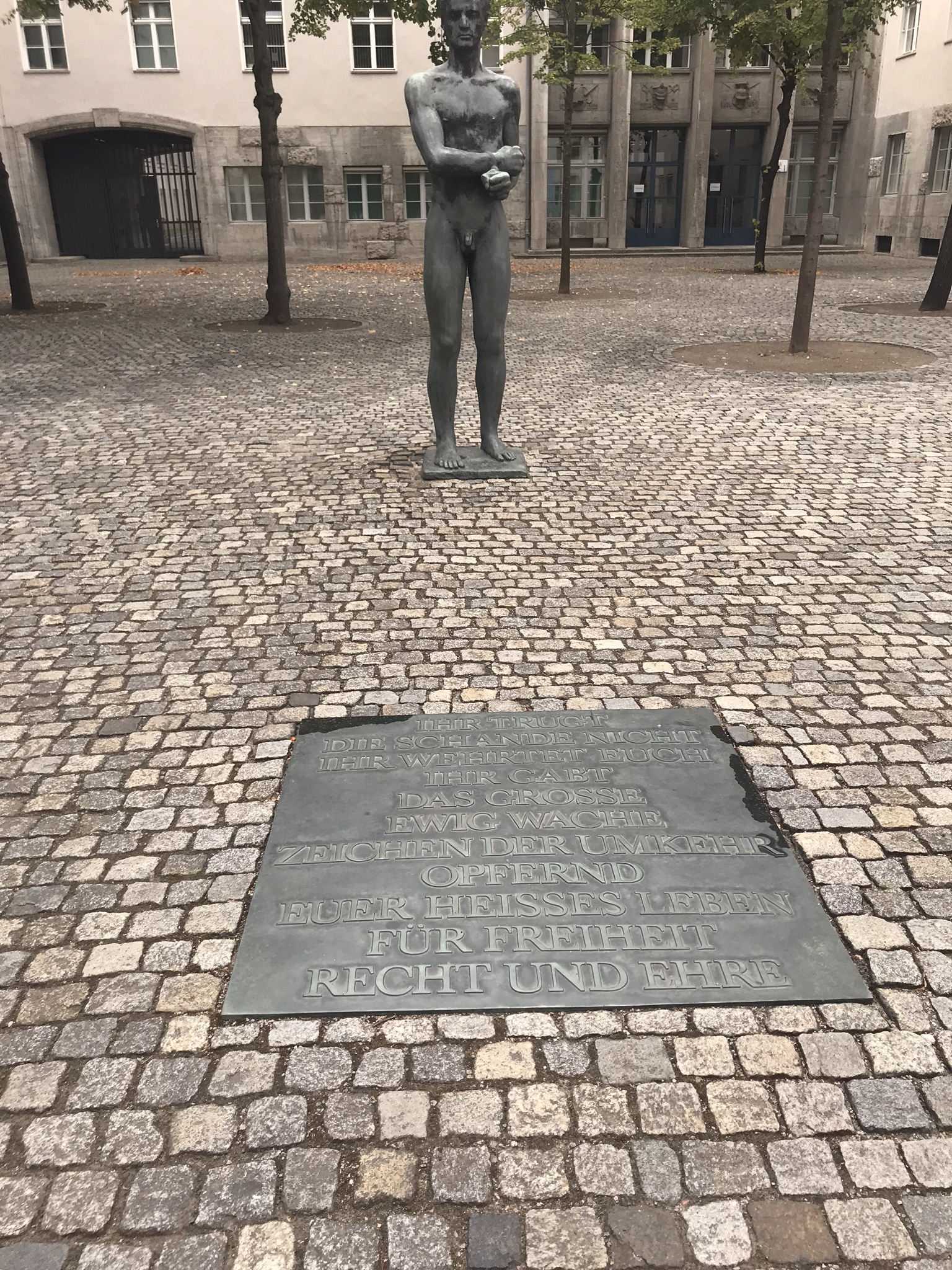
Resistance is Not Futile: Remembering the Men and Women of the German Resistance and Operation Valkyrie

 The Courtyard at Bendlerstraße Where Von Stauffenberg and others Were Executed

Friends of Padre Steve’s World,

July 20th holds many meanings and provides for inspiration for anyone who is human, with the exception of conspiracy theorists and deniers of history. Today we remember the 50th anniversary of the landing of the Landing Module Eagle of Apollo XI on the Moon. The success of the mission can be described as miraculous, a triumph of human achievement in an era of deep division. But twenty-five years to the day before the landing a few imperfect, yet courageous men and women dared to attempt the overthrow of Adolf Hitler and his genocidal Nazi regime.

Stauffenberg with Colonel Mertz von Quirnheim, another key Conspirator who was murdered with Stauffenberg when the Plot Failed 

The participants knew that if they failed they would be labeled as traitors, and they were right. Colonel Claus von Stauffenberg, who planted a bomb at Hitler’s East Prussian Headquarters was quite correct when he noted:

“I know that he who will act will go down in German history as a traitor; but he who can and does not, will be a traitor to his own conscience.” 

Another conspirator, Major General Henning Von Tresckow was even more blunt about their prospects.

“It is almost certain that we will fail. But how will future history judge the German people, if not even a handful of men had the courage to put an end to that criminal?”

The plot failed, Hitler lived. Stauffenberg, Tresckow, many of their immediate associates died. Eventually, thousands of people, many of whom only were guilty of association. The purge and executions of those connected with the plot would continue to Hitler’s death.

In the days we live we are witnessing our President using the same words and terminology to describe anyone who opposes him. He disrespects the Constitution, and the instructions that were designed by our founders to prevent the rise of a tyrant. His words, actions, and policies tend toward both racism and fascism; and they foster violence. The steady rise in White Nationalist and neo-Nazi groups, that the President has not condemned, as well as the number of open White Nationalist and neo-Nazi men running for office at the local and state level as Republicans show that Trump is not a casual anomaly in the GOP. The President, like it or not, has become the voice of White Nationalism, and the far right. Republican moderates for the most part have acquiesced to the new order. Even long time supporters like former Attorney General Jeff Sessions, hardly a man considered liberal, were ruthlessly jettisoned by the President.

There are times that resistance seems almost hopeless. I was talking with one of my friends who is very discouraged about the situation. He is an idealist. I spent much of the evening trying to buck him up.

British Historian Laurence Rees wrote:

“human behavior is fragile and unpredictable and often at the mercy of the situation. Every individual still, of course, has a choice as to how to behave, it’s just that for many people the situation is the key determinate in that choice.” 

We have to put an end to the Trump regime at the ballot box, or should Congress fulfill its Constitutional duties and begin impeachment hearings, regardless of whether a conviction is attained, he and his supporters have made statements that he may not give up power without a physical fight, that of course would bring about a Constitutional crisis and maybe civil war.

His former attorney, Michael Cohen has said exactly that. Trump is destroying the hard work of Americans and our allies to build a better would, and in almost every country, Trump is destroying the image and moral leadership of the United States. Patriotism requires that those committed to the ideals, institutions, and the laws of the country must resist when those are threatened, from inside or outside the country, and if they resist an elected President who shows no regard for those ideals, institutions, and laws, they will be labeled traitors.  Tresckow said in his time:

“We have to show the world that not all of us are like him. Otherwise, this will always be Hitler’s Germany.”

Henning von Tresckow 

Those are import words, but just substitute the name Trump for Hitler. Tresckow was no socialist or liberal, but he believed in freedom. In fact he wrote regarding the Prussian political tradition and how it could be subverted to support evil:

“The idea of freedom can never be disassociated from real Prussia. The real Prussian spirit means a synthesis between restraint and freedom, between voluntary subordination and conscientious leadership, between pride in oneself and consideration for others, between rigor and compassion. Unless a balance is kept between these qualities, the Prussian spirit is in danger of degenerating into soulless routine and narrow-minded dogmatism.”

Truthfully that is a spirit much like the United States that which is engulfing the United States today, soulless routine and narrow minded dogmatism. The tension that exists in the key ideal of the Declaration of Independence and the United States Constitution, and the words of Trump and his supporters men who desire to rule by fiat and by extra-Constitutional means, cannot be more marked than it is today.

In the movie adaptation of the plot to kill Hitler Valkyrie: Tresckow is quoted:

“God promised Abraham that he would not destroy Sodom if he could find ten righteous men… I have a feeling that for Germany it may come down to one.”

To be sure, Trump is no Hitler, though his words sound more and more Hitlerian every day. I will not call the President a Nazi, though he has give tacit support to Neo-Nazi and White Supremacist groups and frequently engages in racist diatribes. He is certainly acting as any authoritarian leader would, and we have to heed the warning of Russian dissident Gary Kasparov:

“dictators & would be autocrats do not ask “Why?” when it comes to using power for their advantage. They ask “why not?”

To go back to the words of Tresckow in Valkyrie, in noting it may come down to the actions of one man or woman, my friends, that “one” may come down to you or me. We cannot sit silently by as more and more actions that would have been considered as criminal in any other era of United States are perpetrated by the President and his followers.

It was not until the late 1960s that most Germans considered the men who attempted to kill Hitler heroes and not traitors. Those who criticize, and work through legal and constitutional means to oppose Trump are already being labeled by him, his supporters, and the right wing media machine based at Fox News as enemies of the state, traitors, and mislabeled as Socialists and Communists; an old tactic of the American Right since the Russian Revolution. The truth doesn’t matter, it’s simply a way to stake rage against fellow citizens.

At this time we still have recourse to the law, elections, and our institutions. How long that remains is another matter. Once Hitler took absolute power, most Germans found ways to make their peace with his regime and turn a blind eye even to its crimes.

I don’t know if Trump will ever attain such absolute power, but it is possible. In which case the equation will change. If that happens risk of risk of resistance will be so high that many will go silent and just try to get along. Even without that kind of threat most Republicans have already done that.

Sophie Scholl and Members of the White Rose in Munich Near the Ost Bahnhof in 1942

That is the real danger, when people who know better acquiesce for their own safety. Sophie Scholl, a 22 year old student at the University of Munich was part of a resistance movement called The White Rose. She and her friends, students and professors embarked on writing pamphlets to distribute throughout Germany to tell the truth about the evils of the Nazi regime. She wrote about this danger:

“The real damage is done by those millions who want to ‘survive.’ The honest men who just want to be left in peace. Those who don’t want their little lives disturbed by anything bigger than themselves. Those with no sides and no causes. Those who won’t take measure of their own strength, for fear of antagonizing their own weakness. Those who don’t like to make waves—or enemies. Those for whom freedom, honour, truth, and principles are only literature. Those who live small, mate small, die small. It’s the reductionist approach to life: if you keep it small, you’ll keep it under control. If you don’t make any noise, the bogeyman won’t find you. But it’s all an illusion, because they die too, those people who roll up their spirits into tiny little balls so as to be safe. Safe?! From what? Life is always on the edge of death; narrow streets lead to the same place as wide avenues, and a little candle burns itself out just like a flaming torch does. I choose my own way to burn.”

I have more to write on this but will close for the night.

So until tomorrow,

Peace,

Padre Steve+

2 Comments

Filed under ethics, History, holocaust, laws and legislation, leadership, Military, national security, nazi germany, News and current events, Political Commentary, racism, White nationalism

Where Will Trump and His Followers Thoughts, Words, and Actions Lead?

Friends of Padre Steve’s World,

Last night I wrote about the Racial Rubicon that President Trump and his followers at a rally crossed. It was sobering, because what I and others have said about him since the day he announced his candidacy was on full display. Trump had ignited the bonfire three days before by telling people to send four Congresswomen of color back to their country of origin. All are American citizens, three of the four born in the USA and one a naturalized citizen.

Never before has a sitting President opened the doors of racism so wide as President Trump, even James Buchanan and his work to tip the Supreme Court In the Dred Scott decision, and his attempt to overthrow the law by attempting to have Kansas admitted as a Slave State, an effort that was successfully opposed by Senator Stephan A. Douglas, Democrat from Illinois, a member of Buchanan’s own Party. Buchanan threatened him, but Douglas, otherwise not a friend of slaves held his ground and built a bi-partisan coalition in the House and Senate to defeat Buchanan. Unfortunately, there is no one like the late Senator from Illinois. Douglas paid the political price, though the Democratic nominee in 1860, the party split and in a second nominating convention nominated John C. Breckinridge, Splitting the party and bringing Abraham Lincoln to office.

So where does this lead? That is a question one of my readers asked on Twitter today. I wish that I knew. But I remember the words of Mahatma Gandhi:

“Your beliefs become your thoughts, Your thoughts become your words,

Your words become your actions, Your actions become your habits,

Your habits become your values, Your values become your destiny.”

I sincerely believe that Donald J. Trump is incapable of discerning truth from lies. He lies so much that it has become ingrained in his very soul. In regard to this aspect of Of Trump’s personality, I am reminded of the words of Adolf Hitler’s Finance Minister, Count Lutz Schwerin von Krosigk, who noted: “He wasn’t honest with his most intimate confidants…. In my opinion, he was so thoroughly untruthful that he could no longer recognize the difference between truth and lies.

Today the President attempted to pass the blame, and in effect through his chanting supporters under the bus, saying that “He did not like it, he did not agree with it,” but the problem is that he started it, he planted it through his tweets and statements in the days before. He reveled as the crowed chanted as he spoke against Representative Ilan Omar of Minnesota “Send her back, Send her back!” Representative Mark Walker, Republican from North Carolina (who I actually met and drank beer with in 2017 after the Congressional Baseball Game) immediately voiced his concern and consternation about the display, but very few other Republicans found anything to complain about. Senator Lindsey Graham blamed it on Trump’s narcissism, and the statements of Omar and the other Congresswomen, not racism, despite the decades of evidence demonstrating the latter.

Gandhi’s words are as true today as when he wrote them. Americans today have the choice of being, to use the words of Yehuda Bauer “The horror of the Holocaust is not that it deviated from human norms; the horror is that it didn’t. What happened may happen again, to others not necessarily Jews, perpetrated by others, not necessarily Germans. We are all possible victims, possible perpetrators, possible bystanders.” 

If you wonder how such events happen in a democracy, look no further than the words of Yale Historian Timothy Snyder:

“The European history of the twentieth century shows us that societies can break, democracies can fall, ethics can collapse, and ordinary men can find themselves standing over death pits with guns in their hands. It would serve us well today to understand why.”

The questions for all Americans today, will we be perpetrators, victims, or bystanders, or will ordinary Americans find themselves standing over death pits with guns in their hands.

Those are the questions after Trump and his followers actions over the past few days. Believe me, people I know, people I would have believed in ordinary times to be good and decent people are mocking those who criticize the President and making excuses for the illegal and immoral racist words and policies of his administration. For me that is frightening.

Where does it end? I leave that to you, but as a historian, ethicist, and Priest I have to say that if Trump remains in power by ballot or bullet, it will be something that will bring such shame to our country that generations from now our descendants will burdened with, just as the descendants of the Nazis. Sadly, we never did that with our Slave owners and those who brought about the Civil War, including my ancestors.

Until tomorrow,

Peace,

Padre Steve+

3 Comments

Filed under crime, ethics, History, holocaust, laws and legislation, leadership, nazi germany, News and current events, Political Commentary, racism, Religion

“Don’t Believe Him Anymore, He’s Telling the Truth: the Paradox Of Trump’s Lies and Racist Words and Actions

Friends of Padre Steve’s World,

Over the weekend in a series of tweets targeting female Democratic Party members of Congress, President Trump rekindled the subject of his racist and White Nationalist views, which he began the very day that he announced his candidacy for President. In his tweets he challenged their citizenship and told them that they should go home and fix the countries they came from. His tone was similar to when he referred to other countries as shit hole countries. The next day he doubled down on it and so did many of his Congressional, right wing media, and members of his White, Evangelical Christian base.

Likewise, over his first two and a half years the President has told over 8,000 direct lies or distortions of the truth, and regularly charges his critics with lying, fake news, or even treason. Back in 2015 I said that I believed that he was a racist, and I compared his words to those of the racist Know Nothings Of the 1830s to 1860s in a blog article back then.

Those words cost me friends, but I think that the President’s every tweet, word, and policy, as well as his actions have proven me right; from his announcement, to Charlottesville, to his immigration policies, to his “shit hole countries” remarks, to his tweets over the weekend, and remarks Monday. They were all bloody red meat which his followers swallowed hook line and sinker, especially White Evangelical Protestants who form a large part of his base.

The President’s racism is not not a new thing. In the 1990s when five black youths were falsely accused, charged and later acquitted of raping a woman jogger in New York’s Central Park, Trump took out newspaper adds urging their conviction and the use of the death penalty. One of his earliest ventures in the New York Real Estate market was in 1973  in which the Justice Department showed that he discriminated against minorities applying to live in his apartments. Trump settled out of court.

The President’s past anti-Semitic comments wreaked of Nazi comments in the Third Reich. His continued words and policies against non-White Christian immigrants before he was elected and since his election show all the evidence that he is an out and out racist. I would like to believe that such could not be true, but every action of his demonstrates it. The old saying that if it walks like a duck, swims like a duck, and quacks like a duck is most appropriate when dealing with the words, actions, tweets, and policies of this President, his administration, and his Party. Every day I see Republicans tweeting, writing, or saying that this is all President Obama’s fault, which is absolute bullshit.

If you asked me what the President could do to change my mind I would answer the following:

Stop lying. However, this is not possible because he honestly believes everything he says. He lies so much that he cannot tell truth from a lie. Most people understand when they are lying, even when they lie to protect someone from harm, but Trump cannot tell the difference. It’s habitual, and pathological, and his Party, supporters, and media accomplices let it happen. He was all in on the birther  conspiracy theories about President Obama, Hell, even the leaders of the Democrat controlled House of Representatives, and their so-called moderates struggle with accusing him of being a racist.

Second, the President could stop dividing Americans based on race or disagreement with his racial policies. He could easily stop his racist rants on Twitter or at his rallies if he did not personally believe them and revel in the adoration of his followers who pick up his chants.

As a historian it almost feels like the things I studied about the anti-immigrant Know Nothings, the ante-Bellum Slave Power South, Jim Crow, the treatment of almost every ethnic group which has ever arrived in the United States, to include the Irish, Germans, Italians, Poles, other Eastern Europeans, Arabs, Jews, Asians, including the internment of Japanese American citizens in World War Two, the treatment of others including Cubans, Haitians, and others fleeing political persecution or natural disasters. Please let’s not forget what how we treated the inhabitants of the country we took over in regard to Native Americans, Mexicans, and even the French.

Sure, we do have our better angels, but the history Of the United States demonstrates a clear, consistent, and unending history or racism, hatred of immigrants, especially those of darker skin, or non-Christian religions. Sadly, that racism is rising exponentially, in both extremist groups and in the mainstream of the GOP and White America. I can hardly believe what I am seeing. It reminds me of the very racist tenor of the busing debate in my home town back in 1974-75.

As far as the lying, I am reminded of the words of Adolf Hitler’s Finance Minister, Count Lutz Schwerin von Krosigk noted: “He wasn’t honest with his most intimate confidants…. In my opinion, he was so thoroughly untruthful that he could no longer recognize the difference between truth and lies. 

This very evening at one of his rallies Trump supporters began to chant “Send her back” in relation to U.S. Congresswoman Ilhan Omar, Democrat from Minnesota, a naturalized citizen whose parents fled war torn Somalia in the early 1990s. It sounded like a Nazi rally. Trust me, I have watched and listened to plenty of Nazi propaganda and seen just how the President uses the same type of language and gestures to goad his supporters into such behavior.

So my friends I will leave you with that to ponder. I think that the quote fits, and if he is not turned out of office that he will destroy the laws and institutions that made this country great.

And finally, this I hate to say, if after all of this someone still supports the President, they are most likely racist, and White Nationalist. Trump appeals not to the better angels of our nature, but the demonic nature, that which despises that Sacred Secular Scripture Of the Declaration “we hold these truths to be self-evident, that all men are created equal, and endowed by their creator with certain unalienable rights…” 

White Nationalists and Know Nothings hate those words and seek to limit them to themselves, as it appears that the President does. I don’t know them man, but his words and actions, past and current lead me to believe that there is no other answer to the paradox of Donald Trump.

So until tomorrow,

Peace,

Padre Steve+


4 Comments

Filed under civil war, ethics, faith, History, laws and legislation, leadership, News and current events, Political Commentary

The Disadvantages Of Belonging To Supposedly Inferior Races, Part Three: When Law is Opposed to Justice

Friends of Padre Steve’s World

Today the third of a multi-part installment of a section of my book “Mine Eyes Have Seen the Glory” Race, Religion, Ideology, and Politics in the Civil War Era which deals with American Slavery in the ante-bellum period. These next articles deal with the subject of what happens when laws are made that further restrict the liberty of already despised, or enslaved people. In this case the subject is the Compromise of 1850 and its associated laws such as the Fugitive Slave Act of 1850.

This is an uncomfortable period of history for Americans with either a sense of conscience, or those who believe the racist myths surrounding the “Noble South” and “The Lost Cause.”  I hope that you find them interesting, especially in light of current events in the United States.

In the light of two and a half years of racist remarks, policies, actions, and the tweets of President Trump, and members of the GOP, including the Governor Of Tennessee who proclaimed today a day to honor Confederate General Nathan Bedford Forrest who directed one of the most horrific massacres of the Civil War at Fort Pillow, and then after the war founded the original iteration of the Ku Klux Klan, terrorizing newly freed slaves and citizens in the Reconstruction Era demonstrate a return to unabashed racism. Of course that racism also spans the legal and economic spheres of life in our country. It always has. After this series has run I will write about that in some specifics. I want to take my time before I post. I want to make sure that every word I say is the truth and not unduly influenced by emotions or politics.

Today the House voted to condemn President Trump’s racist remarks about four freshmen, women of color Congresswomen. He questioned the citizenship, even though all are native born citizens and challenged them to “go back to their countries.” It is a comment that has been made about almost every immigrant who has ever came to this country; the Irish, the Germans, the Italians, the Poles, the Greeks, Russians, Chinese, Japanese, Arabs of all religions, not to mention people who lived in this country before we took it over, Native Americans, Mexicans, and even the French, and the men and women of African descent who were brought here against her will as slaves, and even after their emancipation are often treated as less than citizens, or even human.

So until tomorrow and where I finish this article or write about the incredibly racist words and behavior of the President and the majority of his Party.

Peace,

Padre Steve+

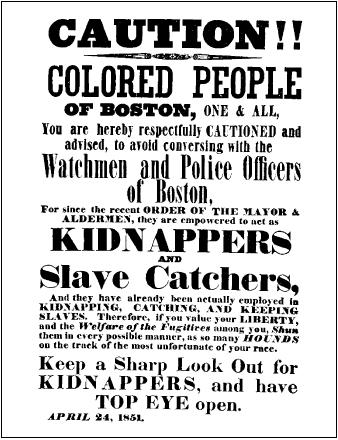
fugitive-slave-law

A Warning to Blacks in Boston regarding the Fugitive Slave Law

For all practical purposes the Compromise of 1850 and its associated legislation nationalized the institution of slavery, even in Free States. It did this by forcing all citizens to assist law enforcement in apprehending fugitive slaves. It also voided state laws in Massachusetts, Vermont, Ohio, Connecticut, Pennsylvania and Rhode Island, which barred state officials from aiding in the capture, arrest or imprisonment of fugitive slaves. “Congress’s law had nationalized slavery. No black person was safe on American soil. The old division of free state/slave state had vanished….” [3] If there was any question as to whose “States Rights” the leaders of the South were advocating, it was certainly not those of the states whose laws were voided by the act.

That law required all Federal law enforcement officials, even in non-slave states to arrest fugitive slaves and anyone who assisted them, and threatened law enforcement officials with punishment if they failed to enforce the law. The law stipulated that should “any marshal or deputy marshal refuse to receive such warrant, or other process, when tendered, or to use all proper means diligently to execute the same, he shall, on conviction thereof, be fined in the sum of one thousand dollars.” [4] In effect the law nullified state laws and forced individual citizens and local officials to help escaped slaves regardless of their own convictions, religious views, and state and local laws to the contrary.

Likewise the act compelled citizens in Free states to “aid and assist in the prompt and efficient execution of this law, whenever their services may be required….” [5] Penalties were harsh and financial incentives for compliance attractive.

“Anyone caught providing food and shelter to an escaped slave, assuming northern whites could discern who was a runaway, would be subject to a fine of one thousand dollars and six months in prison. The law also suspended habeas corpus and the right to trial by jury for captured blacks. Judges received a hundred dollars for every slave returned to his or her owner, providing a monetary incentive for jurists to rule in favor of slave catchers.” [6]

The law gave no protection for even black freedmen, who simply because of their race were often seized and returned to slavery. The legislation created a new extra-judicial bureaucratic office to decide the fate of blacks. This was the office of Federal Commissioner and it was purposely designed to favorably adjudicate the claims of slaveholders and their agents, and to avoid the normal Federal Court system. There was good reason for the slave power faction to place this in the law, many Federal courts located in Free States often denied the claims of slave holders, and that could not be permitted if slavery was to not only remain, but to grow with the westward expansion of the nation.

When slave owners or their agents went before these new appointed commissioners, they needed little in the way of proof to take a black back into captivity. The only proof or evidence other than the sworn statement by of the owner with an “affidavit from a slave-state court or by the testimony of white witnesses” [7] that a black was or had been his property was required to return any black to slavery. The affidavit was the only evidence required, even if it was false.

runaway

Since blacks could not testify on their own behalf and were denied legal representation before these commissioners, the act created an onerous extrajudicial process that defied imagination. Likewise, the commissioners had a strong a financial incentive to send blacks back to slavery, unlike normal courts the commissioners received a direct financial reward for returning blacks to slave owners. “If the commissioner decided against the claimant he would receive a fee of five dollars; if in favor ten. This provision, supposedly justified by the paper work needed to remand a fugitive to the South, became notorious among abolitionists as a bribe to commissioners.” [8] It was a system rigged to ensure that African Americans had no chance, and it imposed on the citizens of Free states the legal obligation to participate in a system that many wanted nothing to do with.

Douglass.JPG

                                                Frederick Douglass 

Frederick Douglass wrote about the new law in the most forceful terms:

“By an act of the American Congress…slavery has been nationalized in its most horrible and revolting form. By that act, Mason & Dixon’s line has been obliterated;…and the power to hold, hunt, and sell men, women, and children remains no longer a mere state institution, but is now an institution of the whole United States.” [9]

Douglass was correct as was demonstrated during an incident in Boston in 1854 where an escaped slave named Anthony Burns, who had purchased his freedom, was arrested under the Fugitive Slave Act. The arrest prompted a protest in which, “an urban mob – variously composed of free Negro laborers, radical Unitarian ministers, and others – gathered to free him. They stormed the Federal courthouse, which was surrounded by police and wrapped in protective chains….Amid the melee, one protestor shot and killed a police deputy.” [10] The heated opposition to Burns’ arrest provoked the passions of thousands of Bostonians who protested for his release that caused the Massachusetts governor to deploy two batteries of artillery outside the courthouse to deter any more attacks. When the Federal Fugitive Slave Law commissioner consigned Burns to his Southern owner, the prisoner placed in shackles and was marched down State Street. Tensions were now running extremely high and a “brigade of Massachusetts militia and local police were required to run Burns through a gauntlet and deposit him on the ship that would remand him to Virginia.” [11] Bostonians began to see their city as it was in the early days of the American Revolution, as a place that resisted tyranny. Neither did they did not forget Burns but raised the money to purchase his freedom. William Lloyd Garrison wrote, “the “deed of infamy… demonstrated as nothing else that “only “the military power of the United States” could sustain slavery.” [12] Nevertheless, Boston’s “mercantile elite had vindicated law and order” [13] but in the process they helped move so abolitionists who had been advocates of pacifism and non-violence to physical resistance to the bounty hunting Southerners. “Across the North, prisons were broken into, posses were disrupted, and juries refused to convict.” [14]

Violence between slave hunters and their protectors did break out in September 1851 when “a Maryland slave owner named Edward Gorsuch crossed into Pennsylvania in pursuit of four runaways.” [15] Gorsuch and his armed posse found them in the Quaker town of Christiana, where they were being sheltered by a free black named William Parker and along with about two dozen other black men armed with a collection of farm implements and a few muskets who vowed to resist capture. Several unarmed Quakers intervened and recommended that Gorsuch and his posse leave for their own sake, but Gorsuch told them “I will have my property, or go to hell.” [16] A fight then broke out in which Gorsuch was killed and his son seriously wounded, and the fugitives escaped through the Underground Railroad to Canada.

The Christiana Riot as it is called now became a national story. In the North it was celebrated as an act of resistance while it was decried with threats of secession in the South. President Millard Fillmore sent in troops and arrested a number of Quakers as well as more than thirty black men. “The trial turned into a test between two cultures: Southern versus Northern, slave versus free.”  [17] The men were charged with treason but the trial became a farce as the government’s case came apart. After a deliberation of just fifteen minutes, “the jury acquitted the first defendant, one of the Quakers, the government dropped the remaining indictments and decided not to press other charges.” [18] Southerners were outraged, and one young man whose name is forever linked with infamy never forgot. A teenager named John Wilkes Booth was a childhood friend of Gorsuch’s son Tommy. “The death of Tommy Gorsuch’s father touched the young Booth personally. While he would move on with his life, he would not forget what happened in Christiana.” [19]

The authors of the compromise had not expected such resistance to the laws. On his deathbed Henry Clay, who had worked his entire career to pass compromises in order to preserve the Union, praised the act, of which he wrote “The new fugitive slave law, I believe, kept the South in the Union in ‘fifty and ‘fifty-one. Not only does it deny fugitives trial by jury and the right to testify; it also imposes a fine and imprisonment upon any citizen found guilty of preventing a fugitive’s arrest…” Likewise Clay depreciated the Northern opposition and condemned the attempt to free Anthony Burns, noting “Yes, since the passage of the compromise, the abolitionists and free coloreds of the North have howled in protest and viciously assailed me, and twice in Boston there has been a failure to execute the law, which shocks and astounds me…. But such people belong to the lunatic fringe. The vast majority of Americans, North and South, support our handiwork, the great compromise that pulled the nation back from the brink.” [20] 

While the compromise had “averted a showdown over who would control the new western territories,” [21] it only delayed disunion. In arguing against the compromise South Carolina Senator John C. Calhoun realized that for Southerners it did not do enough to support the peculiar institution and that it would inspire Northern abolitionists to redouble their efforts to abolish slavery. Thus, Calhoun argued not just for the measures secured in the compromise legislation, but for the permanent protection of slavery:

“He understood that slavery stood at the heart of southern society, and that without a mechanism to protect it for all time, the Union’s days were numbered.” Almost prophetically he said “I fix its probable [breakup] within twelve years or three presidential terms…. The probability is it will explode in a presidential election.”  [22]

Of course it was Calhoun and not the authors of the compromise who proved correct. The leap into the abyss of disunion and civil war had only been temporarily avoided. However, none of the supporters anticipated what would occur in just six years when a “train of unexpected consequences would throw an entirely new light on the popular sovereignty doctrine, and both it and the Compromise of 1850 would be wreaked with the stroke of a single judicial pen.” [23]

To be continued…

                                                           Notes

[1] Ibid. Guelzo Fateful Lightning pp.62-63

[2] Ibid. Guelzo Fateful Lightning p.68

[3] Ibid. Goldfield  America Aflame p.71

[4] ______________Fugitive Slave Act of 1850 retrieved from the Avalon Project, Yale School of Law http://avalon.law.yale.edu/19th_century/fugitive.asp 11 December 2014

[5] Ibid. Fugitive Slave Act of 1850

[6] Ibid. Goldfield America Aflame p.71

[7] Ibid. McPherson The Battle Cry of Freedom  p.80

[8] Ibid. McPherson The Battle Cry of Freedom p.80

[9] Ibid. Goldfield America Aflame p.72

[10] Goodheart, Adam 1861: The Civil War Awakening Vintage Books a division of Random House, New York 2011 p.42

[11] Ibid. Varon Disunion! The Coming of the American Civil War 1789-1858 p.241

[12] Mayer, Henry All on Fire: William Lloyd Garrison and the Abolition of Slavery W.W. Norton and Company, New York and London 1998 p.442

[13] Ibid. McPherson The Battle Cry of Freedom p.84

[14] Ibid. Guelzo Fateful Lightning p.73

[15] Ibid. Guelzo Fateful Lightning p.73

[16] Ibid. McPherson The Battle Cry of Freedom p.84

[17] Steers, Edward Jr. Blood on the Moon: The Assassination of Abraham Lincoln The University of Kentucky Press, Lexington 2001 p.33

[18] Ibid. McPherson The Battle Cry of Freedom p.85

[19] Ibid. Steers  Blood on the Moon: The Assassination of Abraham Lincoln p.33

[20] Oates, Stephen B. Editor The Approaching Fury: Voices of the Storm, 1820-1861 University of Nebraska Press, Lincoln and London 1997 p.94

[21] Ibid. Guelzo Fateful Lightning p.71

[22] Ibid. Goldfield America Aflame p.64

[23] Ibid. Guelzo Fateful Lightning p.71

3 Comments

Filed under civil rights, civil war, economics and financial policy, ethics, History, laws and legislation, leadership, News and current events, Political Commentary, racism

The Disadvantage Of Belonging to so called Inferior Races: Race and Slavery in Ante-Bellum America

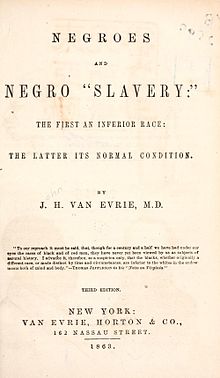
negroes_and_negro_-slavery

Friends of Padre Steve’s World

I am tired after working in the house most of the weekend and providing some help to a friend who has fallen on hard times. The good thing is that I am finally really responding well to my aquatic physical therapy and the gel injections in my knees. The damage to both is still there, but my pain levels in both knees have gone from a continuous 7-10 on the pain scale to a livable 2-5. I get my final  set of injections tomorrow morning after aquatic PT. If my recovery progresses as it has I should be, able to do much more than I am now, which is a hell of a lot more than a month ago when I was walking with the aid of a cane or crutches.

So today, and for the next couple of days  I’m posting sections my book “Mine Eyes Have Seen the Glory” Race, Religion, Ideology and Politics in the Civil War Era”  dealing with American Slavery in the ante-bellum period. I will do so again the next two days as I continue to catch up on things needed in the house that I couldn’t do for 10 months. Thankfully, my friend who was helping he with laying down our floors last summer after our upstairs flood is helping me to wrap that up and give me advice that will help us sell our house so we can get a ranch house without all the steps that we have to navigate now. Honestly, when you purchase a house with lots of steps in your mid-40s you don’t think about the ravages of time and what happens to your knees. This past year Judy has had both of her knees replaced, I have had a failed meniscus surgery on my left knee and failed injection treatments on my right knee. I am finally getting better. She is on the road to recovery but still suffering a lot of pain.

These next articles deal with the subject of what happens when laws are made that further restrict the liberty of already despised, or enslaved people. In this case the subject is the Compromise of 1850 and its associated laws such as the Fugitive Slave Act of 1850.

This is an uncomfortable period of history for Americans with either a sense of conscience, or those who believe the racist myths surrounding the “Noble South” and “The Lost Cause.”  I hope that you find them interesting, especially in light of current events in the United States as many of the same attitudes and justifications are being used in order to justify discrimination and even violence against immigrants and citizens of darker skin colors. President Trump’s Tweets today about non-white female Congress members shows that the sentiment that justified the enslavement American Blacks and slaves is still alive and well.  As Mark Twain noted, “history does not repeat itself but it does rhyme.” 

Peace,

Padre Steve+

                                               The Background 

The ante-bellum South was an agrarian society that depended on the free labor provided by slaves. In a socio-political sense the South was an oligarchy that offered no freedom to slaves, openly discriminated against free blacks and provided little hope of social or economic advancement for poor and middle class whites.  However, despite this, even poor whites supported it.  Many Southern Yeoman farmers were willing to tolerate their second class status because they: “feared the fall from independent producer to dependent proletarian, a status he equated with enslavement” [1] more than remaining subservient to planters and plantation owners. In fact, for them slavery was the one institution that kept them above the despised black.

In 1861, Dr. J.H. Van Evrie, promoted the scientific racist of ichthyologist Louis Agassiz in a pamphlet entitled “Negroes and Negro Slavery;” The First an Inferior Race – The Latter, Its Normal Condition” expressed how most Southerners felt about African Americans be they slave or free, and Jefferson Davis hoped that Van Evrie’s arguments would persuade people to adopt the view that racial equality was a fallacy which could not be tolerated, Van Evrie wrote:

“He is not a black white man, or merely a man with a black skin, but a DIFFERENT AND INFERIOR SPECIES OF MAN; – that this difference is radical and total… that so called slavery is neither a “wrong” nor an “evil, but a natural relation based upon the “higher law,” in harmony with the order, progress, and general well-being of the superior one, and absolutely in keeping with the existence of the inferior race.”  [2]

While all Northern states had abolished slavery, or were in the process of gradual abolition in the after independence and the Civil War and had moved to an economic concept of free labor, the South had tied its economy and society to the institution of slavery. The contrast was well said by the members of an Alabama agricultural society, which noted in 1846:

“Our condition is quite different from that of the non-slaveholding section of the United States. With them their only property consists of lands, cattle and planting implements. Their laborers are merely hirelings, while with us our laborers are our property.” [3]

Van Evrie was not the only person making such distinction between the races. Dr. Samuel Cartwright wove the pseudo-science of the day into the narrative of the Bible, noting:

“I have thus hastily and imperfectly noticed some of the more striking anatomical and physiological peculiarities of the Negro race. The question may be asked, Does he belong to the same race as the white man? Is he a son of Adam? Does his particular physical confirmation stand in opposition to the Bible, or does it prove its truth?… Anatomy and physiology have been interrogated, and the response is, that the Ethiopian, or Canaanite, is unfitted for the duties of a free man….” [4]

He also noted:

“The Declaration of Independence, which was drawn up at a time when negroes were scarcely regarded as human beings, “That all men are by nature free and equal,” was only intended to apply to white men…” [5]

Northerners on the other hand, even in states where the last vestiges of slavery held on, nearly universally ascribed to the understanding that there was a dignity to labor and that free labor was essential if people were to have a better life. It undergirded their understanding of human dignity and that “labor was the source of all value.” [6]

That understanding of the intrinsic value of free labor continued to gain ground in the North in the decades preceding the Civil War and found much of its support in the Calvinist theology that predominated in most Protestant Northern denominations. Labor was intrinsic to one’s calling as a Christian and a human being, slave labor, at least in the eyes of many Northerners undercut that idea. Success in one’s calling glorified God and provided earthly evidence that a person was among the elect. For many Northern Christians, “the pursuit of wealth thus became a way of serving God on earth, and labor, which had been imposed on fallen man as a curse, was transmuted into a religious value, a Christian calling.” [7]  Such ideas found their way into Republican political thought even when not directly related to religion.  William Evarts said in 1856 “Labor gentlemen, we of the free States acknowledge to be the source of all of our wealth, of all our progress, of all our dignity and value.” [8] Abraham Lincoln noted that “the free labor system…opens the way for all, and energy and progress, and improvement in condition for all,” [9] and Lincoln also noted something inherent in the economic theory of Adam Smith that Labor is prior to, and independent of capital…in fact, capital is the fruit of labor.” [10]

However, the South by the 1830s had completely wedded itself to slavery and southern advocates of slavery deplored the free-labor movement as wage slavery and extolled the virtue of slavery. James H. Hammond condemned the free-labor movement in his King Cotton speech to the Senate in 1858:

“In all social systems there must be a class to do the menial duties, to perform the drudgery of life…. It constitutes the very mudsill of society….Such a class you must have, or you would not have that other that leads to progress, civilization and refinement….Your whole hireling class of manual laborers and ‘operatives,’ as you call them, are essentially slaves. The difference between us is, that our slaves are hired for life and well compensated…yours are hired by the day, not cared for, and scantily compensated.” [11]

Even so, the fact that the slave barons “were forced at every election to solicit the votes of “ignorant, slovenly, white trash in the country” with “frequent treats that disgrace our elections,” [12] rankled and humiliated many members of the Southern aristocracy. It was a marriage of two disparate parties linked by their membership in a superior race, something that only the continued existence of slavery ensured.

Lincoln extolled the virtues of free-labor, noting his own experiences after his election: “I am not ashamed to confess that twenty five years ago I was a hired laborer, mauling rails, at work on a flat boat – just what might happen to any poor man’s son.”  [13] Other Northerners lauded free-labor as the basis of upward mobility, and the New York Times noted that “Our paupers to-day, thanks to free labor, are our yeomen and merchants of tomorrow.” [14]

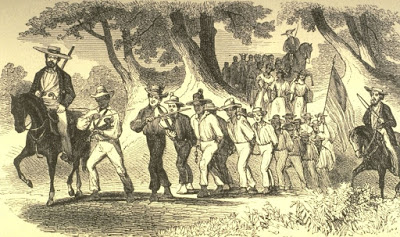
slave-coffle2

                                                       Slave Coffle

But whites in the South held labor in contempt due to the system of slavery, and the divergent views of each side were noted by Thomas Ewing who noted that labor “is held honorable by all on one side of the line because it is the vocation of freedmen – degrading in the eyes of some on the other side because it is the task of slaves.” [15] Of course with labor being the task of African slaves for southerners, the issue was entwined with race, and “Even if slavery was wrong, its wrongs were cancelled out for nonslaveholders by the more monstrous specter of racial equity.”  [16]

Georgia Governor Joseph E. Brown emphasized the threat to whites in that blacks would be their social equals and competitors should slavery end. The racial component assured poor southern whites that they were superior to blacks and an Alabama lawyer wrote “The privilege of belonging to the superior race and being free was a bond that tied all Southern whites together… and it seemed from a Southern stand-point, to have for its purpose the leveling of all distinctions between the white man and the slave hard by.” [17] But poor white workers who remained in the South “repeatedly complained about having to compete with slaves as well as poorly paid free blacks” [18] leading many to seek a new livelihood in either Free States or the new territories.

For Southern politicians and slaveholders, the expansion of slavery was essential to its continued maintenance in the states where it was already legal. “Because of the need to maintain a balance in the Senate, check unruly slaves, and cultivate fertile soils, many planters and small plantation owners- particularly those living in the southern districts of the cotton states- asserted that their survival depended on new territory.” [19] In those decades “a huge involuntary migration took place. Between 800,000 and 1 million slaves were moved westward….” [20]

The need for slaves caused prices to soar, largely due to the ban on the import of slaves from Africa. This made the interregional trade much more important and linked the upper and lower south as well as the new slave-holding territories into “a regionwide slave market that tied together all of the various slaveowning interests into a common economic concern.” [21] In some older states like Virginia where fewer slaves were required, the exportation of slaves became a major industry:

“male slaves were marched in coffles of forty or fifty, handcuffed to each other in pairs, with a long chain through the handcuffs passing down the column to keep it together, closely guarded by mounted slave traders followed by an equal number of female slaves and their children. Most of them were taken to Wheeling, Virginia, the “busiest slave port” in the United States, and from there they were transported by steamboat to New Orleans, Natchez, and Memphis.”[22]

To be continued…

Notes

[1] Ibid. McPherson Drawn With Sword p.50

[2] Van Evrie, J.H. “Negroes and Negro Slavery;” The First an Inferior Race – The Latter, Its Normal Condition 1861 in The Confederate and Neo-Confederate ReaderThe Great Truth about the Lost Cause, Loewen, James W. And Sebesta, Edward H. Editors, University Press of Mississippi, Jackson, 2010 p.75

[3] Ibid. Levine Half Slave and Half Free p.19

[4] Cartwright, Samuel A. Diseases and Peculiarities of the negro Race, 1851 in Loewen, James W and Sebesta, Edward H. The Confederate and Neo-Confederate reader: The Great Truth about the Lost Cause University of Mississippi Press, Jackson 2010 p.66

[5] Ibid. Cartwright Diseases and Peculiarities of the negro Race, 1851 p.70

[6] Foner, Eric Free Soil, Free Labor, Free Men: The Ideology of the Republican Party Before the Civil War Oxford University Press, Oxford and New York 1970 and 1995 p.7

[7] Ibid. Foner Free Soil, Free Labor, Free Men pp.12-13

[8] Ibid. Foner Free Soil, Free Labor, Free Men p.12

[9] Ibid. McPherson The Battle Cry of Freedom: The Civil War Era p.28

[10] Ibid. Foner Free Soil, Free Labor, Free Men p.12

[11] Ibid. McPherson The Battle Cry of Freedom p.196

[12] Ibid. Guelzo Fateful Lightening p.38

[13] Ibid. McPherson The Battle Cry of Freedom p.28

[14] Ibid. Foner Free Soil, Free Labor, Free Men p.16

[15] Ibid. Foner Free Soil, Free Labor, Free Men p.16

[16] Ibid. Guelzo Fateful Lightening p.38

[17] Ibid. Guelzo Fateful Lightening p.39

[18] Ibid. Levine Half Slave and Half Free p.44

[19] Ibid. Egnal  Clash of Extremes pp.125-126

[20] Korda, Michael. Clouds of Glory: The Life and Legend of Robert E. Lee Harper Collins Publishers, New York 2014 p.203

[21] Deyle, Steven The Domestic Slave Trade in Major Problems in the Civil War and Reconstruction Documents and Essays Third Edition edited by Michael Perman and Amy Murrell Taylor Wadsworth Cengage Learning Boston MA 2011 p.53

[22] Ibid. Korda Clouds of Glory: The Life and Legend of Robert E. Lee  p.203

Leave a comment

Filed under civil rights, civil war, ethics, History, laws and legislation, News and current events, Political Commentary, racism

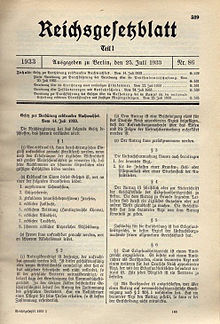
Eliminating Political Opposition and Laws Enabling Crimes Against Humanity: Germany July 14th 1933

Friends of Padre Steve’s World,

On July 14th 1933 two laws were passed by the Nazi led government, less than five and a half months after Hitler’s legal accession to power, and four and a half months after he, under the Weimar Constitution’s Article 48 seized power following the Reichstag Fire. 

One law, under the policy of Gleichschaltung (coordination) all political parties other than the Nazi Party were prohibited. The Parties of the Right and Center voluntarily dissolved themselves, the Communists had already been made illegal and their surviving leaders went underground. The Social Democrats resisted until the end, but were banned.

The second law, was much easier to enforce without official political parties to oppose it was much more drastic. It did not only deny people their political rights, it determined that some people were life unworthy of life and people who could not be allowed to reproduce and would be sterilized in order to purify the the Aryan race. That law was called Gesetz zur Verhütung erbkranken Nachwuchses or the Law for the Prevention of Genetically Diseased Offspring. 

It read:

The Reich government has passed the following law, which is hereby promulgated:

§ 1.  Anyone suffering from a hereditary disease can be sterilized by a surgical operation if, according to the experience of medical science, there is a high probability that his offspring will suffer from serious physical or mental defects of a hereditary nature.
Anyone suffering from any of the following diseases is considered hereditarily diseased under this law:

1. Congenital mental deficiency

2. Schizophrenia

3. Manic-depression

4. Hereditary epilepsy

5. Hereditary St. Vitus’ Dance (Huntington’s Chorea)

6. Hereditary blindness

7. Hereditary deafness

8. Serious hereditary physical deformity.

Furthermore, anyone suffering from chronic alcoholism can be sterilized.

§ 2.  Applications for sterilization can be made by the individual to be sterilized. If this person is legally incompetent, has been certified on account of mental deficiency, or is not yet 18, a legal representative has the right to make an application on this person’s behalf but needs the consent of the court of guardians to do so. In other cases of limited competency, the application needs to be approved by the legal representative. [ . . . ]

§ 3.  Sterilization can also be requested by the following: 1. the state physician. 2. In the case of inmates of hospitals, nursing homes, and penal institutions, by the head thereof.

§ 4.  The application is to be made to the office of the Eugenics Court; it can either be made in writing or dictated to the court. The facts upon which the application is based should be supported by a medical certificate or confirmed in some other way. The office must inform the state physician of the application.

§ 5.   Responsibility for the decision rests with the Eugenics Court that has jurisdiction over the district in which the person to be sterilized officially resides.

§ 6.  The Eugenics Court is to be attached to a district court [Amtsgericht]. It consists of a district court judge acting as chairman, a state physician, and another physician certified by the German Reich and particularly well trained in eugenics…

§12. Once the Court has decided on sterilization, the operation must be carried out even against the will of the person to be sterilized, unless that person applied for it himself. The state physician has to attend to the necessary measures with the police authorities. Where other measures are insufficient, direct force may be used.

This law comes into effect on January 1, 1934.
Berlin, July 14, 1933.


The Reich Chancellor
Adolf Hitler

The Reich Minister of the Interior
Frick

The Reich Minister of Justice
Dr. Gürtner

During the first year of the law over 64,000 people were forcibly sterilized. During the course of the Reich’s existence over 400,000 people were forcibly sterilized. Fewer than 1% of those who appealed the decision for sterilization gained a reprieve. The law was the first in a series of laws and policy decisions that would lead to the Holocaust. 

Many of the Eugenics laws in the Third Reich modeled themselves on Eugenics laws in many American States, as well as the studies of well know American, and English Eugenicists Of the time, men who approved of the German laws when they were published.

In our own country there are those who want to deny care and insurance for care for people whose conditions are considered a drain on the economy, and while there is a strong political lobby opposed to abortion, most of those allegedly pro-life people and politicians seem to care about the health and quality of life once it emerges from the womb. The law Hitler signed forbade the abortion of Aryan fetuses, but allowed for the abortions of fetuses who might be less than perfect or require expensive medical care to maintain.

With the systematic devaluation of life in this country based on the economic value of people, and the very obvious belief that the lives of racial and certain religious minorities as not having the same value as Americans of European descent. While some would like to believe that a problem isolated to the radical right wing backers of President Trump, there are places where well off white liberals and progressives attempt to insulate themselves from racial and religious minorities.

Irregardless of the seeming contempt for well off white liberals and progressives For the lives and circumstances of minorities so long as they are not their neighbors, the greater threat to life is the political and economic ideology of so called conservatives that devalues life to its economic and racial benefit; the same kind of people who support President Trump’s racial, economic, and medical policies. The same people who espouse explicitly racist views, and whose leader calls his opponents, be they political, educational, or those who dare to criticize him in the media as “enemies of the state.”  The only thing keeping the President and his followers total control is the fact that our constitutional institutions are barely holding and there has been no crisis such as the Reichstag Fire a terrorist event, a Major War to suspend the Constitution and to enable the Executive Branch to take total control of the country, possibly ban political opposition, and freedom of speech and association.

That is what I worry about. Once the basic freedoms under the Constitution are abrogated, once citizens are determined to be enemies of the state then it is possible for that same executive branch to pass laws laws by decree that suspend the liberties, or take the lives of those deem life unworthy of life.

So until tomorrow,

Peace

Padre Steve+


1 Comment

Filed under economics and financial policy, ethics, healthcare, History, holocaust, laws and legislation, nazi germany, News and current events, Political Commentary

To Kill a Mockingbird at 59: Sometimes the Bible in the Hand Of One Man is Worse than a Whiskey Bottle in the Hand Of Another

mock

Friends of Padre Steve’s World,

Tomorrow marks the 59th the anniversary of the release of Harper Lee’s classic novel To Kill a Mockingbird. I have read the book, and seen the film many times. Sadly, it is all too relevant in our time. Race hatred and a belief in the absolutes of aberrant forms of Christianity which bless White Racism are rampant in the United States and Europe, many of these groups are overtly Fascist and Authoritarian.

That alone is to make the novel and the film worth reading and watching, especially if you haven’t read the book or seen the film.

Sadly, such people would “kill the Mockingbird” to ensure that they keep their privileged position in society. The Mockingbirds are those that they have condemned to social inferiority and discrimination and eternal punishment, especially gays and the LGBT community, but others as well.

This is especially the case of the preachers, pundits and politicians that crowd the airwaves and internet with their pronouncements against Gays, immigrants, Arabs, poor blacks, political liberals, progressive Christians, and for that matter anyone who simply wants the same rights enjoyed by these Christians.

In the book there is a line spoken by Miss Maudie Atkinson, a neighbor of Atticus Finch and his children. She says to Atticus’s daughter Scout:

“Sometimes the Bible in the hand of one man is worse than a whisky bottle in the hand of another… There are just some kind of men who – who’re so busy worrying about the next world they’ve never learned to live in this one, and you can look down the street and see the results.”

As I survey the world of Christian conservatives I become surer of this every day. I’ve often wrote about my own fears in regard to dealing with such people as well as the troubling trends that I see. Last week I wrote five articles on the trends that I see in the church, trends toward greed, political power, social isolation and the active campaign of some to deny basic civil rights to people that they hate on purely religious grounds.

The language of some like Matt Staver of Liberty Counsel, Tony Perkins of the American Family Association and a host of others describe actions of governments and courts to ensure equal treatment of all people under the law as threats to Christians, affronts to them and of course to God. Their words are chilling. Matt Staver commented a few years back that if the Supreme Court upheld marriage equity for gays that it would be like the Dred Scott decision. Of course that is one of the most Orwellian statements I have ever heard, for the Dred Scott decision rolled back the few rights that blacks had anywhere in the country and crushed the rights of people in non-slave states.

Again, as a reminder to readers, especially those new to the site, I spent a large amount of my adult Christian life in that conservative Evangelical cocoon. I worked for a prominent television evangelist for several years, a man who has become an extreme spokesman for the religious political right. I know what goes on in such ministries, I know what goes on in such churches. I know the intolerance and the cold hearted political nature of the beast. I know and have gone to church with Randall Terry, the former head Operation Rescue who once said: “Let a wave of intolerance wash over you. I want you to let a wave of hatred wash over you. Yes, hate is good…” I have walked in those shoes, I have been whipped up by those preachers. I fully understand them, and because I do I am in a unique position to critique their words and actions, especially as the supposedly moral majority snuggle up with one of the most amoral men ever to become President, solely to protect and crease their political power. They have surrendered their claim to being a party of morality, and embraced evil for the sake of their power. Without empathy, they judge and condemn others not like them. They are incapable of understanding anything that conflicts with their visions of White Power, racial superiority, and an interpretation of Christianity which needs state support in order to survive.

As Atticus Finch told his children:

“You never really understand a person until you consider things from his point of view… Until you climb inside of his skin and walk around in it.”

They cannot, thus I total reject the message of such people now, not out of ignorance, but because I have walked in their shoes. At times I supported their causes, not to any extreme, but all too often my crime was simply said nothing when I knew that what they preached, taught and lived was not at all Christian, but from the pits of Hell.

As far as them being entitled to hold whatever opinion they want, even if I disagree, yes that is their right. But as Atticus said:

“People are certainly entitled to think that I’m wrong, and they are entitled to full respect for their opinions. But before I can live with other folks I’ve got to live with myself. The only thing that doesn’t abide by majority rule is a person’s conscience.”

My conscience will not allow me to be silent when I see men like Staver, Perkins, Franklin Graham, Robert Jeffress, Pat Robertson, and so many others preach hatred towards those who are different than them. Their reach and power has only increased with their support of President Trump.

In the movie and the book the Mockingbirds were Tom Robinson, the black man falsely accused of rape and assault and Boo Radley, a shy recluse feared by his neighbors, a man who stories were made up about; stories that turned a simple man into a monster in the eyes of people who did not know him. Today they are others who fit the Mockingbird role, people who just want to get along and live in peace, but who endure discrimination and damnation from those who call themselves Conservative Christians.

Jem Finch, the son of Atticus asks his sister a question in the book and the film:

“If there’s just one kind of folks, why can’t they get along with each other? If they’re all alike, why do they go out of their way to despise each other?”

I ask the same question on a daily basis.

So until tomorrow I wish you a good night.

Peace

Padre Steve+

4 Comments

Filed under books, christian life, civil rights, ethics, faith, film, History, LGBT issues, movies, News and current events, Political Commentary

“Fanaticism and Ignorance is Forever Busy” The Scopes Monkey Trial at 94Years, and Inherit the Wind

donald-trump-prays-with-religious-leaders

Friends of Padre Steve’s World,

“As long as the prerequisite for that shining paradise is ignorance, bigotry and hate, I say the hell with it.” Henry Drummond (Spencer Tracy) Inherit the Wind

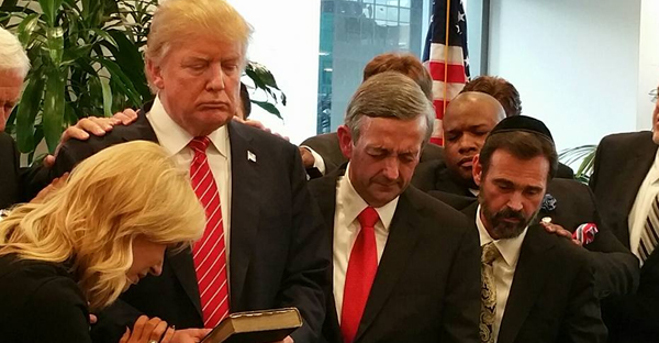
Tomorrow is the 84th Anniversary of the beginning of what became known as the Scopes Monkey Trial which was dramatized in the 1960 film Inherit the Wind. I really do believe that it is well worth watching, especially when a charlatan like Donald Trump, a man with no Christian virtues whatsoever stokes up the hopes of conservative Christians by catering to his base of Conservative Christians who hang on his every word, like a cult, believing that he, through the police power of the state will Christianity great again.

Of course the Christianity that Trump and his followers refers to is not that of Jesus, but that of Constantine and every other strongman who has used the Christians and the church to achieve earthly power and to crush any opposition. Noted televangelists have come to Trump’s side, many like John Hagee saying that Christians that God will punish Christians, that vote against Trump. That is why this film is still so pertinent.

It is fascinating that a play and film set about an incident that actually occurred in the 1920s remains so timeless. It is hard to believe that 90 years after the trial and over 50 years after the movie that our society would still be debating the issue in the movie and that legislatures and school boards are still attempting to pass religious doctrine off as science.

inherit-the-wind

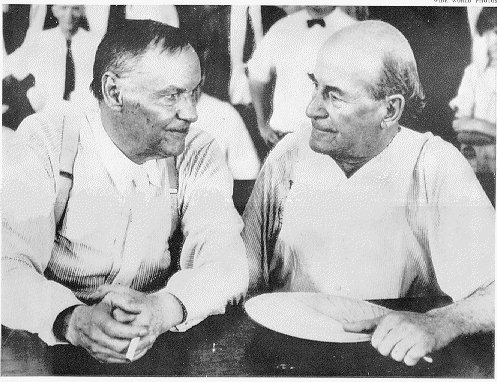
It is a film about what is commonly called the “Scopes Monkey Trial” which was litigated in July of 1925 and featured an epic battle between populist three time Presidential Candidate and former Secretary of State William Jennings Bryan and famed defense attorney Clarence Darrow. The film is not completely historically accurate. It was adapted from a play by the same name. It came out following the hysteria of the McCarthy Era, when people were condemned and blacklisted for their freedom of speech, association; frequently on the basis of false testimony against them. However, the film captures the blind hatred of religious bigots the willingly ignorant who object to any belief or theory that threatens their superior position in society.

The trial was brought about after the passage of the Butler Act in Tennessee. It was an act that made it a criminal offense to teach evolution in any publicly funded school. The act stipulated:

“That it shall be unlawful for any teacher in any of the Universities, Normals and all other public schools of the State which are supported in whole or in part by the public school funds of the State, to teach any theory that denies the story of the Divine Creation of man as taught in the Bible, and to teach instead that man has descended from a lower order of animals.”

The author of the act was Tennessee State Representative John W. Butler, a farmer and the head of the World Christian Fundamentals Association an interdenominational organization dedicated to a “New Protestantism” based on the Pre-Millennial interpretation of Bible prophecy.

itw2

Butler was heavily influenced by William Jennings Bryant who with his followers had gotten legislation banning evolution in 15 states. H.L. Mencken commented that over the years of his public life that Bryant, who had been a progressive advocate had “transformed himself” into some “sort of Fundamentalist Pope.”

Butler was opposed to the teaching of evolution and the act passed the house by a vote of 75-1. No public hearings had been held on it and no debate proffered.

Butler’s legislation did face some opposition in the State Senate. However it passed there on a vote of 24-6 after the famous Fundamentalist evangelist Billy Sunday preached as series of revival meetings to incite public opinion in favor of the bill. Sunday’s message was clear, he preached that “Education today is chained to the Devil’s throne” and praised Butler and the House for their “action against that God forsaken gang of evolutionary cutthroats.” The bill was signed into law by Governor Austin Peay, but Peay expected little to come of it.

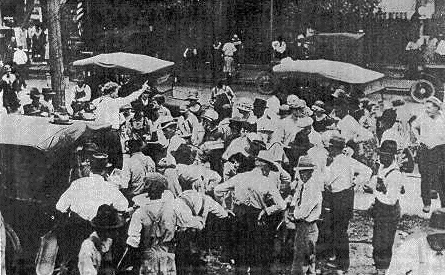
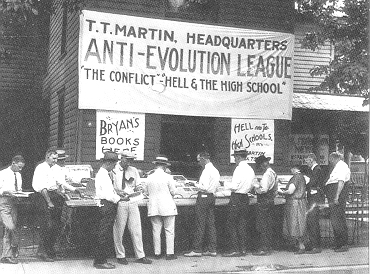
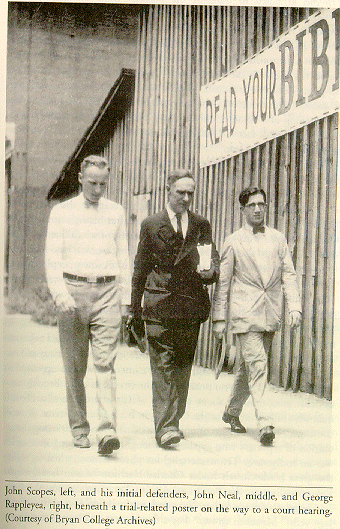
The American Civil Liberties Union put the law to the test using high school biology teacher John Scopes who was charged with breaking the law. The trial ended up becoming less about the guilt or innocence of Scopes or even the constitutionality of the law, but rather as the field where the conflict between religious and social issues and faith versus intellectualism was fought. Butler, the man who legislated the law on religious grounds covered it as a correspondent.

daytonscene

Mencken wrote of the trial:

“The Scopes trial, from the start, has been carried on in a manner exactly fitted to the anti- evolution law and the simian imbecility under it. There hasn’t been the slightest pretense to decorum. The rustic judge, a candidate for re-election, has postured the yokels like a clown in a ten-cent side show, and almost every word he has uttered has been an undisguised appeal to their prejudices and superstitions. The chief prosecuting attorney, beginning like a competent lawyer and a man of self-respect, ended like a convert at a Billy Sunday revival. It fell to him, finally, to make a clear and astounding statement of theory of justice prevailing under fundamentalism. What he said, in brief, was that a man accused of infidelity had no rights whatever under Tennessee law…”

It was an epic event covered by news outlets across the nation and the atmosphere in the town outside the courthouse was circus like, something that the movie depicts very well. The defense was not allowed to produce Scientists as witnesses, even to the chagrin of Butler who despite his opposition to evolutionary theory felt that it was not fair. When all was said and done Scopes had been convicted and a fine of $100 assessed, which was overturned on appeal. Bryan died a week after the trial and of the 15 states with similar legislation to Butler passed them into law.

SCO_EVOL

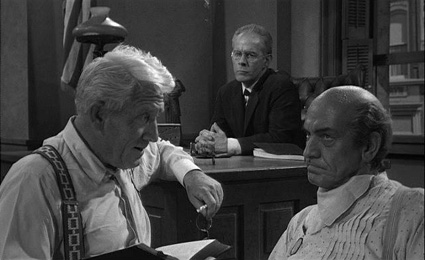
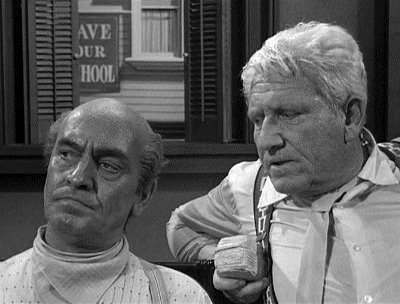
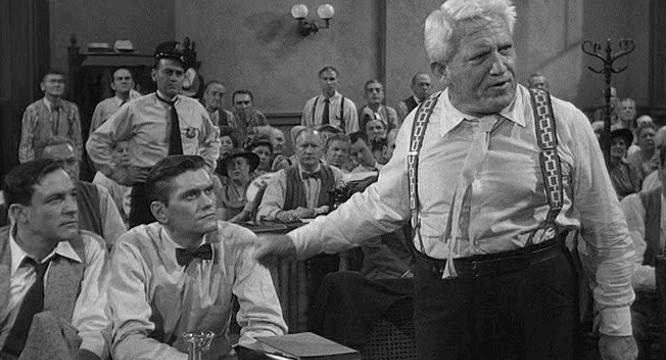
The film is based on the play of the same name written in 1950 by Jerome Lawrence and Robert E. Lee. It was written during the height of the McCarthy Era and opened in 1955. The first film version starring Spencer Tracy as Henry Drummond (Clarence Darrow), Frederic March as Matthew Harrison Brady (William Jennings Bryan), Gene Kelly as E.K. Hornbeck (H.L. Mencken) while Dick York played Bertram Cates (John Scopes). Lawrence and Lee invented some fictional characters including Reverend Brown played by Claude Akins.

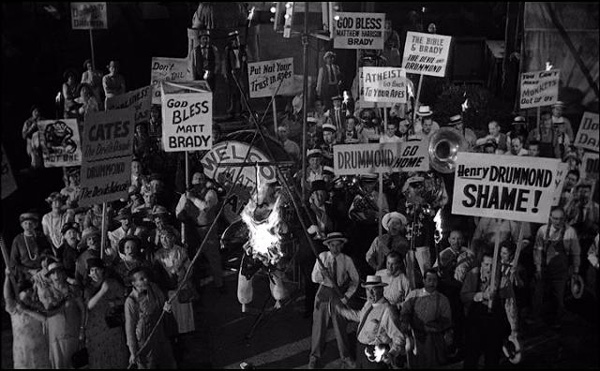
The film directed by Stanley Kramer captures the raw emotions of the trial, the participants and the spectators who came from near and far. The depiction of the angry mob of Christians is terrifying to watch. In the film they sing:

“We’ll hang Bertram Cates to a sour apple tree, we’ll hang Bertram Cates to a sour apple tree, we’ll hang Bertram Cates to a sour apple tree. Our God is marching on! Glory Glory Hallelujah! Glory Glory Hallelujah! Glory Gory Hallelujah! His truth is marching on. We’ll hang Henry Drummond to a sour apple tree, we’ll hang Henry Drummond to a sour apple tree, we’ll hang Henry Drummond to a sour apple tree, our God is marching on.”

inheritwind

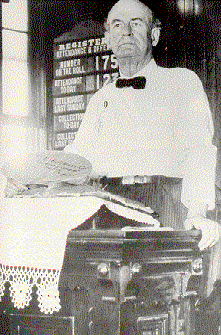
March’s depiction of Matthew Harrison Brady is riveting. The Brady of the film does not do justice to other parts of Bryan’s life. Bryan, outside his fight against evolution was ahead of his time in many ways. Earlier in his career he had pressed for Universal Suffrage, fought against war and labored against the social Darwinism of the banks, business and the Robber Barons. However the loss of three Presidential elections left him bitter and it is believed that he saw the trial as an opportunity to regain the limelight and perhaps build a base to again run for President. This speech by Brady is a fair characterization of Bryan’s beliefs:

“I have been to their cities and I have seen the altars upon which they sacrifice the futures of their children to the gods of science. And what are their rewards? Confusion and self-destruction. New ways to kill each other in wars. I tell you gentlemen the way of science is the way of darkness.”

The problem with the Bryant of the Scopes Trial was that he was a caricature of his former self, he played to the crowds. The trial played to the worst parts of his character and that shows in the movie depiction. Some Christians find this an unfair portrayal and even call it a lie, however even though March’s portrayal is fictional it does fit the spirit of the trial which is captured in the writings of many of the contemporary commentators of the trial. Mencken wrote of the real Bryan: It is a tragedy, indeed, to begin life as a hero and to end it as a buffoon.


wjb_pulpit

Another of those commentators, Marcet Haldeman-Julius wrote of the real Bryan:

“As he sat there in the court room, day after day, silent, fanning, fanning, his face set I was appalled by the hardness, the malice in it. No one who has watched the fanatical light in those hard, glittering black eyes of Bryan’s can doubt but that he believes both in a heaven and in a hell. At the same time the cruel lines of his thin, tight-pressed mouth proclaim, it seems to me, that he would stop at nothing to attain his own ends. It is anything but a weak face–Bryan’s. But it is a face from which one could expect neither understanding nor pity. My own opinion is that he is sincere enough in his religion. Also that in it is included the doctrine Paul so frankly taught–that a lie told for the glory of God is justified…”

scope2

But I think that the real drama and tension in the film comes from Spencer Tracy in his portrayal of Drummond. This speech is taken almost verbatim from the trial:

“Can’t you understand? That if you take a law like evolution and you make it a crime to teach it in the public schools, tomorrow you can make it a crime to teach it in the private schools? And tomorrow you may make it a crime to read about it. And soon you may ban books and newspapers. And then you may turn Catholic against Protestant, and Protestant against Protestant, and try to foist your own religion upon the mind of man. If you can do one, you can do the other. Because fanaticism and ignorance is forever busy, and needs feeding. And soon, your Honor, with banners flying and with drums beating we’ll be marching backward, BACKWARD, through the glorious ages of that Sixteenth Century when bigots burned the man who dared bring enlightenment and intelligence to the human mind!”

0237318_11378_MC_Tx360

I think that this speech is the real crux of the tension that we face even now. Legislators in a number of States have enacted laws of much the same kind of spirit as Butler and defended them with the same kind of fire as Bryan. Civil libertarians, especially secular ones bring up the same issues as Darrow did. I am a Christian and a Priest and my thinking about this is much like that espoused by Drummond in the movie.

So the film may be a fictional depiction of the Scopes Trial, but it is a film that I think that people would do well to watch. I don’t expect everyone to agree with me or the issues that I agree with brought up by the character of Henry Drummond. However, I think that everyone should watch the film and come to their own conclusions as well as to ask themselves how their particular ethic, whether secular or religious informs them in how they deal with this issue and so many others that divide us today.

Bryant’s death, coming a few days after the trial was nowhere as near as dramatic as the death scene in the movie, sometimes fiction makes the story a bit more entertaining.

But the film also gives a warning to cynics like Mencken. After Brady’s death and the trials end there is a fascinating dialogue between Drummond (Darrow) and Hornbeck (Mencken). It is worth watching:

Henry Drummond : My God, don’t you understand the meaning of what happened here today?

E. K. Hornbeck : What happened here has no meaning…

Henry Drummond : YOU have no meaning! You’re like a ghost pointing an empty sleeve and smirking at everything people feel or want or struggle for! I pity you.

E. K. Hornbeck : You pity me?

Henry Drummond : Isn’t there anything? What touches you, what warms you? Every man has a dream. What do you dream about? What… what do you need? You don’t need anything, do you? People, love, an idea, just to cling to? You poor slob! You’re all alone. When you go to your grave, there won’t be anybody to pull the grass up over your head. Nobody to mourn you. Nobody to give a damn. You’re all alone.

E. K. Hornbeck : You’re wrong, Henry. You’ll be there. You’re the type. Who else would defend my right to be lonely?

I just know when I watch it, that it could have been in the news this week, only with a different cast of characters. My concern is that there is a very loud minority that wants to inflict its particular religious view on everyone and use the public treasure to do it. The attitude of many of these people is much like the characters from the actual Scopes Trial including their view that pushes both demonizes those they oppose and their desire to regulate the secular opposition to the sidelines.

SCOPES1

I know that the same accusation is made by religious people of secularists, however I have seen the results of religious wars in Iraq and the Balkans, and from history. Those conflicts and the brutality of religious people in them give me great pause when I see religious and political leaders here suggest curtailing the civil liberties and even using the law against those that they oppose. As Drummond asked in the movie: “Must men go to jail because they find themselves at odds with a self-appointed prophet?”

That is why this film and that trial are still so important, for the very practice of liberty and protection of the First Amendment.

Peace

Padre Steve+

Leave a comment

Filed under civil rights, enteratinment, faith, film, History, laws and legislation, movies, News and current events, Political Commentary

Reflecting on the Best Of American Sports Teams

Friends of Padre Steve’s World,

The United States Women’s National Team, was simply the best and I continue to be in love with them.

They were derided before the tournament, mostly by male commentators. Their one of a kind outspoken veteran star player and co-Captain was viciously attacked in public statements by the President Of the United States, and they were criticized by others for their dominance and love of the game and love of team. I have never seen any winning team in any sport so derided for their unity, their dominance, and their ability to win against some of the best teams in the world, including Sweden, France, and England. In the final they defeated the Netherlands team which had played brilliantly the entire tournament, never trailing in a game until Megan Rapinoe scored on a penalty kick in the 61st minute of the championship game.

Their victory today was more than a victory for their team it was a victory for the proposition in the Declaration Of Independence that all people are created equal. In addition to winning they forced the hand of FIFA to increase the financial aspects of the game to women, doubling and then quadrupling the amount of money dedicated to the women’s tournament.

Beyond that, these women, and the members of the team over the past quarter of a century have blazed a trail of excellence that is hard to match. Forget about the men’s Olympic Basketball “Dream Teams”, made up of the best players in the NBA, no one cared when they ran up scores, dominated, and celebrated their wins. Forget the United States men’s Baseball team who cannot win or come close to winning an international tournament because the MLB owners won’t let their best players compete, or the U.S. Men’s Soccer team which has never gotten past the semifinals in the World Cup despite more funding and higher salaries than those of the USNWT.

The U.S. Women speak for more than sports. They speak for the equality of the Declaration, and the rights of women (and men) everywhere who are discriminated against because of gender, race, or religion. By the way when I speak of gender I don’t just talk male and female, but also of my LGBTQ friends, brothers and sisters.

This was a special team. They had a lot of detractors, including former teammates, but they showed their metal and won, in a convincing manner. They scored the most goals ever by a women’s treat in World Cup history and only allowed three goals against them in seven games. They defeated three of the highest rated teams in the world just to get to the final. They dealt with age and injuries, and still showed a joy for the game, love of team, and yes, patriotism, even the kind of which is unpopular and makes authoritarians uncomfortable and angry.

In that, Megan Rapinoe, the object of so much of President Trump’s disdain, won both the tournament’s Golden Boot for the most goals and assists, as well as the Golden Ball as best player of the tournament. As a patriot who believes and hopes for the best that our country has to offer, I hope that she and the team refuse any invitation to Trump’s White House. They fought for too much to surrender those victories to a man who would use them for a photo op and then continue to speak badly of them.

Congratulations to the American Women who won the Women’s World Cup and so much more, this year, as well as in 1995, 1999, and 2015. They all deserve our respect, appreciation, and admiration; but especially this team, for they are the face of ALL United States Soccer. They are the people who have inspired American women and men to compete at the highest levels of soccer worldwide.

So until tomorrow,

Peace,

Padre Steve+

Leave a comment

Filed under civil rights, leadership, LGBT issues, Loose thoughts and musings, News and current events, soccer, sports and life

The Bloodiest Battle on American Soil: The Human Cost at Gettysburg

gburg dead2

Friends of Padre Steve’s World

This week I have been posting about Gettysburg, Independence Day, and a commentary on the toxic nationalism of President Trump’s hijacking of Independence Day. We have been visiting with friends and I have been catching up on my reading. I completed Ian Kershaw’s “To Hell and Back: Europe 1914-1949; I’m about halfway through Geoff Megargee’s “Inside Hitler’s High Command”; and I am about two thirds of the way through with Danielle Allen’s “Our Declaration: A Reading Of the Declaration of Independence In Defense of Equality.” They are all worth the read in an age where much of our citizenry lacks a basic understanding of the principles of the Declaration and worships at the altar of brute military and economic force, thinking that somehow those are the guarantors of freedom and liberty. They are not. Kershaw’s book shows the cost of toxic nationalism and ideologies that destroyed Europe in two World Wars, Megargee’s shows the cost of militarism and militaries  that become compliant with authoritarian leaders. 

So tonight I repost a final article from my Gettysburg text. It deals with the human cost of that battle. 

I am a career military officer who suffers from PTSD, TBI and other afflictions after serving in Iraq’s Al Anbar Province in 2007-2008.  I have seen firsthand the terrible effects of war. I am also a historian and I  have served as Assistant Professor at a major military staff college which helps educate senior military officers from this country and other countries. In that capacity I taught ethics as well as led the Gettysburg Staff ride, or study of the Battle of Gettysburg. When teaching I always attempted to deal with the human cost of war.

Gettysburg was the most costly battle ever fought on the American continent. Around 50,000 men were killed or wounded there in three days of battle. William Tecumseh Sherman noted that “war is hell.” I agree, there is nothing romantic about it. The effects of war last generations and though we have been at war for the last seventeen and a half years, war itself is an abstract concept to most Americans. It is fought by professionals and only experienced by most Americans on the news, movies or most the banal manner, video games; thus the cost in human terms is not fully appreciated, and nor can it be, we are far too insulated from it. Over the past forty plus years our politicians have insulated the public from war, and in doing so they have ensured that we remain in perpetual war which benefits no one. That is a big reason why I write so much about it, not to glorify or romanticize it, but to try in some war to help make it real  to my readers. This is a another draft chapter from my Gettysburg text. 

Peace

Padre Steve+

Walt Whitman Wrote:

“Ashes of soldiers South or North, As I muse retrospective murmuring a chant in thought, The war resumes, again to my sense your shapes, And again the advance of the armies. Noiseless as mists and vapors, From their graves in the trenches ascending, From cemeteries all through Virginia and Tennessee, From every point of the compass out of the countless graves, In wafted clouds, in myriads large, or squads of twos or threes or single ones they come, And silently gather round me…”

Too often we look at distant battles and campaigns in terms of strategy, operations, tactics, leadership and the weaponry employed. Likewise we might become more analytical and look at the impact of the battle or campaign in the context of the war it was fought, or in the manner in which the tactics or weapons used revolutionized warfare. Sometimes in our more reflective moments we might look at individual bravery or sacrifice, often missing in our analysis is the cost in flesh and blood.

Admittedly the subject is somewhat macabre. But with the reality being that very few people in the United States, Canada or Western Europe have experienced the terrible brutality of war it is something that we should carefully consider any time the nation commits itself to war. By we, I mean all citizens, including the many soldiers, sailors and airmen who never see the personally see people they kill, or walk among the devastation caused by the highly advanced, precision weapons that they employ from a great distance, sometimes thousands of miles. In some parts of our military we have men and women who have the mission of targeting and killing enemies and then walking home to their families, but in the Civil War killing in combat “remained essentially intimate; soldiers were able to see each other’s faces and to know whom they had killed.” [1]

While the words of William Tecumseh Sherman that “War is Hell” are as true as when he spoke them; the tragic fact is that for most people war is an abstract concept, antiseptic and unreal; except for the occasional beheading of a hostage by Islamic militants or the videos shot by the perpetrators of crimes against humanity on the internet. Thus the cost of war and its attendant cost in lives, treasure and to the environment are not real to most people in the West.

We use words to describe the business of war which dehumanize the enemy, and we describe their deaths in words more palatable to us. Dave Grossman, the army infantry officer who has spent his post military life writing about the psychology of war and killing wrote:

“Even the language of men at war is the full denial of the enormity of what they have done. Most solders do not “kill,” instead the enemy was knocked over, wasted, greased, taken out, and mopped up. The enemy is hosed, zapped, probed, and fired on. The enemy’s humanity is denied, and he becomes a strange beast called a Jap, Reb, Yank, dink, slant, or slope. Even the weapons of war receive benign names- Puff the Magic Dragon, Walleye, TOW, Fat Boy, Thin Man- and the killing weapon of the individual soldier becomes a piece or a hog, and a bullet becomes a round.” [2]

We can now add the terms Haji and Raghead to Grossman’s list of dehumanizing terms for our opponents from our most recent wars in Iraq and Afghanistan.

The words of Guy Sager in his classic work The Forgotten Soldier about World War Two on the Eastern front is lost on many that study war:

“Too many people learn about war with no inconvenience to themselves. They read about Verdun or Stalingrad without comprehension, sitting in a comfortable armchair, with their feet beside the fire, preparing to go about their business the next day, as usual…One should read about war standing up, late at night, when one is tired, as I am writing about it now, at dawn, while my asthma attack wears off. And even now, in my sleepless exhaustion, how gentle and easy peace seems!” [3]

In an age where so few have served in the military and even few have seen combat in some way shape or form many who study war are comfortable experts who learn about war with no inconvenience to themselves. When I hear men and women, the pundits, politicians and preachers, that Trinity of Evil who constantly exhort governments and peoples to go to war for causes, places or conflicts that they have little understanding of from the comfort of their living rooms or television studios I grow weary. I fully comprehend the words of Otto Von Bismarck who said: “Anyone who has ever looked into the glazed eyes of a soldier dying on the battlefield will think hard before starting a war.” [4]

As a historian who also is a military chaplain who has seen war I struggle with what Sager said. Thus when I read military history, study and write about particular battles or engagements, or conduct staff rides as like the Gettysburg trip that we are embarking on, the human cost is always present in my mind. The fact that I still suffer the effects of PTSD including night terrors and chronic insomnia keeps what I do in good focus, and prevents me from being a comfortable expert.

Thus, it is my view, to conduct a staff ride, to walk the battlefield; especially in somewhat uncomfortable weather is a good thing. It connects us more in at least a small way to the men that fought there, died there, or brought home wounds that changed them forever.

To walk a battlefield where tens of thousands of men were killed and wounded is for me a visit to hallowed ground. I have felt that at Waterloo, Verdun, Arnhem, Normandy, the Bulge, the West Wall, the Shuri Line on Okinawa, Antietam, Chancellorsville, Stone’s River, and of course the battlefield which I have visited more than any in my life, Gettysburg. There are times when I walk these fields that I am overcome with emotion. This I think is a good thing, for as an American who has family ties to the Civil War, Gettysburg in particular is hallowed ground.

In doing this I try to be dispassionate in how I teach and while dealing with big issues that my students will face as Joint Staff Officers. Some of them will become Flag or General Officers, with the responsibility of advising our nation’s leaders as well planning and conducting the military operations on which the lives of thousands or maybe hundreds of thousands of people depend. Thus I do feel a certain responsibility to teach not only the strategy and other important military aspects of this campaign, but also the cost in human lives and ethical considerations. I take this work seriously because it forces us to remember what war is about and its nature, which Clausewitz wrote is “a paradoxical trinity-composed of primordial violence, hatred and enmity…” [5]which William Tecumseh Sherman so rightly understood without the euphemisms that we so frequently use to describe it: “War is cruelty, and you cannot refine it….”

As the sun set on the evening of July 3rd 1863 the battered Army of Northern Virginia and the battered but victorious Army of the Potomac tended their wounds, buried their dead and prepared for what might happen next. On that afternoon it was as if “the doors of Hell had shut” and the next day, the Glorious 4th of July “The heavens opened, and a thunderstorm of biblical proprotions drenched the battlefield, soaking dead, wounded and able-bodied men equally.” [6]

Following the disastrous attack aimed at the Union center, Lee and his surviving commanders prepared for an expected Union counter attack. However, George Meade, the commander of the Army of the Potomac who had correctly anticipated Lee’s assault decided not to gamble on a counter attack, though it was tempting. He knew too well the tenacity and skill of the Confederate commanders and soldiers on the defense and did not want to risk a setback that might give Lee another chance, thus “the two sides stared at each other, each waiting for the other to resume the fighting, neither did.” [7]

As the Confederate army retreated and Meade’s army pursued another army remained at Gettysburg, “an army of the wounded, some 20,350 in number, a third of them Confederate….” Just 106 surgeons were spared from the Army of the Potomac and “the comparatively few overburdened surgeons and attendants now on duty still labored every day to the point of exhaustion.” [8] These overworked men were aided by local volunteers as well as members of the U.S. Sanitary Commission, the Christian Commission and the Sisters of Charity. These men and women “brought organization to the hospitals, relief to the medical staffs and the local volunteers, and immense comfort to the wounded, whether blue or butternut.” [9]

The dead and wounded littered the battlefield and the sights and smells were ghastly:

“Wherever men gazed, they saw dead bodies. A New Yorker thought they “lay as thick as the stones that is on father’s farm.” A stench smothered the field, moving John Geary to tell his wife, “My very clothes smell of death.” A Regular Army veteran exclaimed, “I have seen many a big battle, most of the big ones of the war, and I never saw the like.” [10] A resident of Gettysburg walked up to Little Round top and wrote of what she observed from the peak of that rocky hill:

“surrounded by the wrecks of battle, we gazed upon the valley of death beneath. The view there spread out before us was terrible to contemplate! It was an awful spectacle! Dead soldiers, bloated horses, shattered cannon and caissons, thousands of small arms. In fact everything belonging to army equipments was there in one confused and indescribable mass.” [11]

At Joseph Sherfy’s farm, scene of some of the heaviest fighting on the second day, his barn “which had been used as a field hospital, was left a burnt ruin, with “crisped and blackened limbs, heads and other portions of bodies” clearly visible.” [12] When the rains came, the wounded suffered terribly. Many of the field aid stations were set up next to the creeks that crisscrossed the battlefield, and those streams quickly flooded as torrents of rain water caused them to overflow their banks. “A New Jersey soldier watched in horror as the flood waters washed over and carried away badly wounded men unable to move to safety….” [13]

Oliver Howard took his escort to do a reconnaissance of the town on July 4th, one of the cavalry troopers described the scene:

“The battle field was the Awfulest sight I ever saw…The woods in front of our men the trees were riddled with Cannon ball and bullets evry limb shot off 20 feet high. Some say the Rebel dead lay six deep in the grave yard where we lay. Nearly every grave stone was shattered by shots and everything was torn to pieces. I went through the town on the 4th of July with the General. The streets were covered with dead. Evry frame house were riddled with balls the brick ones dented thick where shot had hit.” [14]

Field hospitals were often little more than butcher shops where arms and legs were amputated by overworked surgeons and attendants while those with abdominal wounds that could not be easily repaired were made as comfortable as possible. Triage was simple. If a casualty was thought to have a reasonable chance at survival he was treated, if not they were set aside in little groups and allowed to die as peacefully as possible. Churches were requisition for use of the surgeons. A volunteer nurse noted: “Every pew was full; some sitting, some lying, some leaning on others. They cut off the legs and arms and threw them out the windows. Every morning the dead were laid on the platform in a sheet or blanket and carried away.” [15]

Chaplains were usually found with the doctors, caring for the physical as well as the spiritual needs of the wounded. Protestant chaplains might ensure that their soldiers “knew Jesus” and Catholics administered the Last Rites, often working together across denominational lines to care for their soldiers.

A Union chaplain described the ministry in the field hospitals and aid stations:

“Some of the surgeons were posted well up toward the front to give first aid. More of them were in the large field hospitals of division in more secure places at the rear. The chaplain might be at either place or at both by turns. Some made a point of watching for any wounded man who might be straggling back, who perhaps could be helped up into the saddle and ride back to the hospital. When the demand for help became urgent the chaplains were nurses. As the rows of wounded men grew longer, chaplains went from man to man to see what could be done to relieve their pain, perhaps to take a message or letter. All day into the night this work would continue. A drink of water, a loosened bandage on a swollen limb, a question answered, a surgeon summoned, a whispered word of comfort marked their course. Each night at sundown the men who died during the day were buried, with a short prayer, side by side in a common grave, each in his uniform with canvas wrapped around his face and a strip of paper giving his name and regiment in a bottle buttoned under his blouse.” [16]

The war would challenge the theology of the clergy who served as chaplains on both sides, as “individuals found themselves in a new and different moral universe, one in which unimaginable destruction had become a daily experience. Where could God belong in such a world? How could a benevolent deity countenance such cruelty and suffering? Doubt threatened to overpower faith….” [17] That sense of bewilderment is not lacking today among those of faith who return from war.

Some men, clergy and laity alike would attempt to find a theological meaning to the suffering. Many would do so in the theology of John Calvin which emphasized the Providence and foreknowledge of God. That theological frame of reference, of the results of battles and the death or wounding of men in war and the attendant suffering was found in the will, or providence of God was quite common among men of both sides who grew up during the Second Great Awakening, as it is today; and for some it was carried to fatalistic extremes. However, others like Colonel William Oates of the 15th Alabama, who considered himself a believing Christian, wrote that he believed God:

“endowed men with the power of acting for themselves and with responsibility for their acts. When we went to war it was a matter of business, of difference of opinion among men about their temporal affairs. God had nothing to do with it. He never diverted a bullet from one man, or caused it to hit another, nor directed who should fall or who should escape, nor how the battle should terminate. If I believed in such intervention of Providence I would be a fatalist….”[18]

The carnage around the battlefield was horrifying to most observers. Corporal Horatio Chapman of the 20th Connecticut Volunteers wrote about the sight on Cemetery Ridge on the night of July 3rd following the repulse of Pickett’s Charge:

But in front of our breastworks, where the confederates were massed in large numbers, the sight was truly awful and appalling. The shells from our batteries had told with fearful and terrible effect upon them and the dead in some places were piled upon each other, and the groans and moans of the wounded were truly saddening to hear. Some were just alive and gasping, but unconscious. Others were mortally wounded and were conscious of the fact that they could not live long; and there were others wounded, how bad they could not tell, whether mortal or otherwise, and so it was they would linger on some longer and some for a shorter time-without the sight or consolation of wife, mother, sister or friend. I saw a letter sticking out of the breast pocket of one of the confederate dead, a young man apparently about twenty-four. Curiosity prompted me to read it. It was from his young wife away down in the state of Louisiana. She was hoping and longing that this cruel war would end and he could come home, and she says, “Our little boy gets into my lap and says, `Now, Mama, I will give you a kiss for Papa.’ But oh how I wish you could come home and kiss me for yourself.” But this is only one in a thousand. But such is war and we are getting used to it and can look on scenes of war, carnage and suffering with but very little feeling and without a shudder.” [19]

Colonel William Oates of the 15th Alabama whose brave troopers assaulted Little Round Top on July 2nd wrote:

“My dead and wounded were nearly as great in number as those still on duty. They literally covered the ground. The blood stood in puddles in some places on the rocks; the ground was soaked with the blood of as brave men as ever fell on the red field of battle.” [20]

Another Confederate soldier described the scene west of the town on July 4th:

“The sights and smells that assailed us were simply indescribable-corpses swollen to twice their size, asunder with the pressure of gases and vapors…The odors were nauseating, and so deadly that in a short time we all sickened and were lying with our mouths close to the ground, most of us vomiting profusely.” [21]

The burial of the dead was too much for the soldier’s alone to accomplish. “Civilians joined the burial of the dead out of both sympathy and necessity. Fifty Confederates lay on George Rose’s fields; seventy-nine North Carolinians had fallen on a perfect line on John Forney’s farm.” [22]

Those tending the wounded recalled how many of the wounded selflessly asked medical personnel to tend others more badly wounded than themselves; a volunteer nurse wrote her sister: “More Christian fortitude was never witnessed than they exhibit, always say-‘Help my neighbor first, he is worse.’” [23] The Confederate wounded were the lowest priority for the badly overwhelmed Union surgeons and Lee had not done much to help, leaving just a few surgeons and attendants to care for the Confederates left on the battlefield. The Confederate wounded housed in the classrooms of Pennsylvania College were left in dire straits:

“All the rooms, halls and hallways were occupied with the poor deluded sons of the South,” and “the moans prayers, and shrieks of the wounded and dying were everywhere.” Between 500 and 700 wounded Confederates were jammed in with “five of our surgeons” and “no nurses, no medicines no kinds of food proper for men in our condition….” [24]

Across the battlefield the wounded were being treated in a variety of makeshift aid stations and field hospitals:

“Sergeant Major David E. Johnson of the Seventh Virginia was taken to the Myers house after the bombardment, suffering from a shrapnel wound to his left side and arm. “The shed in which I was placed,” he recalled, “was filled with the wounded and dying….I spoke to no one, and no one to me, never closed my eyes to sleep; the surgeons close by being engaged in removing the limbs of those nearby to be amputated….I heard nothing but the cries of the wounded and the groans of the dying, the agonies of General Kemper, who lay nearby, frequently being heard.” [25]

The suffering was not confined to the hospitals; John Imboden commanding the cavalry brigade protecting the Confederate wounded being transported home and supply trains described the horror of that movement:

“Scarcely one in a hundred had received adequate surgical aid, owning to the demands on the hard working surgeons from still far worse cases tat had to be left behind. Many of the wounded in the wagons had been without food for thirty-six hours. Their torn and bloody clothing, matted and hardened, was rasping the tender, inflamed, and still oozing wounds….From nearly every wagon as the teams trotted on, urged by whip and shout came such cries and shrieks as these:

“My God! Why can’t I die?” “My God! Will no one have mercy and kill me?” “Stop! Oh! For God’s sake stop for just one minute; take me out and leave me to die on the roadside.” “I am dying! I am dying! My poor wife, my dear children, what will become of you?” [26]

Eventually, by July 22nd with most of the wounded evacuated a proper general hospital was set up east of the town and the remaining wounded taken there. That hospital, named Camp Letterman grew into “a hundred –acre village of cots and tents, with its own morgue and cemetery, and served more than 3,000 wounded before it was finally closed in November.” [27]

As for the families of the dead, many never found out the details of their loved one’s deaths, which caused their losses to be “in some sense unreal and thus “unrealized,” as the bereaved described them, recognizing the inhibition of mourning that such uncertainty imposed.” [28] Much was because of how overwhelmed the field hospital staffs were, and how inadequate their records of treatment and the dispositions of bodies were sketchy at best. “Reports from field hospitals were riddled with errors and omissions, often lacked dates, and were frequently illegible, “written with the faintest lead pencil.” [29]

Among the killed and wounded were the great and the small. John Reynolds who died on day one, Winfield Scott Hancock, the valiant commander of the Union II Corps was severely wounded during Pickett’s Charge. Dan Sickles, the commander of Third Corps who had nearly brought disaster on the Federal lines by advancing to the Peach Orchard on July 2nd had his leg amputated after being grazed by a cannon ball at the Trostle Farm. Sickles, who survived the wound and the war, would visit the leg, which had carefully ordered his surgeons to preserve. The leg is now displayed at the National Museum of Health and Medicine in Washington D.C.

The Army of the Potomac lost a large number of brigade and regimental commanders including Strong Vincent, the young and gallant brigade commander who helped save Little Round Top; George Willard who brought redemption to his Harper’s Ferry brigade on Cemetery Ridge stopping Barksdale’s charge on July 2nd; Colonel Augustus Van Horne Ellis who before being killed at Devil’s Den told his staff “the men must see us today;” and the young Elon Farnsworth, who had been promoted from Captain to Brigadier General just days before his death in a senseless ordered by his division commander Judson “Kill Cavalry” Kilpatrick, against Hood and McLaws dug in divisions as the battle ended.

The Confederates suffered grievous losses. Divisional commanders like Dorsey Pender and Johnston Pettigrew were mortally wounded, John Bell Hood was severely wounded, Isaac Trimble, wounded and captured while Harry Heth was wounded. Casualties were even higher for commanders and the brigade and regiment level, the list included excellent commanders such as Paul Semmes and William Barksdale, while Wade Hampton, Stuart’s best brigade commander was seriously wounded and would be out of action for months. The toll of brigade and regimental commanders who were killed or wounded was fearful. “At the regimental level approximately 150 colonels, lieutenant colonels and majors had been killed, wounded or captured. Of that number nineteen colonels had been slain, the most in any single battle in which the army had been engaged. Captains now led regiments.”[30]

In Picket’s division alone all three brigade commanders, Kemper, Armistead and Garnett were killed or wounded while twenty-six of forty Field Grade officers were casualties. Forty-six percent (78 of 171) of the regiments of the Army of Northern Virginia suffered casualties at the command level. The Confederate casualties, especially among the best leaders were irreplaceable and Lee’s Army never recovered from the loss of seasoned leaders who were already in short supply.

For some like Private Wesley Culp of the 2nd Virginia it was a final trip home. Culp had grown up in Gettysburg and had taken a job in Virginia prior to the war. In 1861 he enlisted to serve among his friends and neighbors. He was killed on the morning of July 3rd on Culp’s Hill on the very property owned by his uncle where he grew up and had learned to hunt.

One witness, Frank Haskell looked in at a field hospital in the Union II Corps area and wrote:

“The Surgeons with coats off and sleeves rolled up…are about their work,… “and their faces and clothes are spattered with blood; and though they look weary and tired, their work goes systematically and steadily on- how much and how long they have worked, the piles of legs, arms, feet, hands, fingers…partially tell.” [31]

All told between 46,000 and 51,000 Americans were killed or wounded during the three days of Gettysburg. Busey and Martin’s Regimental Strengths and Losses at Gettysburg list the following casualty figures, other accounts list higher numbers, some as many as 53,000. One also has to remember that many of the missing soldiers were killed in action, but their bodies were simply never found.

                           Killed               wounded         missing         total

Union                    3,155                14,531             5,369           23,055

Confederate         4,708                12,693             5,830            23,231

Total                     7,863               27,224            11,199          46,286

To provide a reference point we need to remember that in 8 years of war in Iraq the United States suffered fewer casualties than during the three days of Gettysburg. It was the bloodiest single battle in American history, and it was a battle between brothers not against foreign enemies. To put it another perspective, even at the lowest estimates “the “army of Northern Virginia suffered something comparable to two sinkings of the Titanic, the 2001 attacks on the World Trade Center and the Pentagon, ten repetitions of the Great Blizzard of 1888, and two Pearl Harbors.” [32]Robert E Lee testified to Congress following the war “the war… was an unnecessary condition of affairs, and might have been avoided if forbearance and wisdom had been practiced on both sides.” [33]  Lee’s “Old Warhorse” James Longstreet asked “Why do men fight who were born to be brothers?” [34]

The carnage and death witnessed by survivors of Gettysburg and the other battles of the war changed Civil War soldiers as much as war has before or after. James Garfield, who served as a general in the Union army and went on to become President of the United States noted: “at the sight of these dead men whom other men killed, something went out of him, the habit of a lifetime, that never came back again: the sense of the sacredness of life and the impossibility of destroying it.” [35]

Others, like veterans of today had trouble adjusting to life after the war. “Civil War veterans had trouble finding employment and were accused of being drug addicts. Our word “hobo” supposedly comes from homeless Civil War veterans- called “hoe boys” – who roamed the lanes of rural America with hoes on their shoulders, looking for work.” [36] Following the war, during the turmoil of Reconstruction and the massive social change brought about by the industrialization of society and rise of “industrial feudalism” numerous veterans organizations were founded, for those that belonged to them they were “one of the principle refuges for old soldiers who had fought for a very different world than the one they found around them.” The Grand Army of the Republic was the most prominent of these organizations. “In more than 7,000 GAR posts across the United States, former soldiers could immerse themselves in a bath of sentimental memory; there, they established a ritualized camp geography, rekindled devotion to emancipation and preached the glories of manly independence.” [37]

At the end of the war, Joshua Chamberlain, the hero of Little Round Top who was well acquainted with the carnage of war suffered immensely. His wounds never healed fully, and he struggled to climb out of “an emotional abyss” in the years after the war. Part was caused by his wounds which included wounds to his sexual organs, shattering his sexuality and caused his marriage to deteriorate. He wrote his wife about the “widening gulf between them, one created at least in part by his physical limitations: “There is not much left in me to love. I feel that all too well.” [38]

Gouverneur Warren, who had helped save the Union at Little Round Top wrote to his wife while on Engineering duty after the war: He wrote in 1866 “Indeed the past year…was one of great despondency for me…I somehow don’t wonder that persons often remark how seldom I laugh, but it is really seldom that I do.” He wrote again in 1867 “I wish I did not dream that much. They make me sometimes dread to go to sleep. Scenes from the war, are so constantly recalled, with bitter feelings I wish to never experience again. Lies, vanity, treachery, and carnage.” [39]

The killing at Gettysburg and so many other battles “produced transformations that were not readily reversible; the living into the dead, most obviously, but the survivors into different men as well, men required to deny, to numb basic human feelings at costs they may have paid for decades after the war ended, as we know twentieth and twenty-first-century soldiers from Vietnam to Iraq continue to do; men who like James Garfield, were never quite the same again after seeing fields of slaughtered bodies destroyed by me just like themselves.” [40]

Joshua Chamberlain asked the most difficult questions when viewing the devastation around Petersburg in the final days of the war:

“…men made in the image of God, marred by the hand of man, and must we say in the name of God? And where is the reckoning for such things? And who is answerable? One might almost shrink from the sound of his own voice, which had launched into the palpitating air words of order–do we call it?–fraught with such ruin. Was it God’s command that we heard, or His forgiveness that we must forever implore?” [41]

Notes

Chamberlain’s questions should always be in our minds as we send young men and women to war. 

Notes

[1] Faust, Drew Gilpin, This Republic of Suffering: Death and the American Civil War Vintage Books, a division of Random House, New York 2008 p.41

[2] Grossman, Dave On Killing: The Psychological Costs of Learning to Kill in War and Society. Back Bay Books, Little, Brown and Company New York 1995, 1996 p.92

[3] Sager, Guy The Forgotten Soldier originally published as Le Soldat Oublie Editions Robert Laffont 1967, Translation Harper and Row Inc 1971, Brasey’s Washington D.C 2000 p.223

[4] Bismarck, Otto von Speech, August 1867

[5] Clausewitz, Carl von. On War Indexed edition, edited and translated by Michael Howard and Peter Paret, Princeton University Press, Princeton NJ 1976 p.89

[6] Wittenberg, Eric J, Petruzzi, David and Nugent, Michael F. One Continuous Fight: The Retreat from Gettysburg and the Pursuit of Lee’s Army of Northern Virginia July 4-14 1863 Savas Beatie LLC New York NY and El Dorado Hills CA 2008,2001 p.27

[7] Ibid. Wittenberg One Continuous Fight p.28

[8] Sears, Stephen W Gettysburg Houghton Mifflin Co. Boston and New York 2003 p.508

[9] Ibid. Sears Gettysburg p.510

[10] Wert, Jeffry D. The Sword of Lincoln: The Army of the Potomac Simon and Schuster, New York and London 2005 p.303

[11] Schultz, Duane The Most Glorious Fourth: Vicksburg and Gettysburg July 4th 1863. W.W. Norton and Company New York and London, 2002 p.357

[12] Faust This Republic of Suffering p.81

[13] Ibid. Wittenberg One Continuous Fight p.30

[14] Ibid. Wittenberg One Continuous Fight pp.32-33

[15] Ibid. Sears Gettysburg. p.508

[16] Brinsfield, John W. et. al. Editor, Faith in the Fight: Civil War Chaplains Stackpole Books, Mechanicsburg PA 2003 pp.121-122

[17] Ibid. Faust. This Republic of Suffering p.267

[18] Oates, Willam C. and Haskell, Frank AGettysburg: The Confederate and Union Views of the Most Decisive Battle of the War in One Volume Bantam Books edition, New York 1992, originally published in 1905 p.138

[19] Chapman, Horatio Civil War Diary of a Forty-niner pp.22-24 Retrieved from http://www.dbappdev.com/vpp/ct20/hdc/HDC630703.htm 8 April 2014

[20] Oates, William C. Southern Historical Papers, April 6th, 1878 retrieved from http://www.brotherswar.com/Civil_War_Quotes_4h.htm 18 July 2014

[21] _________ What Happened to Gettysburg’s Confederate Dead? The Blog of Gettysburg National Military Park, retrieved from http://npsgnmp.wordpress.com/2012/07/26/what-happened-to-gettysburgs-confederate-dead/ 18 July 2014

[22] Ibid. Faust. This Republic of Suffering p.81

[23] Catton, Bruce The Army of the Potomac: Glory Road Doubleday and Company, Garden City New York, 1952 p.333

[24] Guelzo, Allen C. Gettysburg: The Last Invasion Vintage Books a Division of Random House, New York 2013 p.469

[25] Brown, Kent Masterson Retreat from Gettysburg: Lee, Logistics and the Gettysburg Campaign University of North Carolina Press, Chapel Hill and London, 2005 p.56

[26] Imboden, John D. The Confederate Retreat from Gettysburg in Battles and Leaders of the Civil War Volume III, The Tide Shifts. Edited by Robert Underwood Johnson and Clarence Clough Buel Castle, Secaucus NJ p.424

[27] Ibid. Guelzo Gettysburg: The Last Invasion pp.469-470

[28] Ibid. Faust. This Republic of Suffering p.267

[29] Ibid. Faust. This Republic of Suffering p.113

[30] Wert, Jeffry D. A Glorious Army: Robert E. Lee’s Triumph 1862-1863 Simon and Schuster, New York and London 2011 Ibid. Guelzo Gettysburg: The Last Invasion p.444

[31] Sears, Stephen W. Gettysburg Mariner Books, Houghton Mifflin Company Boston, New York 2004 p.466

[32]

[33] Flood, Charles Bracelen, Lee: The Last Years Houghton Books, New York 1981 p.124

[34] Longstreet, James in New York Times, July 24, 1885, retrieved from the Longstreet Society http://www.longstreetsociety.org/Longstreet_Quotes.html18 July 2014

[35] Ibid. Faust. This Republic of Suffering p.55

[36] Shay, Jonathan Odysseus in America: Combat Trauma and the Trials of Homecoming Scribner, New York and London 2002 p.155

[37] Guelzo Allen C. Fateful Lightening: A New History of the Civil War Era and Reconstruction Oxford University Press, Oxford and New York 2012 p.523

[38] Longacre, Edward Joshua Chamberlain: The Soldier and the ManCombined Publishing Conshohocken PA 1999 p.259

[39] Jordan, David M. Happiness is Not My Companion: The Life of G.K. Warren Indiana University Press, Bloomington Indiana 2001 pp.248-249

[40] Ibid. Faust. This Republic of Suffering p.60

[41] Chamberlain, Joshua Lawrence, The Passing of the Armies: An Account of the Final Campaign of the Army of the Potomac, Based on the Personal Reminisces of the Fifth Corps G.P Putnam’s Son’s 1915, Bantam Books, New York 1993 Amazon Kindle Edition p.41

Leave a comment

Filed under civil war, ethics, Gettysburg, History, leadership, Military, News and current events, Political Commentary, us army