Yearly Archives: 2018

John Reynolds Gives Battle: Gettysburg Day One

IronBrigade10161001

Friends of Padre Steve’s World

This is another section of my text on the Battle of Gettysburg dealing with General John Reynold’s and his decision to give battle as the cavalrymen of John Buford fought a delaying action against the Confederate forces of A.P. Hill and Harry Heth. 

I hope that you enjoy.

Peace

Padre Steve+

On the night of June 30th Reynolds was awash in reports, some of them conflicting and even though he was without Meade’s course of action for the next day “concluded that Lee’s army was close by and in force.” [1] He spent the night at his headquarters “studying the military situation with Howard and keeping in touch with army headquarters.” [2] Howard noted Reynolds anxiety and “received the impression that Reynolds was depressed.” [3] After Howard’s departure Reynolds took the opportunity to get a few hours of fitful sleep before arising again at 4 a.m. on July 1st.

When morning came, Reynolds was awakened by his aide Major William Riddle with Meade’s order to “advance the First and Eleventh Corps to Gettysburg.” [4] Reynolds studied the order and though he expected no battle that morning, expecting “only moving up to be in supporting distance to Buford” [5] took the prudent and reasonable precautions that his Confederate opponents A.P. Hill and Harry Heth refused to take as they prepared to move on Gettysburg.

His troops were in fine spirits that morning even though it had been busy. After a breakfast of hardtack, pork and coffee the troops moved out. An officer of the Iron Brigade noted that the soldiers of that brigade were “all in the highest spirits” while Lieutenant Colonel Rufus Dawes of the “placed the fifes and drums at the head of the Sixth Wisconsin and ordered the colors unfurled” as the proud veterans marched forward into the sound of the raging battle to the tune of “The Campbell’s are Coming.” [6]

Though Reynolds was not expecting a fight he organized his march in a manner that ensured if one did happen that he was fully prepared. The precautionary measures that he took were those that any prudent commander having knowledge that strong enemy forces were nearby would take. Reynolds certainly took to heart the words of Napoleon who said “A General should say to himself many times a day: If the hostile army were to make its appearance in front, on my right, or on my left, what should I do?”[7]

This was a question that A.P. Hill and Harry Heth seemed not to consider on that warm and muggy July morning when Heth was committing Lee’s army to battle on his own authority. Reynolds was also about to commit the Army of the Potomac to battle, but unlike Heth who had no authority to do so, Reynolds “had at least been delegated the authority for making such a decision” [8] by his army commander George Meade. Though Meade was unaware of what was transpiring in the hills beyond Gettysburg he implicitly trusted the judgement of Reynolds, and Meade been with the advanced elements of Reynold’s wing he too “probably would have endorsed any decision he made.” [9]

Reynolds placed himself with the lead division, that of Wadsworth, and “directed Doubleday to bring up the other divisions and guns of the First Corps and had ordered Howard’s Eleventh Corps up from Emmitsburg.” [10] Reynold’s also understood the urgency of the situation and “wanted all the fighting troops to be up front, so he instructed Howard not to intermingle his supply wagons with his infantry. Similar instructions had been given to Abner Doubleday; to ensure that the First Corps wagons would wait until the Eleventh Corps foot soldiers had passed.” [11]

Instead operating in the normal fashion of rotating units on the march, Reynolds opted to save time. Since Wadsworth’s First Division was further advanced than his other First Corps divisions, Reynolds instructed it to move out first with Cutler’s brigade in the lead followed by the Iron Brigade under Brigadier General Solomon Meredith. In doing so Reynolds countermanded the order of the acting corps commander Doubleday who had ordered Wadsworth’s division to allow the other divisions of First Corps to pass his before advancing. Reynolds told Wadsworth that Doubleday’s order “was a mistake and that I should move on directly.” [12]

He went forward with Wadsworth’s division and gave Doubleday his orders for the coming engagement. Doubleday later recalled that when Reynolds arrived to discuss the situation that Reynolds:

“read to me the various dispatches he had received from Meade and Buford, and told me that he should go at once forward with the leading division – that of Wadsworth – to aid the cavalry. He then instructed me to draw in my pickets, assemble the artillery and the remainder of the corps and join him as soon as possible. Having given me these orders, he rode off at the head of the column, and I never saw him again.” [13]

Reynolds ordered Howard’s Eleventh Corps to follow First Corps and according to Doubleday directed an aid of Howard to have Howard “bring his corps forward at once and form them on Cemetery Hill as a reserve.” [14]Howard received the order and since his troops were ready to move out “no time was lost in setting them in motion.” [15] While some writers believe that Reynolds directed Oliver Howard to prepare Cemetery Hill as a fallback position [16] there is more evidence that points to Howard selecting the that commanding hill himself. [17] Regardless of which is correct the result was that both Reynolds and Howard recognized the importance of the position and took action to secure it.

Likewise Reynolds ordered Sickles’ III Corps to come up from Emmitsburg where that corps had bivouacked the previous night. [18] Sickles had heard the guns in the distance that morning and sent his senior aide, Major Henry Tremain to find Reynolds. Reynolds told Tremain “Tell General Sickles I think he had better come up” but the order left Sickles in a quandary. He recalled “he spend an anxious hour deciding what to do” [19] for he had “been ordered by Meade to hold his position at Emmitsburg” [20] and Sickles sent another rider to Reynolds and awaited the response of his wing commander instead of immediately advancing to battle on 1 July and it would not be until after 3 P.M. that he would send his lead division to Gettysburg.

According to Doubleday Reynolds’s intention was “to fight the enemy as soon as I could meet him.” [21] Reynolds rode forward with some of his staff into the town as the infantry of the First Corps and the Eleventh Corps moved advanced. As they rode through the town Reynolds and his party were met by “a fleeing, badly frightened civilian, who gasped out the news that the cavalry was in a fight.” [22] When he came to the Lutheran Seminary he came across Buford. It was a defining moment of the Civil War, a moment that shaped the battle to come. It has been recounted many times and immortalized on screen in the movie Gettysburg, a time “when the entire battle would come down to a matter of minutes getting one place to another.” [23]

As the rough and tumble Kentuckian, Buford, and Reynolds, the dashing Pennsylvanian, discussed the situation they had to know that odd that they were facing. With close to 32,000 rebels from the four divisions of Hill’s and Ewell’s corps closing in from the west and the north and with only about 18,000 men of First Corps, Eleventh Corps and Buford’s cavalry division to meet them, the odds were not in his favor, but unlike other battles that the army of the Potomac faced, this time the army and its commanders were determined not to lose the battle and not to retreat and for the first time John Reynolds “led the advance” and for the first time in the war “might have some say about fighting.” [24]

Reynolds and Buford committed their eighteen thousand men against Lee’s thirty-two thousand in a meeting engagement that develop into a battle that would decide the outcome of Lee’s invasion. Likewise it was a battle for the very existence of the Union. Abner Doubleday noted the incontestable and eternal significance of the encounter to which Buford and Reynolds were committing the Army of the Potomac on July 1st 1863:

“The two armies about to contest on the perilous ridges of Gettysburg the possession of the Northern States, and the ultimate triumph of freedom or slavery….” [25]

Even though they understood that they were outmanned and outgunned by the advancing Confederates, both Buford and Reynolds knew that this was where the battle must be waged. It was here on this spot, for the ground gave them an advantage that they would not have elsewhere; but only if they could hold on long enough for the rest of the army to arrive. As Alan Nolan wrote: “this Pennsylvania ground – was defensible, and behind it, through the town, loomed Cemetery Hill, another natural point of defense if the battle at Seminary Ridge went against the Federals.” [26]
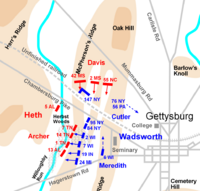
200px-Gettysburg_Day1_1045

Reynolds vs. Heth July 1st

When John Buford saw Reynolds infantry advancing as the Confederates increased the pressure on his outnumbered cavalry, he remarked to a staff member “now we can hold this place.” [27] Buford was not mistaken, when Reynolds rode up to the scene of the battle on Seminary Ridge he greeted Buford, who was in the cupola of the seminary. He called out “What’s the matter John?” to which Buford replied “The devil’s to pay” before he came down to discuss the tactical situation with Reynolds. [28] Buford explained the situation noting that “I have come upon some regiments of infantry…they are in the woods…and I am unable to dislodge them.” [29]

Reynolds needed no other convincing. He asked Buford if he could hold and quickly sent off a number of messages. One officer wrote: “The Genl ordered Genl Buford to hold the enemy in check as long as possible, to keep them from getting into town and at the same time sent orders to Genl Sickles…& Genl Howard to come as fast as possible.” [30]Additionally, Reynolds sent a message to Meade stating: “The enemy are advancing in strong force. I fear they will get to the heights beyond the own before I can. I will fight them inch by inch, and if driven into the town, I will barricade the streets and hold them back as long as possible.” [31] He directed Major Weld of his staff to take it to Meade with all haste as Weld recalled: “with the greatest speed I could, no matter if I killed my horse.” [32] When Meade received the report he was concerned, but with great confidence in Reynolds’s ability he remarked “Good!…That is just like Reynolds; he will hold on to the bitter end.” [33]

After dictating his instructions and sending off his messengers, Reynolds then did what no senior Confederate commander did during the entirety of the battle, he rode back and took personal charge of the movements of his troops to hurry them forward. Unlike Heth who so badly misjudged the tactical situation, he had taken note of the ground and recognized from Buford’s reports that “the Confederates were marching only on that single road and thus would not be able to push their forces to the front any faster than Reynolds could reach the battlefield with his First Corps divisions.”[34] It was a key observation on his part which again allowed him to make appropriate decisions as to how he shaped the battle.

explorepahistory-a0h4p1-a_349

Reynolds leadership at this point might be considered reckless by the standards of our day when senior commanders control battles from miles away with the help of real time intelligence and reporting, including live video feeds, or even the standards of the Second World War. But then in the Civil War a commander in combat could only really control the actions of troops that he could see and because of the time that it took to get messages to subordinate commanders, and the real possibility that verbal orders could be badly misinterpreted in the heat of battle.

Reynolds exercised command directing infantry formations into battle and assisting his artillery battery commanders in the placement of their guns. This was far different than the way that most senior Confederate leaders, including Lee, Longstreet, Hill and Ewell directed their units during the battle of Gettysburg. But such action such action was in keeping with Reynolds’s character, especially in the defense of his home state. Reynolds’ philosophy of command regarding volunteer troops was that they “were better led than driven” [35] and as such he led from the front and Abner Doubleday noted that Reynolds was “inflamed by at seeing the devastation of his native state, was most desirous of getting at the enemy as soon as possible.” [36]

iron brigade forward

“For God’s Sake Forward!” McPherson’s Ridge

John Reynolds recognized that time was of the essence if his forces were to hold the ground west of the town selected a shortcut around the town for First Corps. Those forces were directed across the fields near the Condori farm toward the back side of Seminary Ridge, with Reynolds’ staff helping to remove fences to speed the advance. [37] It was not an easy advance as the troops had to move across the farm fields at an oblique and have to “double-quick for a mile and a quarter in the thick humidity just to reach the seminary.” [38]One member of the corps recalled “I never saw men more willing to fight than they were at Gettysburg.” [39]

Recognizing that “after two full hours of fighting, Buford’s troopers”fighting on McPherson’s Ridge, were “at the limits of their endurance,”Reynolds ordered Wadsworth’s brigades “to bolster the cavalry and oppose the rebel infantry coming at them.” [40]

As troops arrived Reynolds directed them into position. He directed the artillery of Captain James Hall’s 2nd Maine Battery to McPherson’s Ridge instructing Hall “I desire you to damage their artillery to the greatest possible extent, and to keep their fire from our infantry until they are deployed….” [41]

The leading infantry of First Corps was Major General James Wadsworth’s understrength division containing just two brigades, just over 3000 soldiers, its losses from Chancellorsville not being made good and as the result of the loss of regiments discharged because their enlistments had expired. [42] Wadsworth was not a professional soldier, but like many generals on both sides was a political general who despite his lack of military experience was a natural leader of men. Wadsworth was “a vigorous white-haired old man who had been a well-to-do gentleman farmer in New York State before the war” [43] and he “had interrupted his service in the war to run for and lose his state’s governorship the preceding fall.” [44] He ran against the anti-war, anti-administration and frequently pro-Southern Copperhead Horatio Seymour, but he did not leave the army in order return to the state to mount a personal campaign “on the ground that it did not befit a soldier.” [45]

“What the gray haired general lacked in experience and skill, he compensated with a fighting spirit.” [46] Oliver Howard of Eleventh Corps said that Wadsworth was “always generous and a natural soldier” [47]and while Wadsworth was no professional but he performed admirably on July 1st 1863. Wadsworth was beloved by his men because he demonstrated true concern and care for their living conditions and training and on that morning Wadsworth was commanding his division leading it into action with “an old Revolutionary War saber in his hand.” [48] The gallant Wadsworth would be mortally wounded ten months later leading a division of Gouverneur Warren’s Fifth Corps in the opening engagements of the Wilderness. Secretary of the Navy Gideon Welles noted in his diary when Wadsworth died that Wadsworth “should, by right and fair-dealing, have been at this moment Governor of New York…No purer or single-minded patriot than Wadsworth has shown himself in this war. He left home and comforts and wealth to fight the battles of the Union.” [49]

With their gallant commander at their head the division may not have had much in force in the way of numbers, but the units of the division were “good ones,”composed of hardened combat veterans that went into battle with an eye to victory. In the van was Brigadier General Zylander Cutler’s brigade of New Yorkers and Pennsylvanians, the “celebrated Bucktails.” [50] When they were mustered into service the soldiers of the 13th Pennsylvania had adopted a “bucktail” attached to their service caps as a distinctive insignia, a practice that spread to other regiments of the brigade and for which the brigade became known throughout the army.

Cutler had spent much of his early life in Maine working in a number of fields and businesses. He made a fortune several times and lost it, first when his mill burned down, but he rebuilt his businesses and diversified and “as a leading businessman, Cutler was elected to the Maine senate, college trusteeships and a railroad directorship, but he was financially ruined by the panic of 1866 and moved to Milwaukee to start his career over again.” [51] The tough-minded Cutler had some previous military experience fighting Indians as a member of the Maine militia and was made Colonel of the 6th Wisconsin. Cutler was described by one of his soldiers as “being as “rugged as a wolf” and was “a tenacious fighter, a trait that endeared him to the tough-minded Gibbon.” [52] After Antietam Gibbon recommended Cutler for promotion to Brigadier General and command of the Iron Brigade, but Cutler had been wounded at the bloody Battle of Brawner’s Farm and Solomon Meredith gained a promotion and command of that celebrated brigade. However, in on November 29th 1862 having recuperated from his wounds Cutler was promoted to brigadier general and received command of his Bucktails in March of 1863. The brigade saw only minor action at Chancellorsville and Gettysburg would be the fierce brigadier’s first chance since being wounded to command in combat.

This fine brigade was followed by Brigadier General Solomon Meredith’s “Iron Brigade” composed of westerners in their distinctive black “Jefferson Davis” or “Hardie” hats. The brigade had been initially commanded by Major General John Gibbon, now commanding a division in Winfield Scott Hancock’s Second Corps. Gibbon turned the brigade into one of the finest in the army. At the Battle of Turner’s Gap on South Mountain during the Antietam campaign, the brigade earned its name.

After that bloody battle George McClellan exclaimed “They must be made of Iron!” and Hooker replied, “By the Eternal, they are iron! If you had seen them at Bull Run as I did, you would know them to be iron.”[53] In the fierce battle at South Mountain the brigade had lost over a quarter of its strength, but had gained a share of immortality among the ranks of the United States Army. “The Western soldiers immediately seized on this as their title, and the reputation of the brigade and its new name were soon broadcast around Federal campfires.” [54] The regiments of the brigade rivalled many Regular Army units in effectiveness and discipline and “the black hats became their trademark.” [55] Often committed to the fiercest battles the brigade had been decimated, but now along with the Bucktails it advanced up down Seminary Ridge and up the back side of McPherson’s Ridge. A member of an artillery battery who saw the Bucktails and the Iron Brigade advance recalled:

“No one…will ever again see those two brigades of Wadsworth’s Division – Cutler’s and the Iron Brigade – file by as they did that morning. The little creek made a depression in the road, with a gentle ascent on either side, so that from our point of view the column, as it came down the slope and up the other, had the effect of huge blue billows of men topped with a spray of shining steel, and the whole spectacle was calculated to give nerve to a man who never had one before.” [56]

Reynolds directed Cutler’s Bucktails to proceed north of the Cashtown Pike and then “called the Iron Brigade into action on the south side” [57]leading the hearty Westerners himself. Reynolds directed then Wadsworth to take change of the action on the north side of the road while he looked after the left. [58] When Reynolds made that decision he made another. He ordered the 6th Wisconsin of the Iron Brigade into reserve, leaving the Iron Brigade a regiment short but giving him the advantage of having a ready reserve which “permitted them to take full advantage of their interior lines, shift their strength about, and apply it where most needed.” [59]

At about 10:30 the 2nd Wisconsin advanced into the woods Reynolds urged them forward: “Forward men, for God’s sake and drive those fellows out of those woods….” [60] As he looked around toward the seminary to see the progress of reinforcements, Reynolds was struck in the back of the neck by a bullet and fell dead. “Had it come a short time earlier, Reynolds’s death might have thrown the I Corps into fatal confusion.” [61] But Doubleday, who command now fell was up to the task on that sultry July morning.

MenBrooklyn

Cutler’s brigade moved north and engaged Davis’ men near the railroad cut. Here the Cutler’s line was “hardly formed when it was struck by Davis’s Confederate brigade on its front and right flank.” [62] His troops were heavily outnumbered by the advancing Confederates and Davis’ troops initially had the upper hand. In a savage fight they inflicted massive casualties on Cutler’s regiments which outnumbered and being flanked were ordered to withdraw by Wadsworth in order to save them, with the exception of one regiment, the 147th New York nicknamed the Ploughboys which “did not get the order” [63] and though isolated held its ground, “with the support of a fresh six-gun battery whose gunners simply refused to quit.” [64]This was the 2nd Maine Battery under the command of Captain James Hall. Though caught in a cross fire of Rebel artillery and assailed by skirmishers Hall’s artillerymen gamely continued the fight withdrawing by sections, “fighting a close canister range and suffering severely.” [65] The New Yorkers and Hall’s battery battled the Mississippians and the “Ploughboys fell “like autumn leaves; the air was full of lead.” [66]
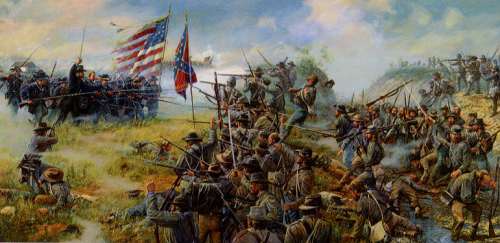
railroad_cut

The inexperienced Davis and his green troops were buoyed by this “gratifying local success” [67] and attempted to exploit it. At this point the Confederates were fatigued by the long march and the fighting and the troops of the 2ndMississippi and 55th North Carolina “were all jumbled together without regiment or company.” [68] Davis attempted to use the unfinished railroad cut “as cover for getting on the enemy’s flank without exposure.” [69]It was a decision that Davis lived to regret. As his troops his units crowed into it, the two regiments of Cutler’s brigade south of the turnpike, the 14th Brooklyn and the 95th New York turned to meet them and were joined by the reserve regiment of the Iron Brigade, the 6nd Wisconsin under Lieutenant Colonel Rufus Dawes. Dawes ordered an immediate advance and called out to Major Edward Pye of the 95th “Let’s go for them Major.” The 6th Wisconsin and the New Yorkers took the Confederates in the flank with enfilade fire, “it was like shooting fish in a barrel.” [70] Dawes’ men slaughtered many of those unfortunate soldiers, and the battle soon became a hand to hand struggle as North Carolinians and Mississippians struggled with the Wisconsin men and New Yorkers.
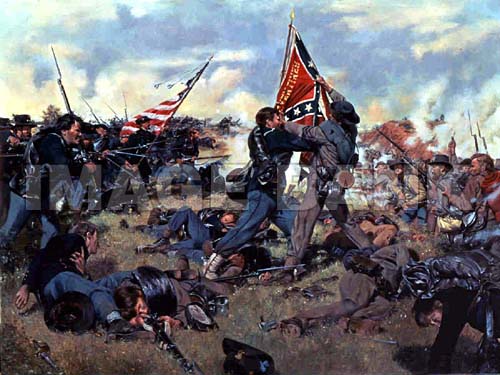
fightforthecolors2la

The melee in and around the cut did not last long:

“for the Confederates were unable to resist their attackers….From the brow of the cut Dawes shouted down to the Confederates below him: “Where is the colonel of this regiment?” A Confederate field officer heard him and replied, “Who are you?” Dawes answered, “I command this regiment. Surrender or I will fire.” [71] Dawes’s men took over 200 prisoners, [72] and the battle flag of the 2ndMississippi. [73]

The charge had last but minutes yet had shattered Joe Davis’s brigade. Davis was wholly unprepared for this reverse and signaled his forces to pull back convinced that “a heavy force was…moving rapidly to our right.” [74] However, the cost to the 6th Wisconsin was great, “Dawes estimated that 160 men of the 6th fell, not including the brigade guard, whose casualties he did not know.” [75]

Brigadier General Solomon Meredith’s Iron Brigade, which had been brought forward by Doubleday hit Archer’s brigade in the front in the woods on McPherson’s Ridge. Meredith was an unmarried North Carolina Quaker who had moved to Indiana in 1840 owning little more than the clothes that he was wearing. He became a farmer but found politics more to his liking and was elected as a county sheriff and to the state legislature. When the war came he was serving as the Clerk of Wayne County. Meredith, like so many volunteer officers on both sides owed much of his advancement in the army to his political connections. In Meredith’s case this was to Meredith’s friend Governor Oliver Morton. Critics of Meredith decried his appointment as Colonel of the 19thIndiana as “a damnable swindle.” [76] Yet Meredith commanded the regiment effectively and received command of the brigade in November 1862. John Gibbon, the regular officer who initially commanded the brigade was critical of Meredith’s appointment but the soldiers appreciated their kind, six-foot seven-inch tall commander who they affectionately knew as “Long Sol.”But despite the carping of his political enemies and the opposition of Gibbon, Meredith like so many others like him who, “extroverted and ambitious by nature, accustomed to asserting themselves, these men did the best that they could, for themselves and their responsibilities, and they somehow sufficed” [77] though they had no formal military training or experience.

As the Iron Brigade advanced toward McPherson’s Ridge and engaged the enemy, Doubleday “urged the men…to hold it all hazards.” Doubleday later wrote that the troops of the brigade, “full of enthusiasm and the memory of their past achievements they said to me proudly, “If we can’t hold it, where will you find men who can?” [78]

Animated by the leadership of Reynolds and now Doubleday they “rushed to the charge, struck successive heavy blows, outflanked and turned the enemy’s right, captured General Archer and a large portion of his brigade, and pursued the remainder across Willoughby Run.”[79] The effect was dramatic as the Iron Brigade overwhelmed Archer’s brigade, whose soldiers now realized they were facing “the first team.” Members of the Iron Brigade recalling the voices of Confederate soldiers exclaiming “Here are those damned black-hat fellers again…’Taint no militia-that’s the Army of the Potomac.” [80] As they attempted to withdraw they piled up at a fence near Willoughby Run and were hit in the flank by “a Michigan regiment that had worked its way around through the woods to the south.” [81] Archer’s Confederates were unable to resist the assault of the Iron Brigade, “Some fled; others threw down their arms and trembling asked where they should go, while others simply dropped their rifles and ducked through the Union formations to the Union rear.”[82]

As for their commander, Archer the ignominy only got worse. “A muscular Irish private in the 2nd Wisconsin ran forward and seized General Archer bodily and made a prisoner of him.” [83] Coddington wrote: “It was a bad moment for the Army of Northern Virginia, and Archer gained the unenviable distinction of being the first of its general officers to be captured after Lee took command.” [84] Doubleday, who knew Archer from the old army, wrote of meeting Archer after that very angry general after had been taken prisoner and roughed up by the aforementioned Private Maloney. Doubleday greeted his old comrade saying: “Archer! I’m glad to see you,” and reached out his hand to greet his friend, to which Archer replied “Well, I’m not glad to see you by a damn sight” and refused to shake Doubleday’s hand. [85]

With the Archer’s brigade whipped and Davis’s in flight Solomon Meredith pulled back the brigade and “was reforming his lines when a shell exploded near him.” [86] Meredith’s horse was killed and fell on him and the tall general was struck in the head by a shell fragment which fractured his skull and rendered him hors d ’combat for the rest of the battle.

Contrary to the reports of many of the Confederates involved, stating that they were outnumbered, some of which have achieved nearly mythic status in some accounts of the battle, the forces engaged were relatively evenly matched. [87]Clifford Dowdey says that the Iron Brigade “heavily outnumbered the one brigade they met. Archer’s….” [88] Such accounts are usually based on the reports of Heth and other confederate commanders. Heth in his after action report wrote that “Archer, encountered heavy masses in his front, and his gallant little brigade, after being almost surrounded by overwhelming forces in front and on both flanks, was forced back….” [89]

However, such was not the case. The reason for this repulse was not that the Union forces had “overwhelming forces” or “greatly superior numbers.” Instead the Archer’s brigade and the Iron Brigade were fairly evenly matched with Archer having about 1,130 men and the Iron Brigade 1,400 while Davis outnumbered Cutler nearly two to one having between 2,400 and 2,600 men in the battle to Cutler’s 1,300. [90]

Following the repulse of Archer and Davis’s brigades by Reynolds’s First Corps, Heth withdrew his badly mauled brigades back to Herr’s Ridge in order to reform them and bring up the brigades of Brockenbrough and Pettigrew before he could resume his attack. In his next assault he would also be supported by Pender’s fresh division which was now coming up.

Coddington notes that the outcome of the opening engagement came down to leadership and “the superior tactical skills of the Northern generals,”who “created a reserve force” with one regiment of the Iron Brigade which “permitted them to take full advantage of their interior lines, shift their strength about, and apply it where most needed.” [91] It was a “calculated risk,” for it assumed that the depleted Iron Brigade could handle Archer’s brigade effectively with only four of their five assigned regiments. [92]Again, even with the loss of Reynolds it was a case of Harry Heth being out-generaled, this time by Abner Doubleday. Heth “had not exercised the close field command by means of which Doubleday had won the brief, furious action.” [93]
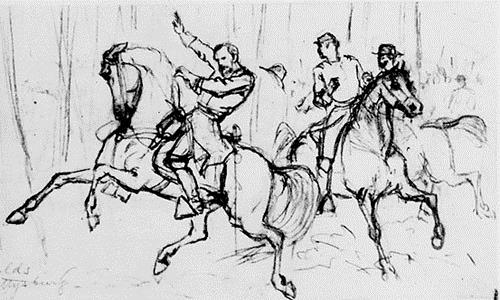
death of reynolds

The Death of Reynolds

Reynolds was dead, but the series of command decisions reached by Reynolds under the pressure of a meeting engagement “where neither side held an immediate advantage” [94] were critical to the army. Likewise, because he had effectively communicated his intent to his subordinate commanders they were able to continue the fight despite his death, and his superiors and successors were able to effectively continue the battle that he had initiated. When he went into action he had “barely a third of his corps available, and confronting a force of unknown size, he had put himself at the head of his troops to lead them in a vigorous attack.” [95]

Though shaken by Reynolds’ loss, the Union troops fought on at McPherson and Seminary Ridge under the command of Doubleday until the assault of Ewell on their left and the arrival of Pender’s fresh division forced them from their positions. However Reynolds’s death was a major blow for the Federal forces for it “removed from the equation the one person with enough vision and sense of purpose to manage this battle.” [96] Despite this Reynolds, by pushing forward with his troops on McPherson’s Ridge ensured that Howard was able to secure Cemetery Hill and Cemetery Ridge, without which Gettysburg would have been lost.

The contrast between Reynolds and his opponents was marked. Hill was ten miles away from the action. Heth was too far to the rear of his troops to direct their advance when they ran into trouble and did not begin to take control until after the brigades of Davis and Archer had staggered “back up the ravine, with Davis’s temporarily wrecked.” [97] In contrast to Heth, Reynolds “hurried to the front, where he was able to inspirit the defense and throw troops into the decisive zone.” [98] At every point in the brief encounter John Reynolds showed himself superior to his opponents as he directed the battle. “Dedicated to an aggressive forward defense in the vanguard of the entire Army of the Potomac, Reynolds, at the cost of his own life had blunted the Rebel thrust and bought valuable time that permitted the balance of Meade’s army to take possession of the coveted high ground….” [99]

Though he paid for his efforts with his life but his sacrifice was not in vain. Reynolds’s tactics “gave the First Corps room for maneuver in front of Gettysburg and upset General Hill’s timetable.” [100] Harry Hunt noted: “…by his promptitude and gallantry he had determined the decisive field of the war, and he opened brilliantly a battle which required three days of hard fighting to close with a victory.” [101]

Notes

[1] Ibid. Pfanz Gettysburg: The First Day p.48

[2] Ibid. Coddington The Gettysburg Campaign: A Study in Command p.261

[3] Ibid. Pfanz Gettysburg: The First Day p.48

[4] Ibid. Coddington The Gettysburg Campaign: A Study in Command, p.261

[5] Ibid. Sears, Gettysburg. p. 158

[6] Nolan, Alan T. The Iron Brigade: A Military History Indiana University Press, Bloomington IN, 1961 and 1994 pp.233-234

[7] Napoleon Bonaparte, Military Maxims of Napoleon in Roots of Strategy: The Five Greatest Military Classics of All Time edited by Phillips, Thomas R Stackpole Books Mechanicsburg PA 1985 p.410

[8] Ibid. Sears, Gettysburg. p. 165

[9] Ibid. Pfanz Gettysburg: The First Day p.49

[10] Ibid. Nolan The Iron Brigade p.233

[11] Trudeau, Noah Andre. Gettysburg: A Testing of Courage, Harper Collins Publishers, New York 2002 p.159

[12] Ibid. Trudeau, Gettysburg: A Testing of Courage p.156

[13] Doubleday, Abner Chancellorsville and Gettysburg: Campaigns of the Civil War VI Charles Scribner’s Sons, Bew York 1882 pp.70-71

[14] Ibid. Doubleday Chancellorsville and Gettysburg p.71

[15] Carpenter, John A. Sword and Olive Branch: Oliver Otis Howard Fordham University Press, New York 1999 p.51

[16] Ibid. Pfanz Gettysburg: The First Day p.76

[17] Green, A. Wilson. From Chancellorsville to Gettysburg: O. O. Howard and Eleventh Corps Leadership in The First Day at Gettysburg edited by Gallagher, Gary W. Kent State University Press, Kent Ohio 1992 p. 70

[18] Ibid. Sears, Gettysburg. p. 158

[19] Keneally, Thomas American Scoundrel: The Life of the Notorious Civil war General Dan Sickles Anchor Books, a Division of Random House, New York 2003 p.275

[20] Swanberg, W.A. Sickles the Incredible Copyright by the author 1958 and 1984 Stan Clark Military Books, Gettysburg PA 1991 p.202

[21] Ibid. Trudeau, Gettysburg: A Testing of Courage p.156

[22] Ibid. Sears, Gettysburg. p. 165

[23] Ibid. Guelzo, Gettysburg: The Last Invasion p.142

[24] Ibid. Nichols Toward Gettysburg p.200

[25] Ibid. Doubleday Chancellorsville and Gettysburg p.68

[26] Ibid. Nolan The Iron Brigade p.235

[27] Ibid. Guelzo, Gettysburg: The Last Invasion p.142

[28] Ibid. Sears, Gettysburg. p. 172

[29] Ibid. Guelzo, Gettysburg: The Last Invasion p.143

[30] Ibid. Trudeau, Gettysburg: A Testing of Courage p.172-173

[31] Schultz, Duane The Most Glorious Fourth: Vicksburg and Gettysburg July 4th 1863. W.W. Norton and Company New York and London, 2002 p.202

[32] Ibid. Trudeau, Gettysburg: A Testing of Courage p.173

[33] Huntington, Tom Searching for George Gordon Meade: The Forgotten Victor of GettysburStackpole Books, Mechanicsburg PA 2013 p.154

[34] Ibid. Sears, Gettysburg. p. 166

[35] Ibid. Coddington The Gettysburg Campaign: A Study in Command, p.277

[36] Doubleday, Abner. Chancellorsville and Gettysburg: Campaigns of the Civil War – VI Charles Scribner’s Sons, New York 1882 p.68

[37] Ibid. Pfanz Gettysburg: The First Day p.75

[38] Ibid. Guelzo, Gettysburg: The Last Invasion p.145

[39] Ibid. Wert The Sword of Lincoln p.275

[40] Foote, Shelby, The Civil War, A Narrative. Volume Two Fredericksburg to Meridian Random House, New York 1963 p.469

[41] Gottfried, Bradley The Artillery of Gettysburg Cumberland House Publishing, Nashville TN 2008 pp.28-29

[42] Ibid. Sears, Gettysburg. p. 34 Sears notes that in between Chancellorsville and Gettysburg, First Division of I Corps had lost a full brigade due to the expiration of enlistments.

[43] Catton, Bruce The Army of the Potomac: Glory Road Doubleday and Company, Garden City New York, 1952 p.270

[44] Ibid. Sears, Gettysburg. p. 34

[45] Ibid. Catton The Army of the Potomac: Glory Road p.271

[46] Ibid. Wert The Sword of Lincoln p.275

[47] Ibid. Howard Autobiography of Oliver Otis Howard 5995 of 9221

[48] Ibid. Catton The Army of the Potomac: Glory Road p.271

[49] Girardi, Robert I. The Civil War Generals: Comrades, Peers, Rivals in Their Own Words Zenith Press, MBI Publishing, Minneapolis MN 2013 p.184

[50] Ibid. Sears, Gettysburg. p. 34

[51] Ibid. Nolan The Iron Brigade p.16

[52] Tagg, Larry The Generals of Gettysburg: The Leaders of America’s Greatest Battle Da Capo Press Cambridge MA 1998 Amazon Kindle Edition p.19

[53] Hebert, Walter H. Fighting Joe Hooker University of Nebraska Press, Lincoln and London 1999. Originally published by Bobbs-Merrill, New York 1944 p.137

[54] Ibid. Nolan The Iron Brigade p.130

[55] Ibid. Nolan The Iron Brigade p. 54

[56] Ibid. Nolan The Iron Brigade p. 234

[57] Ibid. Catton The Army of the Potomac: Glory Road p.271

[58] Ibid. Pfanz Gettysburg: The First Day pp.75-76

[59] Ibid. Coddington The Gettysburg Campaign: A Study in Command, p.275

[60] Ibid. Coddington The Gettysburg Campaign: A Study in Command, p.271

[61] Longacre, Edward G. John Buford: A Military Biography Da Capo Press, Perseus Book Group, Cambridge MA p.194

[62] Ibid. Hunt, The First Day at Gettysburg in Battles and Leaders of the Civil War Volume III, The Tide Shifts p.277
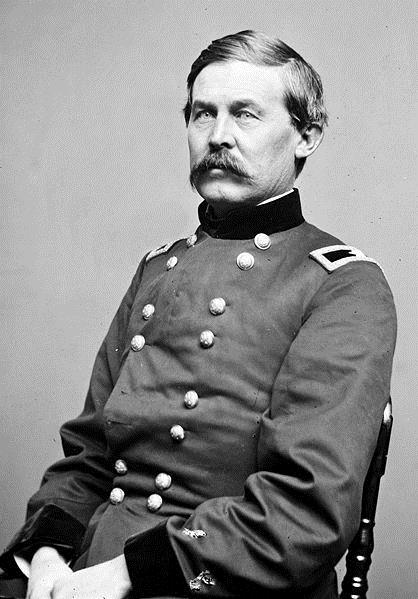
[63] Ibid. Catton The Army of the Potomac: Glory Road p.272

[64] Dowdy, CliffordLee and His Men at Gettysburg: The Death of a Nation Skyhorse Publishing, New York 1986, originally published as Death of a Nation Knopf, New York 1958 p.96

[65] Ibid. Hunt, The First Day at Gettysburg in Battles and Leaders of the Civil War Volume III, The Tide Shifts p.277

[66] Ibid. Pfanz Gettysburg: The First Day p.86

[67] Ibid. Dowdy Lee and His Men at Gettysburg p.96

[68] Ibid. Pfanz Gettysburg: The First Day p.104

[69] Ibid. Dowdy Lee and His Men at Gettysburg p.96

[70] Ibid. Dowdy Lee and His Men at Gettysburg p.97

[71] Ibid. Pfanz Gettysburg: The First Day p.112

[72] Ibid. Guelzo, Gettysburg: The Last Invasion p.153

[73] Ibid. Sears, Gettysburg. p. 178

[74] Ibid. Guelzo, Gettysburg: The Last Invasion p.153

[75] Ibid. Pfanz Gettysburg: The First Day p.109

[76] Ibid. Nolan The Iron Brigade p.20

[77] Ibid. Nolan The Iron Brigade p.173

[78] Ibid. Doubleday Chancellorsville and Gettysburg p.73

[79] Hunt, Henry. The First Day at Gettysburg in Battles and Leaders of the Civil War Volume III, The Tide Shifts. Edited by Robert Underwood Johnson and Clarence Clough Buel Castle, Secaucus NJ p.277

[80] Ibid. Catton The Army of the Potomac: Glory Road p.273

[81] Foote, Shelby, The Civil War, A Narrative. Volume Two Fredericksburg to Meridian Random House, New York 1963 pp.470-471

[82] Ibid. Pfanz Gettysburg: The First Day p.99

[83] Ibid. Catton The Army of the Potomac: Glory Road p.274

[84] Ibid. Coddington The Gettysburg Campaign: A Study in Command, p.271

[85] Ibid. Foote The Civil War, A Narrative. Volume Two Fredericksburg to Meridian p.470

[86] Ibid. Tagg The Generals of Gettysburg p.17

[87] Ibid. Foote The Civil War, A Narrative. Volume Two Fredericksburg to Meridian p.469 Even Foote in his account of Archer’s brigade makes the comment “Staggered by the ambush and outnumbered as they were….”

[88] DowdyLee and His Men at Gettysburg: The Death of a Nation p.95

[89] Luvaas, Jay and Nelson Harold W editors. The U.S. Army War College Guide to the Battle of Gettysburg South Mountain Press, Carlisle PA 1986 p.9

[90] Ibid. Coddington The Gettysburg Campaign: A Study in Command, p.274

[91] Ibid. Coddington The Gettysburg Campaign: A Study in Command, p.274

[92] Ibid. Coddington The Gettysburg Campaign: A Study in Command, p.274

[93] Ibid. Dowdy Lee and His Men at Gettysburg: The Death of a Nation p.97

[94] Ibid. Sears, Gettysburg. p. 168

[95] Ibid. Coddington The Gettysburg Campaign: A Study in Command, p.277

[96] Ibid. Trudeau, Gettysburg: A Testing of Courage p.171

[97] Ibid. DowdyLee and His Men at Gettysburg: The Death of a Nation p.97

[98] Krick, Robert K. Three Confederate Disasters on Oak Ridge: Failures of Brigade Leadership on the First Day of Gettysburg in The First Day at Gettysburg edited by Gallagher, Gary W. Kent State University Press, Kent Ohio 1992 p.113

[99] Ibid. Tagg The Generals of Gettysburg p.12

[100] Ibid. Coddington The Gettysburg Campaign: A Study in Command, p.277

[101] Ibid. Hunt, The First Day at Gettysburg in Battles and Leaders of the Civil War Volume III, The Tide Shifts p.277
1 Comment

Filed under civil war, Gettysburg, History, leadership, Military, us army

“I Will Live and Die under the Flag of the Union.” John Buford, Hero of Gettysburg

Friends of Padre Steve’s World

As I noted yesterday I am going to be posting about the Battle of Gettysburg for the next few days. All of these articles have appeared on my blog before and are part of my text on the Battle of Gettysburg which my agent is shopping to various publishers. This article is about the Union Cavalry commander, General John Buford who would lead a masterful delaying action against Confederate forces far superior to his small division on July 1st 1863. 

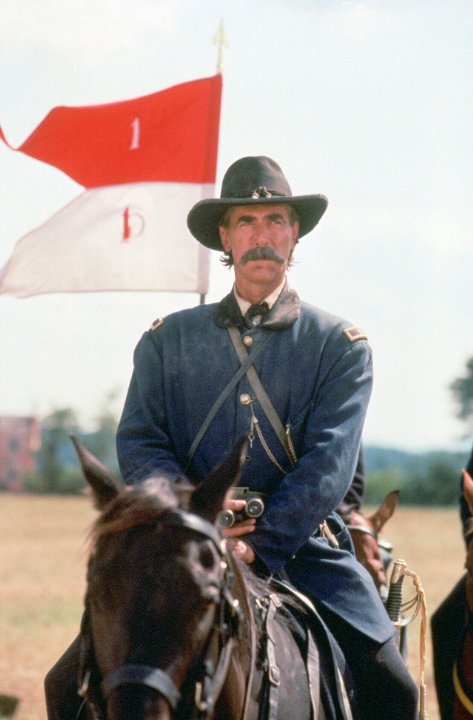
Buford is a fascinating character, played to perfection by Sam Elliott in the movie Gettysburg he was one of the officers whose extraordinary leadership denied Lee a victory at Gettysburg, preserved the Union and led to the defeat of the Confederacy. I hope you enjoy this little piece about a most amazing man. 

Peace

Padre Steve+

buford

“He was decidedly the best cavalry general we had, and was acknowledged as such in the army, though being no friend to newspaper reporters…In many respects he resembled Reynolds, being rough in the exterior, never looking after his own comfort, untiring on the march and in the supervision of all the militia in his command, quiet and unassuming in his manners.” Colonel Charles Wainwright on Buford (Diary of Battle, p.309)

John Buford was born in Kentucky and came from a family with a long military history of military service, including family members who had fought in the Revolutionary War and War of 1812. In fact according to some the family military pedigree reaches back to England’s War of the Roses.

Buford’s family was well off with a spacious plantation near Versailles on which labored forty-five slaves, and his father also established a stage line which carried “passengers and freight between Frankfort and Lexington.”His father divested himself of his property, selling his home, business and slaves and moved to Stephenson Illinois in 1838. [1] The young Buford developed an interest in military life which was enlivened by his half-brother Napoleon Bonaparte Buford who graduated from West Point in 1827, and his brother would be influential in helping John into West Point, which he entered in 1844.

Buford graduated with the class of 1848 which included the distinguished Union artilleryman John Tidball, and the future Confederate brigadier generals “Grumble Jones and “Maryland” Steuart. Among his best friends was Ambrose Burnside of the class of 1847. He did well academically but his conduct marks kept him from graduating in the top quarter of his class.

Upon graduation he was commissioned as a Brevet Second Lieutenant of Dragoons, however too late to serve in Mexico. Instead he was initially assigned to the First United States Dragoons but less than six months after joining was transferred to the Second Dragoons when he was promoted to full Second Lieutenant.

Instead of going to Mexico Buford “spent most of the 1850s tracking and fighting Indians on the Plains.” [2] During this period, the young dragoon served on the Great Plains against the Sioux, where he distinguished himself at the Battle of Ash Creek and on peacekeeping duty in the bitterly divided State of Kansas and in the Utah War of 1858.

His assignments alternated between field and staff assignments and he gained a great deal of tactical and administrative expertise that would serve him well. This was especially true in the realm of the tactics that he would employ so well at Gettysburg and on other battlefields against Confederate infantry and cavalry during the Civil War. Buford took note of the prevailing tactics of the day which still stressed a rigid adherence to outdated Napoleonic tactics which stressed mounted charges and “little cooperation with units of other arms or in the taking and holding of disputed ground.” [3] While he appreciated the shock value of mounted charges against disorganized troops he had no prejudice against “fighting dismounted when the circumstances of the case called for or seemed to justify it.” [4] Buford’s pre-war experience turned him into a modern soldier who appreciated and employed the rapid advances in weaponry, including the repeating rifle with tremendous effect.

Despite moving to Illinois Buford’s family still held Southern sympathies; his father was a Democrat who had opposed Abraham Lincoln. Buford himself was a political moderate and though he had some sympathy for slave owners:

“he despised lawlessness in any form – especially that directed against federal institutions, which he saw as the bulwark of democracy…..He especially abhorred the outspoken belief of some pro-slavery men that the federal government was their sworn enemy.” [5]

After the election of Abraham Lincoln, the officers of Buford’s regiment split on slavery. His regimental commander, Colonel Philip St. George Cooke, a Virginian and the father-in-law of J.E.B. Stewart announced that he would remain loyal to the Union, others like Beverly Robertson who would command a brigade of cavalry during the Gettysburg campaign resigned their commissions.

For many officers, both those who remained loyal to the Union and those who joined the Confederate cause the decision was often difficult, and many anguished over their decisions as they weighed their allegiance to the Union against their loyalty to home and family. Buford was not one of them.

Since Buford’s family had longstanding ties to Kentucky, the pro-secession governor of Kentucky, Beriah Magoffin offered Buford a commission in that states’ militia. At the time Kentucky was still an “undeclared border slave state” and Buford loyal to his oath refused the governor’s offer. He wrote a brief letter to Magoffin and told his comrades that “I sent him word that I was a Captain in the United States Army and I intend to remain one.” [6]Around the same time the new provisional government of the Confederacy “offered Buford a general officer’s commission, which reached him by mail at Fort Crittenden.” [7] According to Buford’s biographer Edward Longacre “a well-known anecdote has him wadding up the letter while angrily announcing that whatever future had in store he would “live and die under the flag of the Union.” [8]

However Buford’s family’s southern ties, and lack of political support from the few remaining loyal Kentucky legislators initially kept him from field command. Instead he received a promotion to Colonel and an assignment to the Inspector General’s Office, although it was not the field assignment that he desired it was of critical importance to the army in those early days of the war as the Union gathered its strength for the war. Buford was assigned to mustering in, and training the new regiments being organized for war. Traveling about the country he evaluated each unit in regard to “unit dress, deportment and discipline, the quality and quantity of weapons, ammunition, equipment, quarters, animals and transportation; the general health of the unit and medical facilities available to it; and the training progress of officers and men.” [9] Buford was a hard and devastatingly honest trainer and evaluator of the new regiments. He was especially so in dealing with commanding officers as well as field and company officers. Additionally he was a stickler regarding supply officers, those he found to be incompetent or less than honest were cashiered.

Buford performed these duties well but desired command. Eventually he got the chance when the politically well-connected but ill-fated Major General John Pope who “could unreservedly vouch for his loyalty wrangled for him command of a brigade of cavalry.” [10] After Pope’s disastrous defeat at Second Bull Run in August 1862 Buford was wounded in the desperate fighting at Second Manassas and returned to staff duties until January 1863 when he was again given a brigade. However, unlike many of the officers who served under Pope, Buford’s reputation as a leader of cavalry and field commander was increased during that campaign.

Buford was given the titular title of “Chief of Cavalry of the Army of the Potomac” by George McClellan, a title which sounded impressive but involved no command during the Antietam campaign. Following that frustrating task he continued in the same position under his old West Point friend Ambrose Burnside during the Fredericksburg campaign. Buford lost confidence in his old friend and was likely “shocked by his friend’s deadly ineptitude, his dogged insistence on turning defeat into nightmare.” [11]

When Burnside was relieved and Fighting Joe Hooker appointed to command the army, Buford’s star began to rise. While he was passed over by Hooker for command of the newly organized First Cavalry division in favor of Alfred Pleasanton who was eleven days his senior, he received command of the elite Reserve Brigade composed of mostly Regular Army cavalry regiments. When Major General George Stoneman was relieved of command following the Chancellorsville campaign, Pleasanton was again promoted over Buford.

In later years Hooker recognized that Buford “would have been a better man for the position of chief” [12] but in retrospect Buford’s pass over was good fortune for the Army of the Potomac on June 30th and July 1st 1863. Despite being passed over for the Cavalry Corps command, Buford, a consummate professional never faltered or became bitter. Despite the Pleasanton’s interference and “lax intelligence-gathering” [13]   During the Gettysburg campaign he led his brigade well at Brandy Station as it battled J.E.B. Stuart’s troopers, after which he was recommended for promotion and given command of the First Cavalry division of the Cavalry Corps. [14]

Following Brandy Station Buford led his troopers aggressively as they battled Stuart’s troopers along the Blue Ridge at the battles of Aldie, Philmont, Middleburg and Upperville. It was at Upperville while fighting a hard action Confederate Brigadier general “Grumble Jones’s brigade that Buford’s troopers provided Hooker with the first visual evidence that Lee’s infantry was moving north into Maryland and Pennsylvania.

burford reynolds monuments

When Hooker was relieved on the night of June 27th and 28th George Meade gave Buford the chance at semi-independent command without Pleasanton looking over his shoulder. Meade appreciated Pleasanton’s administrative and organizational expertise and took him out of direct field command. Meade had his Cavalry Corps commander “pitch his tent next to his own on almost every leg of the trip to Pennsylvania and rarely let him out of sight or earshot.” [15]

One of Meade’s staff officers, Theodore Lyman gave this description of Buford:

“He is one of the best of the officers…and is a singular looking party. Figurez-vous a compactly built man of middle height, with a tawny mustache and a little, triangular gray eye, whose expression is determined, not to say sinister. His ancient corduroys are tucked into a pair of ordinary cowhide boots, his blue blouse is ornamented with holes; from which one pocket thereof peeps a huge pipe, while the other is fat with a tobacco pouch. Notwithstanding this get-up he is a very soldierly looking man. Hype is of a good natured disposition, but is not to be trifled with.” [16]

When he was ordered to screen the army as it moved into Pennsylvania, Buford was confident about his troopers and their ability and he and his men performed their duties admirably. On June 29th Buford’s men skirmished with two of Harry Heth’s regiments near the town of Fairfield, which Buford promptly reported to Meade and John Reynolds after ascertaining their size and composition.

The Battle of Gettysburg would be the zenith of Buford’s career. His masterful delaying action against Harry Heth’s division on July 1st 1863 enabled John Reynold’s wing of the army to arrive in time to keep the Confederates from taking the town and all of the high ground which would have doomed any union assault against them. Following Gettysburg Buford continued to command his cavalry leading his division in a number of engagements. In early November the worn out cavalryman who had been in so many actions over the past year came down with Typhoid. In hopes that he would recover he was told that he would be appointed to command all the cavalry in the West, however his health continued to decline. He was officially promoted to Major General of Volunteers by President Lincoln, over the objection of Secretary of War Stanton who disliked deathbed promotions. “Upon learning of the honor. Buford is supposed to have whispered, “I wish I could have lived now.” [17] He died later that evening, the last words warning his officers “patrol the roads and halt fugitives at the front.” [18]

John Pope wrote of Buford:

“Buford’s coolness, his fine judgment, and his splendid courage were well known of all men who had to do with him… His quiet dignity, covering a fiery spirit and a military sagacity as far reaching as it was accurate made him…one of the best and most trusted officers in the service.” [19]

Sam Elliot as Buford

Buford was buried at West Point and he is immortalized in the monument dedicated to him on McPherson’s Ridge at Gettysburg where he with binoculars in hand looks defiantly west in the direction of the advancing Confederates. The monument is surrounded by the gun tubes of four Union 3” Rifles, three of which were part of Lieutenant John Calef’s Battery which he directed on the fateful morning of July 1st 1863. He was portrayed masterfully portrayed by Sam Elliott in the movie Gettysburg.

Notes

[1] Longacre, Edward G. John Buford: A Military Biography Da Capo Press, Perseus Book Group, Cambridge MA p.17

[2] Ibid. Guelzo. Gettysburg: The Last Invasion p.121

[3] Ibid. Longacre John Buford p.36

[4] Ibid. Longacre John Buford p.36

[5] Ibid. Longacre John Buford p.54

[6] Ibid. Guelzo. Gettysburg: The Last Invasion p.121

[7] Ibid. Longacre John Buford p.70

[8] Ibid. Longacre John Buford p.70

[9] Ibid. Longacre John Buford p.78

[10] Ibid. Guelzo. Gettysburg: The Last Invasion p.121

[11] Ibid. Longacre John Buford p.122

[12] Ibid. Coddington The Gettysburg Campaign, A Study in Command p.44

[13] Ibid. Longacre John Buford p.173

[14] Ibid. Coddington The Gettysburg Campaign, A Study in Command p.64

[15] Longacre, Edward G. The Cavalry at Gettysburg: A Tactical Study of Mounted Operations during the Civil War’s Pivotal Campaign, 9 June-14 July 1863 University of Nebraska Press, Lincoln and London 1986 p.168

[16] Girardi, Robert I. The Civil War Generals: Comrades, Peers, Rivals in Their Own Words Zenith Press, MBI Publishing, Minneapolis MN 2013 p.38

[17] Ibid. Longacre John Buford p.245

[18] Ibid. Longacre John Buford p.246

[19] Ibid. Girardi The Civil War General p.38

2 Comments

Filed under Gettysburg, History, leadership, Military, us army

A Spirit of Unbelief: Confederates Before Gettysburg

Lieutenant General A. P. Hill

Friends of Padre Steve’s World,

I’m hoping to take a few days off from writing about current events and spend a few days reposting some of my writings about the Battle of Gettysburg.

Peace,

Padre Steve+

When Robert E. Lee learned of the Army of the Potomac’s presence north of the Potomac River he ordered his widely dispersed army concentrate near Cashtown and Gettysburg. It was a complicated movement that involved at least five major operations: the shift of the bulk of Ewell’s Second Corps from its planned attack on Harrisburg, the redirection of Early’s division east from its position on the Susquehanna to the west, the movement of Hill’s Third Corps from the area around Cashtown to a position east of Gettysburg, Longstreet’s First Corps north to Chambersburg and Cashtown and the cavalry brigades of Beverly Robertson, Grumble Jones and John Imboden which were to join the army in Pennsylvania. The movement “would take at least two days – the 29th and the 30th of June – and perhaps more…the complete its concentration, especially since the rains had “made the roads very muddy,” forcing “the infantry” to march off the roads….” [1]

Lieutenant General A.P. Hill’s Third Corps that was nearest of Lee’s major units to Cashtown and Gettysburg. Major General Harry Heth’s division led the corps and arrived at Cashtown on June 29th. His division was followed by that of Major General Dorsey Pender which arrived on the 30th. Hill ordered his last division under the command of Major General Richard Anderson to remain behind at “Fayetteville until July 1, when he would join the rest at Cashtown.” [2]

Cashtown was important as a road junction and because it “was situated at one of the few gaps in the Pennsylvania Mountains” and because one of the roads emanating from it “snaked eight miles to another community called Gettysburg.” [3] However the order to concentrate the army at Cashtown presented its own problems. First was the matter of forage. There was not enough room for all the units ordered to Cashtown to have adequate areas to forage, as:

“each division would (by the standard required of nineteenth-century armies) require a circle twelve and a half miles around its encampments to forage (for water, firewood, and feed for men and horses); one single regiment could denuded an acre of woodland just for firewood every three days.” [4]

Likewise, because of the limited road network, Cashtown was becoming a choke point which as his units closed in slowed their movement and created massive traffic problems and confusion. Hill ordered Heth’s division to take the lead and advance to Cashtown on the 29th. The units of Hill’s corps had to endure heavy rains on the 29th which slowed their march and Heth halted at Cashtown knowing that the army would concentrate there while Pender’s division moved into the area his division had vacated.

Early in the morning of June 30th Harry Heth decided to undertake a foraging expedition to Gettysburg to “search the town for army supplies (shoes especially), and to return the same day.” [5] It was the first in a series of miscalculations that brought Lee’s army into a general engagement that Lee wished to avoid and it is hard to comprehend in light of Lee’s orders not to precipitate a fight.

However, the expedition had taken a toll on the soldiers, especially in terms of shoes, clothes and equipment. The “long march over the hard macadam roads of the North had played havoc with the scraggly foot coverings of Lee’s men.” [6] After muster on the morning of June 30th Heth ordered Johnston Pettigrew’s “brigade to Gettysburg in search of supplies, especially badly needed shoes, which were badly needed by his the men of his division.” Heth, for a reason he never elaborated on decided that there must be shoes in Gettysburg. Perhaps he did not know that the town had been picked clean by John Gordon’s brigade of Jubal Early’s division just a few days before, but for whatever reason he believed this to be the case.

Hill’s Third Corps had been formed as part of the reorganization of the army following Stonewall Jackson’s death after the Battle of Chancellorsville. Hill had a stellar reputation as a division commander; his “Light Division” had distinguished itself on numerous occasions, especially at Antietam where its timely arrival after a hard forced march from Harper’s Ferry helped save Lee’s army late in the battle. At Chancellorsville Hill briefly succeeded Jackson until he too was wounded.

Hill was recommended for promotion to Lieutenant General and command of the new Third Corps by Lee on May 24th 1863. He was promoted over the heads of both Harvey Hill and Lafayette McLaws. The move displeased Longstreet who considered Lafayette McLaws “better qualified for the job.” Likewise there were others who felt that the command should have gone to Harvey Hill, now commanding the Department of North Carolina who’s “record was as good as that of Stonewall Jackson…but, not being a Virginian, he was not so well advertised.” [7]

Ambrose Powell Hill was slightly built and high strung. “Intense about everything” Hill was “one of the army’s intense disbelievers in slavery.” [8] Hill was an 1847 graduate of West Point and briefly served in Mexico but saw no combat. He spent some time in the Seminole wars but due to frequent bouts of ill-health he spent much of his career in garrison duty along the East Coast. Since he was prone to sickness he was assigned to the office of Coastal Survey, a Navy command from 1855 through 1861. Despite pleas from his superiors and his own opposition to secession and slavery, Hill resigned his commission just before Virginia’s secession.

At the outbreak of the war he “received his commission as colonel, and soon trained one of Johnston’s best regiments in the Valley.” [9] He commanded a brigade under Longstreet on the Peninsula and was promoted to Major General and command of the Light Division in May 1862, leading it with distinction, especially at Antietam where his march from Harper’s Ferry and timely arrival on the afternoon of September 17th saved the army of Northern Virginia from utter and complete destruction. He was plagued by health problems which had even delayed his graduation from West Point, health issues that would arise on the first day at Gettysburg.

Hill’s Third Corps was emblematic of the “makeshift nature of the reorganization of the whole army.” [10] It was composed of three divisions. His best and most experienced division was that of the recently promoted and hard fighting Major General Dorsey Pender. Pender’s division was built around four excellent brigades from Hill’s old “Light Division” one of which Pender had commanded before his promotion. Hill had strongly recommended Pender’s promotion during the reorganization, a proposal which was accepted by Lee. Pender, though a fierce fighter and excellent leader, found command of a division to be a heavy burden. He was “an intelligent, reflective man, deeply religious and guided by a strong sense of duty….” [11]

Hill’s second experienced division was that of Major General Richard Anderson. This division had been transferred from Longstreet’s First Corps during the reorganization. Longstreet resented losing the division to Hill, with who he had previously run afoul and this was yet another issue which failed to endear Hill to Longstreet. [12]

The unassuming Anderson had distinguished himself as a brigade and division commander in Longstreet’s corps, but in “an army of prima donnas, he was a self-effacing man, neither seeking praise for himself nor winning support by bestowing it on others.” [13] At Chancellorsville Anderson fought admirably and Lee wrote that Anderson was “distinguished for the promptness, courage and skill with which he and his division executed every order.” [14] With four seasoned brigades under excellent commanders it was a good addition to the corps, although the transition from Longstreet’s stolid and cautious style of command to Hill’s impetuous style introduced “another incalculable of the reshuffled army.” [15]

Major General Harry Heth’s division was the final infantry division assigned to Third Corps. The division was new and had was cobbled together from two brigades of Hill’s old Light Division and “the two new brigades that Jefferson Davis had forced on an already disrupted army organization.” [16] The organization of this division as well as its leadership would be problematic in the days to come, especially on June 30th and July 1st 1863. The hasty and makeshift organization under leaders who had not served together, many of who were new to command, as well as units which had not fought together spelled trouble.

Harry Heth, like Dorsey Pender was also newly promoted to his grade and the action at Gettysburg would be his first test in division command. Heth was a native Virginian. He came from a family that well connected both socially and politically. He had a social charm had “many friends and bound new acquaintances to him” readily. [17] Heth was a cousin of George Pickett. He was a West Point graduate and classmate of Hill. At West Point Heth had an undistinguished academic career and graduated last in the class of 1847. His career in the ante-bellum army was typical of many officers, he served “credibly in an 1855 fight with Sioux Indians” but his real claim to fame was in authoring the army’s marksmanship manual which was published in 1858. [18]

Major General Harry Heth

Heth’s career with the Confederate army serving in western Virginia was undistinguished but he was a protégé of Robert E. Lee who recommended him as a brigade commander to Jackson before Chancellorsville. Tradition states that of all his generals that Heth was the only one “whom Lee called by his first name.” [19] A.P. Hill when writing Lee about the choice of a successor for the Light Division noted that Heth was “a most excellent officer and gallant soldier” but in the coming campaign “my division under him, will not be half as effective as under Pender.” [20] Douglas Southall Freeman noted that Heth was “doomed to be one of those good soldiers…who consistently have bad luck.” [21]

Heth’s division was composed of two depleted brigades from the Light Division which had taken heavy casualties at Chancellorsville. One brigade, commanded by the hard fighting former regular army officer Brigadier General James Archer. Archer was from Maryland and a graduate of Princeton University who had given up a law practice to join the army. Described as a “little gamecock” who “had no sense of fear” [22] Archer had saved the Confederate line at Fredericksburg leading a desperate counterattack at Prospect Hill. The brigade was composed of four veteran regiments, but was now down to barely 1200 soldiers in the ranks by the time it arrived at Cashtown. However, the brigade which was recruited from Alabama and Tennessee was “well led and had a fine combat reputation.”

But the second brigade was more problematic. This was the Virginia brigade under the command of “the plodding, uninspiring Colonel John Brockenbrough.” [23] Brockenbrough was an “1850 of the Virginia Military Institute and a farmer,” who had “entered the Confederate service as Colonel of the 40th (Virginia) in May 1861.” [24] The brigade had once been considered one of the best in the army had deteriorated in quality following the wounding of its first commander Brigadier General Charles Field. Heth took command of it at Chancellorsville where both he and the brigade performed well. The brigade had taken very heavy casualties and now was reduced to under 1000 effectives. When Heth was promoted the lack of qualified officers left it under the command of its senior colonel, John Brockenbrough.[25] Lee did not consider Brockenbrough “suited for promotion” but “could be counted on to keep together a command sadly reduced in numbers.” [26]

Heth’s  third brigade came from Mississippi and North Carolina and was commanded by the “stuffy and ambitious” [27] Brigadier General Joe Davis.  Davis’s uncle was President Jefferson Davis. Davis served on his uncle’s staff for months during the early part of the war but had no combat experience, never leading as much as a company. [28] One author noted that Davis’s promotion to Brigadier General was  “as unadulterated an instance of nepotism as the record of the Confederacy offers.” [29] Davis’s subordinate commanders were no better; one of them, William Magruder was so incompetent that J.E.B. Stuart suggested that “he have his commission revoked.” In Magruder’s outfit only one of the nine field grade officers in his brigade had military training, and that was because he was a graduate of the Naval Academy, hardly fitting for service in the infantry. [30] This brigade was also a makeshift operation with two veteran regiments including the 11th Mississippi which had “gone through blood and fire together on the Peninsula through Antietam.” [31] After Antietam, these units were then paired with two new regiments and a new politically connected commander and sent to the backwater of North Carolina where they saw no action. The veteran regiments “mistrusted not only their commander, but the reliability of its yet untested units.” [32]

Brigadier General Johnston Pettigrew

Heth’s largest brigade was new to the army. Commanded by the North Carolina academic Brigadier General Johnston Pettigrew it had no combat experience. Pettigrew himself was considered a strong leader. He had been badly wounded at Seven Pines and thinking his wound mortal “he refused to permit his men to leave the ranks to carry him to the rear.” [33] He was captured but later paroled and returned to the army to command a brigade later in the year.

Hill was under the impression that Meade’s army was still miles away, having just come from meeting Lee who assured him that “the enemy are still at Middleburg,” (Maryland) “and have not yet struck their tents.” [34] With that assurance Heth decided to use June 30th to send Pettigrew’s brigade on the foraging expedition to Gettysburg. An officer present noted that Heth instructed Pettigrew “to go to Gettysburg with three of his regiments present…and a number of wagons for the purpose of collecting commissary and quartermaster stores for the use of the army.[35]

However Heth did instruct Pettigrew in no uncertain terms not to “precipitate a fight” should he encounter “organized troops” of the Army of the Potomac. [36] Heth was specific in his report that “It was told to Pettigrew that he might find in the town in possession of a home guard,…but if, contrary to expectations, he should find any organized troops capable of making resistance., or any part of the Army of the Potomac, he should not attack it.” [37]

That in mind anyone with the slightest experience in handling troops has to ask the question as to why Heth would employ “so many men on a long, tiring march, especially as without a cavalry escort he took the risk of sending them into a trap” when his “objects hardly justified” using such a large force. [38] Edwin Coddington is particularly critical of Heth in this regard.

Likewise it has to be asked why the next day in light of Lee’s standing orders not to provoke an engagement that Hill would send two divisions, two thirds of his corps on what was supposedly reconnaissance mission. Some have said that Hill would have had to move to Gettysburg on July 1st anyway due to forage needs of the army, [39] but this is not indicated in any of Hill or Heth’s reports.

As his troops neared Gettysburg Pettigrew observed the Federal cavalry of Buford’s 1st Cavalry Division as they neared the town. He received another report “indicating that drumming could be heard in the distance – which might mean infantry nearby, since generally cavalry generally used only bugles.” [40] He then prudently and in accordance with his orders not to precipitate a fight “elected to withdraw rather than risk battle with a foe of unknown size and composition.” [41] His troops began their retrograde at 11 a.m. leaving Buford’s cavalry to occupy the town at ridges. One Confederate wrote “in coming in contact with the enemy, had quite a little brush, but being under orders not to bring a general engagement fell back, followed by the enemy.” [42]

Upon returning Pettigrew told Hill and Heth that “he was sure that the force occupying Gettysburg was a part of the Army of the Potomac” but Hill and Heth discounted Pettigrew’s report. [43] “Heth did not think highly of such wariness” and “Hill agreed with Heth” [44] Hill believed that nothing was in Gettysburg “except possibly a cavalry vedette.” [45] Hill was not persuaded by Pettigrew or Pettigrew’s aide Lieutenant Louis Young who had previously served under both Hill and Pender. Young reported that the “troops that he saw were veterans rather than Home Guards.” [46] Hill reiterated to both that he did not believe “that any portion of the Army of the Potomac was up” but then according to Young Hill “expressed the hope that it was, as this was the place he wanted it to be.” [47] 

Part of the issue was related to the fact that Pettigrew, though highly intelligent, and who had been an observer of wars in Europe was not a professional soldier. Likewise, since had was new to the Army of the Northern Virginia he was an unknown to both Hill and Heth. As such they dismissed his report. In their casual dismissal of Pettigrew’s report, the West Point Graduates Hill and Heth may have manifested an often typical “distain for citizen soldiers…a professional questioning a talented amateur’s observations” [48]

Pettigrew was “aghast at Hill’s nonchalant attitude” [49] while Young was dismayed and later recalled that “a spirit of unbelief” seemed to cloud the thinking of Hill and Heth. [50] In later years Young wrote that the “blindness in part seems to have come over our commanders, who slow to believe in the presence of an organized army of the enemy, thought that there must be a mistake in the report taken back by General Pettigrew.” [51]

Since neither man believed Pettigrew’s report, Heth asked Hill “whether Hill would have any objection to taking his division to Gettysburg again to get those shoes.” Hill replied “none in the world.” [52] It was to be a fateful decision, a decision that brought about a series of events which in turn led to the greatest battle even fought on the American continent.

Lee’s biographer and apologist Douglas Southall Freeman wrote “On those four words fate hung” [53] and in “that incautious spirit, Hill launched Harry Heth’s division down the Chambersburg Pike and into battle at Gettysburg.” [54]

Notes

[1] Guelzo, Allen C. Gettysburg: The Last Invasion Vintage Books a Division of Random House, New York 2013 p.128

[2] Coddington, Edwin B. The Gettysburg Campaign, A Study in Command A Touchstone Book, Simon and Shuster New York 1968 p.194

[3] Robertson, James I. Jr. General A.P. Hill: The Story of a Confederate Warrior Random House, New York 1987

[4] Ibid. Guelzo, Gettysburg: The Last Invasion p.128

[5] Ibid. Coddington, The Gettysburg Campaign, A Study in Command p. 263

[6] Ibid. Robertson A.P. Hill p.205

[7] Foote, Shelby, The Civil War, A Narrative. Volume Two Fredericksburg to Meridian Random House, New York 1963 p.453

[8] Ibid. Dowdy, Lee and His Men at Gettysburg: The Death of a Nation p.79

[9] Ibid. Freeman Lee’s Lieutenant’s a Study in Command p.109

[10] Ibid. Dowdy, Lee and His Men at Gettysburg: The Death of a Nation p.88

[11] Ibid. Dowdy, Lee and His Men at Gettysburg: The Death of a Nation p.85

[12] Ibid. Dowdy, Lee and His Men at Gettysburg: The Death of a Nation p.86

[13] Ibid. Dowdy, Lee and His Men at Gettysburg: The Death of a Nation p.86

[14] Ibid. Freeman Lee’s Lieutenant’s a Study in Command p.512

[15] Ibid. Dowdy, Lee and His Men at Gettysburg: The Death of a Nation p.86

[16] Ibid. Dowdy, Lee and His Men at Gettysburg: The Death of a Nation p.87

[17] Ibid. Freeman Lee’s Lieutenant’s a Study in Command p.527

[18] Krick, Robert K. Three Confederate Disasters on Oak Ridge: Failures of Brigade Leadership on the First Day of Gettysburg in The First Day at Gettysburg edited by Gallagher, Gary W. Kent State University Press, Kent Ohio 1992 p.96

[19] Ibid. Krick. Three Confederate Disasters on Oak Ridge p.96

[20] Ibid. Freeman Lee’s Lieutenant’s a Study in Command p.527

[21] Ibid. Freeman Lee’s Lieutenant’s a Study in Command p.46

[22] Ibid. Guelzo, Gettysburg: The Last Invasion p.134

[23] Sears, Stephen W. Gettysburg. Houghton Mifflin Co. Boston and New York 2003 p.55

[24] Pfanz Harry W. Gettysburg: The First Day University of North Carolina Press, Chapel Hill and London 2001 p.118

[25] Ibid. Dowdy, Lee and His Men at Gettysburg: The Death of a Nation p.87

[26] Ibid. Freeman Lee’s Lieutenant’s a Study in Command p.529

[27] Ibid. Guelzo, Gettysburg: The Last Invasion p.133

[28] Ibid. Freeman Lee’s Lieutenant’s a Study in Command p.533

[29] Ibid. Krick. Three Confederate Disasters on Oak Ridge p.99

[30] Ibid. Krick. Three Confederate Disasters on Oak Ridge p.101

[31] Ibid. Guelzo, Gettysburg: The Last Invasion p.134

[32] Ibid. Guelzo, Gettysburg: The Last Invasion p.134

[33] Ibid. Freeman Lee’s Lieutenant’s a Study in Command p.136

[34] Ibid. Guelzo, Gettysburg: The Last Invasion p.131

[35] Trudeau, Noah Andre. Gettysburg: A Testing of Courage, Harper Collins Publishers, New York 2002 p.128

[36] Ibid. Sears Gettysburg p.136

[37] Ibid. Trudeau Gettysburg: A Testing of Courage, p.129

[38] Ibid. Coddington, The Gettysburg Campaign, A Study in Command p. 263

[39] Ibid. Guelzo. Gettysburg: The Last Invasion p.131 This argument does have merit based on the considerations Guelzo lists but neither Hill, Heth or Lee make any mention of that need in their post battle reports.

[40] Ibid. Trudeau Gettysburg: A Testing of Courage, p.130

[41] Gallagher, Gary. Confederate Corps Leadership on the First Day at Gettysburg: A.P. Hill and Richard S. Ewell in a Difficult Debut in The First Day at Gettysburg edited by Gallagher, Gary W. Kent State University Press, Kent Ohio 1992 p.42

[42] Ibid. Trudeau Gettysburg: A Testing of Courage, p.135

[43] Ibid. Coddington, The Gettysburg Campaign, A Study in Command pp. 263-264

[44] Foote, Shelby, The Civil War, A Narrative. Volume Two Fredericksburg to Meridian Random House, New York 1963 p.465

[45] Ibid. Pfanz Gettysburg: The First Day p.27

[46] Ibid. Gallagher, Gary. Confederate Corps Leadership on the First Day at Gettysburg p.42

[47] Ibid. Pfanz. Gettysburg: The First Day p.27

[48] Ibid. Gallagher, Gary. Confederate Corps Leadership on the First Day at Gettysburg p.42

[49] Ibid. Guelzo. Gettysburg: The Last Invasion p.131

[50] Ibid. Coddington, The Gettysburg Campaign, A Study in Command p. 264

[51] Ibid Pfanz Gettysburg: The First Day p.27

[52] Ibid. Coddington, The Gettysburg Campaign, A Study in Command p. 264

[53] Ibid. Freeman Lee’s Lieutenant’s a Study in Command p. 563

[54] Ibid. Krick. Three Confederate Disasters on Oak Ridge p.94

5 Comments

Filed under civil war, Gettysburg, History, leadership, Military, us army

By Then It Was Too Late: Reflections on a Supreme Court Retirement

27-justice-anthony-kennedy.w710.h473

Friends of Padre Steve’s World,

In his book They Thought they Were Free Milton Mayer wrote of his conversation with a German university professor colleague after the Second World War:

“How is this to be avoided, among ordinary men, even highly educated ordinary men? Frankly, I do not know. I do not see, even now. Many, many times since it all happened I have pondered that pair of great maxims, Principiis obsta and Finem respice—‘Resist the beginnings’ and ‘Consider the end.’ But one must foresee the end in order to resist, or even see, the beginnings. One must foresee the end clearly and certainly and how is this to be done, by ordinary men or even by extraordinary men? Things might have. And everyone counts on that might.

“Your ‘little men,’ your Nazi friends, were not against National Socialism in principle. Men like me, who were, are the greater offenders, not because we knew better (that would be too much to say) but because we sensed better. Pastor Niemöller spoke for the thousands and thousands of men like me when he spoke (too modestly of himself) and said that, when the Nazis attacked the Communists, he was a little uneasy, but, after all, he was not a Communist, and so he did nothing; and then they attacked the Socialists, and he was a little uneasier, but, still, he was not a Socialist, and he did nothing; and then the schools, the press, the Jews, and so on, and he was always uneasier, but still he did nothing. And then they attacked the Church, and he was a Churchman, and he did something—but then it was too late.”

I feel that if we already haven’t reached to point of things being too late that we are not far from that point and we are closer now with the Justice Anthony Kennedy’s announcement of his retirement from the Supreme Court.

Kennedy announced his retirement yesterday after siding with so-called conservatives on President Trump’s Executive Order targeting Muslims primarily from Iran as supposed security threats. It was an ignominious exit from the Supreme Court for a man who though certainly conservative often acted as the conscience of the court who wrestled with difficult issues and sometimes sided with liberals such in the Obergfell v. Hodges case that at least for now legalized marriage equality.

The decision regarding the Executive Order overturned the decision of Korematsu v. United States which upheld the military orders to send Americans of Japanese descent to detention centers, what in were effect American Concentration Camps. JThat ruling along with Dred Scott and Plessy v. Ferguson is considered one of the most unjust in American history. Justice Robert Jackson who later presided as the organizer and chief prosecutor at the Nuremberg War Crimes Trials wrote in dissent of that ruling:

“A military commander may overstep the bounds of constitutionality, and it is an incident. But if we review and approve, that passing incident becomes the doctrine of the Constitution. There it has a generative power of its own, and all that it creates will be in its own image. Nothing better illustrates this danger than does the Court’s opinion in this case.” 

That is the danger of the Executive Order that the Court upheld. Justice Roberts used the twisted logic of Korematsu to uphold the ruling even as he overturned Korematsu. Justice Kennedy concurred and then retired from the Court leaving a vacancy that will almost be certainly filled by a young, aggressive, and doctrinaire conservative of the new order, unrestrained by precedent or principle. Unless the Democrats go Full Bork Jacket and at least two Republicans grow a set of balls civil rights, civil liberties, and the Constitution are doomed.

The man that nominates Kennedy’s successor is even now under investigation for actions that could be considered by a reasonable person as treason against the United States. That man is the President and almost every day he uses power of his office to demonize any opposition and to dehumanize racial, ethnic, and religious minorities while attacking the freedoms enshrined in the Constitution to free speech and the freedom of the press by referring to his critics as “enemies of the people.” 

The President has invoked violence against his opponents since he was a candidate and then cries foul when political opponents urge non-violent resistance to include the public shaming of his staff members and Cabinet officials who plan (Stephen Miller), execute (Kirstjen Nielsen), and defend (Sarah Huckabee Sanders) his actions against helpless people who he labels as murderers, rapists, and criminals.

Sadly most are refugees from political and criminal persecution and violence in their countries, countries that since the 1840s Americans or the United States Government have treated as subhumans. What is happening now is the result of our past polcies coming home to roost.

Marine Corps Major General and two time Medal of Honor Recipient Smedley Butler wrote in his book War is a Racket:

“I spent 33 years and four months in active military service and during that period I spent most of my time as a high class muscle man for Big Business, for Wall Street and the bankers. In short, I was a racketeer, a gangster for capitalism. I helped make Mexico and especially Tampico safe for American oil interests in 1914. I helped make Haiti and Cuba a decent place for the National City Bank boys to collect revenues in. I helped in the raping of half a dozen Central American republics for the benefit of Wall Street. I helped purify Nicaragua for the International Banking House of Brown Brothers in 1902-1912. I brought light to the Dominican Republic for the American sugar interests in 1916. I helped make Honduras right for the American fruit companies in 1903. In China in 1927 I helped see to it that Standard Oil went on its way unmolested. Looking back on it, I might have given Al Capone a few hints. The best he could do was to operate his racket in three districts. I operated on three continents.”

Despite the fact that the United States has been interfering and exploiting their countries for almost two centuries they are criminals because they want to be free. Their crime is being refugees after the United States instituted race based immigration policies in the early 1900s. These policies were later used to deny Jews fleeing the Holocaust from coming to the United States.

Justice Kennedy left after a series of rulings which seemed to undermine his past judicious behavior on the bench. Maybe at 82 years old he simply decided to punt and place his vote in the column of men who gut the Voting Rights Act, support gerrymandered Congressional districts, and support Executive Orders that while refuting the notorious Supreme Court Decision of Korematsu v. United States used the same logic as that majority used to uphold the President’s third attempt at a travel ban directed a Muslims, primarily Iranians. Japanese Americans who suffered under the military orders enforced by civilian courts and upheld by Korematsu were appalled with good reason.

I am going to leave it there for the night.

Until tomorrow,

Peace

Padre Steve+


Leave a comment

Filed under civil rights, ethics, faith, laws and legislation, leadership, LGBT issues, News and current events, Political Commentary

“Silence in the Face of Evil is Evil Itself” A Critique of Politeness and Civility When Confronting Injustice and Evil

Friends of Padre Steve’s World,

Dietrich Bonhoeffer wrote the words “silence in the face of evil is evil itself.”

This is a very difficult article to write because truthfully I believe that civility and mutual respect should be an ideal that we as Americans should not retreat from, as John F. Kennedy noted:

“So let us begin a new remembering on both sides that civility is not a sign of weakness, and sincerity is always subject to proof. Let us never negotiate out of fear. But let us never fear to negotiate.”

I have written about that a number of times, the last being on November 22nd 2016 shortly after President Trump’s election and on the anniversary of Kennedy’s assassination. However, since that time I have seen the President lead a descent into depravity that I fully comprehended then, though I hoped for a different outcome.

The fact is that the President has in his words, deeds, and tweets destroyed any hope of our political divide being healed, or of Americans of different viewpoints being able to reconcile their differences anytime in the foreseeable future. He stokes the hatred and division almost on an hourly basis, and of course his opponents having become wise to him are rolling up their sleeves and fighting back.

Too me that is an unfortunate situation that might become a tragedy for the United States and the world, as Abraham Lincoln noted “a house divided against itself cannot stand.” To GOP Congressman Steve King of Iowa the sight and sound of Trump’s opponents is like “Harpers Ferry” and what comes next will be “Fort Sumter.” Since King proudly displays the Confederate Battle Flag in his office I know exactly what side of this fight that he is on.

The fact is that he and many like him want bloodshed, they want Civil War, they want to remake the Union in a way that Jefferson Davis and his band of traitors failed to do. As a historian of the period with a book awaiting publication the fact is that in the end it comes down to the fact that King, many of the President’s supporters and quite probably the President himself are all White Supremacists. They want a full and complete return to White Man’s Rule and the subservience of all non-white races and non-Christian religions to it. They are the Know Nothings of the North and Slave Power Secessionists of the South rolled into one package of ignorance, incivility, and hatred.

I write often about comparisons of the attitudes and actions administration and its supporters to Nazi Germany, but truth be told there is a lot of dirty laundry in our own history that sheds light on Trump and his supporters.

The fact is that for nearly three decades the vast majority of Northerners were too polite to criticize the egregious actions of the Know Nothings in their midst or the Southern Slave Power Block that dominated the presidency, Congress, and the Supreme Court for the three decades prior to the War of the Rebellion, also known as the American Civil War, or the War Between the States. Honestly, I think that the term ascribed to it by many Union Veterans in the Grand Army of the Republic after the war, the “War of the Rebellion” is the best.

Those opposed to the Know Nothings and Slave Power Block were condemned as being rude, impolite, and worse. Some were physical assaulted. In 1856 Senator Charles Sumner was attacked by Representative Preston Brooks of South Carolina on the floor of the Senate for his speech against the Kansas Nebraska Act. Sumner was beaten until he was unconscious and Brooks’ heavy cane which he used to conduct the attack broke. Brooks continued to beat Sumner aided by Representative Lawrence Keitt also of South Carolina who brandishing a pistol threatened Senators coming to his aid. Sumner has proclaimed no threats of violence but only spoken the truth about the Act and those that supported it. So much for civility and now.

The scurrilous and overtly violent threats against minorities and civil rights advocates by conservatives, especially White Christian conservatives have continued unabated since from the ante-Bellum South and the Know Nothing North, through the War of the Rebellion, Reconstruction, Jim Crow, to the modern day. Whole political campaigns including that of George H.W. Bush run by Lee Atwater turned on the demonization of African Americans. The same is true regarding the Republican revolution led by Newt Gingrich in the 1990s, and again even more so from the time that Candidate Donald Trump descended to the lobby of Trump Tower in 2015 until now. The President proclaims that White Supremacists and Neo-Nazis are “very fine people.”

The President and many of his followers including administration officials like Stephen Miller set the tone while Presidential spokesperson Sarah Huckabee Sanders lies and denies the President’s words and vilifies anyone that dares to question her. So when she is asked to leave a restaurant, or when Miller or DHS Secretary Nielsen are shamed when trying to enter Mexican restaurants it makes makes my heart bleed. People who have no compassion, no sense of empathy and behave as sociopaths and then act the victim when the tables are turned only deserve scorn.

Their anti-immigrant and often blatantly racist tropes of the President, his administration, and his supporters on the Fox Propaganda Network, the Right Wing media, the Putrid Princes of the Captive Conservative Church, and his assorted sordid supporters should be condemned and opposed around the clock. If they are not then any of us who remain silent knowing the evil of these policies is as guilty as anyone that turned their backs on the Jews in Nazi Germany. The higher the office the greater the guilt and culpability.

That being said if had the chance to see any one of them in a public setting I would not resort to public shaming. I do not own a restaurant or business so I could not ask them to leave. However, that being said if any of them the President himself presented themselves to me at my chapel or any civilian church that I might be celebrating the Eucharist I would deny them communion which from a Christian point of view is “a fate worse than a fate worse than death.”

Bonhoeffer wrote:

“Christianity stands or falls with its revolutionary protest against violence, arbitrariness and pride of power and with its plea for the weak. Christians are doing too little to make these points clear rather than too much. Christendom adjusts itself far too easily to the worship of power. Christians should give more offense, shock the world far more, than they are doing now. Christian should take a stronger stand in favor of the weak rather than considering first the possible right of the strong.”

As for me I must tell the truth and protest against the violence and the arbitrary pride of power exhibited by the Trump administration and its supporters. I could not live with myself if I didn’t do so. Some might think this political and in some sense it is, but it is entirely based on my understanding of the Christian faith and the very premise of the founders of this country, that phrase in the Declaration of Independence that “all men are created equal and endowed by their creator with certain unalienable rights, among them being life, liberty, and the pursuit of happiness.”

If need be I would die for that faith and that proposition and I will not be silent in the face of evil.

So until tomorrow,

Peace,

Padre Steve+

3 Comments

Filed under christian life, civil rights, ethics, faith, History, laws and legislation, News and current events, Political Commentary, Religion

The Day I Came to Love Iran: Reflections on the World Cup, Sports, and our Common Humanity

Friends of Padre Steve’s World,

I have a confession to make. After I watched Iran play its first match in the World Cup against Morocco I was hooked, and I hoped that they would advance at least into the round of 16. The plucky Iranian team defeated Morocco, lost to Spain by a score of just 1-0 and tied Portugal today with a score of 1-1. Their fans cheered their team with the enthusiasm that any American would do for our teams in any sport, and many of their fans took the time to protest policies of the Iranian government and Revolutionary Guard. Honestly, eight or twelve years ago I wouldn’t have gotten past the blood sport of international politics and hatred of what I considered to be an enemy. But sports can help build bridges between people that might otherwise be unbridgeable.

I remember my first meeting with an Iranian, it was back when Iran was an ally of the United States and I was a Navy Junior ROTC cadet undergoing training at NTC San Diego. He was an Iranian Navy Lieutenant, since I recognized him as an officer I saluted and he replied. When the Iranian Revolution came I was stunned because I figured that the Shah must have been a good guy, but that was before I learned of how he had come to power and the CIA had overthrown a democratically elected government to put him in power and how he and his secret police did horrific things to the Iranian people.

Let me say as well that I never was a fan of the Ayatollahs or their stormtrooper like Republican Guard and their abuse of human rights or sponsorship or terrorism. That being said there was a moment in time that occurred after the attacks of September 11th 2001 when the Iranians offered their sympathy to us and support for us against Al Qaida. Instead the Bush Administration turned them down and then labeled them as part of the Iraqi and North Korean “Axis of Evil.” Of course that was an incredibly stupid act of hubris since none of the three actually had any connection to Bin Laden and Al Qaida and even more stupidly many Americans including me believed the lies.

But it wasn’t long after that when deployed to the Arabian Gulf about the cruiser USS HUE CITY that I saw Iranian regular Navy ships as well as Coast Guard vessels steer Iraqi smugglers out of their territorial waters and into our hands. The Revolutionary Guard Naval Forces were a different matter, some of their boats harassed our task force flagship, the HMAS Manora and we almost went to war before they withdrew. Of course we ended up invading Iraq which likewise was an enemy of Al Qaida throwing it into chaos and basically handing Iran’s hard liners a victory. But all of that is history.

I have known other Iranians and people of Iranian dissent. Every single one of them has been a wonderful human being. I may oppose the Ayatollahs and the Revolutionary Guards including their actions in Iraq, Syria, and supporting Hezbollah, but I do really believe that if the United States behaved with any kind of moderation towards Iran that the majority of people born after the Revolution and yearning for freedom would overthrow them. I think that the Iranian fans at the World Cup demonstrated more of what Iran is much more than the Ayatollahs or Revolutionary Guard. In fact even during this game there were large demonstrations against the regime in Iran.

I watched Iran’s games against Morocco, Spain, and Portugal and they earned my respect. They didn’t advance to the knockout round but they showed such poise and determination that I could not hope but to hope that they would make it to the next stage. I guess that partly because I have seen the United States do in the World Cup when we have made it into the Cup. I like underdogs unless they are playing against Germany, which I think I have mentioned that I have a rather strong attachment to, but again I digress.

I guess that what I mean to say is that I really do care for the people of Iran. Likewise I hope that the Trump administration will not blunder us into a war with them or push the Iranian people to support a government that most of them despise simply because they feel that they need to defend their country.

Maybe that doesn’t make sense to people who simply hate the Iranians and Muslims based on their nationality, religion, and race. But then I have really stopped caring what such people think about me because in spite of everything I look forward to the day that we can live in peace because having been to war I am tired of it.

Until tomorrow,

Peace

Padre Steve+

Leave a comment

Filed under life, Loose thoughts and musings, middle east, News and current events, sports and life

Celebrating 35 Years of Marriage to the Kindest, Sweetest, Prettiest Person I’ve Ever Met In My Life…

Friends of Padre Steve’s World,

Thirty-five years ago today I married the love of my life and despite many stupid and thoughtless actions we are still married and probably happier than we have ever been. We have been spending the weekend with dear friends and the combined 12 Papillon dogs we have. It has been very nice, relaxing and fun.

It has also been a time for me to recharge my batteries because when we return home tomorrow I will have much to do at work as well as at home as we start to repair and renovate our home after the flooding event we experienced. By then we should hopefully have the insurance settlement to allow us to do what we need after the initial contractor provided by the insurance company wanted thousands of dollars more than the estimate they provided to do what we asked. Today we will go to dinner and celebrate at a restaurant that I like in D.C., but I digress…

We got married just six days after I was commissioned as a Second Lieutenant in the U.S. Army. Three of the men I was commissioned with were in the wedding and I am still in contact with a number of others. We had met almost five years before at San Joaquin Delta College in Stockton, California. I fell in love with her that night.

Our marriage has been a long strange trip, not that there is anything wrong with that. Military life, separations due to deployments and war have been part of our life. Judy has had to endure more than I can imagine to stay with me all these years. She is simply the best. She is creative, talented, kind, resourceful, considerate, and amazingly patient. I have seen her go out of her way to be kind and giving to people just because that’s who she is.

Honestly I fell in love with her the day that we met. When I first asked her on a date a few months later I was so nervous that she thought I was going to ask her to marry me. I loved her and wanted to marry her but I could barely stammer out “would you like to go to a movie?” Thankfully she said yes, otherwise I would have never gotten to the whole marriage thing.

When I think of her I think of what Bill Murray’s character in Groundhog Day, said to Andie McDowell in that movie:

I think you’re the kindest, sweetest, prettiest person I’ve ever met in my life. I’ve never seen anyone that’s nicer to people than you are. The first time I saw you… something happened to me. I never told you but… I knew that I wanted to hold you as hard as I could. I don’t deserve someone like you. But if I ever could, I swear I would love you for the rest of my life.

I still do. So to the most amazing and talented woman in the world, I love you, even more than I did that night we first met.

So to all,of our friends, and to all thank you for being a part of our lives.

Peace,

Padre Steve+

5 Comments

Filed under life, Loose thoughts and musings, marriage and relationships

Friends, Papillons, World Cup, and the Padre’s Pizza

Friends of Padre Steve’s World,

It has been a nice day with our friends in the DC area and our Papillon dogs. It was very relaxing, I got to sleep late, enjoy a nice home cooked breakfast with our friends. After that I retreated to the basement where I watched two World Cup games, Mexico vs. South Korea, and Germany vs. Sweden with Pierre and Izzy beside me on the couch.

Since I have been a fan of the German Mannschaft since mid-1980s when I first took an interest in the soccer with Bayern Munich and the National Team I have become a more and more serious follower of international soccer. I have to say that I really get into well played games especially when my teams are playing and when games are close and my team is on the verge of either advancing to another round or being eliminated things can become very tense, not that the world will end or anything like that, but sometimes it feels like it.

It was like that today when Germany, the reigning champions had to come back to avoid being eliminated in the group stage for the first time since before WWII. In fact they have reached the semifinals the past four World Cups. Tony Kroos the German National who plays for Real Madrid scores the winning goal in the 95th minute, which not only kept Germany alive but set them up well to advance if they defeat South Korea and Mexico with wins or ties against Sweden. Needless to say I will be cheering for Mexico as hard as will be Germany on Wednesday morning.

After the game I went back upstairs, relaxed and socialized and then made The Padre’s Pizza.

What most people don’t know about me is that I worked some of my way through college and seminary working in pizza parlors. While I was on my first active duty tour in the Army I began to experiment with my own pizza dough and sauce recipes and over the years I have become quite well known to my close friends for it. It’s a lot of work because I take the time to craft each pizza, and despite the work I find it very relaxing and good for stress relief. I should do it more often at home.

I love doing it. I love making the dough to perfection, seeing it rise, and turning it into a pizza dough. I love cutting the vegetables so that they not only look good but cook perfectly. I love crafting the sauce with my own blend of spices. Then I love building the pizza so that when it cooks that it looks as spectacular as it tastes. There really is an art to it you don’t see every day.

Tonight I made large two 16″ New York style pizzas topped with mozzarella, provolone, Romano, and Parmesan cheeses, pepperoni, Italian sausage, fresh mushrooms, Roma tomatoes, and garlic, peperocini peppers, and Kalamata olives. I also whipped up a pizza crust which became garlic bread.

Sometimes people ask me why I don’t try to start a pizza parlor, but truthfully I do is truly artisan and trying to mass produce it would take away the fun and turn a stress relief activity into a chore. Likewise I will not answer the question of “when does a pizza become a pizza?” (An obscure Seinfeld reference.)

Now like last night everyone has gone to bed but me and Piere. I’m finishing this up so it will Post after midnight and I will go back to reading the book Seduced By Hitler: the Choices of a Nation and the Ethics of Survival. It was published in 2000 and while I have had it in my library for at least 10 years I never read it until this week. I’m about 40% through it and I will give a synopsis when done.

So anyway, until tomorrow.

Peace,

Padre Steve+

Leave a comment

Filed under life, Loose thoughts and musings, sports and life

Reflections on Life as an Authoritarian State Arises

Friends of Padre Steve’s World,

We are visiting friends in the Washington DC area as we get ready to celebrate our wedding anniversary Monday. It is nice to be relaxing with each other, another friend who is down from Pennsylvania and combined flock of 12 Papillon dogs, three of which are ours. Everyone but me has now gone to their bedrooms while I sip a glass of McClelland’s Highland Single Malt Scotch Whiskey with my little boy Pierre at my side, all 4.8 pounds of him. That’s a good thing.

Since tomorrow’s weather forecast is for continued rain I will probably watch World Cup games, read and spend time with Judy, our friends and the Papillons. If the weather is good Sunday Monday hope to take Judy to the Smithsonian Museum of American History. Monday night we will celebrate our 35th wedding anniversary with our friends. Depending on the weather I hope to get some decent runs and walks in along the Potomac River.

Likewise, despite all that is going on try to take a break from the incessant pounding of crises manufactured by the President and the chaos that he uses to increase his personal power over his administration, the Congress, the media, and yes all of us. Sadly, none of this is going away anytime soon and it will likely become much worse before it gets better; such is the nature of fledgling dictatorships. Even today he demonized all immigrants as criminals and their supporters as being against the rule of law and his supporters applaud as the leaders of his political party cower before him. Eric Hoffer wrote:

Should Americans begin to hate foreigners wholeheartedly, it will be an indication that they have lost confidence in their own way of life.

The words and actions of the President and his supporters bear this out, they claim to be making America great again but they are destroying the very fabric of the ideals on which the nation was founded.

He did this as his administration and immigration agencies imprisons thousands of children, refuses to reunite them with their families, makes plans for camps on military bases to house nearly 150,000 immigrants, sets up checkpoints on American highways demanding that travelers have proof of citizenship, details military JAG officers with no experience in immigration law to serve as Acting US Attorneys to prosecute immigrants.

At a publicity stunt Friday the President compared all immigrants from south of the border to criminals by parading the survivors of people killed by illegals and spouting absolute lies about the number of crimes committed by immigrants, legal and illegal alike. He then took the time to sign his name on the pictures of the victims of those crimes.

Don’t get me wrong, I have a tremendous amount of compassion for the victims of any violent crime. I have stood over the bodies of men, women, and children killed by the bullets of criminals and tried to console their survivors. I did that so many times that I have lost count of the number.

Likewise I have been the victim of violent crime. I was held up at gunpoint with my wife and her family when we were dating and had a pistol pointed at my head as I sat in the back seat of a car unable to go after the gunman without risking the lives of Judy and her parents. I have also had my liefe threatened by White Supremacist for things that I have written, one that was so specific that I reported it to both the local police and the FBI. But in all cases the people who attacked or threatened me were native born Americans.

In the President’s view if you are killed by a dark skinned immigrant your families are called “Angel Families” but if you are killed by an American you and your family do not exist because you serve no political purpose. That my friends is a fact and the statistics show that far more violent crimes are committed by Americans than all immigrants and most actual cases of domestic terrorism in the United States are committed by White Supremacists, and mass murders including those at schools, businesses, entertainment venues, churches or other places of worship are committed by White people, not immigrants. But those go largely unheralded by the President, except for incidental tweets that express thoughts and prayers and praise of law enforcement.

But that is how incipient dictatorships behave. Certain groups are targets, demonized and compared to the worst examples. In the parlance of Trump they are all murderers, rapists, terrorists, gang members, and drug dealers. This behavior runs rampant in dictatorships and authoritarian states. The President has persistently and insidiously invoked that immigrants are evil. Hoffer wrote:

“Hatred is the most accessible and comprehensive of all the unifying agents. Mass movements can rise and spread without belief in a god, but never without a belief in a devil.” 

That has been happening since the day that President Trump announced his candidacy for President and it is no secret. Mexicans were the first devil of his campaign, and he called them criminals, murderers and rapists on the day that he announced his candidacy. The videos of his speeches, his manifold number of Tweets, and the actions of his administration are all too widely available not to be found by anyone seeking the truth about him, but for his most fervent supporters all of those facts are fake, even if he said them in front of millions of people.

Now, events in the United States and at our borders have shown that the President was absolutely correct about his followers when he said that they would continue “to follow him even if he shot somebody on 5th Avenue.”

My friends, it is not going to get any better and we better be ready for what comes next or we will be swept away in the flood of lies and evil to come. Despite his buffoonery, one cannot underestimate the potential evil of the President and his followers. Likewise do not assume that a Blue Wave will happen in November because there may be events that occur which will allow the President to use executive orders enacted by his predecessors during the height of the Cold War and the potential of nuclear war to postpone elections or rule by decree. I refer to this as a Reichstag Fire moment.

Historian Timothy Snyder wrote in his book On Tyranny:

“Modern tyranny is terror management. When the terrorist attack comes, remember that authoritarians exploit such events in order to consolidate power. The sudden disaster that requires the end of checks and balances, the dissolution of opposition parties, the suspension of freedom of expression, the right to a fair trial, and so on, is the oldest trick in the Hitlerian book. Do not fall for it.”

We live in a very perilous time where the vision of our founders could be overturned in the blink of an eye and our Republic, as flawed as it is, but always has embraced the ideal of building a more perfect union will perish from the face of the earth. The nation and people may remain, but the ideal will be gone and with it the Republic.

So until tomorrow or the next post, have a good day.

Peace

Padre Steve+

4 Comments

Filed under civil rights, crime, dogs, ER's and Trauma, ethics, faith, History, holocaust, leadership, marriage and relationships, News and current events, Political Commentary

Resist the Dystopian Law and Order of Trump or be Condemned by History

Friends of Padre Steve’s World,

I love the virtues of the law. When I was in seminary I had friends who asked me why I wasn’t in law school and they didn’t mean it as a compliment. In high school and college debate classes I could be assigned to debate for positions that I abhorred and destroy my opponents by using precedent, history, and even appealing to emotion. Honestly had I not felt a real call to the ministry and later the priesthood I would have become a lawyer, which is something that I occasionally think about doing but at my age I find little motivation to follow, I think that as a priest, historian, and stand-up philosopher and ethicist I can do more with the time required to become a lawyer at my age, but I digress…

The problem is that I see far too many people, especially those in power to be all in favor of being for “law and order” and harsh actions against those alleged lawbreakers while not only excusing, but wholeheartedly supporting the most lawless of Presidents and his policies, almost all of which are based on the most unconstitutional, undemocratic, and inhuman ideas seen in a Western nation since the time of Hitler. To be a “law and order” supporter of President Trump one must subscribe to racism, sexism, homophobia, paranoia, nationalism, and scorn for humanity and even the law itself. If you do not subscribe to that, if you dissent in any way you are an enemy of the President and since the President equates personal loyalty with patriotism an enemy of the state.

Let’s revisit a little bit of history.

The founding fathers of the United States were considered lawbreakers, traitors, and rebels by King George III and his government. One of my distant ancestors. Henry Dundas, Viscount Melville, then serving as Lord Advocate and a member of the House of Lords called them traitors to the Crown. He actually coined the word starvation because he recommended that the rebellious colonies be starved into submission, earning him the nickname of Starvation Dundas. But he was a law and order kind of guy.

In the years after the passage of the Fugitive Slave Act of 1850 people living in Free States could be prosecuted for harboring escaped slaves in the name of the law, even if they were in complete obedience to the laws of their home state. The fact is that at that time States rights only mattered if you were supporting the rights of Slave owners and Slave states. The Dred Scott decision showed this to be fact. To be law and order at that time one had to support white supremacy and the institution of slavery, even if you lived in a Free State. Please don’t get me started on the post-Reconstruction and Jim Crow eras, you can read all of that in my book Mine Eyes Have Seen the Glory’s: Race, Religion, Ideology, and Politics in the Civil War Era when it eventually gets published.

Let’s go now to an even more uncomfortable subject, Nazi Germany and the Holocaust. To be law and order in the Nazi State was to support its racist laws. If you defended or harbored Jews, or for that matter even criticized the policies of the Nazi State you were a criminal. That was the case in Germany as well as the counties that it conquered or occupied. If you harbored or protected Jews you were a criminal. Conversely if you turned in a Jew or informed on their protectors you were obeying the law, thus those who hid and protected people like Anne Frank were criminals while those who turned her and her family in were obeying the law.

In our day President Trump, his administration, and his supporters have turned U.S. law, international law, and basic humanity and I dare say Christian morality on their head in regards to immigrants, legal and illegal alike; racial and ethnic minorities, women, LGBTQ citizens, the free press, and political opponents. Most egregiously this is happening on the Southwestern border of the United States where thousands of children have been separated from their parents who are being prosecuted simply because they are seeking asylum and freedom in a country that they believe stands higher than the countries that they are fleeing.

The policies of the Trump administration are even worse than those of previous administrations, Republican and Democrat, none of which can be called truly humanitarian or in accordance with the principles of the Declaration of Independence. Instead our government and most Republicans have adopted the ideology of King George III and Starvation Dundas; that of the Know Nothings, that of the slaveholder, that of the Jim Crow segregationists, and worst of all that of the Nazi State.

To obey the law is to stand against the principles of the Sermon on the Mount, the Declaration of Independence, the United States Constitution, the Four Freedoms, as well as the principles laid down by the United States and its allies at Nuremberg where Supreme Court Justice Robert Jackson stated before the trials ever started:

“If certain acts of violation of treaties are crimes, they are crimes whether the United States does them or whether Germany does them, and we are not prepared to lay down a rule of criminal conduct against others which we would not be willing to have invoked against us.”

Jackson’s words do not matter to this President or his loyal followers, nor of the words of the Declaration or the Constitution.

I do not recognize my country anymore and I hope almost beyond hope that something will stop our slide into the abyss that Trump and his supporters are bringing upon us. I have to agree with Major General Henning Von Tresckow, a Plotter against Hitler who died in the aftermath of Operation Valkyrie:

“I cannot understand how people can call themselves Christian and not be furious opponents of the Hitler regime.”

He also wrote:

“We have to show the world that not all of us are like him. Otherwise, this will always be Hitler’s Germany.”

Today we simply have to change one word in either of Von Tresckow’s quotes, Trump for Hitler and we also must seriously consider the words of Von Tresckow:

“A man’s moral worth is established only at the point where he is ready to give up his life in defense of his convictions.”

All of us have to show the world that we are not Trump’s America. If we do not we will most deserving of the condemnation of God and history on the United States.

So until tomorrow,

Peace,

Padre Steve+

1 Comment

Filed under christian life, civil rights, civil war, ethics, faith, History, holocaust, laws and legislation, leadership, nazi germany, News and current events, Political Commentary