Category Archives: civil war

Gettysburg at 150: The Accounting in Lives and Difficult Moral Questions

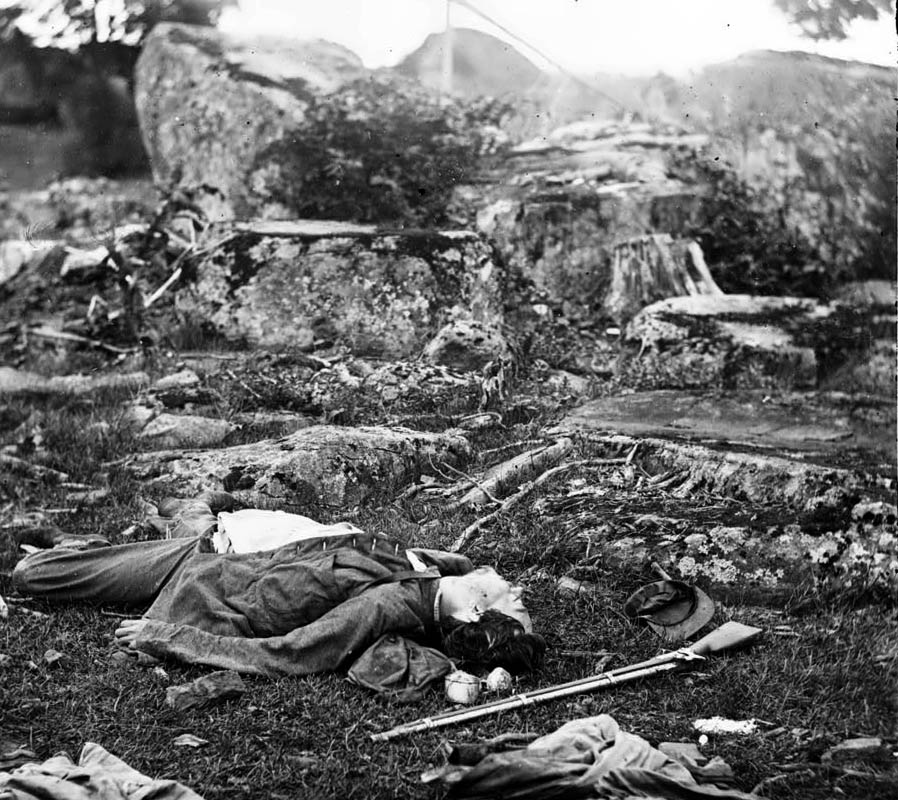
gettysburg-devils-den

“Why do men fight who were born to be brothers?”James Longstreet

“It is well that war is so terrible. We should grow too fond of it.” Robert E Lee

As the sun set on the evening of July 3rd 1863 the battered Army of Northern Virginia and the battered but victorious Army of the Potomac tended their wounds, buried their dead and prepared for what might happen next.

Following the disastrous attack aimed at the Union center, what is commonly called “Pickett’s Charge” Lee and his surviving commanders prepared for an expected Union counter attack. However, George Meade, the commander of the Army of the Potomac who had correctly anticipated Lee’s assault decided not to gamble on a counter attack, though it was tempting. He knew too well the tenacity and skill of the Confederate commanders and soldiers on the defense and did not want to risk a setback that might give Lee another chance.

Savages_Station_field_hospital-600x374

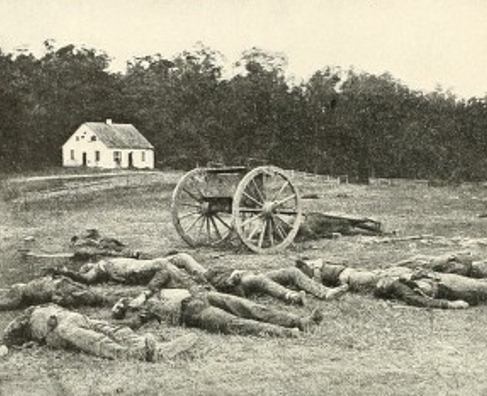
The dead and wounded littered the battlefield. Field hospitals, little more than butcher shops where arms and legs were amputated by overworked surgeons and attendants while those with abdominal wounds that could not be easily repaired were made as comfortable as possible. Triage was simple. If a casualty was thought to have a reasonable chance at survival he was treated, if not they were set aside in little groups and allowed to die as peacefully as possible. Chaplains made their way around, Protestant’s ensuring that their soldiers “knew Jesus” and Catholics administering the Last Rites.

dead-civil-war-soldiers

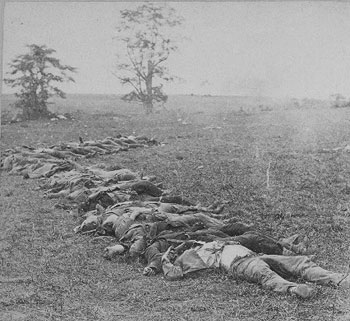
One Confederate soldier describe the scene west of the town on July 4th:

“The sights and smells that assailed us were simply indescribable-corpses swollen to twice their size, asunder with the pressure of gases and vapors…The odors were nauseating, and so deadly that in a short time we all sickened and were lying with our mouths close to the ground, most of us vomiting profusely.” 

Among the killed and wounded were the great and the small. John Reynolds who died on day one, Winfield Scott Hancock, the valiant commander of the Union II Corps wounded during Pickett’s Charge, Mad Dan Sickles, who had nearly brought disaster on the Federal lines by advancing to the Peach Orchard on July 2nd had a leg amputated.

The Confederates suffered grievous losses. Divisional commanders like Dorsey Pender were mortally wounded. John Bell Hood was severely wounded, Isaac Trimble was wounded and captured while Harry Heth was wounded. Numerous Generals were killed or wounded and among regimental commanders the toll was fearful. In Picket’s division alone all three brigade commanders, Kemper, Armistead and Garnett were killed or wounded while 26 of 40 Field Grade officers were casualties. 46% (78 of 171) of the regiments of the Army of Northern Virginia suffered casualties at the command level. The Confederate casualties, especially among the best leaders were irreplaceable and Lee’s Army never recovered from the loss of seasoned leaders who were already in short supply.

One witness, Frank Haskell looked in at a field hospital in the Union II Corps area and wrote:

“The Surgeons with coats off and sleeves rolled up…are about thier work,… “and their faces and clothes are spattered with blood; and though they look weary and tired, their work goes systematically and steadily on- how much and how long they have worked, the piles of legs, arms, feet, hands, fingers…partially tell.” (Gettysburg by Stephen W Sears, Mariner Books, Houghton Mifflin Company Boston, New York 2004 p.466)

All told between 46,000 and 51,000 Americans were killed or wounded during the three days of Gettysburg. Busey and Martin’s Regimental Strengths and Losses at Gettysburg lists the following casualty figures, other accounts list higher numbers. One also has to remember that many of the missing were killed but simply never found or if their bodies were found identified:

killed           wounded         missing         total

Union                    3,155          14,531             5,369           23,055

Confederate         4,708          12,693             5,830            23,231

Total                     7,863           27,224            11,199          46,286

To provide a reference in 8 years of war in Iraq the United States suffered fewer casualties than during the three days of Gettysburg. It was the bloodiest single battle in American history.

At the end of the war, Joshua Chamberlain, the hero of Little Round Top who was well acquainted with the carnage of war asked the most difficult questions:

“…men made in the image of God, marred by the hand of man, and must we say in the name of God? And where is the reckoning for such things? And who is answerable? One might almost shrink from the sound of his own voice, which had launched into the palpitating air words of order–do we call t?–fraught with such ruin. Was it God’s command that we heard, or His forgiveness that we must forever implore?”

May we pray for peace that such an event never take place again.

Peace

Padre Steve+

Leave a comment

Filed under civil war, History, Military

Gettysburg at 150: The Soul of a Hero Joshua Chamberlain

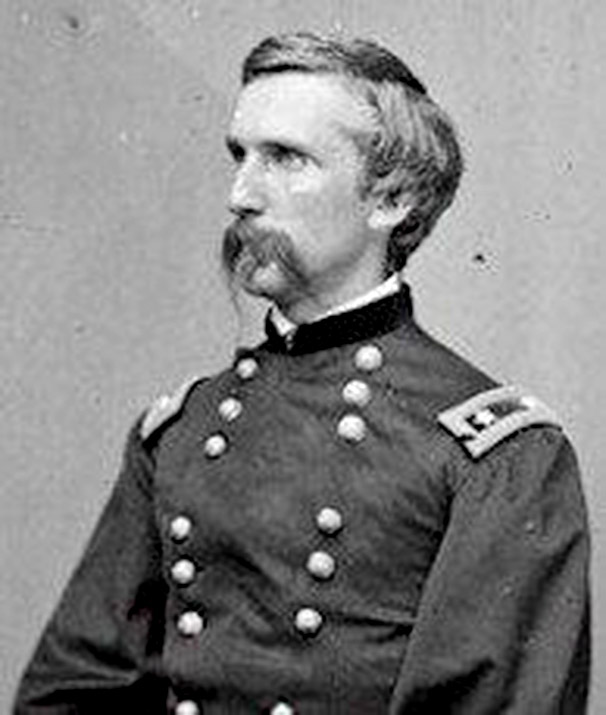
chamberlain

I want to take a brief moment tonight to think about the heart, soul and morality of a soldier, scholar and theologian, Colonel, later Major General Joshua Lawrence Chamberlain, the hero of Little Round Top and certainly a man whose actions as commanding officer of the 20th Maine Regiment at Gettysburg helped preserve the Union.

After the war Chamberlain spoke of the battle often. One of his most famous quotes is a testament to his humanity and integrity.

In great deeds, something abides. On great fields, something stays. Forms change and pass; bodies disappear; but spirits linger, to consecrate ground for the vision-place of souls… generations that know us not and that we know not of, heart-drawn to see where and by whom great things were suffered and done for them, shall come to this deathless field, to ponder and dream; and lo! the shadow of a mighty presence shall wrap them in its bosom, and the power of the vision pass into their souls.”

Chamberlain was a graduate of Bowdoin College and Bangor Theological Seminary, fluent in 9 languages other than English. He was Professor of Rhetoric at Bowdoin before seeking an appointment in a Maine Regiment without consulting either the college or his family. He was offered command of the 20th Maine but asked to be appointed as a Lieutenant Colonel which he was in August 1862. He fought at Fredericksburg and was named commander of the regiment when Colonel Ames, his commander was promoted following Chancellorsville.

Chamberlain was awarded the Medal of Honor for his valor at Little Round Top in 1893. He was gravely wounded during the siege of Petersburg in June of 1864 while commanding a brigade and promoted to Brigadier General. He returned to duty later in the year as commander of the 1st Brigade, 1st Division V Corps and was again wounded at Petersburg in a skirmish at Quaker Road and was promoted to Brevet Major General by Abraham Lincoln. Chamberlain received the surrender of Lee’s decimated Army if Northern Virginia. He would go on to serve as a four term Governor of Maine and remained active with the Grand Army of the Republic veteran’s organization, remained active as an educator and President of Bowdoin College and founded the Maine Institute for the Blind which is now known as the Iris Foundation. He died of his wartime wounds on February 24th 1914.

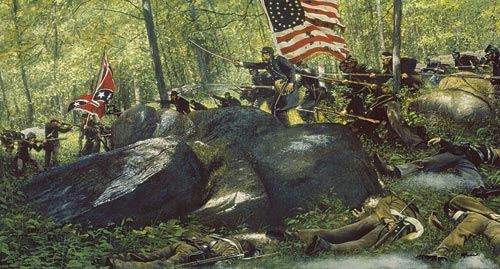
LRT

As the 20th Maine, tired from fighting off numerous assaults by attacking Confederates and now out of ammunition saw another wave of Confederates come up the slopes of Little Round Top Chamberlain ordered his men to fix bayonets and execute a right wheel. The move caught the advancing Rebels who were sensing victory by complete surprise. Chamberlain wrote in his official report of the battle:

“The enemy seemed to have gathered all their energies for their final assault. We had gotten our thin line into as good a shape as possible, when a strong force emerged from the scrub wood in the valley, as well as I could judge, in two lines in echelon by the right, and, opening a heavy fire, the first line came on as if they meant to sweep everything before them. We opened on them as well as we could with our scanty ammunition snatched from the field.

It did not seem possible to withstand another shock like this now coming on. Our loss had been severe. One-half of my left wing had fallen, and a third of my regiment lay just behind us, dead or badly wounded. At this moment my anxietv was increased by a great rbar of musketry in my rear, on the farther or northerly slope of Little Round Top, apparently on the flank of the regular brigade, which was in support or Hazlett’s battery on the crest behind us. The bullets from this attack struck into my left rear, and I feared that the enemy might have nearly surrounded the Little Round Top, and only a desperate chance was left for us. My ammunition was soon exhausted. My men were firing their last shot and getting ready to “club” their muskets.

It was imperative to strike before we were struck by this overwhelming force in a hand-to-hand fight, which we could not probably have withstood or survived. At that crises, I ordered the bayonet. The word was enough. It ran like fire along the line, from man to man, and rose into a shout, with which they sprang forward on the enemy, now not 30 yards away. The effect was surprising; many of the enemy’s first line threw down their arms and surrendered. An officer fired his pistol at my head with one hand, while he handed me his sword with the other. Holding fast by our right, and swinging forward our left, we made an extended “right wheel,” before which the enemy’s second line broke and fell back, fighting from tree to tree, many being captured, until we had swept the valley and cleared the front of nearly our entire brigade.”

The successful defense of Little Round Top by Chamberlain’s gallant 20th Maine as well as the other regiment’s of Colonel Strong Vincent’s brigade saved the Army of the Potomac from being enveloped by the Confederate right wing and defeated in detail. Such a defeat very probably would have given the peace party in the North the leverage that they needed to change the political calculus and end the war, giving the Confederacy independence and destroying the Union.

Though he was a valiant soldier Chamberlain was thoughtful and never lost his sense of honor, integrity or Christian morality in the war. Perhaps it was his education or upbringing. Perhaps it was ideals that were so much a part of his psyche that no matter where he served, or how great the sacrifice and suffering that he still kept his essential humanity. Even in victory he maintained a magnanimous spirit towards former enemies when they surrendered.

As the war drew to a close and Chamberlain continued to lead troops in mortal combat in the campaign at Petersburg and Appomattox Chamberlain saw much that caused to to ask hard questions. With friends lying dead and dying around following the Battle at the Quaker Road on March 30th 1865 Chamberlain pondered:

“But we had with us, to keep and care for, more than five hundred bruised bodies of men–men made in the image of God, marred by the hand of man, and must we say in the name of God? And where is the reckoning for such things? And who is answerable? One might almost shrink from the sound of his own voice, which had launched into the palpitating air words of order–do we call t?–fraught with such ruin. Was it God’s command that we heard, or His forgiveness that we must forever implore?”

I think that we have a lot to learn from Joshua Chamberlain. His question at the Quaker Road is one that anyone leading nations, or military units into the valley of the shadow of death need to ask, especially when the war or conflict is waged “in the name of God” whoever’s God it might be.  All too often evil done in the name of the Almighty is blessed by the Trinity of Evil, the Preacher, Pundits and Politicians who use being on the side of God to justify the basest evil and inhuman deeds. But then maybe it is only the rare man like Chamberlain who can see through the darkness and still discern the “divine spark” in a man.

gl-pr-105

As Chamberlain received the surrender of the units of the Army of Northern Virginia he paid the bedraggled but still proud Confederates the honor of a salute. One Rebel General said to him “You astonish us by your honorable and generous conduct. I fear we should not have done the same by you had the case been reversed.” Another commented “I went into that cause and I meant it. We had our choice of weapons and of ground, and we have lost. Now” pointing at the Stars and Stripes “that is my flag, and I will prove myself as worthy as any of you ” (Soul of the Lion: A Biography of General Joshua L. Chamberlain. by Willard M Wallace, Thomas Nelson and Sons, New York 1960. Reprinted 1991 by Stan Clark Military Books, Gettysburg PA. p.190) 

May we all learn to find that divine spark before it is too late.

Peace

Padre Steve+

1 Comment

Filed under civil war, faith, History, Military, philosophy

Gettysburg at 150 Day One: “For God’s Sake Forward!” John Reynolds at Herr’s or McPherson’s Ridge July 1st 1863

z_maritato_ironbrigadeforward

Iron Brigade Forward! Battle of Gettysburg, PA – July 1, 1863 by Mark Maritato

“…by his promptitude and gallantry he had determined the decisive field of the war, and he opened brilliantly a battle which required three days of hard fighting to close with a victory.” Major General Harry Hunt, Chief of Artillery, Army of the Potomac on the actions of Major General John F Reynolds at Gettysburg

Major General John Reynolds was on his home soil. A native of Lancaster Pennsylvania  Reynolds was the senior Corps commander in the Army of the Potomac. Considered by his peers and superiors to be the best commander in the Army he had been given command of a wing of the Army, his own I Corps, Oliver Howard’s XI Corps and John Sedgewick’s III Corps. He also had John Buford’s 1st Cavalry Division under his command.

Early in June Abraham Lincoln had offered command of the Army of the Potomac to Reynolds, however Reynolds’ set a condition which Lincoln in the political climate of the time could not grant, that he would be free from the political interference which had beset previous Army commanders. Both Reynolds’ request and Lincoln’s response are understandable. Lincoln respected Reynolds and when Major General Joseph Hooker was relieved of command of the Army by Lincoln Major General George Meade, commander of V Corps another Pennsylvanian took his place with Reynolds keeping his position.

As the Army of the Potomac reacted to the advance of Robert E  Lee’s Confederate Army of Northern Virginia Hooker pursued and Meade continued the pursuit into Pennsylvania once he took command.

Reynolds’ wing of three Infantry corps and Buford’s Cavalry division acted as the advance elements of the Army. Late in the afternoon of June 30th Buford’s troops observed Johnston Pettigrew’s brigade of Harry Heth’s division near Gettysburg. Pettigrew on detecting Buford’s cavalry refused to engage and Buford made the choice to take the good high ground west of Gettysburg and hold it in order to give Reynolds followed by the rest of the Army time to arrive.

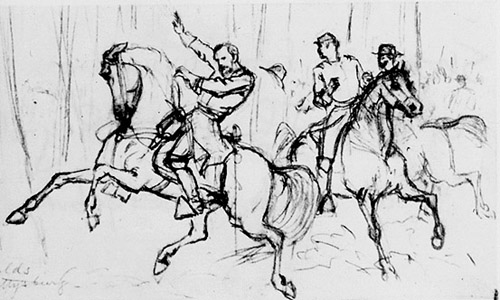
WaudSketch

The Death of Reynolds (Waud)

Reynolds sent messages late in the evening to both Reynolds and the Union Calvary Corps commander, Major General Alfred Pleasanton describing the situation. Reynolds’ units were south of Emmitsburg moving north and on the morning of the 1st of July he brought his troops up as Buford and his cavalry troopers engaged Heth’s division in a delaying action in order to give Reynolds’ units time to get to the good high ground around Gettysburg.

Reynolds rode ahead and briefly met Buford at the Lutheran Seminary where Buford ensured Reynolds that his troopers could hold. With that Reynolds ordered his leading corps, the lead division under the command of Abner Doubleday to advance to the action at the double-quick. He then sent a message to Meade through a staff officer stating “Tell the General that we will hold the heights to the south of the town, and that I will barricade the streets of the town if necessary.”

As his units arrived into an already raging battle Reynolds directed them to key areas of the battlefield. As he directed the “Iron Brigade” into position in Herr’s (McPherson’s) Woods Reynolds exhorted the men forward.“Forward! men, forward! for God’s sake, and drive those fellows out of the woods!” As he said these words he was struck by a bullet in the head and died instantly.

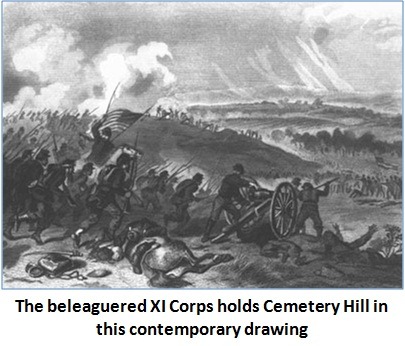
In the immediate confusion following Reynolds’ death the I and XI Corps confusion reigned. It seemed that the Union corps now fighting two Confederate Corps, Hill’s 3rd Corps which they had been fighting since the morning and Ewell’s 2nd Corps which arrived in a flanking position to their north during the afternoon might be routed. The Federal troops, I Corps now under the command of Doubleday and XI under Major General Oliver Howard withdrew through Gettysburg to Cemetery Hill where they were rallied by Reynolds’ old friend Major General Winfield Scott Hancock of II Corps.

Hill’s troops entered the town but did not attempt to take the hill while Ewell passed on an opportunity to take nearby Culp’s Hill which would have dislodged the Federal right flank.

The first day ended with the Army of the Potomac holding the high ground in an easily defensible position on interior lines. Lee’s Army was spread out and the defense mounted by Buford and Reynolds had disrupted Hill’s Corps, causing significant casualties.

Buford is to be given much of the credit for choosing the ground of the battle and fighting a stellar delaying action against superior forces. But had Reynolds not brought his units up in the expeditious manner in which he did and then all of Buford’s efforts might have been in vain. The two men, bound by their professionalism and commitment to duty and their oath helped save the Union on that first day of July 1863.

reynolds

Charles Veil who served as a staff officer under Reynolds wrote the following epitaph stating that Reynolds “was a man who knew not fear or danger was, in a word (he was) one of our very best Generals. Wherever the fight raged the fiercest, there the General was sure to be found, his undaunted courage always inspired men with energy & courage.” 

Peace

Padre Steve+

Leave a comment

Filed under civil war, History, leadership, Military

Gettysburg at 150 Day One: Lee Blunders into Battle

800px-First_day_at_gettysburg

Pender’s Brigade on Day One

The Army of Northern Virginia commanded by Robert E Lee was now deep in Union territory and nearly blind to the location of the Federal Army of the Potomac. On the 30th advanced units of Dick Ewell’s Second Corps had gone nearly as far as Harrisburg while most of the Army was on the road around Chambersburg and Cashtown. Lee’s Cavalry Division under the command of J.E.B. Stuart was far away engaging Union Cavalry around Hanover and not in position to report on Union troop movements. General A.P. Hill sent Johnston Pettigrew’s Brigade of Harry Heth’s Division to Gettysburg on the 30th but Pettigrew observing the Federal cavalry of Buford’s 1st Cavalry Division take up positions on Seminary Ridge declined to engage and reported the Federal concentration to Hill.

As reports from the spy Harrison came to Lee and Longstreet Lee began to concentrate the Army around Cashtown. However the morning of July Hill ordered Harry Heth’s division to move on Gettysburg without the benefit of cavalry support or reconnaissance believing that the troops reported by Pettigrew could be nothing more than local militia. His leading brigades under Brigadier General James Archer and Joseph Davis took heavy casualties and soon Heth became embroiled in a fight with Buford’s cavalry and lead elements of the Federal 1st Corps under the command of Major General John Reynolds.

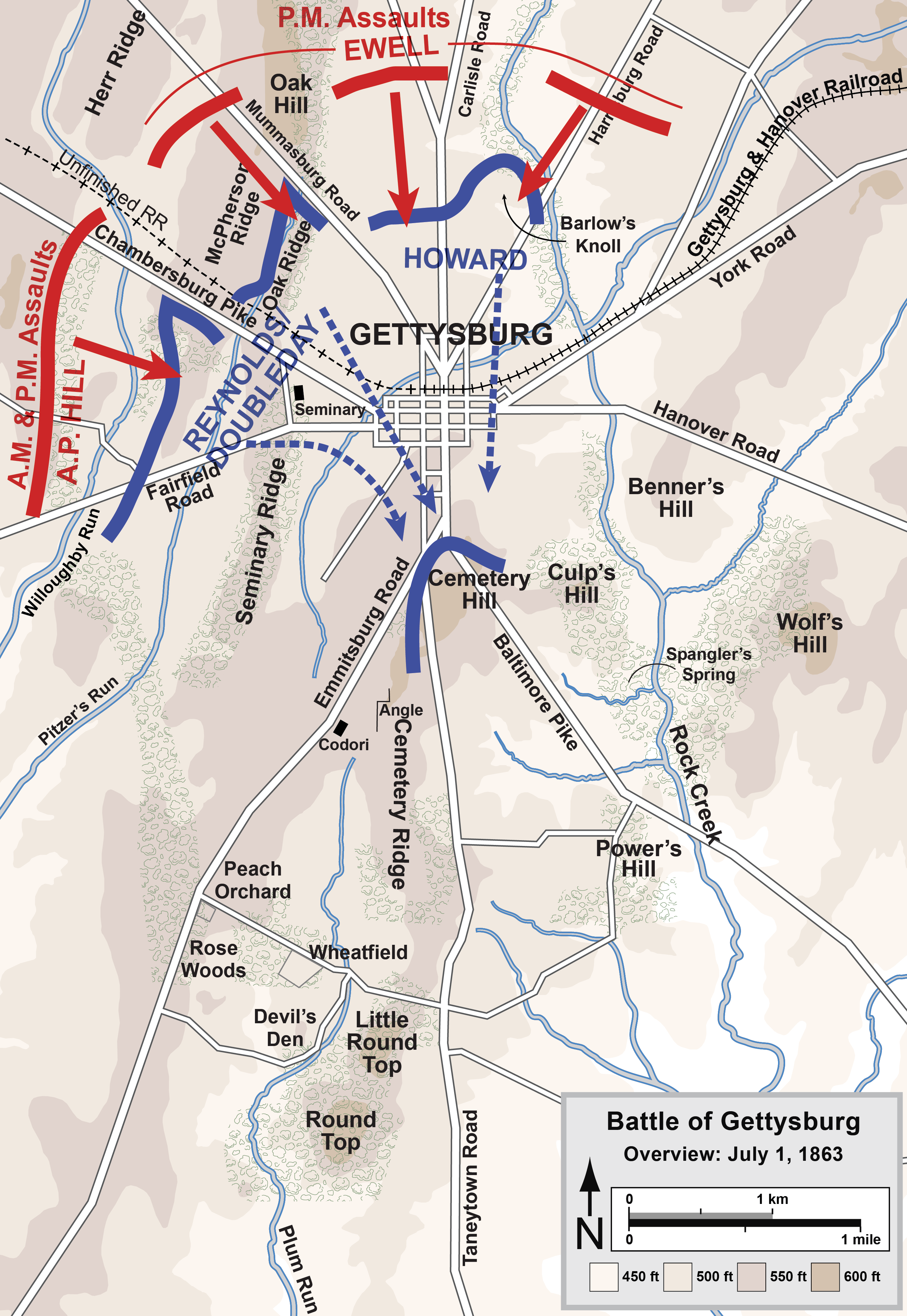
Gettysburg_Battle_Map_Day1

Gettysburg Day One (Map by Hal Jespersen, http://www.posix.com/Com)

Lee was surprised by the engagement and though he chastised Heth for getting involved committed his army to the attack. Reynolds was killed early in the engagement but the fight was bitter, the Iron Brigade exacted a fearful toll on Archer and Davis’s brigades. The attack by Hill’s 3rd Corps was helped immensely when elements of Ewell’s 2nd Corps arrived on the right flank of the Federal XI Corps, forcing the Federal troops to withdraw through Gettysburg and up to Cemetery Ridge. Ewell’s arrival was fortuitous because it tilted the balance to Lee, but the advantage was short lived.

z_schmehl_leedeliberates

Lee Deliberates Heth’s Advance – Gettysburg by Bradley Schmehl

 Ewell failed to press the attack on Cemetery Ridge or Culp’s Hill while Federal forces were still disorganized, despite the repeated entreaties of Major General Isaac Trimble who was with him. The delay would be fatal to Lee’s intentions as Lee decided to give battle at Gettysburg, ignoring General Longstreet’s plea to disengage take up a favorable position between Gettysburg and Washington DC and force the Army of the Potomac to attack.

doncemeteryhilljuly1_zps512a40fa

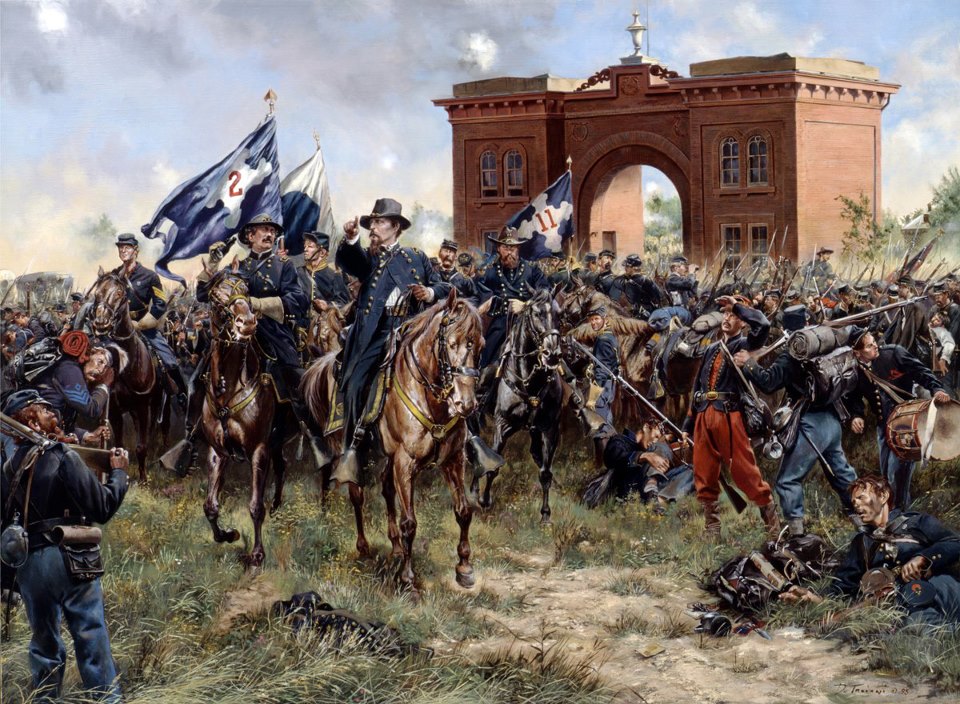
Don Troiani’s Painting of Hancock taking Command on Cemetery Hill on Day One

The Army of Northern Virginia came very close to sweeping Federal forces from the field on July 1st in spite of Lee’s lack of planning and clear commanders intent. That much is clear. His orders to Ewell, to take the high ground “if practicable” we interpreted by Ewell in a manner that he determined not to be practicable, so the advanced Federal corps under the command of Major General Winfield Scott Hancock were able to regroup, dig in and be reinforced by the rest of the Army.

Whether Lee intended to engage the Army of the Potomac at Gettysburg so early in a campaign where his multiple and contradictory strategic aims and lack of clear commander’s intent to his subordinate commanders created confusion is debated. Much of the controversy comes from Lee’s own correspondence which indicates that he might have not fully understood his own intentions. Some correspondence indicates that Lee desired to avoid a general engagement as long as possible while other accounts indicate that he wanted an early and decisive engagement. The controversy was stoked after the war by Lee’s supporters, particular his aides Taylor and Marshal, and Longstreet’s supporters.

Isaac Trimble, traveling with Lee at the beginning of the invasion of Pennsylvania recored that Lee told him:

“We have again outmaneuvered the enemy, who even now does not know where we are or what our designs are. Our whole army will be in Pennsylvania day after tomorrow, leaving the enemy far behind and obliged to follow by forced marches. I hope with these advantages to accomplish some single result and to end the war, if Providence favors us.” (Glenn Tucker, High Tide at Gettysburg (Indianapolis: The Bobbs-Merrill Co.: 1958), p. 24.)

The vagueness of Lee’s instructions to his commanders, many of whom were occupying command positions under him for the first time and were unfamiliar with his command style led to confusion. Where Stonewall Jackson might have understood Lee’s intent, even where Lee issued vague or contradictory orders, many others including Hill and Ewell did not. Lee did not change his command style to accommodate his new commanders and that lack of flexibility on Lee’s part proved fatal to his aims in the campaign.

xi-corps-holds-cemetery-hill

The vagueness of Lee’s intent was demonstrated throughout the campaign and was made worse by the fog of war. Day one ended with a significant tactical victory for Lee’s army but without a decisive result which would be compounded into a strategic defeat by Lee’s subsequent decisions on the 2nd and 3rd of July.

Until tomorrow,

Peace

Padre Steve+

Leave a comment

Filed under civil war, History, Military

Gettysburg at 150 and the Lingering Curse of the “Lost Cause” on the United States

gal9vfvf1

This week I will be writing a lot about the Battle of Gettysburg which happens to fall in the days before the celebration of our Declaration of Independence. Some of these will be articles that I published before and some will be new work. I think that the American Civil War and its consequences today is something that we need to look at as a society, and not from the romanticized “Lost Cause” revisionism that is so popular among many even today.

Last year washed up rocker and now political activist Ted Nugent wrote in the Washington Times “I’m beginning to wonder if it would have been best had the South won the Civil War.”  I find his remark appalling and disgraceful but I have come to expect such comments from him and and others who voice similar sentiments. But Nugent is not alone, an organization called The League of the South states its goals in very clear language: “The League of the South is a Southern Nationalist organization whose ultimate goal is a free and independent Southern republic.”

When I hear such sentiments and they are many now days I think of men like Joshua Chamberlain. Chamberlain was a college professor who served in the Union Army and won fame and the Medal of Honor for the defense of Little Round Top at Gettysburg. There is a quote from the film Gods and Generals which I think about when I hear anyone suggesting that it would have been better for the Confederacy to have won the war:

“Now, somewhere out there is the Confederate army. They claim they are fighting for their independence, for their freedom. Now, I can not question their integrity. I believe they are wrong but I can not question it. But I do question a system that defends its own freedom while it denies it to an entire race of men. I will admit it, Tom. War is a scourge, but so is slavery. It is the systematic coercion of one group of men over another. It has been around since the book of Genesis. It exists in every corner of the world, but that is no excuse for us to tolerate it here when we find it right in front of our very eyes in our own country. As God as my witness, there is no one I hold in my heart dearer than you. But if your life, or mine,is part of the price to end this curse and free the Negro, then let God’s work be done.”

There is a spot near the Copse of Trees along Cemetery Ridge which is referred to as the “High Water Mark of the Confederacy.” It is the spot close to where Confederate Brigadier General Lewis Armistead fell mortally wounded as the decimated remains of his command were overwhelmed by Union forces shortly after they breached the Union line. It is a place immortalized in history, literature and film. It is the place that marked the beginning of the end for the great evil of slavery in America.

My ancestors lived in Cabell County which in 1861 was part of Virginia. They were slave holders along the Mud River, a tributary of the Ohio River just to the north of what is now Huntington West Virginia. When war came to the country the family patriarch James Dundas and my great, great grandfather joined the 8th Virginia Cavalry Regiment in which he served the bulk of the war as a Lieutenant.  When it ended he refused to sign the loyalty oath to the Union and had his lands, which are now some of the most valuable in that part of West Virginia confiscated and sold by the Federal Government.  He was a believer in the “Lost Cause” that romantic and confused idea about the rightness of the South in its war against what they called “Northern aggression.”

Because he and others on both sides of my family served in Confederate ranks I am eligible for membership in the Sons of the Confederacy. However it is something that I cannot do.  There are some that do this as a means to honor their relatives that served in the war and I do not make light of their devotion to their family, but there are some that take that devotion to places that I cannot go.  As much as I admire the valor and personal integrity of many military men who served the Confederacy I cannot for a moment think that their “cause” was just.

It has been said that the North won the war but that the South won the history.  I think this is true. Many people now days like to reduce the reasons for the war to the South protecting its rights.  Sometimes the argument is “states rights” or “economic freedom” and those that make these arguments romanticize the valor shown by Confederate soldiers on the battlefield but conveniently ignore or obscure the evil of the Southern economic system.

The “rights” and the “economic freedom” espoused by those that led the secession and that are lamented by those like Nugent were based upon the enslavement and exploitation of the Black man to maintain an archaic economy based on agriculture, particularly the export of King Cotton.  Arguments which try to place the blame on the North, especially arguments that attempt to turn the Northern States into economic predators’ intent on suppressing the economic rights of Southerners only serve to show the bankruptcy of the idea itself. The fact that the “economic and political freedom” of Southerners was founded on the enslavement of a whole race of people matters not because the “cause” is greater.

One interesting point that many turn a blind eye to is that in each of its campaigns above the Mason Dixon Line Lee’s Army rounded up blacks, mostly freemen and sent them back to the South in chains to be used as slaves. I have to wonder what Southern success at Gettysburg would have meant to African Americans today. Lee believed that his campaign in Pennsylvania would bring about a result that would change the political situation in the North and bring about a situation where the North would recognize Southern independence. He wrote in April of 1863 “next fall there will be a great change in public opinion at the North. The Republicans will be destroyed & I think the friends of peace will become so strong that the next administration will go in on that basis…”

Of course Lee was wrong and his campaign was flawed in large part because he did not adequately define his intent to his commanders. That much is obvious in the writings of the surviving participants after the war.

The overall situation for the Confederacy in June of 1863 was grim. There had been food riots in Richmond, Vicksburg was on the bring of falling and with it the Confederacy would be split in two along the Mississippi River, the Union blockade of Southern ports was working, the South had not been recognized by any foreign powers and the textile industries of Europe had found other suppliers for “King Cotton.” Despite this Lee held on to the hope that a military victory in the East could change the political calculus.

The fact is that the longer the South relied solely on its agriculture which was supported by the institution of slavery it deprived itself of the means of economic progress, the same progress that propelled the North to prosperity. The south lagged in all industrial areas as well as transportation infrastructure. The majority of non-slave owning whites lived at the poverty line and only enjoyed some elevated social status because the slaves ranked beneath them on the sociological and economic hierarchy.  The South depended on cheap imports from England, which then was still considered an enemy of the country. When tariffs to protect newly establish American industries were enacted in 1828 South Carolina attempted to nullify the Federal law even raising troops and threatened a revolt in 1832.

The Southern economic system was immoral and antiquated. It enslaved blacks and it impoverished most rural Southerners, with the exception of those that owned the land and the slaves. It was a hateful, backward and loathsome system which even the southern churches attempted to justify from Scripture. Southern Baptists, Methodists and Presbyterians would all break away from their parent denominations regarding their support for the institution of slavery.

This does not mean that I think that the average Confederate soldier or officers were dishonorable men. Many officers who had served in the United States Army hated the breakup of the Union but served the South because it was the land that they were from. It was the home of their families and part of who they were.  To judge them as wanting 150 years later when we have almost no connection to family or home in a post industrial world is to impose the standards of a world that they did not know upon them. For those that gave up everything to serve one can feel a measure of sympathy.  So many died and so much of the South was destroyed in the defense of that “cause” one has to wonder just why the political and religious leaders of the South were willing to maintain such an inadequate and evil economic system one that hurt poor Southern whites nearly as much as it did blacks.

The war devastated the South and the radicals that ran “Reconstruction” ensured that Southerners suffered terrible degradation and that Southern blacks would have even more obstacles raised against them by the now very angry and revengeful whites.  It would take another 80-100 years to end segregation and secure voting rights for blacks. Thus I have no desire to become part of an organization that even gives the appearance of supporting the “cause” even if doing so would allow me to “honor” an ancestor who raised his hand against the country that I serve.

I was raised on the West Coast but have lived in the South much of my adult life due to military assignments. I have served in National Guard units that trace their lineage to Confederate regiments in Texas and Virginia. Despite my Confederate connections both familial and by service I can find little of the romance and idealism that some find in the Confederacy and the “Lost Cause.” I see the Civil War for what it was, a tragedy of the highest order brought about by the need of some to enslave others to maintain their economic system.

Today there are many that use the flags of the Confederacy outside of their historic context. They are often used as a symbol of either racial hatred or of defiance to the Federal Government by white Supremacist or anti-government organizations.  Many that use them openly advocate for the overthrow of the Federal Government.  The calls for such “revolt” can be found all over the country even in the halls of Congress much as they were in the 1830s, 40s and 50s. Some of this is based in libertarian economic philosophy which labels the government as the enemy of business, some based social policies which are against their religious beliefs and some sadly to say based in an almost xenophobic racial hatred.  The scary thing as that the divisions in the country are probably as great as or greater than they were in the 1850s as the country lurched inexorably to Civil War with neither side willing to do anything that might lessen their political or economic power even if it means the ruin of the country.

As seems to be the case around this time of year I have seen the symbols of the Confederacy, particularly the Battle Flag displayed in manners that can only be seen as symbols of defiance. July 4th will be celebrated this week and it seems to me that the flag that should be most prominently displayed is the Stars and Stripes not the Confederate Battle flag or even the Gadsen Flag which has become the symbol of the modern Tea Party movement.  Somehow I find the flag flown in rebellion to the country that I serve displayed in such an arrogant manner.

For people like the Federal Government which is the enemy. Now I know that our system of government has its flaws. Likewise I cannot agree more about the corruption of many in political office, regardless of their political allegiance.  While it is true that the Federal Government has taken upon itself many powers some never envisioned by those that crafted the Constitution, it has done so because leaders of both political parties have consented to it and even worked to strengthen the Federal Government with the consent of the American people that elect them again and again.

Despite this much of this has been accomplished by the Federal Government has been for the good for the country and people no matter what the critics say. Many of the things that we enjoy today are the result of the work of the Federal Government and not business as much as those that deify big corporations want to believe. There are the National Parks, laws against child labor and for safe workplaces brought about by Teddy Roosevelt, the infrastructure built in the 1930s and 1940s by the Franklin Roosevelt administration. The Roosevelt administration also brought about Social Security and banking regulations to protect Americans from corporations and banks that violated the public trust. The Eisenhower administration began the Interstate Highway system which is the backbone of our transportation system.  Likewise the Space Program and yes even the military have led the way in technological, scientific and medical innovation including that thing that we all take for granted today the Internet.

Today quite a few people are calling for revolt or secession if they do not get what they want be it socially, politically or economically. For years politicians on both sides have fought to minimize such talk and enact compromises with the usual discontent that comes with compromise.  Unfortunately many of those compromises have had the effect of widening the political divide much as the various compromises on the road to the Civil War.  Jefferson said of the Missouri Compromise of 1824: “but this momentous question, like a fire bell in the night, awakened and filled me with terror. I considered it at once as the knell of the Union. It is hushed indeed for the moment, but this is a reprieve only, not a final sentence. A geographical line, coinciding with a marked principle, moral and political, once conceived and held up to the angry passions of men, will never be obliterated; and every new irritation will mark it deeper and deeper.”

We have allowed the issues of our time to become a fire of unbridled angry passion where those with almost no historical understanding and whose history is often based on myth stake claims and promote ideas that will destroy this Union if they continue. Unfortunately we have not yet reached the high water mark of this movement yet and I fear like Jefferson that the hatred and division will only grow worse as both radical on the right and left prepare for conflict.

This week we celebrated the 236th anniversary of our Declaration of Independence.  It is a remarkable occasion. It is the anniversary that free people as well as those oppressed around the world look to as a beacon of liberty. It has been paid for time and time again, especially during that cruel Civil War which killed more American soldiers than any other war that we have fought.

A few months after Gettysburg Abraham Lincoln a man much reviled by those that have romanticized the Cause and who is demonized by many “conservative” politicians and pundits today as a “tyrant” made these brief remarks at the site of the battle:

Four score and seven years ago our fathers brought forth on this continent, a new nation, conceived in Liberty, and dedicated to the proposition that all men are created equal.

“Now we are engaged in a great civil war, testing whether that nation, or any nation so conceived and so dedicated, can long endure. We are met on a great battlefield of that war. We have come to dedicate a portion of that field, as a final resting place for those who here gave their lives that that nation might live. It is altogether fitting and proper that we should do this. But, in a larger sense, we cannot dedicate—we cannot consecrate—we cannot hallow—this ground. The brave men, living and dead, who struggled here, have consecrated it, far above our poor power to add or detract. The world will little note, nor long remember what we say here, but it can never forget what they did here. It is for us the living, rather, to be dedicated here to the unfinished work which they who fought here have thus far so nobly advanced. It is rather for us to be here dedicated to the great task remaining before us—that from these honored dead we take increased devotion to that cause for which they gave the last full measure of devotion—that we here highly resolve that these dead shall not have died in vain—that this nation, under God, shall have a new birth of freedom— and that government of the people, by the people, for the people, shall not perish from the earth.”

Today with so many radicals, especially those on the political right, but some on the left such as the “Anonymous” group doing all that they can to plunge us into yet another civil war we should remember Lincoln’s words and rededicate ourselves to this Union, this remarkable Union.  Tony Blair the former Prime Minster of Great Britain remarked in 2011:

“It may be strange for a former British Prime Minister to offer thoughts on America when the country will be celebrating its independence from Britain. But the circumstances of independence are part of what makes America the great and proud nation it is today. And what gives nobility to the American character.

That nobility isn’t about being nicer, better or more successful than anyone else. It is a feeling about the country. It is a devotion to the American ideal that at a certain point transcends class, race, religion or upbringing. That ideal is about values, freedom, the rule of law, democracy. It is also about the way you achieve: on merit, by your own efforts and hard work.

But it is most of all that in striving for and protecting that ideal, you as an individual take second place to the interests of the nation as a whole. This is what makes the country determined to overcome its challenges. It is what makes its soldiers give their lives in sacrifice. It is what brings every variety of American, from the lowest to the highest, to their feet when “The Star-Spangled Banner” is played.

Of course the ideal is not always met – that is obvious. But it is always striven for.

The next years will test the American character. The world is changing. New powers are emerging. But America should have confidence. This changing world does not diminish the need for that American ideal. It only reaffirms it.”

I think that the Prime Minister got it right and Ted Nugent is an ignorant fool but he has the right to be one.

Peace

Padre Steve+

6 Comments

Filed under civil rights, civil war, History, News and current events, Political Commentary

The Things that We Do: Killer Angels and Hew-Mons : The Part of Humanity we Don’t Like to Talk About

images-47

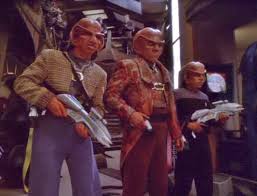
“Let me tell you something about Hew-mons, Nephew. They’re a wonderful, friendly people, as long as their bellies are full and their holosuites are working. But take away their creature comforts, deprive them of food, sleep, sonic showers, put their lives in jeopardy over an extended period of time and those same friendly, intelligent, wonderful people… will become as nasty and as violent as the most bloodthirsty Klingon. You don’t believe me? Look at those faces. Look in their eyes.” Quark to Nog Deep Space Nine- The Siege of AR-558 

We human beings, regardless of our race, religion or political ideology are a complex lot.

On one hand we can exhibit the utmost kindness, compassion, care and charity and on the other hand we can bless, endorse, encourage. condone and execute the most cruel,  hateful, violent and “inhuman” acts against our fellow human beings. We are quite a contradictory lot if you ask me.

It really is a most interesting and at times contradictory phenomena when you look at it. Of course, I like to believe, as to most of us I am quite sure like to think that we have either been created by God or evolved into a species that rises above the baser parts of life, the things that we like to say were done in years past but are no longer a part of who we are as human beings.

The same can be said for those of us that consider ourselves to be Christians. We look back on nearly 2000 years of Christendom and well, it is not a pretty sight. But like every other generation of Christians we like to think that we are better, perhaps more spiritual, better educated, better interpreters of the Bible or even perhaps better in tune with the Holy Spirit of God than were those before us.

Of course those of us that think that we are so advanced that we have evolved past violence, cruelty, hatred and avarice, be we Christians or not tend to gloss over the fact that we are human, or as Quark calls us “Hew-mons.” As such we are capable of the most extreme acts of kindness, love and benevolence as well as the utmost in cruelty.

0919071823

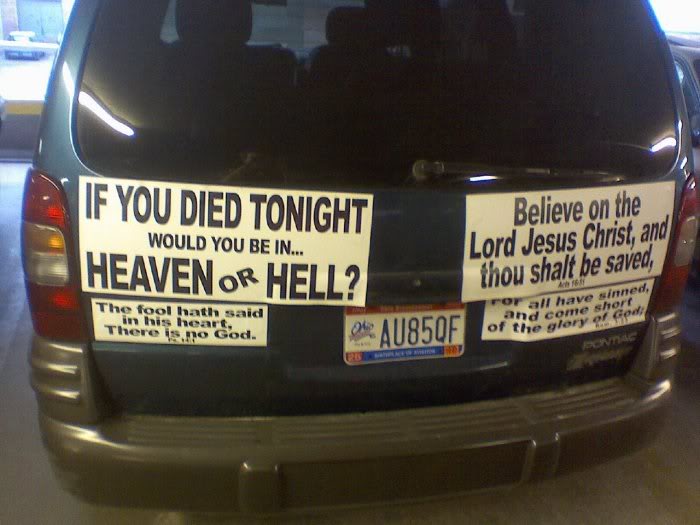
Of course when I say “we” I do include “me” because I am like about everyone else, I have my good days and bad and as much as I would like to think that I am better than my baser instincts something happens and I find that I am not. That much is evident any time I get out into traffic or go to Wal-Mart. It is a good thing that I do not display any Christian symbols on either of my cars, I don’t want God getting blamed for my lack of Christian behavior, and frankly I wish more Christians would do the same. I have lost count of the number of vehicles adorned with Christian symbols, bumper stickers and personalized plates that have ignored all the basic courtesies, rules of the road and polite behavior and who are frankly rude assholes that probably shouldn’t be allowed to drive that make me wish that they would keep their faith in Jesus to themselves, it makes Jesus look bad. But I digress… but just a moment, why do so many of these people drive mini-vans? At least I seem to end up behind them or get cut off by them. Maybe the mini-van is an invention of the Devil? You won’t get me behind the wheel of one.

No wonder that Paul the Apostle laments in the 7th Chapter of the Epistle to the Romans “I can will what is right, but I cannot do it. For I do not do the good I want, but the evil I do not want is what I do.”  Martin Luther, the great leader of the Reformation commented on this passage “This tension lasts in us as long as we live; though in one person it is greater, in another less, according as the spirit or the flesh, and he fights with himself until he becomes wholly spiritual.” It is one of the most honest commentaries on scripture even written no wonder we don’t like it.

I don’t know about you but this does make me think, take inventory of my own strengths, weaknesses, virtues and vices. The fact is that in any given situation Quark’s description of Hew-mons in general is very applicable to me.

480908_655507297796895_1863071676_n

In Michael Shaara’s novel The Killer Angels and the film Gettysburg there is a remarkable exchange between Colonel Joshua Chamberlain, Colonel of he 20th Maine and Professor of Natural and Revealed Religions at Bowdin College and Sergeant Buster Kilrain, an exile from Ireland fighting for the Union.

Colonel Joshua Lawrence Chamberlain: [quoting Hamlet] “What a piece of work is man, in form and movement how express and admirable. In action how like an angel.”

Sergeant ‘Buster’ Kilrain: “Well, if he’s an angel, all right then. But he damn well must be a killer angel.” 

In light of all that we see every day as human beings we must find it in our hearts to agree with Kilrain. We are such a contradictory species. As Spock would say “fascinating.”

Peace

Padre Steve+

3 Comments

Filed under christian life, civil war, faith, star trek

Remembering Why We Keep Memorial Day

memorial-day1-300x225

“even if those who come after us are to forget all that we hold dear, and the future is to teach and kindle its children in ways as yet unrevealed, it is enough for us that this day is dear and sacred…”

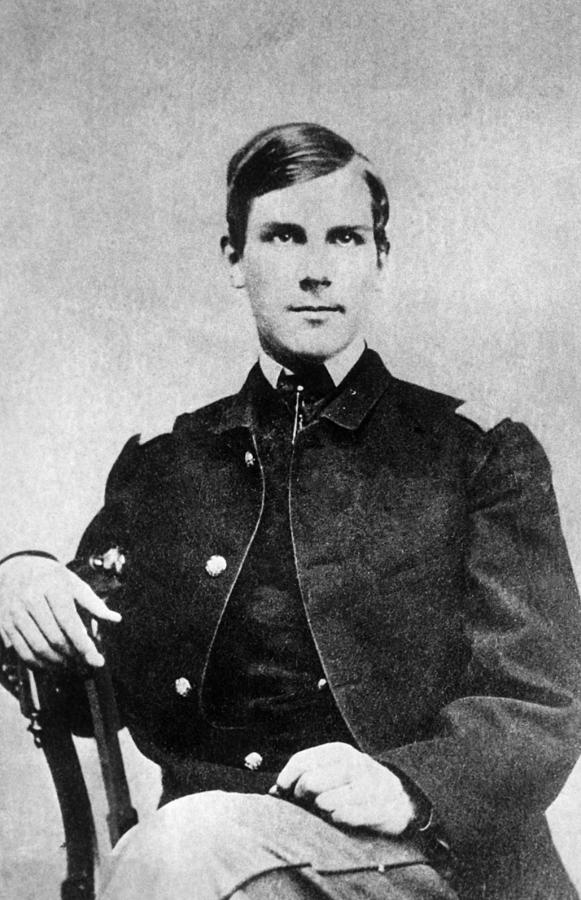
Nearly 20 years after the Civil War, Oliver Wendell Holmes Jr. then serving as Chief Justice of the Massachusetts Supreme Court spoke on Memorial Day 1884 in Keene New Hampshire at a gathering of veterans. He recalled an incident not long before where he had heard a young man ask “why people still kept up Memorial Day. The question was one that he pondered before his speech and that he attempted to find an answer, not to his fellow veterans who certainly understood their shared memories of war “but an answer which should command the assent of those who do not share our memories.”

I think that having an answer for the question is as timely now as when Holmes first pondered it. Though his war was twenty years past and had torn the nation apart, there were still many men on both sides who had served in that terrible time and but even so many people were not only forgetting the war and the sacrifices made by so many but intent on becoming rich. Something that he would directly state in a Memorial Day address to the graduating class of Harvard University in 1895:

1-oliver-wendell-holmes-jr-1841-1935-everett

Oliver Wendell Holmes Jr in the Civil War

“The society for which many philanthropists, labor reformers, and men of fashion unite in longing is one in which they may be comfortable and may shine without much trouble or any danger. The unfortunately growing hatred of the poor for the rich seems to me to rest on the belief that money is the main thing (a belief in which the poor have been encouraged by the rich), more than on any other grievance. Most of my hearers would rather that their daughters or their sisters should marry a son of one of the great rich families than a regular army officer, were he as beautiful, brave, and gifted as Sir William Napier. I have heard the question asked whether our war was worth fighting, after all. There are many, poor and rich, who think that love of country is an old wife’s tale, to be replaced by interest in a labor union, or, under the name of cosmopolitanism, by a rootless self-seeking search for a place where the most enjoyment may be had at the least cost.”

However his message to his fellow veterans, mostly men from his own former regiment, the 20th Massachusetts was quite personal and something that they could find meaning in. Holmes understood war, he had seen much action and had been wounded at Ball’s Bluff, Antietam and Chancellorsville. He talked of the shared experience of war, something that those who have fought in our nation’s wars, as well as combat veteran soldiers in other countries can understand far more than people that have only known peace, even while their countrymen are at war.

dscn0044

Holmes remembrances of the war and the comrades that he and those present had served with, those living and those dead is powerful. Many of us who have served in the wars that began on September 11th 2001 have lost friends in either Iraq or Afghanistan, and many more who are wounded or maimed in body, mind and spirit. Many survivors of wounds today would have died in previous wars.

Likewise his descriptions of the memories of war, triggered by “accidents” are real to those that have experienced war and combat.

“Accidents may call up the events of the war. You see a battery of guns go by at a trot, and for a moment you are back at White Oak Swamp, or Antietam, or on the Jerusalem Road. You hear a few shots fired in the distance, and for an instant your heart stops as you say to yourself, The skirmishers are at it, and listen for the long roll of fire from the main line. You meet an old comrade after many years of absence; he recalls the moment that you were nearly surrounded by the enemy, and again there comes up to you that swift and cunning thinking on which once hung life and freedom–Shall I stand the best chance if I try the pistol or the sabre on that man who means to stop me? Will he get his carbine free before I reach him, or can I kill him first?These and the thousand other events we have known are called up, I say, by accident, and, apart from accident, they lie forgotten.”

dscn0064

We all have our memories of our wars, those of us who remain, be we veterans of Iraq or Afghanistan, Somalia, Desert Storm, Lebanon, Vietnam, Korea or World War II. It is hard to believe that so few remain from World War II and Korea, and that even the Vietnam veterans are aging rapidly, most now in their 60s or 70s. In as much as the wars of the past decade have been fought by a tiny minority of American citizens fewer and fewer will understand the bond that we share through our memories of the living and the dead. We have been set apart by our experiences, even though the wars that we have fought differ in many ways.

As such we should whenever possible take the time to meet and remember. That might be as groups of friends, unit associations or perhaps local chapters of Veterans organizations. We do this to remember but also to remind ourselves that we cannot live in the past alone, for the present likewise calls us to action, even after our service is complete.

Army+Marine+Casualties+Afghanistan+War+Return+dSZmlJbciN5l

Holmes put it well: “When we meet thus, when we do honor to the dead in terms that must sometimes embrace the living, we do not deceive ourselves. We attribute no special merit to a man for having served when all were serving. We know that, if the armies of our war did anything worth remembering, the credit belongs not mainly to the individuals who did it, but to average human nature. We also know very well that we cannot live in associations with the past alone, and we admit that, if we would be worthy of the past, we must find new fields for action or thought, and make for ourselves new careers.”

We remember the past, we remember our fallen and we remember the families who have lost loved ones in these wars as well as those whose lives have been changed and maybe even torn apart by the changes that war has wrought in their loved ones who returned different from war. In our service we have been set apart and as such as Holmes so well states we have the duty to “bear the report to those who will come after us.” His words carry forth to us today, we few we happy few as Shakespeare so eloquently wrote.

“nevertheless, the generation that carried on the war has been set apart by its experience. Through our great good fortune, in our youth our hearts were touched with fire. It was given to us to learn at the outset that life is a profound and passionate thing. While we are permitted to scorn nothing but indifference, and do not pretend to undervalue the worldly rewards of ambition, we have seen with our own eyes, beyond and above the gold fields, the snowy heights of honor, and it is for us to bear the report to those who come after us.” 

n671902058_1896194_6303

I will remember my time in Iraq and those that I served alongside. I will also remember friends who served in other units who did not return as well as those Marines, Sailors and Soldiers that I see every day in our Naval Hospital suffering from the physical, psychological and spiritual wounds of war.

This weekend I will remember and on Monday, that sacred day that we set aside to remember the fallen I take some time at noon to join in that time of remembrance and pray that maybe someday war will be no more.

That is why I think that we should remember Memorial Day even if others forget.

Peace

Padre Steve+

5 Comments

Filed under civil war, History, iraq,afghanistan, Military, shipmates and veterans, vietnam

The Battle of Hampton Roads: 9 March 1862: The Epic Beginning of Modern Naval Warfare

800px-The_Monitor_and_Merrimac

On the morning of March 8th 1862 the CSS Virginia steamed slowly from her base at Portsmouth Virginia into Hampton Roads at the mouth of the Chesapeake Bay. Awaiting her was a US Navy squadron of wooden warships including the steam Frigate USS Minnesota, the Sloop of War USS Cumberland and Frigate USS Congress and a number of smaller vessels. The Virginia was an armored ram built from the salvaged remains of the large steam frigate USS Merrimack which had been burned at Gosport (Now Norfolk) Naval Shipyard. Her plans had been leaked to the US Navy which was also in the process of constructing a number of ironclad ships of different types. The first of these ships to be ready was the USS Monitor, a small ship mounting a single heavily armored turret mounting two powerful 11” Dalghren smoothbore guns was still steaming to Hampton Roads when Virginia came out for battle.

CSSVirginia1862.2.ws

During the ensuing fight of March 8th Virginia rammed and sank Cumberland which though fatally wounded disabled two of Virginia’s 9” in guns. She destroyed Congress by gunfire which burned and blew up and appeared to be in position to destroy Minnesota the following day as that ship had run hard aground. The losses aboard Cumberland and Congress were severe and included the Captain of the Congress and Chaplain John L. Lenhart of Cumberland, the first US Navy Chaplain to die in battle. During the battle Virginia had several men wounded including her Captain Franklin Buchanan.

Cumberland_rammed_by_Merrimac

Due to the coming of darkness and a falling tide the acting commander of Virginia, Lieutenant Catsby Ap Roger Jones her executive officer took her in for the night. During the night Monitor, under the command of Lieutenant John Worden arrived and took up station to defend Minnesota.

603px-Battle_of_Hampton_Roads_Map

The next morning Virginia again ventured out and was intercepted by the Monitor. The ships fought for over three hours, with Monitor using her superior speed and maneuverability to great effect. During the battle Monitor suffered a hit on her small pilothouse near her bow blinding her Captain. Neither side suffered much damage but the smokestack of Virginia was pierced in several places affecting her already poor engine performance.  Jones broke off the action and returned to Gosport for repairs and Monitor remained on station.

USSMonitor1862.3.ws

The battle showed the world the vulnerability of wooden warships against the new ironclads. Monitor in particular revolutionized naval warfare and warship construction. Her defining mark was the use of the armored gun turret which over the succeeding decades became the standard manner for large ships guns to be mounted. Turrets like the warships they were mounted upon grew in size and power reaching their apex during the Second World War.

arizon-main-battery2

Both Virginia and Monitor reached less than glorious ends. Virginia had to be destroyed by her crew to prevent her capture just over two months after the battle on May 11th 1862. Monitor survived until January 31st 1862 when she sank during a heavy storm off Cape Hatteras North Carolina with the loss of 16 of her 62 man crew. The remains of two of those men, recovered during the salvage of Monitor’s engines, turret, guns and anchor were interred at Arlington National Cemetery yesterday. The relics from Monitor and some from Virginia are displayed at the Mariners Museum in Newport News (http://www.marinersmuseum.org )while one of Virginia’s anchors resides on the lawn of the Museum of the Confederacy in Richmond.

Those early ironclads and the brave men who served aboard them revolutionized naval warfare and their work should never be forgotten.

Peace

Padre Steve+

Leave a comment

Filed under civil war, History, Navy Ships, US Navy

Remembering the Deal with the Devil that Has Brought us the Sequester

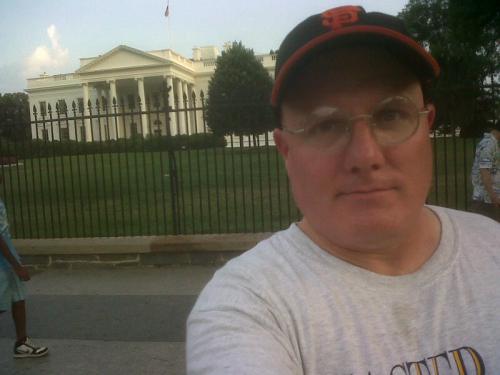
me-white-house1

“But we have no one to blame but ourselves. We voted them all into office and we have encouraged their repugnant behavior with our votes which more often than not were purchased by the fear mongering engaged by each side and our desire to have our special interests and or ideology come out on top.” Padre Steve August 2nd 2011

Back in late July 2011 it appeared that the Federal Government would o what it had never done, default on the payments for the National Debt. I was in Washington that week and could not believe what had become of the country.

For me it was a week that I remember well because on a nighttime picture taking expedition on the National Mall I fell off a darkened ledge at the Washington Monument while turning to line up another picture while walking in the dark.

That week I wrote a number of articles on my observations of what was happening. Since it appears there is a strong chance of the dreaded “Sequester” occurring in a bit over 48 hours I am posting those articles in their entirety here along with the links to the articles on this website.

As a historian and serving Naval Officer I really have a hard time believing what is happening in our government. I can only imagine it is the same kind of feeling that officers in service in 1860 and 1861 felt as their families, friends and the elected officials home states were pushing the country into the abyss. Unfortunately now, as it was then there is enough blame to spread copious amounts between politicians, preachers, and pundits the Unholy Trinity of both parties and across the political spectrum. Men, women and institutions that care more for their special interests than the country that gives them the opportunity to achieve great things.

These are my writings from that unfortunate week in our history. Unfortunately nothing leads me to believe that anything has changed since then and that the leaders of both of our political parties and their supporters in their respective media, corporate and lobbying interests and partisan pundits and preachers on both sides will not do all they can to ensure the ruin of this country.

While I have my own opinions about the root causes of this situation and my own political leanings. That being said I cannot fail to note that among our political classes and their supporters that to some degree they and we are all to blame.  No one wants to hear that but it is the truth. Most of us and certainly our political leaders, lobbyists, business leaders and pundits have by refusing to listen to those we disagree with have brought us to this point. Just like 1860. This is something that need not have ever had to happen. I agree with the hero of the first day of the Battle of Gettysburg, Union General John Buford: “I am disgusted and worn out with the system that seems to prevail.”

God help us because I do not believe that our leaders have the capacity in themselves to do anything.

Peace

Padre Steve+
dscn9994

A Tuesday in DC: Lunch with a Dear Friend and a Night walk through the Monuments

Today was another good day, in fact really good day at the conference I am attending with the George Washington Institute for Spirituality and Health.  At lunch I was able to spend some time with my former commanding officer at Marine Security Forces.  It was good to see Mike again.  He and I went through some very trying times together and I treasure his friendship as well of that of his family.  I think that of all the commanding officers that have served under which have included some incredible men that he was the best.  We are a lot alike in many ways both rather cerebral and out of the box thinkers. We basically are the same generation as far as military service goes, when he was a young Marine Corps Officer I was a young Army Officer.

We reminisced about the way the country was back then how our leaders still worked together and even if we disagreed with the policies of those in the opposing party that we still knew that we were Americans and that at the end of the day we were friends.  I guess that Mike and I are dinosaurs now; we tend to look at the big picture and both being career officers of the same generation have seen the country change. We both entered the military during the Cold War and after the loss of Vietnam.  Our teachers were the men that served in that war, those who came home to a then hostile country.  Neither Mike nor I are service academy types nor the products of conservative military schools, Mike went to Harvard and attended Navy ROTC and I went to a California State University School, CSU Northridge and took Army ROTC at UCLA.  We both come from strong yet tolerant religious traditions and were influenced by chaplains early in our careers.  Mike’s academic background is Economics mine Theology and Military History and both of us hold advanced degrees in those subjects.  We both graduated from the Marine Corps Command and Staff College.  We have both served overseas and in combat.  We love our country and treasure our military service and that of the men and women that we have served with over so many decades.

I am honored that Mike will administer the Oath of Office when I am promoted on September 1st at Harbor Park in Norfolk Virginia.  By the way Mike loves baseball too and being from Boston he is a Red Sox fan.  His dad, a die hard fan died a few months before the Sox broke the “Curse of the Bambino” in 2004. My dad died a few months before his San Francisco Giants won the World Series in 2010.

Talking with Mike today made me think back to a time when things were not like what they are now, where political opponents were simply opponents and not “the enemy.”  I shared with Mike the terms the German Military used in the Second World War to describe those that they fought against.  The Western Allies were “die Gegener” or simply opponents and for the most part the German military observed the Geneva Convention and Laws of War when fighting the Americans, British and French.  However with the Soviet Unionit was different.  The Soviets were “Der Feind” or the enemy.

As divided as we were in the 1970s and 1980s there was still a modicum of respect for the other side and ability to work together when we needed and Mike brought up the relationship of Ronald Reagan and Thomas “Tip” O’ Neill, vigorous political opponents who remained friends.  However there is today and has been for the past 20 years or so for members of the extreme wings of both major parties to identify their opponents as “enemies.”  The language difference is significant. An opponent is a adversary that you hope to defeat but there is not a hatred involved and when the competition ceases the opponents remain friends and even colleagues even as they prepare for the next “game” so to speak.

Enemies are another matter.  To be an enemy is to assume that the other side poses an existential threat to your side or your agenda.  Thus there can be no compromise and the opponent is not simply to be defeated but destroyed and annihilated much like the Old Testament when the Israelites were commanded by God to kill everything even the babies and pregnant women.  So much for being pro-life but I digress….

Today we are more divided than any time since the Civil War, blood is boiling and if there is compromise it will be a mere truce until the next round of political bloodletting which if we are not careful may become actual bloodletting and the enemies allow their unbridled hatred of each other spill out into open conflict.  Such affairs never end well and if we remember our history our Civil War’s military conflict was over in a few years and yet with the relatively primitive weapons of the ay killed more Americans than any other conflict.  The after effects well, frankly Scarlett took over a hundred years to recover from and I would dare posit that some believe that the war is not yet over.

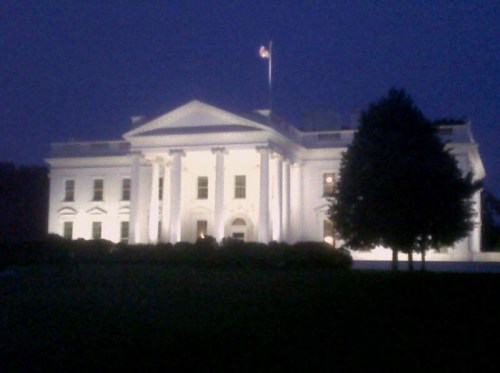
Tonight I went to dinner alone cancelling my plans to head out to watch the Nationals play the Marlins. I needed the time and solitude and somehow a trip on the DC Metro seemed the last place that I would find it. I walked to the Gordon Biersch where I had dinner, drank a few beers and watched the Orioles beat the Blue Jays.  After dinner I detoured from my normal route back to my campus housing which takes me in front of the White House.

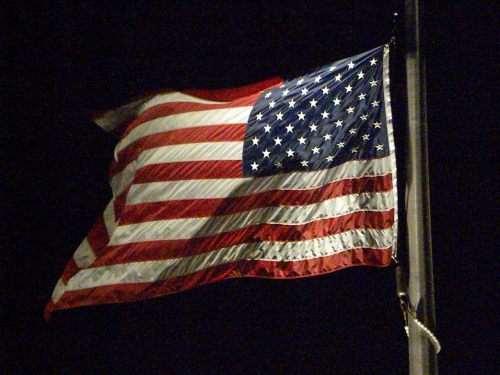
Amid the lights and the amazing splendor of the buildings adorned with American and District of Columbia Flags I walked and simply observed people.  Tourists from across the nation and the world were taking pictures, business people and government workers hurried about, vendors hawked their patriotic wares, mostly made in China I might add or snack foods.  Here and there a protester sought to draw attention to their pet cause, there is the anti-nuclear weapons protestor that has been camped across from the White House since 1981, people demanding to see the Birth Certificate, those protesting for the removal of various Arab dictators and others peppered about. Capitol Police and Secret Service officers were out in force and amid the fortress like surroundings of many government buildings and the offices such as the World Bank and major business and financial institutions armed police and private security stood watch with cameras watching every move.

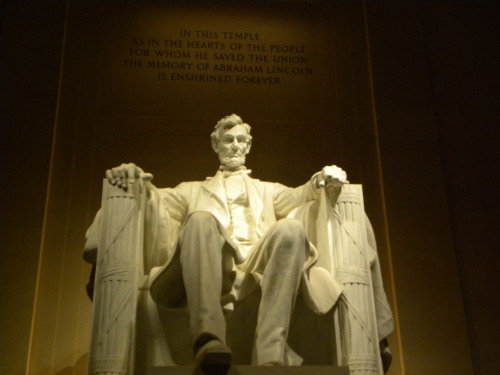
When I passed the White House I was rather down.  So I decided to walk the monuments that adorn the Capitol Mall.  I passed the Executive Office Building and Washington Monument and crossed the street to the World War Two Memorial.  At each place I paused before I continued to walk into the night.  I then stopped by the Korean War Memorial and the Vietnam War Memorial, the stark reminder of the men and women killed and missing in that war as well as the rip in the fabric of the nation that I am not sure we have ever gotten past.  I then went and paused before the Lincoln Memorial and I thought of the immortal words spoken by President Lincoln in his Second Inaugural Address shortly before he was cut down by a bullet fired by John Wilkes Booth.  They are words of reconciliation spoken even while Americans fought Americans in the last months of the war.
dscn0061

Fellow-Countrymen:  At this second appearing to take the oath of the Presidential office there is less occasion for an extended address than there was at the first. Then a statement somewhat in detail of a course to be pursued seemed fitting and proper. Now, at the expiration of four years, during which public declarations have been constantly called forth on every point and phase of the great contest which still absorbs the attention and engrosses the energies of the nation, little that is new could be presented. The progress of our arms, upon which all else chiefly depends, is as well known to the public as to myself, and it is, I trust, reasonably satisfactory and encouraging to all. With high hope for the future, no prediction in regard to it is ventured.

On the occasion corresponding to this four years ago all thoughts were anxiously directed to an impending civil war. All dreaded it, all sought to avert it. While the inaugural address was being delivered from this place, devoted altogether to saving the Union without war, insurgent agents were in the city seeking to destroy it without war—seeking to dissolve the Union and divide effects by negotiation. Both parties deprecated war, but one of them would make war rather than let the nation survive, and the other would accept war rather than let it perish, and the war came.

One-eighth of the whole population were colored slaves, not distributed generally over the Union, but localized in the southern part of it. These slaves constituted a peculiar and powerful interest. All knew that this interest was somehow the cause of the war. To strengthen, perpetuate, and extend this interest was the object for which the insurgents would rend the Union even by war, while the Government claimed no right to do more than to restrict the territorial enlargement of it. Neither party expected for the war the magnitude or the duration which it has already attained. Neither anticipated that the cause of the conflict might cease with or even before the conflict itself should cease. Each looked for an easier triumph, and a result less fundamental and astounding. Both read the same Bible and pray to the same God, and each invokes His aid against the other. It may seem strange that any men should dare to ask a just God’s assistance in wringing their bread from the sweat of other men’s faces, but let us judge not, that we be not judged. The prayers of both could not be answered. That of neither has been answered fully. The Almighty has His own purposes. “Woe unto the world because of offenses; for it must needs be that offenses come, but woe to that man by whom the offense cometh.” If we shall suppose that American slavery is one of those offenses which, in the providence of God, must needs come, but which, having continued through His appointed time, He now wills to remove, and that He gives to both North and South this terrible war as the woe due to those by whom the offense came, shall we discern therein any departure from those divine attributes which the believers in a living God always ascribe to Him? Fondly do we hope, fervently do we pray, that this mighty scourge of war may speedily pass away. Yet, if God wills that it continue until all the wealth piled by the bondsman’s two hundred and fifty years of unrequited toil shall be sunk, and until every drop of blood drawn with the lash shall be paid by another drawn with the sword, as was said three thousand years ago, so still it must be said “the judgments of the Lord are true and righteous altogether.”

With malice toward none, with charity for all, with firmness in the right as God gives us to see the right, let us strive on to finish the work we are in, to bind up the nation’s wounds, to care for him who shall have borne the battle and for his widow and his orphan, to do all which may achieve and cherish a just and lasting peace among ourselves and with all nations.

As I walked through the warm and humid night air I imagined what it must have been like for officers of the United States Army, Navy and Marine Corps as the nation split in 1861 with many Southerners leaving the service to enter the service of their own states.  Many tearful goodbyes were spoken by men that had served together in war and peace and on the lonely frontier of the nation, men who in a few moths time would be commanding American armies and killing their fellow Americans.  My family fought for the South being from Virginia.  I cannot say that I would have done different like them and so many Southerners or if like General George Thomas of Virginia I would have remained with the Union incurring the wrath of his family for the rest of his life.  Since I have never taken my Oath lightly I can only imagine that I would have done what Thomas did even if it meant the loss of family.

Today I fear that even if our leaders can avert a default on or debts that they have now set the stage for worse I the coming months and years. The open hatred and contempt of our leaders for one another and the ideas that each stand for has wounded the nation more deeply than any default or government shutdown could ever do. This is not simply partisan discourse it is a deep enmity and hatred that has not been seen in this country for 150 years.  If cooler heads do not prevail soon the damage may be irreparable and the consequences more terrible than we can imagine and why anyone would willingly continue down this road is beyond me, but hatred does terrible things to people and nations.

Since it was nearing10 PMI hailed a taxi by the Lincoln Memorial.  I entered into a conversation with the driver, an immigrant from Morocco who has been in the United States 22 years.  I mentioned my concern and he was far more hopeful than me. He said he believed that a shutdown would be averted.  I love immigrants especially recent ones who have left home and family to become Americans.  My dad’s side family has been in this country since 1747 and my mother’s even longer.  It was inspiring for me to hear this man still be in awe of this nation despite all of our troubles. When I left the cab I thanked him, gave him a decent tip shook his hand and in my woeful Arabic said “Assalamu alaikum” or peace be unto you.

As a historian I tend to see the dangers in what is happening in our country and I do have legitimate concerns, but when I hear the words of hope and awe that this country engenders in those who come here to be free I hope again in spite of myself.
img00156-20110726-2050

Meditations on a Wednesday Night in Washington DC 

I was reflective tonight and thinking about all of those great men and women who sacrificed so much to the sake of this land and also the world as I walked the capitol late this evening.  As I saw the flags around the Washington Monument at half staff in honor of former Chairman of the Joint Chiefs of Staff General John Shalikashvili my thoughts turned to the words of America the Beautiful.

O beautiful for spacious skies,

For amber waves of grain,

For purple mountain majesties

Above the fruited plain!

America! America!

God shed His grace on thee,

And crown thy good with brotherhood

From sea to shining sea!

Today was another very good day in regard to the conference I have been attending at the George Washington University Medical School Institute for Spirituality and Healthcare.  Today was a day to practice what we have earned so far with men and women that are employed by the Medical School as “model patients.”  These are people that work with medical students before they even see a real patient and that simulate what the students might encounter when they actually start seeing patients as senior medical students and then as in their various internships and residencies following graduation.  I was very enlightening as we had the chance to be the physician in our encounters with the various actors.  Mine went very well and I thank God for the fact that I have worked with some very fine physicians that have modeled wonderful, compassionate and human care of patients on the various ICUs that I have worked in.

I have been very pensive this week due to the chaos that seems to reign in the halls of Congress in regard to the debt ceiling and intransigence of the members of that esteemed body to bother to work with each other or the President.

This evening I went out with my cousin Becky, actually she is my wife Judy’s cousin and works with one of the “Men in Black” law enforcement agencies headquartered in our nation’s capitol.  She was with a co-worker who has served at the end of the Cold War in Germany and in the Gulf War and we had a wonderful night talking, eating and drinking good beer at the Rock Bottom Brewery in Arlington.  After we were one I had Becky drop me off near the White House because I wanted to wander again about some of the monuments this time with my good camera as I wanted some good pictures from what I observed Tuesday night.

O beautiful for pilgrim feet

Whose stern impassion’d stress

A thoroughfare for freedom beat

Across the wilderness.

America! America!

God mend thine ev’ry flaw,

Confirm thy soul in self-control,

Thy liberty in law.

Since I have been at the conference or out most of the day I have only heard bits and pieces of the news, just enough to know that the Republicans and Democrats are still driving the train over the cliff even as some in each party attempt to throw the emergency brake to try to stop disaster from overtaking our fragile economy as well as that of the world.  The problem as I see it is that a vocal minority is hell bent on forcing their agenda at any cost and sabotaging the cooler heads in their own and the opposition party.

O beautiful for heroes prov’d

In liberating strife,

Who more than self their country lov’d,

And mercy more than life.

America! America!

May God thy gold refine

Till all success be nobleness,

And ev’ry gain divine.

Last night I was out and was a bit melancholy as I walked the monuments but came home encouraged by an immigrant cabbie from Morocco who still holds this nation in awe and wonder. It was something that I didn’t expect because it seems that so many of us that have lived here for all of our lives no longer have that sense of awe, wonder and appreciation for this now battered land.

I started at the White House and the proceeded past the Washington Monument to the World War Two Memorial, down the National Mall and pat the reflecting pool to the Korean War Memorial, the Lincoln Memorial and the Vietnam War Memorial before walking the 7 or 8 blocks back to the GWU campus where I am staying.

O beautiful for patriot dream

That sees beyond the years

Thine alabaster cities gleam

Undimmed by human tears.

America! America!

God shed His grace on thee,

And crown thy good with brotherhood

From sea to shining sea.

Tonight I took my time and did not get back to my room until 1230 AM.  I was more deliberate than last night and really pondered then things that made this country great and the sacrifices made by so many that we might enjoy freedom that most of the world cannot imagine.  I realized that it was not our economic or military might that made us great but the ideals that this country was founded upon and the sacrifices of men and women of many races and faiths who have each in their own way worked for the cause of liberty many at the cost of their lives in war or sadly in some cases at the hands of their own countrymen.

I do pray that the politicians, pundits and preachers, that “unholy Trinity” who have so terribly afflicted out nation and people with their loathing of all that are different than them will realize the damage that they have done to the peace and the very fabric of this country.  I pray that we are able to be one nation, or as it so well expressed on the Great Seal of the United States E Plurbus Unum, “out of many one.”

As I settled down and prepared for bed I came across a poem in a book of prayers that Judy put together for my birthday during one of those very lean seminary years.  It is by Alan Paton, a South African educator, writer and anti-apartheid activist who died in 1988 five years before the end of that evil system.  It is a poem but also a prayer and I think that it speaks as much to me now as the first time that I read it when Judy gave me this gift.

O Lord, open my eyes that I might see the needs of others;

Open my ears that I may hear their cries;

Open my heart that they need not be without succor;

Let me not be afraid to defend the weak because of the anger of the strong,

Nor defend the poor because of the anger of the rich.

Show me where love and faith are needed and bring me to those places;

And so open my eyes and my ears that I may this coming day

Be able to do some work of peace for thee. Amen.
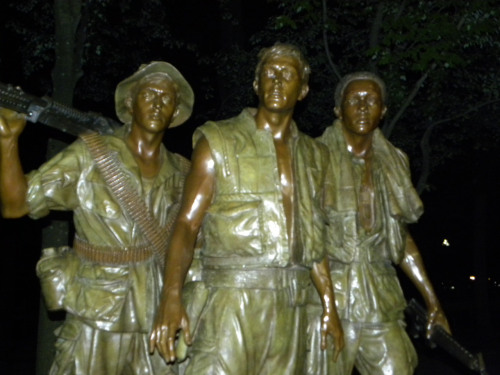
dscn0064

A Physically Painful Thursday Night in DC: Dinner with a Classmate and watching Our Government Implode

I have spent most of the day in some bad physical pain. Last night while walking around the National Mall taking pictures I hurt myself.  I was walking from the Washington Monument toward the World War Two Memorial looking at the Lincoln Memorial and trying to figure out a good camera angle.  I wanted good pictures so instead of walking down either of the sidewalks that line the Mall I wanted to stay in the center which meant walking “cross country” so to speak in the dark.

I was sizing up the shot of the Lincoln Memorial while walking forward and I turned briefly to look back to see if I had a good shot of the Washington Monument and the Capitol Dome.  As I made this slight turn I found that there was nothing under my right foot and I went crashing down onto a sidewalk about three feet below.  I landed on the side of my right leg with the main impact seeming to be at the place where the fibula and tibia come together just below the knee.  I felt a sharp pain but got up and limped back to GWU while getting shots of the WWII Memorial, the Korean andVietnamand Lincoln Memorials.  I got back to my room in a substantial amount of pain and it took forever to get comfortable enough to get to sleep.  When I got up all I could do was hold onto walls as I made my way across the room and put my leg up on the coffee table in the living area.  Eventually I made my way over to the conference site where thankfully I was able to keep my leg up most of the day.

When the conference was over I changed clothes to meet my friend Pat, a Marine Lieutenant Colonel who I attended the Marine Corps Command and Staff College with and met up with inIraqin 2007.  We met at Fado’s an Irish Pub where I had a very tasty Shepherd’s Pie and several pints of Kilkenny Ale which I have not had since traveling in the Mediterranean and the Gulf.  On the way there I rode the DC Metro and was very careful to not put any extra pressure on my leg than was absolutely necessary until I got caught in a crosswalk and had to try to run across to beat the light.  I am in good physical shape and I figured since I could walk I could probably still run.  I was wrong. The first time my right foot hit the ground a shock wave went through my leg with the area that I had injured erupting in pain bad enough to bring tears to my eyes.

After dinner I left the Metro station near GWU and stepped off what I thought was a short one step which were actually two steps again landing on my already throbbing leg.  I managed to get to my room where after a couple of Aleve tablets the edge is starting to come off of the pain.  Tomorrow I will check out of my room and the conference and about 900-930 AM will hit the road out of town.  I am in enough pain that as soon as I get into Virginia Beach I will stop at the Navy Clinic at Joint Base Little Creek or the Naval Medical Center to get my leg checked out.

I was very glad to get together with Pat and to enjoy the fellowship.  There is something about the shared military experience including war that binds people together.  It was as if we had seen each other yesterday, but then we chat often on Facebook and comment a lot on “The New Adventures of Doctrine Man!”

While we were talking another stake was placed in the talks to raise the nation’s debt ceiling. I believe that the nation is now being held hostage by a minority of people on the political right and left who have decided it is better for them to destroy the economy of the nation and livelihood of the vast majority of Americans to gain a short term political advantage in the 2012 elections.

This is not the first time this national suicide pact has happened.  It is now so late and the sides so far apart with such great enmity between them that even if in the now unlikely event a debt ceiling deal is reached the damage is done. Our national credit rating will be downgraded and although the nation will survive life will become exponentially more difficult for most Americans and the chaos will spread around the globe.

Back in the late 1920s the radical left and radical right in the German Weimar Republic represented by the German Communist Party on the Left and Hitler’s National Socialist Party of Germany on the Right sabotaged the more moderate politicians of the Center Party and the Socialist Party of Germany.  When Wall Street Crashed and the World entered the “Great Depression” the parties of the Left and Right became even more polarized leading President Paul Von Hindenburg to appoint Hitler to form a government.

Of course the rest as we historians are prone to say is history. The short sighted policies and actions of the German political parties after the collapse of the Empire eventually brought about the Nazi dictatorship.  If our political leaders continue down this path we can expect that the already fragile economy will take a terrible hit.  We can expect that many people in the United Statesand around the World will suffer the economic effects of the actions of these so called leaders.  As things get worse the extremists in both major political parties aided and abetted by those that think that they can gain by this tragedy will fight it out until one or the other beats the other party into submission.

This will not be good and I expect that the pain of what our political leaders inflict on us will be far greater than the physical pain that I feel now. God help us all.
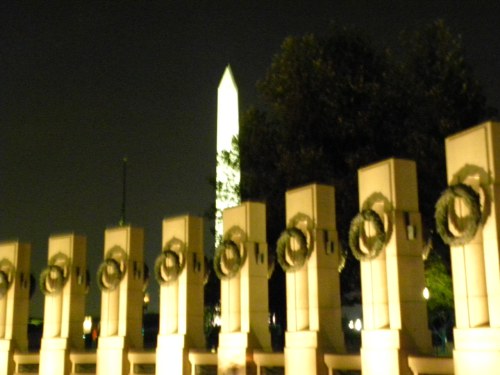
dscn0044

Be Careful…there is a point of no return and we may have crossed it

Be careful with your thoughts because they turn into words

Be careful with your words because they turn into actions

Be careful with your actions because they turn into habits

Be careful with your habits because they become your character

Be careful with your character because it defines you 

Ezra Taft Benson (former Secretary of Agriculture) quoted by Buck O’Neil

On Wednesday night I took a walk about our Nation’s Capitol.  It was a beautiful night and the buildings and monuments were illuminated in the most spectacular ways.  It was inspiring in a sense to see them, symbols of the greatness of the country and the people how sacrificed themselves to build it.  I can understand why so many millions of people have come to this country from all over the world to become Americans and be part of our dream.

In fact I became so engrossed I taking pictures that night that in the darkness I did not see an unilluminated ledge not far from theWashingtonMonument.  I fell from it onto the waiting sidewalk below and crunched my right leg pretty bad.  I had it checked out and x-rayed at the Naval Health Clinic at Joint Base Little Creek when I returned to Virginia. The doctor assumes that there is a good chance that I have a hairline fracture of either my tibia or fibula just below the knee and I am being referred for further tests when I return to Camp LeJeune Monday.  Until then I am on crutches and pain meds.

I fell over the ledge that I had no idea was where it was.  It was inadvertent and even when I got up and looked at it I had a hard time making it out.  However there are those in the country including many in the political leadership and media that seem to want us to go over a cliff because they perceive that it helps them and their agenda.  They see the ledge and they know the danger but they unfortunately enabled by “we” press on to the abyss.

For many years the political ideologues on the extremes of the Left and the Right in the United States have harbored the worst thoughts about those that do not match up with their ideologies. I have been writing for quite some time about how divided our body politic is and how dangerous the situation has become.

The contemptuous thoughts of the Left for the Right and Right for the Left first turned to words and those words became commonplace, so common that they became habitual.  In a sense they have become part of the political DNA of the most extreme among us.

The attitudes that we have formed and angry words which we now use so ubiquitously are reflective of a deep hatred that now is becoming what defines us as a people.  In fact the deep and abiding hatred which now permeates our society is now threatening the international standing and I would say the national security of the United States.  We have only ourselves to blame because through our actions and inactions of the past decade we have made our choice to be what we have become and there is no one group especially in our political, media and business elites that have served us well.  In fact we have as voters chosen this toxic mix of elected officials often more influenced by hate spewing pundits and our own self interests rather than that of the nation and future generations much as we would like to claim that we are looking out for the future.

We have chosen badly and we are paying for it.  We are being held hostage by those that we elected, men and women who supposedly know better than to destroy the country in order to save it as was about the village of Bien Tre in the Vietnam War… “we had to destroy the village in order to save it.” The Left and right have racked up massive debt over the past decade which has made previous debt pale in significance.  Each like to blame one another as “mostly to blame” but each has a major part of the responsibility for the mess that we are in.  However the amazing thing is that neither side nor we the electorate seems to be able to hold ourselves responsible.

Without going into the whole debt ceiling debacle which now has us on the edge of a default which we can only pray will not be as bad as real economists around the world say it will be; the fact is that we have made the mess and now our leaders are failing us. I have to say that all of them have used this made up crisis to some extent to further their goals and agendas at the expense of the country.  That is a shame and our elected leaders of all parties and factions are at fault and it comes back to character, theirs and ours.

You see it is about more than the budget or the debt ceiling. It is about hatred of fellow Americans which has been preached by hypocritical ideologues for decades on the radio, television and now the internet.  Much of it is as raw, hateful and disingenuous propaganda disguised as “news” as was Julius Streicher’s Nazi Der Sturmer and the Communist Party Die Rote Fahne were in Weimar Germany.  That poison has infected us and most of us line up on one side of the propaganda machine or the other.  We know what happened to the Weimar Republic, racked by bills it could not pay, massive unemployment brought on by the Great Depression and a desperate population led by politicians that intentionally used their misery to derail the efforts of government after government to try to manage the crisis.  They ended up with Hitler, the head of a large and vocal political movement which refused to compromise with anyone to bring down the Republic that they hated.

Whatever happens in regard to the debt ceiling and future budget negotiations the damage has been done.  The soul of our nation and our national character has been damaged perhaps irreparably.  Our leaders hate each other and the most influential media in the country, the talk radio and cable news pundits of all stripes throw gasoline on the fire every day. The social and political anarchy will reign until one side or the other has crushed their opposition.  Those in the middle lose either way as they will be crushed by whichever side wins unless they ally themselves with the winning side no matter who it is.

History teaches us that such times are at best tumultuous and at worst cataclysmic.  The consequences when great nations engage in such political fratricide it usually has grave consequences that effect it as well as nations and peoples far beyond its borders.

It is time for everyone to take a step back from the abyss before we plunge headlong into something that we will regret which will only benefit those that seek to benefit from it.  Or are we too stupid to see what is happening?

Thoughts, words, habits, character….be careful.

God help us all
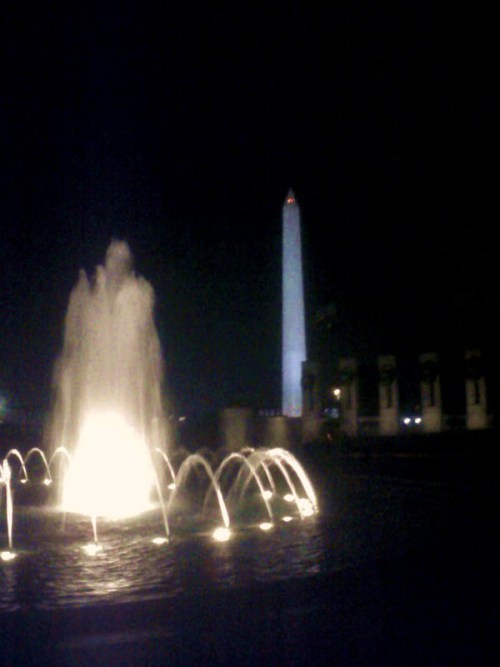
img00169-20110726-2126

We won’t let this Happen again….Until the Next Time

“I am disgusted and worn out with the system that seems to prevail.” Brigadier General John Buford 

The news is abuzz tonight about the bi-partisan deal that has been agreed to by the President, the Speaker of the House and Majority Leader of the Senate.  The details will come out but certainly there will be those unhappy with the deal.  I don’t know what is in it and the devil is always in the details.

I am a realist and the details seldom bode well. Like John Buford a career Officer during the Civil War I have become disgusted and worn out watching the men and women that we have elected to public office work so hard to fracture this country that I hold so dear.

Tomorrow I expect that the deal will pass in the House and Senate unless the hard core right and left work together to embarrass their respective leaders. Since neither side had enough votes to do this on their own despite weeks of impassioned and often bitter argument with neither side listening to the other it has come down to this moment.  Personally in light of all that has transpired between the current Congress and the Obama administration even if this is passed Monday on Tuesday the death struggle will resume. Of course the deal may not pass and like Confederate General Robert E. Lee perhaps questioning his own rejection of  Union we might someday say  “the war… was an unnecessary condition of affairs, and might have been avoided if forbearance and wisdom had been practiced on both sides.”  

That struggle has already begun as some Tea Party leader declared Congressman Allen West and three other Tea Party Supported House Members as “Tea Party defectors” for supporting Speaker of the House John Boehner’s plan over the weekend.  On July 27th Tea Party Nation leader Judson Phillips urged Boehner “to go” and be replaced by a “Tea Party Speaker of the House” while The Party Patriot co-founder Jenny Beth Martin suggested a similar thing.  Many Liberals are equally critical of the President and Majority Leader Harry Reid with a growing number stating that they believe that President Obama has betrayed their ideals one Democrat Congressman calling the deal a “sugar coated Satan sandwich.”

The battle lines are still drawn and the language except for the utilitarian language that compromise was necessary to stave off a default has not changed an iota.  The language of compromise does not sit well with the most vocal members of the Tea Party faction nor those on the hard Left.  Many Tea Party leaders and members continue to argue that their leadership to push the government into default to achieve their goals.

The default may not happen now but the crisis is not past.  No it will be with us for a long time with more division, more bitterness and more fuel being poured onto the flames of hatred that have consumed us.  Much like the various crises and compromises on the road to the Civil War nothing substantial has changed.  In fact William Gross the head of PIMCO one of the major global investment groups said that a downgrade was “inevitable” and that “Congress has basically proven itself to be dysfunctional and this will carry on for months even if the crisis is basically resolved in the next few days.”

We have crossed the Rubicon and unless an external and existential threat to our nation forces our leaders to work together I seriously doubt that this will end well.  The President failed to lead when he had a super-majority and his allies in Congress squandered the chance that they were given in 2008.  The Republicans after taking the House in 2010 are doing the same.  Neither side will admit to their behavior. Both will with good reason to point the finger of blame at their opponents while ignoring their own contributions to this sordid state of affairs.

I can see it as if has already happened. The Unholy Trinity of politicians, pundits and preachers will step up their rhetoric inciting their followers to adopt even more uncompromising positions.  The already fearful enmity will deepen and the center will disappear. Emotion in the form of hatred will drive the arguments that neither side will listen to even as the United States and the world economy worsens and the wars continue.  Young Americans will give their lives in Iraq and Afghanistan even as their political leaders on both sides of the aisle seek ways to reduce the force and even the pay and benefits that they have earned after 10 years of unending war that the rest of the nation while seemingly grateful does not understand nor share. “We few, we happy few…” William Shakespeare quotes Henry V before the Battle of Agincourt.

Tonight I have been watching the movie Gettysburg which I think is a fitting reminder of what happens when the Unholy Trinity finally achieves their goal of destroying the very fabric of the nation and pits brother against brother.  Hopefully cooler heads will prevail and somehow, some way we will get through this before we long for the day that makes what we are experiencing now look good.

Like General James Longstreet I wonder “Why do men fight who were born to be brothers?”
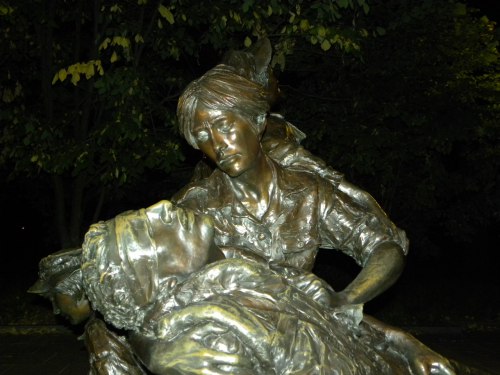
dscn0066

The Deal is Done and are We? There are Always Results

“but this momentous question, like a fire bell in the night, awakened and filled me with terror. I considered it at once as the knell of the Union. it is hushed indeed for the moment. but this is a reprieve only, not a final sentence. a geographical line, coinciding with a marked principle, moral and political, once conceived and held up to the angry passions of men, will never be obliterated; and every new irritation will mark it deeper and deeper.” Thomas Jefferson on the Missouri Compromise

I believe that Thomas Jefferson in describing the results of the Missouri Compromise aptly describes the mood of our times and the consequences of politicians that lead us to the dark abyss of hatred and civil war.   There are times that I wish that I was not a historian or theologian for then I could simply be ignorant of the place that our elected leaders are leading us.

Yesterday and today I sat convalescing at home trying to stay off of my injured leg as the final actions were taken in the House and the Senate on the Debt Ceiling Compromise. I felt as if I was watching a national tragedy being marketed as by some as a triumph of cooperation.  I was amazed that talk which was paired with the opponents of the measure in both parties.  I felt that those praising their actions to pass the increase and related budgetary cuts were saying it all for show even as they sharpened their swords for the next battle even as the vast majority of Americans expressed anger and frustration with the behavior of their elected officials.  A Pew Research poll indicated “72 percent of American characterized the recent budget negotiations as “ridiculous, disgusting, stupid, and frustrating.”

But we have no one to blame but ourselves. We voted them all into office and we have encouraged their repugnant behavior with our votes which more often than not were purchased by the fear mongering engaged by each side and our desire to have our special interests and or ideology come out on top. We have been engaged in what conservative columnist Pat Buchanan declared a “culture war” for the past two decades and wars be they cultural, ideological, and economic or military have consequences.  The longer they go on the worse and more violent they become until one side finally loses and the landscape is destroyed. A conservative German newspaper noted “It is this war-like rhetoric that has so poisoned American politics.” The Germans should know something of this.  The “Kulturkrieg” and the violent hatred of their countrymen in the wake of the defeat of the First World War and humiliation of Versailles brought about civil war.  The pursuit of radical ideologies in the following years is what doomed the ill-fated Weimar Republic when the economic calamity of the Great Depression struck and led to the tragedy of the Nazi takeover and ultimately led to World War Two.

I believe that the actions of all parties in this forced crisis were a disservice to the citizens of this country, the memory of all who have gone before us and done more to damage our standing in the world than I could ever imagine.  It is as if the leaders of the country have forgotten why they are even in Washington.  There is no unity of purpose, only the language of war being used against fellow Americans.  A German newspaper wrote “No one can forget the Civil War atmosphere in which this debt fight has taken place. It weighs on America’s international reputation. From the point of view of financial markets, the dysfunctional nature of Washington is a risk factor that must be calculated for in the future.”

The sad thing is that there is so much work that has to be done and it is more than reducing Federal Government spending. Our industries have been shipped wholesale overseas using the treaties that business has foisted upon their willing accomplices in both parties in the name of “free trade.”  Our unemployment continues to rise and many economic experts believe that we are entering a “double dip” recession which some believe could easily become a depression. The infrastructure of the nation crumbling with the businesses that benefit from them refusing to contribute to their maintenance unless they receive government contracts and money in return.  We are committed to long term ground wars that have sapped the economy and worn out the military which now seem to serve little strategic purpose.   In fact the position of the Army in Afghanistan could be disastrous if Pakistan decides to stop cooperating and not allow us to supply the Army through it.

It is apparent to me that those that can afford it the least and the military will bear the brunt of the cuts that will come and that it will be a long time before this crisis passes.  No one seems to be addressing the major issue of unemployment or economic growth without which there is no recovery.  I heard the President and Senate Majority Leader McConnell repeat what they have said for years but no plans and no action.  As for the military we are worn to a nub, our equipment needs to be replaced and modernized and our troops still deserve the best that we can give them, but even this is on the chopping block, military retirement is called “an expensive entitlement program” by those advocating that the military adopt a private sector pay and benefit plan of little value especially to those that have spent 10 years at war paying with their minds, bodies and spirit fighting wars that the Wall Street bunch has benefited from, the same Wall Street leaders that now call for reductions in military pay and benefits.  It is obscene.

I would like to believe that this is a rough patch that we will get through, but right now with the terrible acrimony present in Washington and all the State Capitols I have a hard time believing that we will.  The President has failed to enunciate any kind of plan or vision and the Tea Party leadership is acting like the Jacobins in Revolutionary France.

I have no idea who will “win” this “culture war” and does it really matter? The result will be a Pyrrhic victory with the winners celebrating on the ruins of the country.  I only know that we all lose.

Leave a comment

Filed under civil war, economics and financial policy, History, laws and legislation, leadership, News and current events, Political Commentary

The Bloodiest Day: The Battle of Antietam 17 September 1863

“Of all the days on all the fields where American soldiers have fought, the most terrible by almost any measure was September 17, 1862. The battle waged on that date, close by Antietam Creek at Sharpsburg in western Maryland, took a human toll never exceeded on any other single day in the nation’s history. So intense and sustained was the violence, a man recalled, that for a moment in his mind’s eye the very landscape around him turned red.” Stephen W Sears

“I have heard of ‘the dead lying in heaps’, but never saw it till this battle. Whole ranks fell together.” Captain Emory Upton, 2nd U.S. Artillery, at Antietam
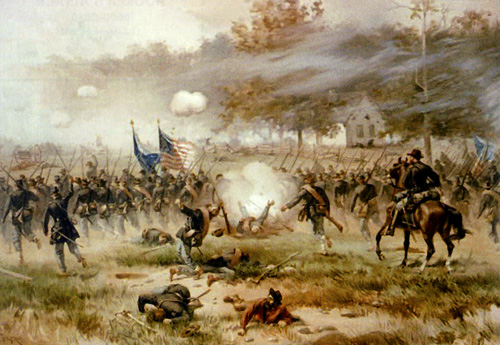
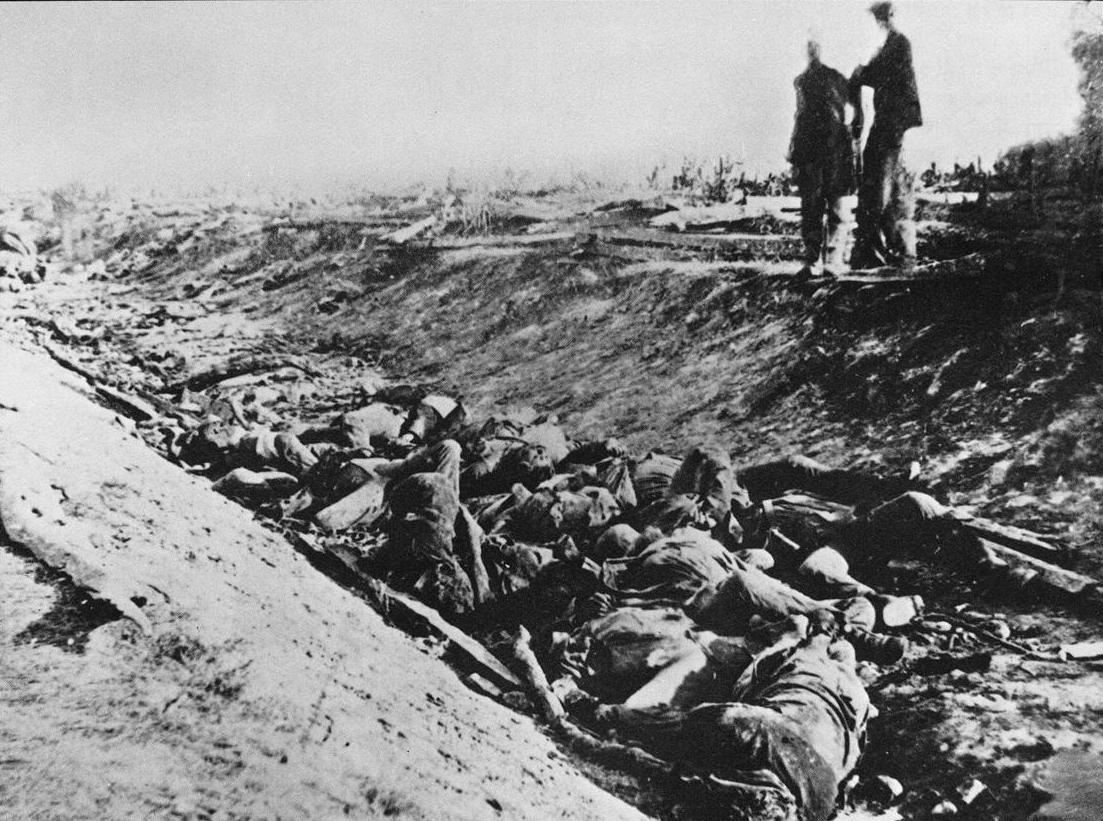
“We were in the very maelstrom of the battle. Men were falling every moment. The horrible noise was incessant and almost deafening. Except that my mind was absorbed in my duties, I do not know how I could have endured the strain.” Lt. Frederick L. Hitchcock, 132nd Pennsylvania, at Bloody Lane, Sept. 17, 1862

To the west of Frederick Maryland a small town named Sharpsburg sits on the west side of a creek. Named Antietam the creek’s headwaters are in Franklin County Pennsylvania and it meanders south where just to the south of Sharpsburg it empties into the Potomac River.

It is a peaceful place, rolling hills and agricultural country with some well preserved stone arch bridges, including one just outside of Sharpsburg. It is hard to believe that 150 years ago the town and the creek were the scene of the bloodiest single day of battle in American history.

On that indian summer day of 1862 the Confederate Army of Northern Virginia, General Robert E Lee, commanding made a stand against the much larger Union Army of the Potomac, Major General George B. McClellan, commanding.

Lee had invaded Maryland following a string of successes in Northern Virginia during that summer of 1862, defeating McClellan outside of Richmond in the Seven Days, and in a campaign of maneuver bested a newly formed Army, the Union Army of Virginia commanded by Major General John Pope defeating it at the Second Battle of Bull Run between 28-30 August 1862. With Northern Virginia’s crops and livestock depleted and his opponents in crisis Lee moved his army north into Maryland. The decision was driven partly by the need to provision his army, but also had the hope of drawing Maryland away from the Union mistakenly believing that public sentiment in that state was pro-Confederate. If the people of Maryland rose up to support Lee it would be disastrous to the Union and endanger the capital itself. A final consideration was the hope that a Confederate victory on Northern soil would bring about the foreign recognition and possibly the intervention of Great Britain on the side of the Confederacy.

The Lost Order

Lee crossed the Potomac on September 3rd and sent his Second Corps west with some elements seizing the Union armory in Harper’s Ferry, others to secure the Baltimore and Ohio Railroad at Martinsburg the rest of the Army was in the area of Frederick. He was pursued by the very cautious McClellan at the head of the Army of the Potomac.

On September 9th Lee issued General Order 191, the infamous “lost order” which a copy of which was found by Union soldiers wrapped around three cigars at a campground recently occupied by Lee’s rear guard element, the division of D.H. Hill on September 13th. The order detailed the disposition of Lee’s army and McClellan seized the opportunity. On the 14th the Army of the Potomac attacked part of Lee’s army at the Battle of South Mountain. The Union won that battle forcing the outnumbered Confederate forces to withdraw, though the delay allowed Lee to concentrate more of his army at Sharpsburg on the 15th.

Although he outnumbered Lee McClellan believed the reports of the Pinkerton Detective Agency which provided intelligence to the army. Those estimates which credited Lee with more than 100,000 troops. He delayed his attack until he had drawn up his full army on the on the 17th.

When he did attack on the 17th his attacks were uncoordinated and though he came close to decisive breakthrough Lee’s army desperately clung to its positions. The action began to the north of the town in the morning and both sides showed incredible ferocity at the Cornfield, where in the space of about three hours nearly 8000 soldiers were killed or wounded. The fighting shifted to the center of the line opposite the town by mid-day. Amid the destructive storm of artillery the armies fought around the Dunker Church and a sunken lane now known as “Bloody Lane.” In the confines of that 800 yard stretch of road over 5000 soldiers were killed or wounded in the course of about four hours. The Union forces broke the Confederate line but reinforcements were not sent and when the the division commander, Major General Israel Richardson was mortally wounded the attack lost its verve and the Confederates under Lieutenant General James Longstreet were able to restore the line.

The south remained quiet as McClellan ordered Major General Ambrose Burnside’s IX Corps to hold off on attacking. Burnside did not receive his orders to attack until 1000. He finally attacked across the south bridge, now known as Burnside’s Bridge in the afternoon. It was another tough fight and Burnside, after several attempts move to the south to flank Confederate forces in the late afternoon with the intention of cutting Lee from off his only escape route.  The Confederates were in a desperate condition. It was at this point, about 3 PM when the division of Major General A.P. Hill arrived and immediately counterattacked breaking up Burnside’s attack. Burnside requested reinforcements from McClellan who refused saying that he had none available. This was not the case, McClellan had two full corps of infantry uncommitted to the battle but still believing that he was outnumbered and that Lee was attempting to trap him.

The actioned ended by 530 PM with both sides rested and reorganized for action the next day. Lee prepared to defend but no Union attack was offered on the 18th. An informal truce was observed to allow the evacuation of the wounded and Lee began his withdraw across the Potomac into Virginia that night. Despite being goaded by Lincoln to pursue McClellan did not and the Union lost the opportunity to destroy Lee’s army n Union territory.

Casualty estimates vary but according to Stephen W Sears in his book Landscape Turned Red that the Army of the Potomac lost 2108 dead, 9540 wounded and 753 missing. He states the best estimate of Confederate casualties are 1546 dead, 7752 wounded and 1018 missing. Most of the missing were likely killed and buried in mass graves or discovered and buried by civilians after the battle. In the space of 12 hours 22719 Americans were killed or wounded. It was the bloodiest single day in American military history.

Though the battle was inconclusive in that Lee’s army survived but had to break off its offensive it had more influence than expected. President Lincoln issued the Emancipation Proclamation on September 22nd and though it did not take effect until January 1st 1863 it marked a turning point in the war.

McClellan failed to take up the offensive in the next tow months and Lincoln relieved him of command giving the Army of the Potomac to Burnside who goaded by Lincoln took the army into battle at Fredericksburg where it met with defeat.

I have been to the battlefield a number of times, once as part of a “staff ride” with the Marine battalion that I was assigned in May of 2000. Each time I go I take the time to ponder the great losses endured by both armies and the individual courage of the soldiers involved. Some of the units that I served with in the Army National Guard in Texas and Virginia trace their lineage and honors to regiments that fought at Antietam and I have felt a connection to the battle because of that. It is hard to imagine the amount of death and carnage taking place in such a placid location in such a short amount of time.

It is something to ponder when some Americans openly suggest another civil war if their party does not win the election.

Peace

Padre Steve+

1 Comment

Filed under civil war, History, Military