Tag Archives: barbara tuchman

History, Critical Thinking & Truth

  
Friends of Padre Steve’s World

Just a short note today as I continue to read, reflect and do some research and writing on my Civil War and Gettysburg Staff Ride text.

Yesterday I was adding books that I have read over the past few months to my “read” list on my Facebook page, and there were a lot more than I remembered as I worked my way through my stack. If you add things to your Facebook page, movies, books, music or television shows, Facebook will provide lists of suggested titles that you can browse. This of course includes books, and not surprisingly to me, most of the books that were suggested were various forms of fiction or children’s books. There were a few literature classics among the suggestions and a host of Bible books. What I noticed was there were few books on history, philosophy, political science, world affairs or even theology listed. William Hughes

I was troubled by this; not because I am against people reading fiction or children’s book by any means, but typically those books, with the exception of some of the children’s books are for entertainment, not learning. As entertainment they are fine, but since almost everything else in our culture is geared toward entertainment I wonder where people are being challenged to think critically, and not simply be sponges for the sound bites offered by the politicians, preachers and pundits who dominate so much of our airwaves and the internet.

Barbara Tuchman wrote, “Books are the carriers of civilization. Without books, history is silent, literature dumb, science crippled, thought and speculation at a standstill. Without books, the development of civilization would have been impossible. They are engines of change (as the poet said), windows on the world and lighthouses erected in the sea of time. They are companions, teachers, magicians, bankers of the treasures of the mind. Books are humanity in print.”

Sadly, many people in this country and around the world are sadly deficient in knowing any history at all, and much of what they do know is based on myth. This is dangerous, historian George Santayana wrote, “Those who cannot remember the past are condemned to repeat it.” But I think that Howard Zinn said it the best:

“History can come in handy. If you were born yesterday, with no knowledge of the past, you might easily accept whatever the government tells you. But knowing a bit of history–while it would not absolutely prove the government was lying in a given instance–might make you skeptical, lead you to ask questions, make it more likely that you would find out the truth.”

Have a great night,

Peace

Padre Steve+

2 Comments

Filed under History, philosophy

Revolutionary Truth Telling & the Discomfort of Thought

IMG_1249

Friends of Padre Steve’s World,

Most of my readers know that in addition to being a Priest and Navy Chaplain that I am a historian and teach both ethics and about Gettysburg as a faculty member at a Staff College. Many of the men and women that I teach will lead our military as commanders, planners and staff officers. As such as I mentioned at beginning of the year my first duty, whether it is in teaching, writing or in ministry is to the truth. In fact I quoted Captain Jean Luc Picard, played by Sir Patrick Stewart in Star Trek the Next Generation: “the first duty of every Starfleet officer is to the truth, whether it’s scientific truth, historical truth or personnel truth…” I am not a Starfleet Officer but as an officer nonetheless I have always believed that the truth matters, but sadly I, like so many of us have turned the other way and not spoken out. But the older I get the more I realize that I cannot be silent about subjects that at one time I turned a blind eye to because they were uncomfortable, unpopular or might hurt my career either in the church or in the military.

I have been writing a lot over the past few months about subjects that many people are controversial and as such many people are uncomfortable with those topics. Whether the issue is civil rights, racism, Gay rights and marriage equality, voting rights, religious freedom and religious intolerance, and even xenophobia, or the connection of symbols such as the Confederate Battle Flag to a heritage that goes to a hatred that extends far beyond the battlefields of the Civil War; I am speaking out. Now I am fully aware of that many of these subjects are controversial. I have been asked in comments on this site and on my various social media accounts, particularly Facebook, why I keep bringing up the uncomfortable past. But I have to, I have a duty to the truth and as Oscar Wilde noted “The truth is rarely pure and never simple.”

The late Howard Zinn, a brilliant historian whose work at one time I discounted, said: “But I suppose the most revolutionary act one can engage in is… to tell the truth.” Who would think that telling the truth could or would be a revolutionary act? However, when one lives in a society where the truth is bent, run over and shredded by politicians, preachers and pundits, what I call the Trinity of Evil; when state school boards whitewash history and force their religious views on children in public schools; where corporations and advertisers use the most crass means to deceive customers; and where established science is not met with denial under the guise of “skepticism;” telling the truth is a revolutionary affair.

The honest truth is that I never expected to be a revolutionary in terms of what so much of society, especially the conservative Christian movement that I spent much of my life in expects. Truthfully, upholding tradition, and for that matter defending myth, is much easier when backed by the certitude of an unbending theology and political is much easier than asking the hard questions. Barbara Tuchman once wrote: “The reality of a question is inevitably more complicated than we would like to suppose.” I guess that is why so many people would rather be content with myth than to ask the really hard questions; be they about history, religion, and science or for that matter anything. One of the must uncomfortable things to admit is that truth is always evolving as we learn more, it is dynamic, not static and to attempt to force people to live by the “truth” of our ancestors is disingenuous, dishonest and denies the reality of the universe that we live. Thomas Jefferson recognized this and wrote:

“I know also, that laws and institutions must go hand in hand with the progress of the human mind. As that becomes more developed, more enlightened, as new discoveries are made, new truths disclosed, and manners and opinions change with the change of circumstances, institutions must advance also, and keep pace with the times. We might as well require a man to wear still the coat which fitted him when a boy, as civilized society to remain ever under the regimen of their barbarous ancestors.” 

So why do I write? I write so that we never forget or push aside the great evils that human beings are capable of committing: The Holocaust, slavery and Jim Crow, the extermination of Native Americans by the millions in the name of God and Manifest Destiny, the enslavement, exploitation, and sometimes the extermination of whole peoples by colonialism; the witch trials, the religious wars of the Reformation, the Inquisition, the Chinese Cultural Revolution, Stalin’s purges, the Tuskegee experiments, the Japanese barbarity in the Rape of Nanking and other places in Asia, the Srebrenica genocide and the Rwandan genocide, just to name a few.

All too often the perpetrators of those events and their descendants as all too willing to last the past lie dormant. But at what cost do we do so? Do we sacrifice justice on the altar of prosperity and peace; do we sacrifice uncomfortable truth in order to remain undisturbed and comforted by myth? Do we condemn our descendants to live under the myths of our ancestors? Would we sacrifice the truth and justice in order to ensure obedience? Howard Zinn correctly observed, “Historically, the most terrible things – war, genocide, and slavery – have resulted not from disobedience, but from obedience.”

President John F Kennedy spoke these words at Yale in 1962: “The great enemy of truth is very often not the lie–deliberate, contrived and dishonest–but the myth–persistent, persuasive and unrealistic. Too often we hold fast to the cliches of our forebears. We subject all facts to a prefabricated set of interpretations. We enjoy the comfort of opinion without the discomfort of thought.”

Personally I would rather ask the questions and confront the past so we might have a better future, because though I am a realist, I also believe in my heart that humanity is capable of overcoming hatred, prejudice and ignorance. The problem is that times get difficult those attitudes can overcome our better nature. As Spencer Tracy’s character in the movie Judgment at Nuremberg said:

“But this trial has shown that under a national crisis, ordinary – even able and extraordinary – men can delude themselves into the commission of crimes so vast and heinous that they beggar the imagination. No one who has sat through the trial can ever forget them: men sterilized because of political belief; a mockery made of friendship and faith; the murder of children. How easily it can happen. There are those in our own country too who today speak of the “protection of country” – of ‘survival’. A decision must be made in the life of every nation at the very moment when the grasp of the enemy is at its throat. Then, it seems that the only way to survive is to use the means of the enemy, to rest survival upon what is expedient – to look the other way. Well, the answer to that is ‘survival as what’? A country isn’t a rock. It’s not an extension of one’s self. It’s what it stands for. It’s what it stands for when standing for something is the most difficult! Before the people of the world, let it now be noted that here, in our decision, this is what we stand for: justice, truth, and the value of a single human being.”

That my friends, is why I write: for justice, truth, and the value of a single human life.

Peace


Padre Steve+

3 Comments

Filed under ethics, faith, film, History, News and current events, philosophy

Truth and Un-sanitized History

10570298_10152872503382059_5058681841617456899_n

Friends of Padre Steve’s World,

I have spent the last couple of days introducing to new readers to things that I have come to believe. Since I am a historian I will continue to do that today.

I have a passion for truth, especially in the realm of historical thought, in fact over the past few years this passion has deepened to a level of profoundness that I never dreamed. In fact for me this passion has become a duty, a duty to truth; an un-sanitized, warts and all examination of subjects attempting to strip away the veneer of myth in order to find truth. This is not easy, but it is what my life has become, knowing that in the long run I will not discover all truth, but hopefully point others to examine history, the sciences, philosophy and even theology to find truth. The process can be uncomfortable, especially when confronted by facts, documents, scientific and archeological data which shows what we used to think was truth, as either incomplete, romantic myth, or even complete lies, untruths and fabrication. Oscar Wilde once wrote,“The truth is rarely pure and never simple.”

Barbara Tuchman once wrote: “The reality of a question is inevitably more complicated than we would like to suppose.” That is the nature of truth. It does not matter if it is truth about history, biography, philosophy and religion, science, politics, economics or any part of life. To actively seek truth means that one must open up themselves to the possibility of doubting, as Rene Descartes wrote: “If you would be a real seeker after truth, it is necessary that at least once in your life you doubt, as far as possible, all things.” I admit that this is not comfortable, but it is necessary.

As a historian I have a tremendous passion for truth, and for unsanitized history and for me this means looking at what we know with a critical eye, to compare and examine sources to question what we or others knew before. Far too often what we believe about our own history is often more preserving myth more than by asking hard questions and applying reasoned critical study. To do this is dangerous, because to do so we have to admit that what we know today could be proven wrong at some time in the future when new facts, documents, archeological finds or other historical or scientific are discovered. To those content with half-truth, partial truth or even myth this is disconcerting, and those of us who attempt to unravel myth from fact and present things in a new way are called “revisionists” as if that is somehow a bad thing. The sad thing is we are having to revise in many cases, supposed history that was revised by people who needed to propagate myth, such as with those who promoted the myth of the Lost Cause, the romantic, noble Confederacy which for well over a half century was propagated as historical truth. This myth was sold to the American public in such in film, television and books, fiction and non-fiction alike, to the point that much of white America, even outside the South accepted the myth of the Lost Cause as truth. Films like Birth of a Nation, Gone with the Wind and even Disney’s Song of the South, helped ingrain the myth as truth, and even today when so much more is known, many people hold on to the myth and attack those who differ. 

A lot of my readers may wonder why I write so much about the American Civil War as well as the ante-bellum and Reconstruction eras of American history. For me they are very important for a couple of reasons; first they are eras, that for good and bad define us as a nation and people. Second, they still have relevance to what happens today, especially in the understanding of liberty, civil rights and race relations.

I have a passion for this. The American Civil War and the Battle of Gettysburg are intrinsic parts of who we are as Americans today. The events of that war and this battle continue to reverberate in many aspects of our political, social and national life. Thus for me teaching about this event and what happened on the “hallowed ground” of Gettysburg, as Abraham Lincoln called it, and even 150 years later it matters far more than most of us realize.

Civil War hero Joshua Chamberlain is an icon of the Civil War and American history. A professor of Rhetoric and Natural and Revealed Religions at Bowdoin College he volunteered to serve with the 20th Maine Infantry, his military career in the Civil War has been depicted in movies such as Gettysburg and Gods and Generals and written about in biographies and even historical fiction. Chamberlain was one of the heroes of Gettysburg, and his story has a myth like quality, but he too was a complex, contradictory and sometimes flawed character. However, Chamberlain attached a great importance to passing down the stories of people who did noble deeds and who lived exemplary lives. He wrote, “The power of noble deeds is to be preserved and passed on to the future.”

I sincerely believe what Chamberlain said and I am getting ready to lead another Staff Ride for students from our Staff College to Gettysburg next month.  I do beleive that the power of noble deeds needs to be preserved and passed on to the future.  Even the deeds of less than perfect, often contradictory and sometimes even scandalous  individuals. That is part of the task of the historian. I do this in what I teach and what I write, both in the academic setting as well as on this website.

We live in a time of great cynicism, some of which I can understand. We also live in a time where many people and our institutions operate in a “zero defect” culture, those who fail in any way are shunted aside, punished or even chastised or ostracized. However, when I look at the men who fought at Gettysburg, or for that matter almost any individual who has accomplished great things, none are perfect people and many have great flaws in character, or supported causes or ideologies that were evil. That being said, even less than perfect people can rise to do great deeds, deeds that need to be remembered, passed down and told to succeeding generations.

Many great leaders, or other men and women that we consider today to be great, influential or important were or are quite fallible. Even those who did great things often made gross mistakes, had great flaws in their character, and some lived scandalous lives. Such deeds may tarnish their legacy or take some of the luster away from their accomplishments. But I think that these flaws are often as important as their successes for they demonstrate the amazing capacity of imperfect people to accomplish great things, as well as the incredible complexity of who we are as people. No one is perfect. There are degrees of goodness and even evil in all of us. It is part of the human condition. That is the beauty of un-sanitized history, that is the beauty of stripping away myth to discover the humanity of people, and to recognize who they are, who we are, the good, the bad and even the ugly.

When I look at the perfection that imperfect people expect of others I am reminded of something that William Tecumseh Sherman said about his relationship with Ulysses Grant. These were flawed men, but they were in large part responsible for the Union victory in the Civil War. However, to be honest, neither man would never reach the level of command that they rose to in our current military culture, nor would they rise to the top in corporate America. They are too flawed. Sherman said it well, “Grant stood by me when I was crazy, and I stood by him when he was drunk, and now we stand by each other.” 

That is a part of my passion about Gettysburg and my appreciation and admiration of the brave men who fought in that battle. As I continue to write about that battle and about those men I hope that my readers will gain a new appreciation of their complex and contradictory natures, as well as think about what that means to us today, as individuals and as a society, for it is only when we strip away the myth and seek the truth. Marcus Aurelius wrote:

“If someone is able to show me that what I think or do is not right, I will happily change, for I seek the truth, by which no one was ever truly harmed. It is the person who continues in his self-deception and ignorance who is harmed.”

Those truths can be scientific, they can be historical or literary, and quite often the truth can also be quite personal.

As John F Kennedy said at Yale in 1962: “The great enemy of truth is very often not the lie–deliberate, contrived and dishonest–but the myth–persistent, persuasive and unrealistic. Too often we hold fast to the cliches of our forebears. We subject all facts to a prefabricated set of interpretations. We enjoy the comfort of opinion without the discomfort of thought.”

So until tomorrow, have a thoughtful night.

Peace

Padre Steve+


1 Comment

Filed under civil war, History, philosophy

Writing About War

IMG_0535

“What a cruel thing is war: to separate and destroy families and friends, and mar the purest joys and happiness God has granted us in this world; to fill our hearts with hatred instead of love for our neighbors, and to devastate the fair face of this beautiful world.” Robert E. Lee in a letter to his wife 1864

Memorial Day weekend is over but I have not stopped reflecting on war and its cost. Having served in combat myself, and having stood over the wounded in field hospitals in Iraq and having seen the devastation of war up close and personal I have a hard time reducing war to the technology, the tactics and trivia that seem to satisfy the consumers of war porn. Call me whatever you want but I cannot get around the human cost of war. William Tecumseh Sherman reflected that “It is only those who have neither fired a shot nor heard the shrieks and groans of the wounded who cry aloud for blood, more vengeance, more desolation. War is hell.” 

One of my favorite historians of the Second World War, Cornelius Ryan who wrote the magnificent accounts of D-Day, The Longest Day, Operation Market Garden, A Bridge Too Far, and the Battle of Berlin, The Last Battle said about his accounts: “What I write about is not war but the courage of man.” I think that writing about courage is appropriate and I do a lot of that. But I think in addition to courage that we also must write about the frailty and fallibility of human beings, especially the leaders who plan and conduct war.

When I teach or write about military history I find it important to make sure that the people who made that history are not forgotten.  After all, as the British military theorist Colin Gray says “people matter most” when we deal with history, policy, or politics, especially in the matter of war. He is right of course, people are the one constant in war. Weapons and tactics may change, but people do not. 

Likewise we cannot forget that war, even wars for the most excruciatingly correct and even righteous reasons are always tragic. The cost of war, even so called “good wars” is devastating. Ernest Hemingway wrote “Never think that war, no matter how necessary, nor how justified, is not a crime.” To the war porn addicts the words of Sherman or Hemingway surely are offensive, but they provide a necessary warning to the politicians, pundits and preachers who cannot get enough war to satiate their bloodlust and need for power. Sadly, most of the men and women who revel in war without end have neither served in combat or have any skin in the game regarding the wars that they support and those which they work so hard to bring about. Maybe if they did then they would not be so quick to send young men and women to war.

Those who follow me on this site know that I write about war a lot, some might say too much, but I cannot help that. My life has been forever changed by war.  If you look back through my archives you can see how my writing has evolved when it comes to dealing with war and part of that is because I do not want the sacrifices of the men and women who fought those wars to be forgotten or cheapened by a society which from the very beginning of our history has done so. Lieutenant General Hal Moore who co-authored the book We Were Soldiers Once, and Young wrote: “in our time battles were forgotten, our sacrifices were discounted, and both our sanity and suitability for life in polite American society were publicly questioned.” By continuing to write and teach I hope to ensure that this does not happen. Maybe I am pissing into the wind so to speak, but I cannot stand by silently.

I am a combat veteran, I have seen the devastation of war, I have lost friends in war, men and women who did not come home. I have seen other friends struggle in the aftermath of war, and I have seen some lose that struggle. Because I am a military historian as well as a priest and I have a sacred duty to ensure that people know the real cost of war.

I do this in my official capacity teaching ethics and leading the Gettysburg Staff Ride for the Staff College where I have the honor to serve as faculty.This itself is interesting as I am spending the final few years of a three and a half decade military career teaching the men and women who in not too long of time will be our nation’s senior military leaders. That is a responsibility that I take most seriously. Thus I always, whether it is in teaching the ethics of war, or about the Battle of Gettysburg I attempt to impress this on my students. I preach from day one to every class that their decisions in the planning process, their recommendations to senior political and military leaders, and their decisions on the battlefield impact real people, their soldiers, the people in the lands that they fight and on the home front. 

I have been writing a text for the Gettysburg Staff Ride which I believe will eventually become at least two and maybe more books. I tie a lot of biographic material in with the text, again in order to make what could be a dry and mechanical affair more real to my students and readers. That is one of the reasons that I find going to Gettysburg and walking that hallowed ground so important.

I find that the lives, beliefs, motivations, relationships, and experiences of people to be paramount to understanding events. People are complex, multi-layered and often contradictory. All of my heroes all have feet of clay, which in a sense makes their stories even richer, and the events that they helped bring about far more more fascinating. By not denying their humanity, by understanding and appreciating their flaws, even the flaws in their character, I gain a more holistic perspective and develop a greater appreciation and empathy for them and a deeper understanding of my own flaws. As T.E. Lawrence wrote “Immorality, I know. Immortality, I cannot judge.” 

The complex and contradictory nature of humanity leads to a lot of confusion for people who see the world through the black and white lens of cosmic dualism where there is only good and evil and “if you’re not for us, you’re against us.”  Human nature shows us that things are much more complex, nuanced and blurry, there are far more than fifty shades of gray when it comes to humanity and the participation of men and women in war.

Because of this otherwise good and honorable people can find themselves for any number of reasons, fighting for an evil cause, while people who are more evil than good can end up fighting for a good cause. Now if you are one of those people who are trapped by an absolute ideological or religious certitude which cannot allow for such contradictions, that statement may confuse or even offend you. For that I do not apologize and I hope that you are offended enough to face the truth, for that is the human condition, and that my friends is what history, and especially that dealing with the most destructive and consequential issues involving humanity must deal with.

Over the weekend I did a series on this site about the tragedy of the British Battlecruiser HMS Hood and the German Battleship Bismarck which transpired over the course of a week in May 1941. In that week the two largest and most powerful warships of their day were sunk taking over 3600 of the roughly 3750 sailors aboard to a watery grave in the North Atlantic. While doing this I had the opportunity to go aboard the USS Wisconsin here in Norfolk, a ship that is roughly the same size of those two doomed warships. As I walked the passageways surrounded by massive armor plating It helped me, a sailor who has served aboard a modern Guided Missile Cruiser and other warships to appreciate the life and death of the sailors on those ships. I thought of the Hood’s who with the exception of three sailors being annihilated as the massive ship exploded, and then I thought about the crew of the Bismarck who had nearly half a day to contemplate their end before the British shells turned their ship into a funeral pyre.

So I will continue to write about war and try in the process to humanize it for my readers and to tell the stories of the tragedy that is war in such a way that even those who have not been to war, can imagine it and in doing so make wise decisions if they are to send other people’s children to fight their wars. The subject is far too important to be left to the purveyors of war porn who seek to satiate the bloodlust of others.

As for the form of my writing, I am becoming much more deliberate in trying to craft the story. Barbara Tuchman wrote something that I am now beginning to appreciate as I write my own book on Gettysburg and the Civil War: “I have always felt like an artist when I work on a book. I see no reason why the word should always be confined to writers of fiction and poetry.”

Anyway, that is all for tonight. Over the coming week I should be putting out my next chapter revision to my Gettysburg text and some other articles.

I wish you all the best.

Peace

Padre Steve+

2 Comments

Filed under History, Military, philosophy

Monday Musings: Books the Carriers of Civilization 


Friends of Padre Steve’s World

It is Monday and I am traveling back home from the conference that I attended in Houston and I am tired after traveling and spending most of the weekend sick. But to be fair the conference was well worth it. 

 As I muse about the the coming week I am stuck on something that I saw about the decline in the number of Americans who read books, and it occurred to me that this is probably a major factor in the ignorance displayed by so many Americans on so many subjects. A Pew survey reported that 23% of Americans read no books whatsoever in 2013 and over a hefty half  of Americans read fewer than five books. The survey did not ask what people were reading but by my perusal of best-seller lists, Amazon.com notifications and bookstore racks it appears that much of what is read is junk. No judgement intended but the best sellers in the non-fiction world are almost universally written by popular but biased and often ignorant political pundits, preachers and politicians. 

As a society we just don’t read, and much of what we do read is not directed toward learning but political-religious indoctrination, or to make us feel good about our own lifestyle or prejudices. 

I am a historian, theologian and stand-up philosopher. I have always read. Since the day I was introduced to the library and the card catalogue in grade school I have never ceased to read, and if I do not become distracted I can read hundreds of pages a day by authors who challenge my presuppositions or shed new light on subjects I already thought myself competent. My wife Judy is the same way, her tastes in subjects is different than mine, but she almost always is reading, be it a real book in print for or and-book. However, that being said I know many people, including people who are educated who have either stopped reading or console themselves in the works of the pundits, politicians and preachers, that Trinity of Evil whose one overriding goal is to convince people to follow what they say without thinking critically. 

if we don’t read, as a civilization we die.

Barbara Tuchman wrote:

 “Books are the carriers of civilization. Without books, history is silent, literature dumb, science crippled, thought and speculation at a standstill. Without books, the development of civilization would have been impossible. They are engines of change (as the poet said), windows on the world and lighthouses erected in the sea of time. They are companions, teachers, magicians, bankers of the treasures of the mind. Books are humanity in print.”

Abraham Lincoln, though lacking a formal education was always reading, it helped make him into one of the most formidable thinkers of his day, and helped him keep perspective even when he met setback after setback that would have crushed anyone else. There are hundreds, if not thousands of other examples that I could cite of men and women whose personal strength and character was shaped by what they read. Sadly, we lack that today, but thankfully it does appear that there might be some hope. According to the Pew survey Minnenials read more than those older than them. 

But just looking around we can see the result of the literary deprivation that afflicts our society. Half-baked conspiracy theories promoted by politicians, pundits and preachers are given the air of respectability by supposed news organizations. When someone has the integrity to ask hard questions or challenge the purveyors of such intellectual smut they are condemned. That my friends is a demonstration of the level of ignorance that we have allowed ourselves to sink to, something that in an age where we have the literary, scientific, philosophical, religious and historical classics of civilization at our figertips, is inexcusable. 

I shall come back to this another time because writing in the aisle seat of a Boeing 737 has some limitations. 

So this week I should be putting out at least one Gettysburg article and possibly one Abraham Lincoln. I will be doing one about the Dootlitle Raid on Toyko which occurred 73 years ago this week during the darkest days of the Second World War as well as some other subjects that I am musing about. 

As for now I am going to use the last hour of my flight to continue reading Doris Kearns Goodwin’s Pulitizer Prize winning book Team of Rivals: The Political Genious of Abraham Lincoln. I highly recommend it. 

So from 39000 feet over Southeestern Ohio I wish you a good day.

Peace

Padre Steve+

8 Comments

Filed under books and literature, Loose thoughts and musings, philosophy, Political Commentary

People Matter: Thoughts on History & Biography

IMG_1915

English historian and military theorist Colin Gray noted that “people matter most” when we deal with history, policy, or politics, especially in the matter of war.

I think one of the sad things about history is that many authors, especially in military history, but other areas as well, seem to treat the participants as bit players in a series of events, rather than a prism from which to understand and view history.

I cannot tell you how many times I have had students, and even colleagues tell me that history is dry, boring and uninteresting to them.  I will not condemn them, for certainly if it is that is case, it is not their fault, but rather those who write and teach history. If all history is, is arbitrary dates, lists of disconnected events and names of people, without any context to their lives, why should they care about it?

When I first began to study history I was much more concerned about events than people. However, over the past couple of years I have began to develop what I call my philosophy of history. That has come about through my study of the events leading to the American Civil War and in particular my study of the Battle of Gettysburg, but also in other historical events such as the Arab Revolt of 1917, and the French adventures in Indochina and Algeria.

In doing all of my research I have read a large number of books, articles and primary sources on these subjects and my personal library appears to be growing at an exponential rate. I have noticed that much of what I have read deals very little with the people involved, unless I am reading a biography, and even some of the biographies seem to be event heavy, and person light and sometimes it seems that the subjects of the biography are often one dimensional, and almost caricatures of who they really were. Some of the alleged biographies that I read would be better described as hagiography, the type of writing used by religious writers to make saints a lot less human. The same style of writing is found in hacks like David Barton and Bill O’Reilly for whom truth matters less than profit and propaganda value.

Such is not history. Neither is history which is designed to support a particular ideology, be it political, religious, or economic. Such is not history, but propaganda. When I see people, in this country forbidding the teaching of history because it is not patriotic enough I want to scream. It is like I watching the propagandists of Stalin’s Soviet Union, Hitler’s Third Reich, or any of many ( that rhymed nicely) other nations that used ideology or religion to supress history that didn’t meet their definition of “patriotic.” But then I digress…

My gut feeling says that such artificial divisions between history and biography do a disservice to the reader.  I take a tremendous pleasure in writing, and I like to try to communicate and interpret facts, which is indeed the vocation of the historian, in a manner that makes them interesting. What I am finding is that when telling the stories of events we must also tell the stories of the people who make these events.

Without such a connection there is little to interest most readers. People tend to be interested in people because there is a connection. The human being is still the human being, no matter what age, country, culture, religion that they belong to. I learned a lot of this from reading the works of Barbara Tuchman

In my writing now I attempt to bring the prism of the biography into the events that I write about.

I had a fellow faculty member note that he liked what I wrote about Gettysburg because it was more than just the events, it was the personal connection he felt to the people.

People matter because they have so many layers. I guess one of the things that makes my writing approach a bit different is that while I am a historian, I am also trained in philosophy, pastoral care and psychology, all of which deal with existential matters.

Image found that the complexities and contradictions of the subjects of history, the people help me understand the events more than anything. That is a “warts and all comment.” I think my epiphanies came in reading about the lives, as well at writings of men like T.E. Lawrence and Gouvereur Warren whose triumphs, struggles, weaknesses and injuries mirror my own. In learning about these men as people, in the context of what they accomplished helps me to understand their history and the era that they lived far more than simply recounting how they influenced a battle.

I find that the lives, beliefs, motivations, relationships, and experiences of people to be paramount to understanding events. People are complex, multi-layers and often contradictory. My heroes all have feet of clay, which in a sense makes their stories even richer, and the events that they helped bring about more fascinating, because then I gain a holistic perspective and develop an empathy for them. Even good and honorable people who find themselves due to race, religion, or nationality fighting for an evil cause, or evil people fighting for a good cause. If you are trapped by ideological or religious certitude that may confuse or even offend you, but it is a part of the human condition. That my friends is history.

Barbara Tuchman noted “that if the historian needs to submit himself to his or her material instead of trying to impose himself on his material, then the material will ultimately speak to him and supply the answers.” 

This is very important, because when we do this we discover the answers to the why questions, the why questions that are often very uncomfortable, yet necessary if we want to discover truth.

I know that I can find connections in the strengths as well as their weaknesses of people that I admire.  Thus when I see ordinary people taking part in events, for good or for evil,I can say that given the same set of circumstances that that could be me. Context matters, nuance matters, people matter. If we do not understand that, history becomes nothing more than a set of manipulate facts that can be used to buttress the most evil of

I do plan on developing these thoughts over the coming weeks and months, but for now it will suffice to say that when I write about history, that people matter.

Peace

Padre Steve+

Leave a comment

Filed under History, philosophy

There Comes a Time… A Bloom County Reality Check

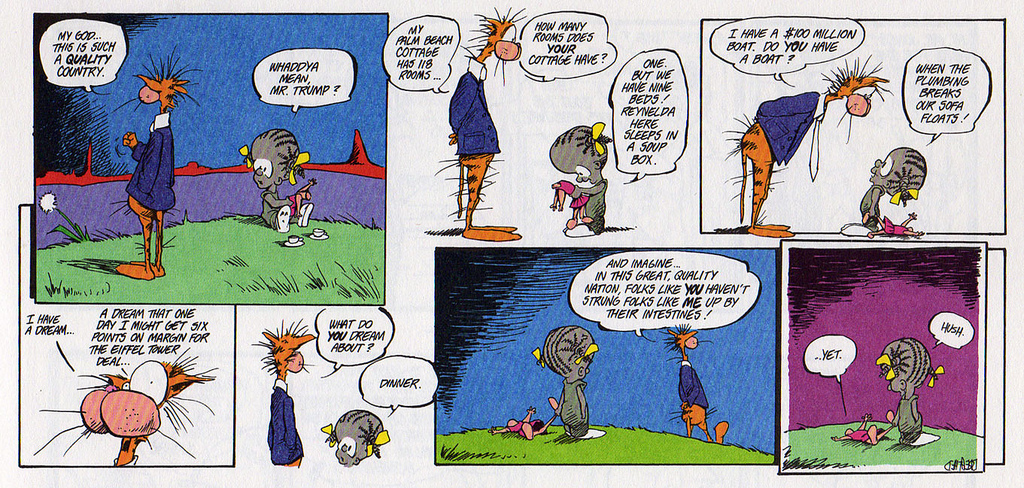
5663117546_c4150a82fc_b

If the print on the strip is too spall on your phone or tablet the link is here: http://www.gocomics.com/bloomcounty/2015/02/17

Likewise if you click on the picture it should be larger and more readable

“Our lives begin to end the day we become silent about things that matter.” Dr. Martin Luther King Jr. 

It is funny how timeless the social commentary of Berkeley Breathed’s classic comic strip Bloom County is even today. The strip shown above is from 1987. It is part of a series of strips where Donald Trump’s brain is transplanted into Bill the Cat’s body leading to some interesting encounters with the citizens of Bloom County.

In this strip, a little Black girl named “Ronald Ann,” named such by her dad after Ronald Reagan meets Mr Trump. The Donald, like all of us has a dream, but his is a bit different, and in the strip he is symbolic of the worst part of our humanity, that which has everything, while denying others of even the chance to achieve. A class of people who have no empathy, and for whom nothing matters but their bottom line, and they have an army of politicians to enshrine their policies into law, pundits who shamelessly defend them, media empires that promote them and their lifestyles as good, and preachers who give the blessing of something that they call “God” to their most ungodly world view.

The amazing thing is that those who promote this vast imbalance don’t even recognize what they are doing to civilization. Barbara Tuchman wrote in her book A Distant Mirror: The Calamitous 14th Century that “When the gap between ideal and real becomes too wide, the system breaks down.”

We are watching this unfold before our very eyes and those leading the charge, the politicians, bankers, moguls, media empires, pundits and preachers are blind to what they are sowing. Sadly they don’t seem to care so long as they have power and their profit margins increase.

What they are sowing is the seed of violent revolution, and not just in the United States, but around the world. They are sowing the seeds of war, they have helped create the growing threat of the Islamic State and Boko Haram, and their short sighted policies will bring down nations and economic systems.

Bu then such people and those who allow them to do what they do do not study history, except for the sanitized kind of myth that makes them feel good and justifies their actions. The same is true of how they view philosophy and religion. That is why they love the pseudo-history of people like David Barton, the philosophy of Ayn Rand, and the theology of Christian Dominionism and the Prosperity Gospel. Sadly, those who call themselves “Christians” and promote this seem oblivious to the fact that it is all based on Social Darwinism, the survival of the fittest. But then to the preachers who support those who benefit by such thought believe that a lie told for the glory of God is justified.

As such they seem to have little capacity for empathy or compassion, the death and suffering of people from disease, poverty and war makes no impact on them. Tuchman wrote “[T]he obverse of facile emotion in the 14th century was a general insensitivity to the spectacle of pain and death.” 

The same is true with technology. We have the most wonderful technological capabilities but instead of harnessing them for good, we turn them into instruments of destruction, instruments that may one day destroy all of us. Tuchman wrote: “For belligerent purposes, the 14th century, like the 20th, commanded a technology more sophisticated than the mental and moral capacity that guided its use.” Sadly, that gap between technology and mental and moral capacity to use it has only grown exponentially in this new century 21st century.

Sadly, that bit of satire about Donald Trump and Ronald Ann in this 1987 Bloom County comic strip is even more true today than when Berkeley Breathed drew it and penned the words. The power of the pen can be seen even today as people who speak out, write or pen satire become targets of those that they critique.

But I can no longer be silent when I see such institutionalized evil that is blessed by the politicians, pundits and preachers, who I call the Trinity of Evil. I would rather be called every epitaph that the promotors and supporters of such a hateful, tyrannical and perverse system can muster, than not to speak the truth. It’s funny how the words to the The Logical Song by Supertramp ring true for me:

“Now watch what you say or they’ll be calling you a radical, liberal, fanatical, criminal.”

I’ll have to write about that song sometime soon, as it seems to speak volumes about my own journey, but I digress…

I said at the beginning of this year that I would seek truth and speak truth. Until I came back from Iraq in 2008, having seen and experienced the horror of war, the lies of my government in launching that war in Iraq that has latterly sowed the wind and is reaping the whirlwind with the Islamic State’s advance, I said nothing, and at times even defended the system. But since then I cannot. I have already paid a price, men who I thought were friends abandoned me, a church that I had faithfully served, threw me out and I have been threatened, harassed and trolled by white supremacists; religious fanatics of various denominations, and political ideologues.

But truth is truth and I cannot be silent. As Dr. King so well put it: “There comes a time when one must take a position that is neither safe, nor politic, nor popular, but he must take it because conscience tells him it is right.”

Peace

Padre Steve+

4 Comments

Filed under civil rights, economics and financial policy, ethics, faith, History, News and current events, philosophy, Political Commentary, Religion

Our Army Would be Invincible if…” Confederate Leadership Pt.1

Friends of Padre Steve’s World

This is the first part of a chapter that I am revising for my Gettysburg text. It deals with the problems faced by Robert E. Lee as he attempted to reorganize the Army of Northern Virginia following his victory at Chancellorsville and the death of Stonewall Jackson. 

Over the next few days I will be posting sections on each of the Confederate army corps and J.E.B. Stuart’s Cavalry Division. The later sections will be largely biographic sketches of the leaders of the Confederate Corps, Divisions and Brigades. Eventually I will have a similar chapter on the leadership of the Army of the Potomac.

Have a great night.

Peace,

Padre Steve+  

Lee1

General Robert E. Lee C.S.A.

An issue faced by armies that are forced to expand to meet the demands of war is the promotion and selection of competent leaders at all levels of command. It has been an issue throughout American military history including during our recent wars in Iraq and Afghanistan. The expansion of forces, the creation of new units, combined with the operational demands to employ those units often creates a leadership vacuum that must be filled. Sometimes this results in officers being promoted, being given field command or critical senior staff positions, who have critical deficiencies of leadership, character, intellect, experience or lack the necessary skill sets to do the job.

We may not see this as often in a long term professional military which has been at war for a significant amount of time, but during the Civil War it was something that both sides had to wrestle with, even for high level commanders. The nature of the armies involved, the high proportion of volunteer officers and political appointees coupled with the dearth of officers who had commanded anything larger than a company or widely scattered regiment made this a necessary evil.

To be fair, some officers of limited experience or training do rise to the occasion and perform in an exemplary manner. Others do not. Those leaders that do not are quite often weeded out over the course of time but often not before their lack of experience, or incompetence proves disastrous on the battlefield. As Barbara Tuchman so eloquently put it:

“When the moment of live ammunition approaches, the moment to which all his professional training has been directed, when the lives of the men under him, the issue of the combat, even the fate of a campaign may depend upon his decision at a given moment, what happens inside the heart and vitals of a commander? Some are made bold by the moment, some irresolute, some carefully judicious, some paralyzed and powerless to act.” [1]

Of course the selection of competent and experienced leaders is essential to the planning and execution of all aspects of Joint Planning and Mission Command, as is the proper supervision and command and control on the battlefield. As was noted in Infantry in Battle:

“Of course, a leader cannot be everywhere, but he can and should weigh the capabilities and limitations of his subordinates, determine the critical point or time of the action, and lend the weight and authority of personal supervision where it is most needed.” [2]

The Death of Stonewall Jackson and the Reorganization of the Army of Northern Virginia

Stonewall_Jackson

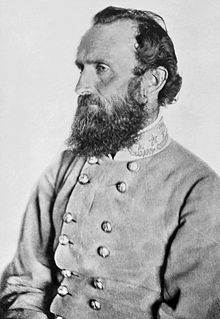
Lieutenant General Thomas “Stonewall” Jackson C.S.A

Stonewall Jackson was dead, and with his death after the Pyrrhic victory at Chancellorsville, General Robert E. Lee was faced with the necessity of reorganizing the Army of Northern Virginia. Jackson’s loss was disastrous for Lee, for he lost the one man who understood him and his method of command more than anyone, someone for whom he had a deep and abiding affection. Months before Jackson’s death Lee said of him: “Such an executive officer the sun has never shown on, I have but to show him my design, and I know that it if it can be done it will be done.” [3]

Jackson’s loss loomed large over the Army and the Confederate nation. Jefferson Davis told his wife Varina at Jackson’s funeral “saw a tear escape her husband’s eye and land on Jackson’s face. “You must excuse me,” Davis said later after silently ignoring a fellow mourner’s conversation. “I am still staggered from such a dreadful blow. I cannot think.” [4] Davis telegraphed Lee and described Jackson’s death “A great national calamity has befallen us.” [5] Lee was devastated, but stoic. When he told his Chief of artillery, Brigadier General William Pendleton of Jackson’s death he wept. Lee told his son Custis “It is a terrible loss. I do not know how to replace him. Any victory would be dear at such a cost. But God’s will be done.” [6]

Jackson’s loss was felt throughout the Confederacy, and not just from a military point of view. Southerners saw the war “as a spiritual and religious crusade, a test of the superiority of their devoutness and culture.” [7] As such victory was seen as part of God’s blessing and defeat or loss of Divine punishment. Jackson was a part of that, his legendary piety, valor and success on the battlefield had imbued the spiritual dimension of the Confederate cause with proof of God’s favor. He had been sent by God, and even in death his memory inspired Confederates, one poet “described Jackson as the Confederate Moses who would not get to the Promised Land” [8] although others most certainly would. In a war where death had become more pervasive and affected almost everyone in the South in a personal way, through the loss of family, friends, or home it was easy to lose sight of “basic values and transcending causes. Jackson’s death brought those values and causes to the fore. To what end remained unclear. The certitude of a holy cause that greeted the war’s onset slid into doubt….” [9] After the war soldiers, journalists and civilians pointed to Jackson’s death as “a premonition of their coming defeat.” One wrote “The melancholy news affected the Confederates in the same way that various omens predicted, before Troy could be captured affected the city’s defenders.” [10]

A forlorn Southern woman wrote: “He was the nation’s idol, not a breath even from a foe has ever been breathed against his fame. His very enemies reverenced him. God has taken him away from us that we may lean more upon Him, feel that he can raise up to Himself instruments to work His Divine Will.” [11] An officer in the Army of Northern Virginia wrote: “One of the greatest heroes of the war has been called from us by an all-wise Providence, no doubt as a punishment for ascribing to a mere man praises due to God for giving us Jackson with the virtues and talents he possessed.” [12] Seeing Jackson’s death in light of the defeat at Gettysburg and other major Confederate reverses in the summer of 1863 Virginia Presbyterians decided that Jackson’s “Untimely” death marked a “further chastisement for sins, especially ingratitude, pride, and dependency on an arm of the flesh.” [13]

After Jackson’s loss Lee said “I had such implicit confidence in Jackson’s skill and energy that I never troubled myself to give him detailed instructions. The most general suggestions were all that he needed.” [14] Lee met the loss with “resignation and deep perplexity,” his words displayed that sense of loss, as well as his sense of faith and trust in God’s providence “I know not how to replace him. God’s will be done. I trust He will raise someone up in his place…” [15] In losing Jackson Lee lost a commander who had the ability to make his most imaginative plans come to life and find fulfillment and despite his efforts he never succeeded in finding a suitable replacement. Jackson was not a great tactician, but unlike any other Confederate commander he could implement Lee’s plans through his:

“single-mindedness of purpose, his unbending devotion to duty, his relentlessness as a foe, and his burning desire at whatever cost, for victory….He possessed an unmatched ability to impose his will on recalcitrant subordinates and on his enemies.” [16]

In addition to the loss of Jackson, Lee was desperately short of qualified senior and mid-level officers and Lee “understood how the diminishing numbers of quality officers impacted the army’s effectiveness.” [17] The problem was serious throughout the army, even though Lee had been victories in many battles, was that it suffered badly from high casualty counts, not just in the aggregate number of troops lost, but in leaders. “From the Seven Days to Chancellorsville, few if any regiments had not lost multiple field grade officers. Casualties among colonels, lieutenant colonels and majors surpassed 300 in total in all of the engagements.” [18]

A major part of Lee’s problem was organizational. In 1862 Lee inherited an army that was a “hodgepodge of forces” [19] which was organized in an “unwieldy divisional command system, where green commanders out of necessity were given considerable independence.” [20] That organization was tested and found wanting during the Seven Days campaign where on numerous occasions division commanders failed to coordinate their actions with those of adjacent divisions or failed to effectively control their own troops during movement to contact or combat.

Shortly after the Seven Days Lee reorganized the army, working with the material that he had. He divided the army into two wings since “Confederate law still did not allow for corps commands” [21] under Jackson and James Longstreet. Each wing was composed of four divisions and consisted of about 30,000 troops apiece. Both would be appointed Lieutenant Generals and their command’s recognized officially as the First Corps and the Second Corps in October 1862. These were massive forces, each nearly three times the size of a Union Corps in the Army of the Potomac.

While both Longstreet and Jackson were technically equals, and Longstreet Jackson’s senior by one day, it was Jackson to whom Lee relied on for the most daring tasks, and whom he truly considered his closest confidant and his “executive officer.” The relationship between Lee and Jackson was one of the most remarkable collaborations in military history and Lee owed much of his battlefield success to Jackson, and as J.F.C Fuller wrote: “Without Jackson, Lee was a one armed pugilist. Jackson possessed that brutality essential in war; Lee did not” [22]

The organization worked well at Second Manassas, Fredericksburg and Chancellorsville, although Longstreet’s corps was detached from the army at the time of the latter. When Jackson was wounded at Chancellorsville on the first night of that battle neither A.P. Hill nor J.E.B. Stuart were able effectively commanded Second Corps during the remainder of the battle.

The temperament and personalities of Longstreet and Jackson served to balance each other, and each enjoyed the trust of Lee. Lee’s biographer Michael Korda calls them the:

“yin and yang of subordinates. Jackson was superb at guessing from a few words exactly what Lee wanted done, and setting out to do it immediately without argument or further instructions; Longstreet was as good a soldier, but he was an instinctive contrarian and stubbornly insisted on making Lee think twice, and to separate what was possible from what was not.” [23]

Both men had been instrumental to Lee’s battlefield success and both played indispensable roles in Lee’s ability to command the army.

Likewise, the sheer size of Lee’s formations posed problems both in moment and combat, as Lee noted “Some of our divisions exceed the army Genl Scott entered Mexico with, & our brigades are larger than divisions”…that created stupendous headaches in “causing orders & req[uisitions] to be obeyed.” [24] Lee wrote to Jefferson Davis on May 20th “I have for the past year felt that the corps of the army were too large for one commander. Nothing prevented my proposing to you to reduce their size and increase their number but my inability to recommend commanders.” [25]

In the hands of Longstreet and Jackson these massive corps were in the good hands of leaders who could effectively handle them, “but in anyone else’s hands, a corps the size of Jackson’s or Longstreet’s might prove so big as to become clumsy, or even worse, might call for a degree of micromanagement that Lee and his diminutive staff might not be able to deliver.” [26] Lee recognized this and did not try to replace Jackson. Instead he wrote Jefferson Davis and explained the reasons for creating a new corps:

“Each corps contains in fighting condition about 30,000 men. These are more than one man can handle & keep under his eye in battle….They are always beyond the range and vision & frequently beyond his reach. The loss of Jackson from the command of one half of the army seems to me a good opportunity to remedy this evil.” [27]

Instead of appointing one man to command Second Corps, Lee reorganized the army and created two corps from it. He stripped a division of Longstreet’s First Corps, that of Richard Anderson, to join the new Third Corps. He also divided the large “Light” Division, which under Hill’s “intelligent administration probably is the best in the army” [28] into two divisions, one commanded by Dorsey Pender and the other by Harry Heth.

The problem for Lee was just who to place in command of the new corps and divisions that he was creating. Lee was deeply aware of this problem, and wrote to John Bell Hood that the army would be “invincible if it could be properly organized and officered. There never were such men in an Army before. The will go anywhere and do anything if properly led. But there is the difficulty-proper commanders- where can they be obtained?” [29] Lee sought the best commanders possible for his army, but the lack of depth in the ranks of season, experienced commanders, as well as the need to placate political leaders made some choices necessary evils.

To be continued…

Notes

[1] Tuchman, Barbara The Guns of August Ballantine Books, New York 1962 Amazon Kindle edition location 2946

[2] _________. Infantry In Battle The Infantry Journal Incorporated, Washington DC 1939, reprinted by the USACGSC with the permission of the Association of the United States Army p.195

[3] Taylor, John M. Duty Faithfully Performed: Robert E Lee and His Critics Brassey’s, Dulles VA 1999 p.128

[4] Davis, William C. Jefferson Davis: The Man and His Hour Harper Collins Publishers New York 1991 p.501

[5] Freeman, Douglas Southall, Lee’s Lieutenant’s a Study in Command, One volume abridgement by Stephen W Sears, Scribner, New York 1998 p.524

[6] Wert, Jeffry D. A Glorious Army: Robert E. Lee’s Triumph 1862-1863 Simon and Schuster, New York and London 2011 p.208

[7] Pryor, Elizabeth Brown. Reading the Man: A Portrait of Robert E. Lee Through His Private Letters Penguin Books, New York and London 2007 p.235

[8] Rable, George C. God’s Almost Chosen Peoples: A Religious History of the American Civil War University of North Carolina Press, Chapel Hill 2010 p.261


[9] Goldfield, David. America Aflame: How the Civil War Created a Nation Bloomsbury Press, New York 2011 p.279

[10] Royster, Charles The destructive War: William Tecumseh Sherman, Stonewall Jackson, and the Americans Alfred A. Knopf, New York 1991 p.227

[11] Glatthaar, Joseph T. General Lee’s Army from Victory to Collapse The Free Press, Simon and Schuster, New York and London 2008 p.255

[12] Ibid. Pryor Reading the Man p.236

[13] Ibid. Rable God’s Almost Chosen Peoples p.261

[14] Dowdy, Clifford. Lee and His Men at Gettysburg: The Death of a Nation Skyhorse Publishing, New York 1986, originally published as Death of a Nation Knopf, New York 1958 p.30

[15] Ibid. Freeman Lee’s Lieutenant’s p.524

[16] Ibid. Wert A Glorious Army p.209

[17] Ibid. Wert A Glorious Army p.217

[18] Ibid. Wert A Glorious Army p.217

[19] Ibid. Dowdy. Lee and His Men at Gettysburg p.30

[20] Hagerman, Edward. The American Civil War and the Origins of Modern Warfare. Midland Book Editions, Indiana University Press. Bloomington IN. 1992 p.110

[21] Ibid. Glatthaar General Lee p.157

[22] Fuller, J.F.C. Grant and Lee: A Study in Personality and Generalship, Indiana University Press, Bloomington IN 1957

[23] Korda, Michael. Clouds of Glory: The Life and Legend of Robert E. Lee Harper Collins Publishers, New York 2014 p.527

[24] Guelzo, Allen C. Gettysburg: The Last Invasion Vintage Books a Division of Random House, New York 2013 pp.20-21

[25] Wert, Jeffry D. General James Longstreet The Confederacy’s Most Controversial Soldier, A Touchstone Book, Simon and Schuster, New York and London 1993 p.248

[26] Ibid. Guelzo, Gettysburg: The Last Invasion pp.20-21

[27] Thomas, Emory Robert E. Lee W.W. Norton and Company, New York and London 1995 p.289

[28] Ibid. Freeman Lee’s Lieutenants p.35

[29] Coddington, Edwin B. The Gettysburg Campaign: A Study in Command, A Touchstone Book, Simon and Schuster New York, 1968 p.12

1 Comment

Filed under civil war, History, leadership, Military

Mine Eyes Have Seen The Glory: Religion, Ideology & the Civil War Part 1

Friends of Padre Steve’s World

This is part one of a very long chapter in my Gettysburg Staff Ride Text. The chapter is different because instead of simply studying the battle my students also get some very detailed history about the ideological components of war that helped make the American Civil War not only a definitive event in our history; but a war of utmost brutality in which religion drove people and leaders on both sides to advocate not just defeating their opponent, but exterminating them.

But the study of this religious and ideological war is timeless, for it helps us to understand the ideology of current rivals and opponents, some of whom we are in engaged in battle and others who we spar with by other means, nations, tribes and peoples whose world view, and response to the United States and the West, is dictated by their religion. 

Yet for those more interested in current American political and social issues the period is very instructive, for the religious, ideological and political arguments used by Evangelical Christians in the ante-bellum period, as well as many of the attitudes displayed by Christians in the North and the South are still on display in our current political and social debates. 

I will be posting the next two parts over the next two days. 

Peace

Padre Steve+

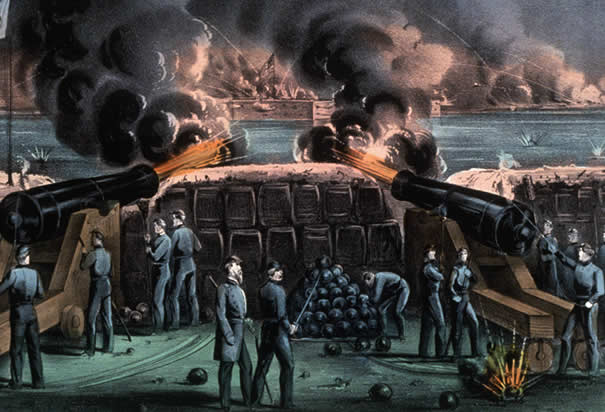
illustration-fort-sumter

“At length on 12th April, the tension could no longer bear the strain. Contrary to instructions, in the morning twilight, and when none could see clearly what the historic day portended, the Confederates in Charleston bombarded Fort Sumter, and the thunder of their guns announced that the argument of a generation should be decided by the ordeal of war. A war, not between two antagonistic political parties, but a struggle to the death between two societies, each championing a different civilization…” 1

War cannot be separated from Ideology, Politics or Religion One can never separate war and the means by which it is fought from its political ends. According to Clausewitz war is an extension or continuation of politics. Of course Clausewitz understood the term politics or policy in the light of the concept of a “World View” or to use the German term Weltungschauung. The term is not limited to doctrine or party politics, but it encompasses the world view of a people or culture. The world view is oft used by the political, media and religious leadership of countries and can be quite instrumental in the decision by a people to go to war; who they war against, their reasons for going to war, the means by which they fight the war, and the end state that they envision. This concept includes racial, religious, cultural, economic and social dimensions of a world view.

One of the problems that modern Americans and Western Europeans have is that we tend to look at the world, particularly in terms of politics and policy, be it foreign or domestic, through a prism from which we cannot see the forest for the trees. We look at individual components of issues such as economic factors, military capabilities, existing political systems, diplomatic considerations and the way societies get information in isolation from each other. We dissect them, we analyze them, and we do a very good job in examining and evaluating each individual component; but we often do this without understanding the world view and ideological factors that link how a particular people, nation or party understand these components of policy.

Likewise policy makers tend to take any information they receive and interpret it through their own world view. This is true even if they have no idea what their world-view is or how they came to it. Most often a world view is absorbed over years. Barbara Tuchman wrote that “When information is relayed to policy-makers, they respond in terms of what is already inside their heads and consequently make policy less to fit the facts than to fit the notions and intentions formed out of the mental baggage that has accumulated in their minds since childhood.” 2

Policy makers often fail to see just how interconnected the most primal elements of the human experience are to the world view of others as well as their own.

Because of this many policy makers, be they military or civilian do not understand how critical the understanding of world view to designing effective polices. Likewise many fail to see how the world view of others influences their application of economic, political, diplomatic and military power as well as the use and dissemination of information in their nation or culture. This is true no matter which religion or sect is involved, even if a people or nation is decidedly secular, and at least outwardly non-religious.

Perhaps this is because we do not want to admit that our Western culture itself is very much a product of primal religious beliefs which informed politics, philosophy, ethics, law, economics, views of race, and even the arts for nearly two millennia. Perhaps it is because we are justifiably appalled and maybe even embarrassed at the excesses and brutality of our ancestors in using religion to incite the faithful to war; to use race and religion justification to subjugate or exterminate peoples that they found to be less than human; or to punish and conquer heretics.

The United States Military made a belated attempt to address ideology, culture and religion in terms of counter-insurgency doctrine when it published the U.S. Army/Marine Counterinsurgency Manual. The discussion of these issues is limited to two pages that specifically deal with various extreme Moslem groups that use that religion as a pillar of their ideology, strategy and operations. But the analysis in the counterinsurgency manual of is limited because its focus is very general and focused at a tactical level.

Likewise the analysis of world view, ideology and religion in the counterinsurgency manual is done in a manner of “us versus them” and though it encourages leaders to attempt to understand the cultural differences there is little in it to help leaders to understand who to do this. Commendably the manual discusses how terrorist and insurgent groups use ideology, frequently based on religion to create a narrative. The narrative often involves a significant amount of myth presented as history, such as how Al Qaida and ISIL using the Caliphate as a religious and political ideal to strive to achieve, because for many Moslems “produces a positive image of the golden age of Islamic civilization.” 3 However, we frequently cannot see how Americans have used, and in some cases continue to the Puritan understanding of a city set on a hill which undergirded Manifest Destiny, the extermination of Native Americans, the War with Mexico, the romanticism of the ante-bellum South and later the Lost Cause.

Policy makers and military leaders must realize that if they want to understand how culture and religious ideology drive others to conquer, subjugate and terrorize in the name of God, they first have to understand how our ancestors did the same thing. It is only when they do that that they can understand that this behavior and use of ideology for such ends is much more universal and easier to understand.

If one wants to see how the use of this compulsion to conquer in the name of God in American by a national leader one needs to go no farther than to examine the process whereby President McKinley, himself a veteran of the Civil War, decided to annex the Philippine in 1898 following the defeat of the Spanish. That war against the Filipinos that we had helped liberate from Spanish rule saw some of the most bloodthirsty tactics employed in fighting the Filipino insurgents, who merely wanted independence. It was a stain on our national honor which of which Mark Twain wrote: “There must be two Americas: one that sets the captive free, and one that takes a once-captive’s new freedom away from him, and picks a quarrel with him with nothing to found it on; then kills him to get his land. . .


A Doubtlessly sincere McKinley sought counsel from God about whether he should annex the the Philippines or not.

“He went down on his knees, according to his own account, and “prayed to Almighty God for light and guidance.” He was accordingly guided to conclude “that there was nothing left to do for us but to take them all, and to educate the Filipinos. And uplift and civilize and Christianize them, by God’s grace to do the very best we could by them, as our fellowmen for whom Christ died.” 4

On the positive side the counterinsurgency manual does mention how “Ideology provides a prism, including a vocabulary and analytical categories, through which followers perceive their situation.” 5 But again it does so at a micro-level and the lessons of it are not applied at the higher levels of strategic thinking and policy.

Thus when faced with cultures for which religion provides the adhesive which binds each of these elements, such as the Islamic State or ISIL we attempt to deal with each element separately, as if they have no connection to each other. But that is where we err, for even if the religious cause or belief has little grounding in fact, science or logic, and may be the result of a cultures attempting to seize upon mythology to build a new reality, it is, in the words of Reggie Jackson the “straw that stirs the drink” and to ignore or minimize it is to doom our efforts to combat its proponents.

Perhaps that is because we do not like to look at ourselves and our own history in the mirror. Perhaps it is because we are uncomfortable with the fact that the face that we see in the mirror is face too similar to those we oppose who are perfectly willing to commit genocide in the name of their God, than we want to admit. Whether this is because we are now predominantly secularist in the way that we do life, or because we are embarrassed by the religiously motivated actions of our forefathers, the result is strikingly and tragically similar.

Clausewitz was a product of classic German Liberalism. He understood the effects of the moral and spiritual concerns inherent in policy, and it flows from his pen, as where he wrote “that the aim of policy is to unify and reconcile all aspects of internal administration as well as of spiritual values, and whatever else the moral philosopher may care to add.” 6 Clausewitz understood that when the motivation behind politics becomes more extreme and powerful; when the politics becomes more than a simple disagreement about isolated policy issues; when the ideology that lays behind the politics, especially ideology rooted in religion evokes primal hatred between peoples, war can come close to reaching the abstract concept of absolute or total war.

Clausewitz wrote:

“The more powerful and inspiring the motives for war, the more they affect the belligerent nations and the fiercer the tensions that precede the outbreak, the closer will war approach its abstract concept, the more important will be the destruction of the enemy, the more closely will the military and the political objects of war coincide, and the more military and less political will war appear to be….” 7

The American Civil War was the first modern war based on the advancement of technology and the changing character of war. But it was also a modern war which reached back to the most primal urges of the people involved, including the primal expressions of religious justification for their actions that both sides accepted as normal.

The American Civil War was caused by the clash of radically different ideologies, ideologies which championed two very different views of civilization, government, economics and the rights of people. However, these different world views were based based upon a common religious understanding:

“whatever their differences over such matters as slavery and political preaching, both sides read their Bibles in remarkably similar ways Ministers had long seen the American republic as a new Israel, and Confederate preachers viewed the southern nation in roughly the same light. The relentless, often careless application of biblical typologies to national problems, the ransacking of scripture for parallels between ancient and modern events produced a nationalistic theology at once bizarre, inspiring and dangerous. Favorite scripture passages offered meaning and hope to a people in the darkest hours and, at the same time, justified remorseless bloodshed.” 8

This understanding manifested itself in each side’s appeal to their Puritan ancestor’s concept of a “city set on a hill,” a mantle that each side claimed to be the legitimate heir. Though they seem radically different, they are actually two sides of the same religious-ideological coin.

The American Civil War was a religious and ideological war. “Like the total wars of the twentieth century, it was preceded by years of violent propaganda, which long before the war had obliterated all sense of moderation, and had awakened in the contending parties the primitive spirit of tribal fanaticism.” 9 It was preceded by the fracturing of political parties and alliances which had worked for compromise in the previous decades to preserve the Union even at the cost of maintaining slavery.

Far from being irrational as some have posited, the actions and behavior of politicians in both the North and the South was completely rational based on their conflicting ideologies and views of their opponents. The “South’s fears of territorial and economic strangulation and the North’s fears of a “slave power” conspiracy are anything but irrational, and only someone who refuses to think through the evidence available to Americans in the 1850s would find either of them at all illogical.” 10

Understanding How Religiously Based Ideology influences Policy, Politics and War Samuel Huntington wrote:

“Blood, language, religion, way of life were what the Greeks had in common and what distinguished them from the Persians and other non-Greeks. Of all the objective elements which define civilizations, however, the most important is usually religion, as the Athenians emphasized. To a very large degree, the major civilizations in human history have been closely identified with the world’s great religions; and who share ethnicity and language but differ in religion may slaughter each other…” 11

The very realistic fears of both sides brought about clash of extremes in politics which defied efforts at compromise and was already resulting in violent and bloody conflicts between ideologues in Kansas, Missouri and Kentucky years before the firing on Fort Sumter. For both sides their views became a moral cause that in the minds of many became an article of their religious faith, and “Religious faith itself became a key part of the war’s unfolding story for countless Americans….” 12 British theorist and military historian J.F.C. Fuller wrote of the religious undergirding of the war:

“As a moral issue, the dispute acquired a religious significance, state rights becoming wrapped up in a politico-mysticism, which defying definition, could be argued for ever without any hope of a final conclusion being reached.” 13

That is why it impossible to simply examine the military campaigns and battles of the Civil War in isolation from the politics, polices, the competing philosophies and the underlying theology which were the worldview that undergirded the arguments of both sides. Those competing philosophies and world views, undergirded by a pervasive nationalistic understanding of religion not only helped to cause on the war but made the war a total war.

Some might wonder where this fits in a text that is about a specific campaign and battle in a war, but for those entrusted with planning national defense and conducting military campaign the understanding of why wars are fought, in particular the ideological causes of war matter in ways that military planners, commanders and even elected political leadership often overlook. Colin Gray notes: “Wars are not free floating events, sufficient unto themselves as objects for study and understanding. Instead, they are entirely the product of their contexts.” 14

Studying the context of the American Civil War is very important in understanding not just it, but also civil wars in other nations which are currently raging. The study of these contexts brings an American or Western historical perspective to those wars, not so much in trying to place a western template over non-western conflicts; but a human perspective from our own past from which we can gain insight into how the people, even people who share a common language, religion and history, can war against each other in the most brutal of fashions. Again I refer to Colin Gray who noted “Policy and strategy will be influenced by the cultural preferences bequeathed by a community’s interpretation of its history as well as by its geopolitical-geostrategic context.” 15

For American and other Western political and military policy makers this is particularly important in Iraq where so many Americans have fought, and in the related civil war in Syria which has brought about the emergence of the Islamic State of Iraq and the Levant.

Likewise in our Western tradition we can see how radical ideology, based on race was central to Hitler’s conduct of war, especially in the East during the Second World War. Hitler’s ideology permeated German military campaigns and administration of the areas conquered by his armies. No branch of the German military, police or civil administration in occupied Poland or Russia was exempt guiltless in the crimes committed by the Nazi regime. It is a chilling warning of the consequences awaiting any nation that allows it to become caught up in hate-filled political, racial or even religious ideologies which dehumanizes opponents and of the tragedy that awaits them and the world. In Germany the internal and external checks that govern the moral behavior of the nation and individuals failed. Caught up in the Nazi system, the Germans, especially the police and military abandoned the norms of international law, morality and decency, banally committing crimes which still reverberate today and which are seen in the ethnic cleansing actions in the former Yugoslavia and other European nations.

Thus the study of the American Civil War, from the cultural, economic, social and religious differences which divided the nation helps us in understanding war. But even more importantly we have to understand the ideological clash between Abolitionists in the North, and Southern proponents of slavery. Both the ideologies of the Abolitionists who believed that African Americans were created by God and had the same rights as whites, as well as the Southern arguments that blacks were inferior and slavery was a positive good, were buttressed by profoundly religious arguments related directly to a divergence in values. It was in this “conflict of values, rather than a conflict of interests or a conflict of cultures, lay at the root of the sectional schism.” 16

Understanding this component of our own nation’s history helps us to understand how those same factors influence the politics, policies, the primal passions and hatreds of people in other parts of the world. Thus they are helpful for us to understand when we as a nation involve ourselves in the affairs of other peoples whose conflicts are rooted in religiously motivated ideology and differences in values, such as in the current Sunni-Shia conflict raging in various guises throughout the Middle East where culture, ideology and economic motivations of the groups involved cannot be separated. We may want to neatly separate economic, strategic, military and geopolitical factors from religious or ideological factors assuming that each exists in some sort of hermetically sealed environment. But to think this is a fallacy of the greatest magnitude. As we have learned too late in the century in our Middle East muddling, it is impossible to separate geopolitical, strategic, military and economic issues from ideological issues rooted in distinctly religious world views, world views that dictate a nation, people or culture’s understanding of the world.

David M. Potter summed up this understanding of the connection between the ideological, cultural and economic aspects and how the issue of slavery connected all three realms in the American Civil War:

“These three explanations – cultural, economic and ideological – have long been the standard formulas for explaining the sectional conflict. Each has been defended as though it were necessarily incompatible with the other two. But culture, economic interest, and values may all reflect the same fundamental forces at work in a society, in which case each will appear as an aspect of the other. Diversity of culture may produce both diversity of interests and diversity of values. Further, the differences between a slaveholding and a nonslaveholding society would be reflected in all three aspects. Slavery represented an inescapable ethical question which precipitated a sharp conflict of values.” 17
o-SLAVERY-facebook


The Impact of Slavery on the Growing Divide between North and South

The political ends of the Civil War came out of the growing cultural, economic, ideological and religious differences between the North and South that had been widening since the 1830s. However, slavery was the one issue which helped produce this conflict in values and it was “basic to the cultural divergence of the North and South, because it was inextricably fused into the key elements of southern life – the staple crop of the plantation system, the social and political ascendency of the planter class, the authoritarian system of social control.” 18 Without slavery and the southern commitment to an economy based on slave labor, the southern economy would have most likely undergone a similar transformation as what happened in the North; thus the economic divergence between North and South would “been less clear cut, and would have not met in such head-on collision.” 19 But slavery was much more than an economic policy for Southerners; it was a key component of their religious, racial and philosophic world view.

The issue of slavery even divided the ante-Bellum United States on what the words freedom and liberty meant, the dispute can be seen in the writings of many before the war, with each side emphasizing their particular understanding of these concepts. Many Southerners, including poor whites saw slavery as the guarantee of their economic freedom. John C. Calhoun said to the Senate in 1848 that “With us, the two great divisions of society are not the rich and poor, but white and black; and all of the former, the poor as well as the rich, belong to the upper class, and are respected and treated as equals.” 20

But it was Abraham Lincoln who cut to the heart of the matter when he noted that “We all declare for liberty” but:

“in using the same word we do not all mean the same thing. With some the word liberty may mean for each man to do as he pleases with himself and the product of his labor; while with others the same word may mean for some men to do as they please with other men and the product of other men’s labor.” 21

The growing economic disparity between the Slave and Free states became more about the expansion of slavery in federal territories as disunion and war approached; for a number of often competing reasons. These differences were amplified by the issue of slavery led to the substitution of stereotypes of each other and had the “effect of changing men’s attitudes toward the disagreements which are always certain to arise in politics: ordinary, resolvable disputes were converted into questions of principle, involving rigid, unnegotiable dogma.” 22 The editor of the Charleston Mercury noted in 1858 that “on the subject of slavery…the North and the South…are not only two peoples, but they are rival, hostile peoples.” 23

This was driven both by the South’s insistence on both maintaining slavery where it was already legal and expanding it into new territories which was set against the vocal abolitionist movement. They were also fighting an even more powerful enemy, Northern industrialists who were not so idealistic, and much more concerned with “economic policy designed to secure Northern domination of Western lands than the initial step in a broad plan to end slavery.” 24 This completion between the regions not only affected politics, it affected religion and culture In the South it produced a growing culture of victimhood which is manifest in the words of Robert Toombs who authored Georgia’s declaration of causes for secession:

“For twenty years past, the Abolitionists and their allies in the Northern states, have been engaged in constant efforts to subvert our institutions, and to excite insurrection and servile war among us…” whose “avowed purpose is to subject our society, subject us, not only to the loss of our property but the destruction of ourselves, our wives and our children, and the dissolution of our homes, our altars, and our firesides.” 25

As the differences grew and tensions rose the South became ever more closed off from the North. “More than other Americans, Southerners developed a sectional identity outside the national mainstream. The Southern life style tended to contradict the national norm in ways that life styles of other sections did not.” 26

The complex relationship of Southern society where the “Southern bodies social, economic, intellectual, and political were decidedly commingled” 27 and politics of the South came more to embrace the need for slavery and its importance, even to poor whites in the South who it did not benefit and actually harmed economically: “the system of subordination reached out still further to require a certain kind of society, one in which certain questions were not publically discussed. It must give blacks no hope of cultivating dissention among the whites. It must commit non slaveholders to the unquestioning support of racial subordination….In short, the South became increasingly a closed society, distrustful of isms from outside and unsympathetic to dissenters. Such were the pervasive consequences of giving top priority to the maintenance of a system of racial subordination.” 28
4.0.4


Southern planters declared war on all critics of their “particular institution” beginning in the 1820s. As Northern abolitionists like William Lloyd Garrison and his newspaper The Liberator grew in its distribution and began to appear in the South various elected officials throughout the South “suppressed antislavery books, newspapers, lectures, and sermons and strove generally to deny critics of bondage access to any public forum.” 29

In response to the proliferation of abolitionist literature in the South, John C. Calhoun proposed that Congress pass a law to prosecute “any postmaster who would “knowingly receive or put into the mail any pamphlet, newspaper, handbill, or any printed, written, or pictorial representation touching the subject of slavery.” 30 Calhoun was not alone as other members of Congress as well as state legislatures worked to restrict the import of what they considered subversive and dangerous literature.

Beginning in 1836 the House of Representatives passed a “gag rule” for its members which “banned all petitions, memorials, resolutions, propositions, or papers related in any way or to any extent whatever to the subject of slavery.” 31 This was challenged by former President John Quincy Adams in 1842 as well as by others so that in 1844 the House voted to rescind it. However Southern politicians “began to spout demands that the federal government and the Northern states issue assurances that the abolitionists would never be allowed to tamper with what John Calhoun had described as the South’s “peculiar domestic institution.” 32 The issue of slavery more than any other “transformed political action from a process of accommodation to a mode of combat.” 33

Around the same time as the gag rule was played out in Congress the Supreme Court had ruled that the Federal government alone “had jurisdiction where escaped slaves were concerned” which resulted in several states enacting “personal liberty laws” to “forbid their own elected officials from those pursuing fugitives.” Southern politicians at the federal and state levels reacted strongly to these moves which they believed to be an assault on their institutions and their rights to their human property. Virginia legislators protested that these laws were a “disgusting and revolting exhibition of faithless and unconstitutional legislation.” 34

The issue of slavery shaped political debate and “structured and polarized many random, unoriented points of conflict on which sectional interest diverged.” 35 As the divide grew leaders and people in both the North and the South began to react to the most distorted images of each other imaginable- “the North to an image of a southern world of lascivious and sadistic slave drivers; the South to the image of a northern world of cunning Yankee traders and radical abolitionists plotting slave insurrections.” 36
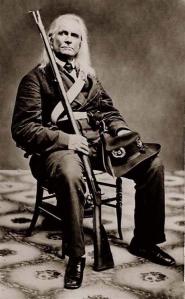
Edmund-Ruffin

The Slaveholder Ideology Personified: Edmund Ruffin

Among the people most enraged by Northern opposition to slavery was Edmund Ruffin. Ruffin was a very successful farm paper editor, plantation owner and ardent old line secessionist from Virginia. In 1860 the then 67 year old Ruffin helped change the world forever when, according to popular legend he pulled the lanyard which fired the first shot at Fort Sumter. While he was there and probably was given the honor of firing the first shot from his battery; other guns from other emplacements may have fired first. 37

Ruffin was a radical ideologue, he had been passionately arguing for secession and Southern independence for fifteen years. Ruffin “perceived the planter civilization of the South in peril; the source of the peril was “Yankee” and union with “Yankees.” Thus he preached revolution, Ruffin was a rebel with a cause, a secular prophet…” 38 He was a type of man who understood reality far better than some of the more moderate oligarchs that populated the Southern political and social elite. While in the years leading up to the war these men, including John Calhoun attempted to secure the continued existence and spread of slavery within the Union through the Congress and the courts, as early as 1850, Ruffin recognized that in order for slavery to survive the slaveholding South would have to secede from the Union. Ruffin and other radical secessionists believed that there could be no compromise with the north. In 1850 he and James Hammond attempted to use a meeting in Nashville to “secure Cooperative State Secession” and wrote to Hammond, against those who sought to use the meeting to preserve the Union, “If the Convention does not open the way to dissolution…I hope it shall never meet.” 39 He believed that in order to maintain the institution of slavery the slave holding states that those states had to be independent from the North.

Ruffin’s views were not unique to him, the formed the basis of how most slave owners and supporters felt about slavery’s economic benefits, Ruffin wrote:

“Still, even this worst and least profitable kind of slavery (the subjection of equals and men of the same race with their masters) served as the foundation and the essential first cause of all the civilization and refinement, and improvement of arts and learning, that distinguished the oldest nations. Except where the special Providence and care of God may have interposed to guard a particular family and its descendants, there was nothing but the existence of slavery to prevent any race or society in a state of nature from sinking into the rudest barbarism. And no people could ever have been raised from that low condition without the aid and operation of slavery, either by some individuals of the community being enslaved, by conquest and subjugation, in some form, to a foreign and more enlightened people.”40

a2a9c088d75423b7f457b194d7c9ea9a

Slavery and National Expansion: The Compromise of 1850

The Ante-Bellum South was an agrarian society which depended on the free labor provided by slaves and in a socio-political sense it was an oligarchy that offered no freedom to slaves, openly discriminated against free blacks and provided little hope of social or economic advancement for poor and middle class whites, but it was maintained because in many cases the Southern Yeoman farmer “feared the fall from independent producer to dependent proletarian, a status he equated with enslavement.” 41 But northerners often driven by religious understandings of human rights founded in the concept of a higher law over a period of a few decades abolished slavery in the years after the United States had gained independence.

However, the South had tied its economy and society to the institution of slavery, and was not content to see it remain just in the original states of the Old South.

The expansion of slavery was essential to its continued maintenance in the states where it was already legal. “Because of the need to maintain a balance in the Senate, check unruly slaves, and cultivate fertile soils, many planters and small plantation owners- particularly those living in the southern districts of the cotton states- asserted that their survival depended on new territory.” 42 In those decades “a huge involuntary migration took place. Between 800,000 and 1 million slaves were moved westward….” 43

slavescars

The need for slaves caused prices to soar. In some older states like Virginia where fewer slaves were required the exportation of slaves became a major industry:

“male slaves were marched in coffles of forty or fifty, handcuffed to each other in pairs, with a long chain through the handcuffs passing down the column to keep it together, closely guarded by mounted slave traders followed by an equal number of female slaves and their children. Most of them were taken to Wheeling, Virginia, the “busiest slave port” in the United States, and from there they were transported by steamboat to New Orleans, Natchez, and Memphis.” 44

In the years the before the war, the North embraced the Industrial Revolution leading to advances which gave it a marked economic advantage over the South in which through its “commitment to the use of slave labor inhibited economic diversification and industrialization and strengthened the tyranny of King Cotton.” 45 The population of the North also expanded at a clip that far outpaced the South as European immigrants swelled the population.

The divide was not helped by the various compromises worked out between northern and southern legislators. After the Missouri Compromise Thomas Jefferson wrote:

“but this momentous question, like a fire bell in the night, awakened and filled me with terror. I considered it at once as the knell of the Union. It is hushed indeed for the moment, but this is a reprieve only, not a final sentence. A geographical line, coinciding with a marked principle, moral and political, once conceived and held up to the angry passions of men, will never be obliterated; and every new irritation will mark it deeper and deeper.” 46

The trigger for the increase in tensions was the war with Mexico in which the United States annexed nearly half of Mexico.

The new territories were viewed by those who advocated the expansion of slavery as fresh and fertile ground for its spread. Ulysses S Grant, who served in the war, noted the effects of the war with Mexico in his memoirs:

“In taking military possession of Texas after annexation, the army of occupation, under General [Zachary] Taylor, was directed to occupy the disputed territory.  The army did not stop at the Nueces and offer to negotiate for a settlement of the boundary question, but went beyond, apparently in order to force Mexico to initiate war….To us it was an empire and of incalculable value; but it might have been obtained by other means.  The Southern rebellion was largely the outgrowth of the Mexican war.”47

Robert Toombs of Georgia was an advocate for the expansion of slavery into the lands conquered during the war. Toombs warned his colleagues in Congress “in the presence of the living God, that if you by your legislation you seek to drive us from the territories of California and New Mexico, purchased by the common blood and treasure of the whole people…thereby attempting to fix a national degradation upon half the states of this Confederacy, I am for disunion.” 48

The tensions in the aftermath of the war with Mexico escalated over the issue of slavery in the newly conquered territories brought heated calls by some southerners for secession and disunion. To preserve the Union, Henry Clay and Daniel Webster, supported by the new President Millard Fillmore were able to pass the compromise of 1850 solved a number of issues related to the admission of California to the Union and boundary disputes involving Texas and the new territories. But among the bills that were contained in it was the Fugitive Slave Law, or The Fugitive Slave Act of 1850. The act was the devise of Henry Clay which was meant to sweeten the deal for southerners. The law would “give slaveholders broader powers to stop the flow of runaway slaves northward to the free states, and offered a final resolution denying that Congress had any authority to regulate the interstate slave trade.” 49 which for all practical purposes nationalized the institution of slavery, even in Free states by forcing all citizens to assist law enforcement in apprehending fugitive slaves and voided state laws in Massachusetts, Vermont, Ohio, Connecticut, Pennsylvania and Rhode Island which barred state officials from aiding in the capture, arrest or imprisonment of fugitive slaves. “Congress’s law had nationalized slavery. No black person was safe on American soil. The old division of free state/slave state had vanished….” 50

fugitive-slave-act-1850-granger-1

That law required all Federal law enforcement officials, even in non-slave states to arrest fugitive slaves and anyone who assisted them, and threatened law enforcement officials with punishment if they failed to enforce the law. The law stipulated that should “any marshal or deputy marshal refuse to receive such warrant, or other process, when tendered, or to use all proper means diligently to execute the same, he shall, on conviction thereof, be fined in the sum of one thousand dollars.” 51

Likewise the act compelled citizens in Free states to “aid and assist in the prompt and efficient execution of this law, whenever their services may be required….” 52 Penalties were harsh and financial incentives for compliance attractive.

“Anyone caught providing food and shelter to an escaped slave, assuming northern whites could discern who was a runaway, would be subject to a fine of one thousand dollars and six months in prison. The law also suspended habeas corpus and the right to trial by jury for captured blacks. Judges received a hundred dollars for every slave returned to his or her owner, providing a monetary incentive for jurists to rule in favor of slave catchers.” 53

The law gave no protection for even black freedmen. No proof or evidence other than the sworn statement of the owner that a black was or had been his property was required to return any black to slavery. Frederick Douglass said:

“By an act of the American Congress…slavery has been nationalized in its most horrible and revolting form. By that act, Mason & Dixon’s line has been obliterated;…and the power to hold, hunt, and sell men, women, and children remains no longer a mere state institution, but is now an institution of the whole United States.” 54

On his deathbed Henry Clay praised the act, which he wrote “The new fugitive slave law, I believe, kept the South in the Union in ‘fifty and ‘fifty-one. Not only does it deny fugitives trial by jury and the right to testify; it also imposes a fine and imprisonment upon any citizen found guilty of preventing a fugitive’s arrest…” Likewise Clay depreciated the opposition noting “Yes, since the passage of the compromise, the abolitionists and free coloreds of the North have howled in protest and viciously assailed me, and twice in Boston there has been a failure to execute the law, which shocks and astounds me…. But such people belong to the lunatic fringe. The vast majority of Americans, North and South, support our handiwork, the great compromise that pulled the nation back from the brink.” 55

To be continued tomorrow….

Notes 

1 Fuller, J.F.C. The Conduct of War 1789-1961 Da Capo Press, New York 1992. Originally published by Rutgers University Press, New Brunswick N.J p.98

2 Tuchman, Barbara W. Practicing History Alfred A. Knopf, New Your 1981 p.289

3 ___________ U.S. Army/ Marine Counterinsurgency Field Manual FM 3-24 MCWP 3-33.5 15 December 2006 with and forward by General David A Petreus and General James Amos, Konecky and Konecky, Old Saybrook CT 2007 p.26

4 Ibid. Tuchman Practicing History p.289

5 Ibid. U.S. Army/ Marine Counterinsurgency Field Manual p.27

6 Clausewitz, Carl von On War Indexed edition, edited and translated by Michael Howard and Peter Paret, Princeton University Press, Princeton NJ 1976 p.606

7 Ibid. Clausewitz On War pp.87-88

8 Rable, George C. God’s Almost Chosen Peoples: A Religious History of the American Civil War University of North Carolina Press, Chapel Hill 2010 p.4

9 Ibid. Fuller The Conduct of War 1789-1961 p.99

10 Guelzo Allen C. Fateful Lightening: A New History of the Civil War Era and Reconstruction Oxford University Press, Oxford and New York 2012 p.95

11 Huntington, Samuel P. The Clash of Civilizations and the Remaking of the World Order Touchstone Books, New York 1997 p.42

12 Ibid. Rable God’s Almost Chosen Peoples p.5

13 Fuller, J.F.C. Decisive Battles of the U.S.A. 1776-1918 University of Nebraska Press, Lincoln 2007 copyright 1942 The Royal Society for the Prevention of Cruelty to Animals p.174

14 Gray, Colin S. Fighting Talk: Forty Maxims on War, Peace, and Strategy Potomac Books, Dulles VA 2009 p.3

15 Ibid. Gray Fighting Talk p.25

16 Potter, David M. The Impending Crisis: America before the Civil War 1848-1861 completed and edited by Don E. Fehrenbacher Harper Collins Publishers, New York 1976 p.41

17 Ibid. Potter The Impending Crisis p.41

18 Ibid. Potter The Impending Crisis p.42

19 Ibid. Potter The Impending Crisis p.42

20 McPherson, James M. Drawn With the Sword: Reflections on the American Civil War Oxford University Press, Oxford and New York 1996 p.50

21 Levine, Bruce Half Slave and Half Free: The Roots of the Civil War Revised Edition, Hill and Wang, a division of Farrar, Strauss and Giroux, New York 1992 and 1995 p.122

22 Ibid. Potter The Impending Crisis p.43

23 Ibid. McPherson Drawn With the Sword p.16

24 Egnal, Marc Clash of Extremes: The Economic Origins of the Civil War Hill and Wang a division of Farrar, Straus and Giroux New York 2009 p.6

25 Dew, Charles B. Apostles of Disunion: Southern Secession Commissioners and the Causes of the Civil War University Press of Virginia, Charlottesville and London 2001 p.12

26 Thomas, Emory The Confederate Nation 1861-1865 Harper Perennial, New York and London 1979 p.5

27 Ibid. Thomas The Confederate Nation p.5

28 Ibid. Potter The Impending Crisis pp.457-458

29 Ibid. Levine Half Slave and Half Free p.166

30 Ibid. Guelzo Fateful Lightening pp.50-51

31 Ibid. Levine Half Slave and Half Free pp.169-170

32 Ibid. Guelzo Fateful Lightening pp.51-52

33 Ibid. Potter The Impending Crisis p.43

34 Ibid. Levine Half Slave and Half Free pp.169-170

35 Ibid. Potter The Impending Crisis p.43

36 Ibid. Potter The Impending Crisis p.43

37 Catton, Bruce The Coming Fury Phoenix Press, London 1961 pp.314-315

38 Ibid. Thomas The Confederate Nation p.1

39 Freehling, William W. The Road to Disunion Volume One: Secessionists at Bay Oxford University Press, Oxford and New York 1990 p.481

40 Ruffin, Edmund The Political Economy of Slavery in McKitrick, Eric L. ed. Slavery Defended: The Views of the Old South. Englewood Cliffs, NJ: Prentice Hall/Spectrum Books, 1963.Retrieved from http://www.pbs.org/wgbh/americanexperience/features/primary-resources/lincolns-political-economy/ 24 March 2014

41 Ibid. McPherson Drawn With the Sword p.50

42 Ibid. Egnal Clash of Extremes pp.125-126

43 Korda, Michael. Clouds of Glory: The Life and Legend of Robert E. Lee Harper Collins Publishers, New York 2014 p.203

44 Ibid. Korda Clouds of Glory: The Life and Legend of Robert E. Lee p.203

45 Ibid. Potter The Impending Crisis p.42

46 Jefferson, Thomas Letter to John Holmes dated April 22nd 1824 retrieved from http://www.loc.gov/exhibits/jefferson/159.html 24 March 2014

47 U.S. Grant, Personal Memoirs of U.S. Grant New York 1885 pp.243-245

48 Ibid. Guelzo Fateful Lightening pp.62-63

49 Ibid. Guelzo Fateful Lightening p.68

50 Goldfield, David America Aflame: How the Civil War Created a Nation Bloomsbury Press, New York, London New Delhi and Sidney 2011 p.71

51 ______________Fugitive Slave of Act 1850 retrieved from the Avalon Project, Yale School of Law http://avalon.law.yale.edu/19th_century/fugitive.asp 11 December 2014

52 Ibid. Fugitive Slave Act of 1850

53 Ibid. Goldfield America Aflame p.71

54 Ibid. Goldfield America Aflame p.72

55 Ibid. Oates The Approaching Fury p.94

3 Comments

Filed under civil rights, civil war, faith, History, laws and legislation, Religion

The First Duty is to Truth: Midweek Musings

IMG_1915
“The truth is rarely pure and never simple.” Oscar Wilde 

Friends of Padre Steve’s World, I have been busily working this past week oThe n a major revision to a chapter of my Gettysburg text about Colonel Strong Vincent and Joshua Lawrence Chamberlain. Part of that appeared here last week. However, as I continued to do more research I realized that what I wrote was not nearly enough, not in terms of words, but in terms of truth. There is much more to the story, especially concerning the relationship of Joshua Chamberlain and his wife Fannie.

There are times when one seeks truth that the timeless truths of the subject matter have to be taken to heart. Truth does matter to me, even when it is uncomfortable, not just for others but for me as well. As I have written before, that in this I am reminded of a quote from Star Trek the Next Generation. It is from an episode called “The First Duty.” In it the seasoned Captain Jean Luc Picard confronts his young protege Wesley Crusher after a disastrous accident that leaves a Star Fleet Academy cadet dead. Picard tells the young Crusher that “the first duty of every Starfleet officer is to the truth, whether it’s scientific truth, historical truth or personnel truth…

Truth is difficult, especially when one builds their belief on myths, be they of their own or others making. For me the study of the Battle of Gettysburg for my work has become a quest for truth. Not so much about the truth of specific incidents on the battlefield but of the great truths that go beyond the battlefield, the enduring truths about human nature, about relationships and about war and peace. In a sense the story of the battle of Gettysburg and those men who fought on it, has become a palette from which I am drawing truths about the human condition as well as my own terribly flawed condition, and in the process busting myths, my own included.

Barbara Tuchman once wrote: “The reality of a question is inevitably more complicated than we would like to suppose.” That is truth, it is truth with battles, politics, and in fact all of life, but many would rather rest content in myth. Thus as Rene Descartes wrote: “If you would be a real seeker after truth, it is necessary that at least once in your life you doubt, as far as possible, all things.”

I doubt a lot. I question a lot more and sometimes that leads to facing things that are uncomfortable. Thus, I will be putting up the redone version of that last article in the next day or two, as well as others where my study is leading me to deeper truths.

My big task now is editing and reorganizing the nearly 450 pages of text that I have written into the past year into a form that I can market to a publisher. I do have a couple of final chapters to write from scratch but hopefully by early spring I will ready to have it complete enough to submit for publication.

In the mean time I will continue to write about other subjects, including some military, some political, some social and some about current events, music, and life in general. There are couple of articles I want to write about some naval battles that have fascinated me for decades as well as more on the inhumanity of the Holocaust, the past and current struggles for civil rights in America and many other subjects.

That being said, you as my readers will get my new insights on Gettysburg, both new and revised articles which reflect that search for truth. I do hope that you find them as something more than simply accounts of the battle, but on the deeper truths of the nature and character of humanity, the nature and character of the conflict that we call war, with all its attendant maladies, but more importantly as a mirror for ourselves. My study of Joshua Chamberlain has resulted in having to face uncomfortable but strangely liberating truths about me and the way I live my life.

This is part of my journey, a journey into truth that goes beyond the mere reporting of facts, facts which often are as subject to interpretation, disputation and change as more “facts” are discovered. The truth is that we have to be able to accept new discoveries once they are determined to be true, or at least at the point that they can be posited as reasonable and worthy of acceptance, no matter how badly they challenge our deep held beliefs, even those about ourselves.  Sadly the lies we believe and persist in telling, and the myths that we believe without question, are much more dangerous than  any new truth that offends us.

I have to agree with Marcus Aurelius who wrote:

“If someone is able to show me that what I think or do is not right, I will happily change, for I seek the truth, by which no one was ever truly harmed. It is the person who continues in his self-deception and ignorance who is harmed.”

Those truths can be scientific, they can be historical or literary, and quite often the truth can also be quite personal.

As John F Kennedy said at Yale in 1962: “The great enemy of truth is very often not the lie–deliberate, contrived and dishonest–but the myth–persistent, persuasive and unrealistic. Too often we hold fast to the cliches of our forebears. We subject all facts to a prefabricated set of interpretations. We enjoy the comfort of opinion without the discomfort of thought.” 

So until tomorrow,

Peace

Padre Steve+


Leave a comment

Filed under faith, History, Loose thoughts and musings, philosophy